The Sun Information 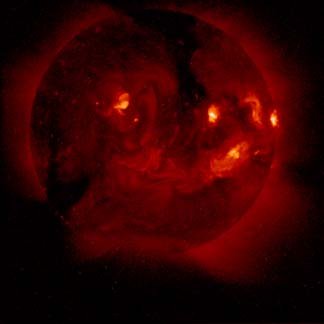 The Sun (or Sol) is the star at the center of our Solar system. Earth orbits the Sun, as do many other bodies, including other planets, asteroids, meteoroids, comets and dust. Its heat and light support almost all life on Earth. The Sun (or Sol) is the star at the center of our Solar system. Earth orbits the Sun, as do many other bodies, including other planets, asteroids, meteoroids, comets and dust. Its heat and light support almost all life on Earth.
The Sun is a ball of plasma with a mass of about 2�1030 kg, which is somewhat higher than that of an average star. About 74% of its mass is hydrogen, with 25% helium and the rest made up of trace quantities of heavier elements. It is thought that the Sun is about 5 billion years old, and is about halfway through its main sequence evolution, during which nuclear fusion reactions in its core fuse hydrogen into helium. In about 5 billion years time the Sun will become a white dwarf.
Although it is the nearest star to Earth and has been intensively studied by scientists, many questions about the Sun remain unanswered, such as why its outer atmosphere has a temperature of over 106 K when its visible surface (the photosphere) has a temperature of just 6,000 K.
The Sun is classified as a main sequence star, which means it is in a state of "hydrostatic balance", neither contracting nor expanding, and is generating its energy through nuclear fusion of hydrogen nuclei into helium. The Sun has a spectral class of G2V, with the G2 meaning that its color is yellow and its spectrum contains spectral lines of ionized and neutral metals as well as very weak hydrogen lines, and the V signifying that it, like most stars, is a "dwarf" star on the main sequence.
The Sun has a predicted main sequence lifetime of about 10 billion years. Its current age is thought to be about 4.5 billion years, a figure which is determined using computer models of stellar evolution, and nucleocosmochronology. The Sun orbits the center of the Milky Way galaxy at a distance of about 25,000 to 28,000 light-years from the galactic centre, completing one revolution in about 226 million years. The orbital speed is 217 km/s, equivalent to one light year every 1400 years, and one AU every 8 days.
The astronomical symbol for the Sun is a circle with a point at its centre. Structure The Sun is a near-perfect sphere, with an oblateness estimated at about 9 millionths, which means the polar diameter differs from the equatorial by about 10 km. This is because the centrifugal effect of the Sun's slow rotation is 18 million times weaker than its surface gravity (at the equator). Tidal effects from the planets do not significantly affect the shape of the Sun, although the Sun itself orbits the center of mass of the solar system, which is offset from the Sun's center mostly because of the large mass of Jupiter. The mass of the Sun is so comparatively great that the center of mass of the solar system is generally within the bounds of the Sun itself.
The Sun does not have a definite boundary as rocky planets do, as the density of its gases drops off following an approximately exponential relationship with distance from the centre of the Sun. Nevertheless, the Sun has a well-defined interior structure, described below. The Sun's radius is measured from centre to the edges of the photosphere.
The solar interior is not directly observable and the Sun itself is opaque to electromagnetic radiation. However, just as the study of the waves generated by earthquakes (seismology) can be used to study the interior structure of the Earth, helioseismology, the study of sound waves that travel through the Sun's interior, has also contributed greatly to our understanding of the Sun's structure. Computer modeling of the Sun is also used as a theoretical tool to investigate its deep layers. Core At the center of the Sun, where its density reaches up to 150,000 kg/m3 (150 times the density of water on Earth), thermonuclear reactions (nuclear fusion) convert hydrogen into helium, producing the energy that keeps the Sun in a state of equilibrium. About 8.9�1037 protons (hydrogen nuclei) are converted to helium nuclei every second, releasing energy at the matter-energy conversion rate of 4.26 million tonnes per second or 383 yottawatts (9.15�1016 tons of TNT per second).
The core extends from the center of the Sun to about 0.2 solar radii, and is the only part of the Sun where an appreciable amount of heat is produced by fusion: the rest of the star is heated by energy that is transferred outward. All of the energy of the interior fusion must travel through the successive layers to the solar photosphere, before it escapes to space.
The high-energy photons (gamma and X rays) released in fusion reactions take a long time to reach the Sun's surface, slowed down by the indirect path taken, as well as constant absorption and re-emission at lower energies in the solar mantle. Estimates of the "photon travel time" range from as much as 50 million years (Richard S. Lewis, The Illustrated Encyclopedia of the Universe, Harmony Books, New York, 1983, p. 65) to as little as 17,000 years. Upon reaching the surface after a final trip through the convective outer layer, the photons escape as visible light. Neutrinos are also released in the fusion reactions in the core, but unlike photons they very rarely interact with matter, and so almost all are able to escape the Sun immediately. Radiation Zone From about 0.2 to about 0.7 solar radii, the material is hot and dense enough that thermal radiation is sufficient to transfer the intense heat of the core outward. In this zone, there is no thermal convection: while the material grows cooler with altitude, this temperature gradient is slower than the adiabatic lapse rate and hence cannot drive convection. Heat is transferred by ions of hydrogen and helium emitting photons, which travel a brief distance before being re-absorbed by other ions. Because of this, it can take a photon nearly 1,000,000 years to reach the photosphere. Convection Zone From about 0.7 solar radii to 1.0 solar radii, the material in the Sun is not dense enough or hot enough to transfer the heat energy of the interior outward via radiation. As a result, thermal convection occurs as thermal columns carry hot material to the surface (photosphere) of the Sun. Once the material cools off at the surface, it plunges back downward to the base of the convection zone, to receive more heat from the top of the radiative zone. Convective overshoot is thought to occur at the base of the convection zone, carrying turbulent downflows into the outer layers of the radiative zone.
The thermal columns in the convection zone form an imprint on the surface of the Sun, in the form of the solar granulation and supergranulation. The turbulent convection of this outer part of the solar interior gives rise to a 'small-scale' dynamo that produces magnetic north and south poles all over the surface of the Sun. Photosphere The visible surface of the Sun, the photosphere, is the layer below which the Sun becomes opaque to visible light. Above the photosphere, sunlight is free to propagate into space and its energy escapes the Sun entirely. Sunlight has approximately a black-body spectrum that indicates its temperature is about 6,000 K, interspersed with atomic absorption lines from the tenuous layers above the photosphere. The photosphere has a particle density of about 1023/m3 (this is about 1% of the particle density of Earth's atmosphere at sea level). The parts of the Sun above the photosphere are referred to collectively as the solar atmosphere. They can be viewed with telescopes operating across the electromagnetic spectrum, from radio through visible light to gamma rays. Temperature Minimum The coolest layer of the Sun is the temperature minimum region about 500 km above the photosphere. It is about 4,000 K. It is the only part of the Sun cool enough to support simple molecules such as carbon monoxide and water; all other parts of the Sun are hot enough to break chemical bonds. Chromosphere Above the visible surface of the Sun is a thin layer, about 2,000 km thick, that is dominated by a spectrum of emission and absorption lines. It is called the chromosphere from the Greek root chromos, meaning color, because the chromosphere is visible as a colored flash at the beginning and end of total eclipses of the Sun. Corona The corona is the extended outer atmosphere of the Sun, which is much larger in volume than the Sun itself. The corona merges smoothly with the solar wind that fills the solar system and heliosphere. The low corona, which is very near the surface of the Sun, has a particle density of 1011/m3 (Earth's atmosphere near sea level has a particle density of about 2x1025/m3). The temperature of the corona is several megakelvins. Structure 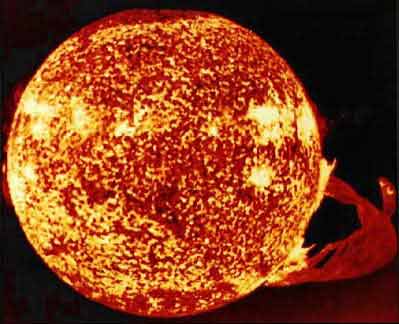 All matter in the Sun is in the form of gas and plasma due to its high temperatures. This makes it possible for the Sun to rotate faster at its equator (about 25 days) than it does at higher latitudes (28 days near its poles). The differential rotation of the Sun's latitudes causes its magnetic field lines to become twisted together over time, causing magnetic field loops to erupt from the Sun's surface and trigger the formation of the Sun's dramatic sunspots and solar prominences. The solar activity cycle includes old magnetic fields being stripped off the Sun's surface starting from one pole and ending at the other. The magnetic field of the sun reverses once for each 11-year sunspot cycle. All matter in the Sun is in the form of gas and plasma due to its high temperatures. This makes it possible for the Sun to rotate faster at its equator (about 25 days) than it does at higher latitudes (28 days near its poles). The differential rotation of the Sun's latitudes causes its magnetic field lines to become twisted together over time, causing magnetic field loops to erupt from the Sun's surface and trigger the formation of the Sun's dramatic sunspots and solar prominences. The solar activity cycle includes old magnetic fields being stripped off the Sun's surface starting from one pole and ending at the other. The magnetic field of the sun reverses once for each 11-year sunspot cycle.
The influence of the Sun's rotating magnetic field on the plasma in the interplanetary medium creates the largest structure in the Solar System, the Heliospheric current sheet. The plasma in the interplanetary medium is also responsible for the strength of the Sun's magnetic field at the orbit of the Earth being over 100 times greater than originally anticipated. If space were a vacuum, then the Sun's 10-4 tesla magnetic dipole field would reduce with the cube of the distance to about 10-11 tesla. But satellite observations show that it is about 100 times greater at around 10-9 tesla. Magnetohydrodynamic (MHD) theory predicts that the motion of a conducting fluid (e.g. the interplanetary medium) in a magnetic field, induces electric currents which in turn generates magnetic fields, and in this respect it behaves like an MHD dynamo.
Position of the Sun Through the Year The path of the Sun across the sky varies throughout the year. The shape described by the Sun's position, considered at the same time each day for a complete year, is called the analemma, and resembles a figure 8, aligned along the North/South direction. The most obvious variation in the Sun's apparent position through the year is a North/South swing over 47 degrees of angle, due to the 23.5 degree tilt of the Earth, but there is an East/West component as well. The North/South swing in apparent angle is the main source of seasons on Earth. Specifications Observation Data Mean Distance from Earth 149.6�106 km (92.95�106 mi or 8.31 minutes at the speed of light)
Visual Brightness (V) −26.8m
Absolute Magnitude 4.8m Orbital Characteristics Mean Distance from Milky Way Core 2.5�1017 km (26000 light-years)
Galactic period 2.26�108 a
Velocity 217 km/s Physical Characteristics Diameter 1.392�106 km (109 Earths)
Oblateness 9�10−6
Surface Area 6.09�1012 km� (11 900 Earths)
Volume 1.41�1018 km� (1 300 000 Earths)
Mass 1.9891�1030 kg (332 950 Earths)
Density 1.408 g/cm�
Surface Gravity 273.95 m s-2 (27.9 g)
Escape Velocity from the Surface 617.54 km/s
Surface Temperature 5780 K
Temperature of Corona 5 MK
Core Temperature ~13.6 MK
Luminosity (Lsol) 3.827�1026 W (3.9�1028 lm or 100 lm/W efficacy)
Mean Intensity (Lsol) 2.009�107 W m-2 sr-1 Rotational Characteristics Obliquity 7.25� (to the ecliptic) 67.23� (to the galactic plane)
Right Ascension of North Pole 1 286.13� (19 h 4 min 30 s)
Declination of North Pole +63.87� (63�52' North)
Rotation Period at Equator 25.3800 days (25 d 9 h 7 min 13 s) 1
Rotation Velocity at Equator 7174 km/h Photospheric Composition Hydrogen 73.46 %
Helium 24.85 %
Oxygen 0.77 %
Carbon 0.29 %
Iron 0.16 %
Neon 0.12 %
Nitrogen 0.09 %
Silicon 0.07 %
Magnesium 0.05 %
Sulfur 0.04 % ** Information provided by Wikipedia, the free online encyclopedia. **
Permission is granted to copy, distribute and/or modify this document
under the terms of the GNU Free Documentation License, Version 1.2
or any later version published by the Free Software Foundation;
with no Invariant Sections, no Front-Cover Texts, and no Back-Cover Texts.
A copy of the license is included in the section entitled "GNU
Free Documentation License". |