Jupiter Information 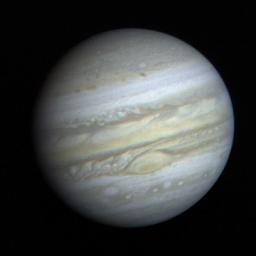 Jupiter is the fifth planet from the Sun and by far the largest within our solar system. Some have described the solar system as consisting of the Sun, Jupiter, and assorted debris,[2]; some describe Jupiter as the solar system's vacuum cleaner, due to its immense gravity well. It, and the other gas giants - Saturn, Uranus, and Neptune, are sometimes referred to as "Jovian planets." The Romans named the planet after the Roman god Jupiter (also called Jove). The astronomical symbol for the planet is a stylized representation of the god's lightning bolt. Jupiter is the fifth planet from the Sun and by far the largest within our solar system. Some have described the solar system as consisting of the Sun, Jupiter, and assorted debris,[2]; some describe Jupiter as the solar system's vacuum cleaner, due to its immense gravity well. It, and the other gas giants - Saturn, Uranus, and Neptune, are sometimes referred to as "Jovian planets." The Romans named the planet after the Roman god Jupiter (also called Jove). The astronomical symbol for the planet is a stylized representation of the god's lightning bolt.
The Chinese, Korean, Japanese, and Vietnamese cultures refer to the planet as the wood star, 木星, based on the Chinese Five Elements (although, curiously enough, through a small telescope, it does somewhat resemble a circular slice of wood in appearance, with the Red Spot being a "knot").
Jupiter has been known since ancient times and is visible to the naked eye in the night sky. In 1610, Galileo Galilei discovered the four largest moons of Jupiter using a telescope, the first observation of moons other than Earth's.
Jupiter is 2.5 times more massive than all the other planets combined, so massive that its barycenter with the Sun actually lies above the Sun's surface (1.068 solar radii from the Sun's center). It is 318 times more massive than Earth, with a diameter 11 times that of Earth, and with a volume 1300 times that of Earth. Quite naturally, Jupiter's gravitational influence has dominated the evolution of the solar system: most planets' orbits lie closer to Jupiter's orbital plane than the Sun's equatorial plane, the majority of short-period comets belong to Jupiter's family (a result due to both Jupiter's mass and its relative celerity), the Kirkwood gaps in the asteroid belt are mostly due to Jupiter, and Jupiter is even thought to have been possibly responsible for the late heavy bombardment of the inner solar system's history.
As impressive as Jupiter's mass is, extrasolar planets have been discovered with much greater masses. There is no clear-cut definition of what distinguishes a large and massive planet such as Jupiter from a brown dwarf star, although the latter possesses rather specific spectral lines. Jupiter is thought to have about as large a diameter as a planet of its composition can; adding extra mass would result in further gravitational compression, in theory leading to stellar ignition. This has led some astronomers to term it a "failed star", although Jupiter would need to be about seventy times as massive to become a star.
Jupiter also has the fastest rotation rate of any planet within the solar system, making a complete revolution on its axis in slightly less than ten hours, which results in a flattening easily seen through an Earth-based amateur telescope. Its best known feature is probably the Great Red Spot, a storm larger than Earth which was first observed by Galileo four centuries ago. Indeed, mathematical models suggest that the storm is a permanent feature of the planet. Jupiter is perpetually covered with a layer of clouds, and may not have any solid surface.
Jupiter is usually the fourth brightest object in the sky (after the Sun, the Moon and Venus; however at times Mars appears brighter than Jupiter, while at others Jupiter appears brighter than Venus). It has been known since ancient times. Galileo Galilei's discovery, in 1610, of Jupiter's four large moons Io, Europa, Ganymede and Callisto (now known as the Galilean moons) was the first discovery of a celestial motion not apparently centered on the Earth. It was a major point in favor of Copernicus' heliocentric theory of the motions of the planets; Galileo's outspoken support of the Copernican theory got him in trouble with the Inquisition. Physical Characteristics Planetary Composition Jupiter is composed of a relatively small rocky core, surrounded by metallic hydrogen, surrounded by liquid hydrogen, which is surrounded by gaseous hydrogen. There is no clear boundary or surface between these different phases of hydrogen; the conditions blend smoothly from gas to liquid as one descends. Atmosphere Jupiter's atmosphere is composed of ~81% hydrogen and ~18% helium by number of atoms. The atmosphere is ~75%/24% by mass; with ~1% of the mass accounted for by other substances - the interior contains denser materials such that the distribution is ~71%/24%/5%. The atmosphere contains trace amounts of methane, water vapour, ammonia, and "rock". There are also traces of carbon, ethane, hydrogen sulfide, neon, oxygen, phosphine, and sulfur. The outermost layer of the atmosphere contains crystals of frozen ammonia.
This atmospheric composition is very close to the composition of the solar nebula. Saturn has a similar composition, but Uranus and Neptune have much less hydrogen and helium.
Jupiter's upper atmosphere undergoes differential rotation, an effect first noticed by Giovanni Cassini (1690). The rotation of Jupiter's polar atmosphere is ~5 minutes longer than that of the equatorial atmosphere. In addition, bands of clouds of different latitudes, known as tropical regions flow in opposing directions on the prevailing winds. The interactions of these conflicting circulation patterns cause storms and turbulence. Wind speeds of 600 km/h are not uncommon. A particularly violent storm, about three times Earth's diameter, is known as the Great Red Spot, and has persisted through more than three centuries of human observation.
The only spacecraft to have descended into Jupiter's atmosphere to take scientific measurements is the Galileo probe. The cloud pattern on Jupiter is the visible system of coloured cloud tops in the atmosphere of the planet Jupiter, remarkable for its stability. Astronomers have given names to parts of this pattern, using the word zone for the light stripes, and belt for the dark stripes, along various latitudes. The pattern and intensity of its belts and zones are famously variable, often changing markedly from opposition to opposition. There are six major belts on Jupiter:
* North and South Equatorial belts
* North and South Temperate belts
* N. North and S. South Temperate belts
There are seven major zones:
* Equatorial zone
* North and South Tropical zone
* North and South Temperate zone
* N. North and S. South Temperate zone
There are two polar regions:
* South polar region
* North polar region
Additionally, there are zones and belts that are more transient in nature and not always visible:
* Equatorial belt
* North Equatorial belt zone (a white zone within the belt)
* South Equatorial belt zone
* North Tropical zone belt (an additional belt inside the white zone) Planetary Rings Jupiter has a faint planetary ring system composed of smoke-like dust particles knocked from its moons by meteor impacts. The main ring is made of dust from the satellites Adrastea and Metis. Two wide gossamer rings encircle the main ring, originating from Thebe and Amalthea. There is also an extremely tenuous and distant outer ring that circles Jupiter backwards. Its origin is uncertain, but this outer ring might be made of captured interplanetary dust. This is a list of the named rings of Jupiter.
Jupiter has a faint planetary ring system composed of smoke-like dust particles knocked off of its moons by meteor impacts. The main ring is made of dust from the satellites Adrastea and Metis. Two wide gossamer rings encircle the main ring, originating from Thebe and Amalthea. There is also an extremely tenuous and distant outer ring that circles Jupiter backwards. Its origin is uncertain, but this outer ring might be made of captured interplanetary dust. | Name | Distance from Jupiter's centre (km) | Width (km) | | 1979 J1R ('Halo Ring') | 100,000 - 122,800 | 22,800 | | 1979 J2R ('Main Ring') | 122,800 - 129,200 | 6,400 | | 1979 J3R ('Gossamer Ring') | 129,200 - 214,200 | 85,000 |
Magnetosphere 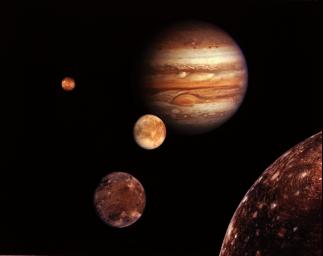 Jupiter has a very large and powerful magnetosphere. In fact, if you could see Jupiter's magnetic field from Earth, it would appear five times as large as the full moon in the sky despite being so much farther away. This magnetic field collects a large flux of particle radiation in Jupiter's radiation belts, as well as producing a dramatic gas torus and flux tube associated with Io. Jupiter's magnetosphere is the largest planetary structure in the solar system. Jupiter has a very large and powerful magnetosphere. In fact, if you could see Jupiter's magnetic field from Earth, it would appear five times as large as the full moon in the sky despite being so much farther away. This magnetic field collects a large flux of particle radiation in Jupiter's radiation belts, as well as producing a dramatic gas torus and flux tube associated with Io. Jupiter's magnetosphere is the largest planetary structure in the solar system.
The Pioneer probes confirmed that Jupiter's enormous magnetic field is 10 times stronger than Earth's and contains 20,000 times as much energy. The sensitive instruments aboard found that the Jovian magnetic field's "north" magnetic pole is at the planet�s geographic south pole, with the axis of the magnetic field tilted 11 degrees from the Jovian rotation axis and offset from the center of Jupiter in a manner similar to the axis of the Earth's field. The Pioneers measured the bow shock of the Jovian magnetosphere to the width of 26 million kilometres (16 million miles), with the magnetic tail extending beyond Saturn�s orbit.
The data showed that the magnetic field fluctuates rapidly in size on the sunward side of Jupiter because of pressure variations in the solar wind, an effect studied in further detail by the two Voyager spacecraft. It was also discovered that streams of high-energy atomic particles are ejected from the Jovian magnetosphere and travel as far as the orbit of the Earth. Energetic protons were found and measured in the Jovian radiation belt and electric currents were detected flowing between Jupiter and some of its moons, particularly Io.
Natural Satellites Jupiter has at least 63 moons. For a complete listing of these moons.
The four large moons, known as the "Galilean moons", are Io, Europa, Ganymede and Callisto. The Jovian moons are listed here by orbital period, from shortest to longest. Moons massive enough for their surfaces to have collapsed into a spheroid are highlighted in purple; these are Galileian moons are comparable in size to the Earth's moon. Irregular (captured) moons are indicated by light grey. . Name
(Pronunciation key) | Diameter (km) | Mass (kg) | Orbital Radius (km) | Orbital Period (d) | Inclination (�) | Eccentricity |
|---|
| Metis | mee'-təs | 43 | 1.2E+17 | 127 690 | 0.294780 | 0.000� | 0.0012 | | Adrastea | ad'-rə-stee'-ə | 26 � 20 � 16 | 7.5E+15 | 128 690 | 0.29826 | 0.000� | 0.0018 | | Amalthea | am'-əl-thee'-ə | 262 � 146 � 134 | 2.1E+18 | 181 170 | 0.49817905 | 0.360� | 0.0031 | | Thebe | thee'-bee | 110�90 | 1.5E+18 | 221 700 | 0.6745 | 0.901� | 0.0177 | | Io | eye'-oe | 3660.0 � 3637.4 � 3630.6 | 8.9E+22 | 421 700 | 1.769137786 | 0.050� | 0.0041 | | Europa | ew-roe'-pə | 3121.6 | 4.8E+22 | 671 034 | 3.551181041 | 0.471� | 0.0094 | | Ganymede | gan'-ə-meed | 5262.4 | 1.5E+23 | 1 070 412 | 7.15455296 | 0.204� | 0.0011 | | Callisto | kə-lis'-toe | 4820.6 | 1.1E+23 | 1 882 709 | 16.6890184 | 0.205� | 0.0074 | | Themisto | thə-mis'-toe | 8 | 6.9E+14 | 7 391 645 | 129.827611 | 15.346� | 0.2006 | | Leda | lee'-də | 20 | 1.1E+16 | 11 097 245 | 238.824159 | 27.210� | 0.1854 | | Himalia | hye-mal'-ee-ə | 170 | 6.7E+18 | 11 432 435 | 249.726305 | 29.590� | 0.1443 | | Lysithea | lye-sith'-ee-ə | 36 | 6.3E+16 | 11 653 225 | 256.995413 | 25.771� | 0.1132 | | Elara | ee'-lər-ə | 86 | 8.7E+17 | 11 683 115 | 257.984888 | 30.663� | 0.1723 | | S/2000 J 11 | 4 | 9.0E+13 | 12 570 575 | 287.931046 | 26.169� | 0.2058 | | Carpo | kar'-poe | 3 | 4.5E+13 | 17 144 875 | 458.624818 | 55.098� | 0.2736 | | S/2003 J 12 | 1 | 1.5E+12 | 17 739 540 | 482.691255 | 134.861� | 0.4449 | | Euporie | ew-por'-ee-ə | 2 | 1.5E+13 | 19 088 435 | 538.779839 | 131.854� | 0.0960 | | S/2003 J 3 | 2 | 1.5E+13 | 19 621 780 | 561.517739 | 111.592� | 0.2507 | | S/2003 J 18 | 2 | 1.5E+13 | 19 812 575 | 569.728015 | 98.461� | 0.1570 | | Thelxinoe | thel-zin'-oe-ee | 2 | 1.5E+13 | 20 453 755 | 597.606695 | 102.844� | 0.2685 | | Euanthe | ew-an'-thee | 3 | 4.5E+13 | 20 464 855 | 598.093368 | 123.649� | 0.2000 | | Helike | hel'-ə-kee | 4 | 9.0E+13 | 20 540 265 | 601.401918 | 120.908� | 0.1375 | | Orthosie | or-thoe'-see-ə | 2 | 1.5E+13 | 20 567 970 | 602.619143 | 101.861� | 0.2433 | | Iocaste | eye'-oe-kas'-tee | 5 | 1.9E+14 | 20 722 565 | 609.426611 | 127.043� | 0.2874 | | S/2003 J 16 | 2 | 1.5E+13 | 20 743 780 | 610.362159 | 149.279� | 0.3185 | | Ananke | ə-nang'-kee | 28 | 3.0E+16 | 20 815 225 | 613.518491 | 149.526� | 0.3963 | | Praxidike | prak-sid'-ə-kee | 7 | 4.3E+14 | 20 823 950 | 613.904099 | 132.099� | 0.1840 | | Harpalyke | har-pal'-ə-kee | 4 | 1.2E+14 | 21 063 815 | 624.541797 | 143.944� | 0.2441 | | Hermippe | hər-mip'-ee | 4 | 9.0E+13 | 21 182 085 | 629.809040 | 149.058� | 0.2290 | | Thyone | thye-oe'-nee | 4 | 9.0E+13 | 21 405 570 | 639.802554 | 116.088� | 0.2526 | | Mneme | nee'-mee | 2 | 1.5E+13 | 21 427 110 | 640.768660 | 147.647� | 0.2214 | | S/2003 J 17 | 2 | 1.5E+13 | 22 134 305 | 672.751882 | 139.842� | 0.2379 | | Aitne | et'-nee | 3 | 4.5E+13 | 22 285 160 | 679.641347 | 143.251� | 0.3927 | | Kale | kay'-lee | 2 | 1.5E+13 | 22 409 210 | 685.323873 | 133.342� | 0.2011 | | Taygete | tay-ij'-ə-tee | 5 | 1.6E+14 | 22 438 650 | 686.674715 | 140.521� | 0.3678 | | S/2003 J 19 | 2 | 1.5E+13 | 22 709 060 | 699.124764 | 140.956� | 0.1961 | | Chaldene | kal-dee'-nee | 4 | 7.5E+13 | 22 713 445 | 699.326904 | 119.572� | 0.2916 | | S/2003 J 15 | 2 | 1.5E+13 | 22 721 000 | 699.676116 | 109.168� | 0.0932 | | S/2003 J 10 | 2 | 1.5E+13 | 22 730 815 | 700.129403 | 115.021� | 0.3438 | | S/2003 J 23 | 2 | 1.5E+13 | 22 739 655 | 700.537990 | 137.576� | 0.3931 | | Erinome | err-rin'-ə-mee | 3 | 4.5E+13 | 22 986 265 | 711.964625 | 143.354� | 0.2552 | | Aoede | ay-ee'-dee | 4 | 9.0E+13 | 23 044 175 | 714.656754 | 112.763� | 0.6012 | | Kallichore | kə-lik'-ə-ree | 2 | 1.5E+13 | 23 111 825 | 717.806112 | 141.240� | 0.2042 | | Kalyke | kal'-ə-kee | 5 | 1.9E+14 | 23 180 775 | 721.020662 | 137.125� | 0.2140 | | Eurydome | ew-rid'-ə-mee | 3 | 4.5E+13 | 23 230 860 | 723.358859 | 143.033� | 0.3770 | | S/2003 J 14 | 2 | 1.5E+13 | 23 238 595 | 723.720459 | 138.885� | 0.2462 | | Pasithee | pə-sith'-ee-ə | 2 | 1.5E+13 | 23 307 320 | 726.932963 | 144.112� | 0.3289 | | Cyllene | sə-lee'-nee | 2 | 1.5E+13 | 23 396 270 | 731.098603 | 115.507� | 0.4116 | | Eukelade | ew-kel'-ə-dee | 4 | 9.0E+13 | 23 483 695 | 735.199980 | 118.384� | 0.2829 | | S/2003 J 4 | 2 | 1.5E+13 | 23 570 790 | 739.293961 | 98.660� | 0.3003 | | Hegemone | hə-jem'-ə-nee | 3 | 4.5E+13 | 23 702 510 | 745.500007 | 150.314� | 0.4077 | | Arche | ar'-kee | 3 | 4.5E+13 | 23 717 050 | 746.185469 | 146.289� | 0.1492 | | Carme | kar'-mee | 46 | 1.3E+17 | 23 734 465 | 747.008062 | 120.659� | 0.3122 | | Isonoe | eye-son'-oe-ee | 4 | 7.5E+13 | 23 832 630 | 751.646937 | 118.554� | 0.1665 | | S/2003 J 9 | 1 | 1.5E+12 | 23 857 810 | 752.838751 | 135.452� | 0.2762 | | S/2003 J 5 | 4 | 9.0E+13 | 23 973 925 | 758.341296 | 117.922� | 0.3071 | | Pasipha� | pə-sif'-ə-ee | 60 | 3.0E+17 | 24 094 770 | 764.082032 | 143.037� | 0.2953 | | Sinope | sə-noe'-pee | 38 | 7.5E+16 | 24 214 390 | 769.779665 | 146.657� | 0.2468 | | Sponde | spon'-dee | 2 | 1.5E+13 | 24 252 625 | 771.603566 | 112.409� | 0.4432 | | Autonoe | aw-ton'-oe-ee | 4 | 9.0E+13 | 24 264 445 | 772.167762 | 129.073� | 0.3690 | | Callirrhoe | kə-lirr'-oe-ee | 9 | 8.7E+14 | 24 356 030 | 776.543335 | 131.895� | 0.2644 | | Megaclite | meg'-ə-klye'-tee | 5 | 2.1E+14 | 24 687 240 | 792.436947 | 143.760� | 0.3078 | | S/2003 J 2 | 2 | 1.5E+13 | 30 290 845 | 1077.018006 | 151.523� | 0.1882 |
Galilean Moons The orbits of Io, Europa, and Ganymede, the largest moon in the solar system, form a pattern known as a Laplace resonance; for every four orbits that Io makes around Jupiter, Europa makes exactly two orbits and Ganymede makes exactly one. This resonance causes the gravitational effects of the three moons to distort their orbits into elliptical shapes, since each moon receives an extra tug from its neighbors at the same point in every orbit it makes.
The tidal force from Jupiter, on the other hand, works to circularize their orbits. This constant tug of war causes regular flexing of the three moons' shapes, Jupiter's gravity stretches the moons more strongly during the portion of their orbits that are closest to it and allowing them to spring back to more spherical shapes when they're farther away. This flexing causes tidal heating of the three moons' cores. This is seen most dramatically in Io's extraordinary volcanic activity, and to a somewhat less dramatic extent in the geologically young surface of Europa indicating recent resurfacing. | The Galilean moons, compared to Earth's moon Luna |
|---|
Name
(Pronunciation key) | Diameter
(km) | Mass
(kg) | Orbital radius (km) | Orbital period (days) |
|---|
| Io | eye'-oe | 3643
(105% Luna) | 8.9�1022
(120% Luna) | 421 700
(110% Luna) | 1.77
(6.5% Luna) | | Europa | ew-roe'-pa | 3122
(90% Luna) | 4.8�1022
(65% Luna) | 671 034
(175% Luna) | 3.55
(13% Luna) | | Ganymede | gan'-i-meed | 5262
(150% Luna) | 14.8�1022
(200% Luna) | 1 070 412
(280% Luna) | 7.15
(26% Luna) | | Callisto | ka-lis'-toe | 4821
(140% Luna) | 10.8�1022
(150% Luna) | 1 882 709
(490% Luna) | 16.69
(61% Luna) |
Classification of Jupiter's Moon Before the discoveries of the Voyager missions, Jupiter's moons were arranged neatly into four groups of four. Since then, the large number of new small outer moons has complicated this picture. There are now thought to be six main groups, although some are more distinct than others. A basic division is between the eight inner regular moons with nearly circular orbits near the plane of Jupiter's equator, which are believed to have formed with Jupiter, and an unknown number of small irregular moons, with elliptical and inclined orbits, which are believed to be captured asteroids or fragments of captured asteroids.
1. Regular moons
1. The inner group of four small moons all have diameters of less than 200 km, orbit at radii less than 200,000 km, and have orbital inclinations of less than half a degree.
2. The four Galilean moons were all discovered by Galileo Galilei, orbit between 400,000 and 2,000,000 km, and include some of the largest moons in the solar system.
2. Irregular moons
1. Themisto is in a group of its own, orbiting halfway between the Galilean moons and the next group.
2. The Himalia group is a tightly clustered group of moons with orbits around 11-12,000,000 km from Jupiter.
3. Carpo is another isolated case; at the inner edge of the Ananke group, it revolves in the direct sense.
4. The Ananke group is a group with rather indistinct borders, averaging 21,276,000 km from Jupiter with an average inclination of 149 degrees.
5. The Carme group is a fairly distinct group that averages 23,404,000 km from Jupiter with an average inclination of 165 degrees.
6. The Pasipha� group is a dispersed and only vaguely distinct group that covers all the outermost moons.
It is thought that the groups of outer moons may each have a common origin, perhaps as a larger moon or captured body that broke up. Specifications Orbital Characteristics Semi-Major Axis 778,412,027 km (5.203 363 01 AU)
Orbital Circumference 4.888 Tm (32.675 AU)
Eccentricity 0.048 392 66
Perihelion 740,742,598 km (4.951 558 43 AU)
Aphelion 816,081,455 km (5.455 167 59 AU)
Orbital Period 4333.2867 days (11.86 a)
Synodic Period 398.88 days
Avg. Orbital Speed 13.056 km/s
Max. Orbital Speed 13.712 km/s
Min. Orbital Speed 12.446 km/s
Inclination 1.305 30� (6.09� to Sun's equator)
Longitude of the Ascending Node 100.556 15�
Argument of the Perihelion 274.197 70�
Number of Satellites 63 Physical Characteristics Equatorial Diameter 142,984 km (11.209 Earths)
Polar Diameter 133,709 km (10.517 Earths)
Oblateness 0.064 87
Surface Area 6.14�1010 km2 (120.5 Earths)
Volume 1.431�1015 km3 (1321.3 Earths)
Mass 1.899�1027 kg (317.8 Earths)
Mean Density 1.326 g/cm3
Equatorial Gravity 23.12 m/s2 (2.358 gee)
Escape Velocity 59.54 km/s
Rotation Period 0.413 538 021 days (9 h 55 min 29.685 s)
Rotation Velocity 12.6 km/s = 45,300 km/h (at the equator)
Axial Tilt 3.13�
Right Ascension of North Pole 268.05� (17 h 52 min 12 s)
Declination 64.49�
Albedo 0.52
Min. Surface Temp. 110 K
Mean Surface Temp. 152 K
Max. Surface Temp. N/A K
Adjective Jovian Atmospheric Characteristics Atmospheric Pressure 70 kPa
Hydrogen ~86%
Helium ~14%
Methane 0.1%
Water Vapor 0.1%
Ammonia 0.02%
Ethane 0.0002%
Phosphine 0.0001%
Hydrogen Sulfide <0.00010% ** Information provided by Wikipedia, the free online encyclopedia. **
Permission is granted to copy, distribute and/or modify this document
under the terms of the GNU Free Documentation License, Version 1.2
or any later version published by the Free Software Foundation;
with no Invariant Sections, no Front-Cover Texts, and no Back-Cover Texts.
A copy of the license is included in the section entitled "GNU
Free Documentation License". |