Pulsars What Are Pulsars? 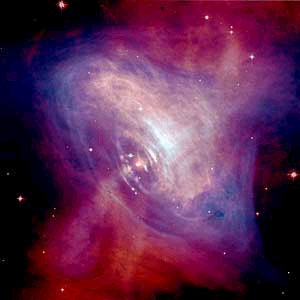 Pulsars are rotating neutron stars that are observable as sources of electromagnetic radiation. The radiation intensity varies with a regular period, believed to correspond to the rotation period of the star. Pulsars are rotating neutron stars that are observable as sources of electromagnetic radiation. The radiation intensity varies with a regular period, believed to correspond to the rotation period of the star.
The first pulsar was discovered in 1967, by Jocelyn Bell and Antony Hewish of the University of Cambridge, UK. Initially baffled as to the unnaturally regular nature of its emissions, the pair dubbed their discovery LGM-1, for "little green men"; their pulsar was later dubbed CP 1919, and is now known by a number of designators including PSR 1919+21. Astrophysicist Peter A. Sturrock writes that "when the first regular radio signals from pulsars were discovered, the Cambridge scientists seriously considered that they might have come from an extraterrestrial civilization. They debated this possibility and decided that, if this proved to be correct, they could not make an announcement without checking with higher authorities. There was even some discussion about whether it might be in the best interests of mankind to destroy the evidence and forget it!" (Sturrock, 154)
CP 1919 emits in radio wavelengths, but pulsars have subsequently been found to emit in the X-ray and gamma ray wavelengths. Hewish received the 1974 Nobel Prize in Physics for this and related radio astronomy work.
Three distinct classes of pulsars are presently known to astronomers, according to the source of energy that powers the radiation:
* Rotation-powered pulsars, where the loss of rotational energy of the star powers the radiation
* X-ray pulsars, where the gravitational potential energy of accreted matter is the energy source, and
* Magnetars, where the decay of an extremely strong magnetic field powers the radiation.
Although all three classes of objects are neutron stars, their observable behaviour and the underlying physics are quite different. There are, however, connections. For example, X-ray pulsars are probably old rotation-powered pulsars that have already lost most of their energy, and have only become visible again after their binary companions expanded and began transferring matter on to the neutron star. The process of accretion can in turn transfer enough angular momentum to the neutron star to "recycle" it as a rotation-powered millisecond pulsar.
The study of pulsars has resulted in many applications in physics and astronomy. Striking examples include the confirmation of the existence of gravitational radiation as predicted by general relativity and the first detection of an extra-solar planetary system.
** Information provided by Wikipedia, the free online encyclopedia. **
Permission is granted to copy, distribute and/or modify this document
under the terms of the GNU Free Documentation License, Version 1.2
or any later version published by the Free Software Foundation;
with no Invariant Sections, no Front-Cover Texts, and no Back-Cover Texts.
A copy of the license is included in the section entitled "GNU
Free Documentation License". |