Nebulae What Is A Nebula? A nebula (Latin for "mist"; pl. nebulae) is an interstellar cloud of dust, gas and plasma. Originally nebula was a general name for any extended astronomical object, including galaxies beyond the Milky Way (some examples of the older usage survive; for example, the Andromeda Galaxy is sometimes referred to as the Andromeda Nebula).
Classification of Nebula
Nebulae can be classified by how they are illuminated:
* Diffuse nebulae are illuminated nebulae
* Emission nebulae are internally illuminated clouds of ionized gas. Two of the most common types of emission nebula are H II regions and Planetary nebulae
* Reflection nebulae are illuminated by reflections from nearby stars. An example is the nebulosity NGC 1435 surrounding the Pleiades star cluster.
* Planetary nebulae are compact shells of gas around a dead star or an intermittantly active star. See Nova.
* Supernova remnants are generally moving away from their parent star at high speed, and are heated by colliding with (relatively) slow moving galactic dust and gas.
* Dark nebulae are unilluminated. They can be detected when they obscure stars or other nebulae. Famous examples include the Horsehead nebula in Orion, and the Coalsack Nebula in the Southern Cross.
Astrophysics of Nebula
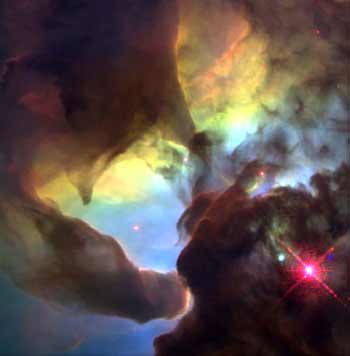 HII regions are the birthplace of stars. They are formed when very diffuse molecular clouds begin to collapse under their own gravity, often due to the influence of a nearby supernova explosion. The cloud collapses and fragments, forming sometimes hundreds of new stars. The newly-formed stars ionize the surrounding gas to produce an emission nebula. HII regions are the birthplace of stars. They are formed when very diffuse molecular clouds begin to collapse under their own gravity, often due to the influence of a nearby supernova explosion. The cloud collapses and fragments, forming sometimes hundreds of new stars. The newly-formed stars ionize the surrounding gas to produce an emission nebula.
Other nebulae are formed by the death of stars. A star that undergoes the transition to a white dwarf blows off its outer layer to form a planetary nebula. Novae and supernovae can also create nebulae known as nova remnants and supernova remnants respectively.
** Information provided by Wikipedia, the free online encyclopedia. **
Permission is granted to copy, distribute and/or modify this document
under the terms of the GNU Free Documentation License, Version 1.2
or any later version published by the Free Software Foundation;
with no Invariant Sections, no Front-Cover Texts, and no Back-Cover Texts.
A copy of the license is included in the section entitled "GNU
Free Documentation License". |