The Moon Information The Moon is the planet Earth's only natural satellite. It has no formal name other than "The Moon", although in English it is occasionally called Luna (Latin for moon), or Selene, to distinguish it from the generic "moon" (natural satellites of other planets are also called moons). Its symbol is a crescent. The terms lunar, selene/seleno-, and cynthion (from the Lunar deities Selene and Cynthia) refer to the Moon (aposelene, selenocentric, pericynthion, etc.).
The average distance from the Moon to the Earth is 384,403 kilometers (238,857 miles). The Moon's diameter is 3,476 kilometers (2,160 miles).
The first manmade object to land on the Moon was Luna 2 in 1959, the first photographs of the otherwise occluded far side of the Moon were made by Luna 3 that same year, and the first people to land on the Moon came aboard Apollo 11 in 1969. The Two Sides The far side is sometimes called the "dark side". In this case "dark" means "unknown and hidden" and not "lacking light" as implied by the name; in fact the far side receives (on average) as much sunlight as the near side, but at opposite times. Spacecraft are cut off from direct radio communication with the Earth when on the far side of the Moon.
One distinguishing feature of the far side is its almost complete lack of maria (singular: mare), which are the dark albedo features. Orbit The Moon makes a complete orbit about once every 28 days. Each hour the Moon moves relative to the stars by an amount roughly equal to its angular diameter, or by about 0.5�. The Moon differs from most satellites of other planets in that its orbit is close to the plane of the ecliptic and not in the Earth's equatorial plane.
Several ways to consider a complete orbit are detailed in the table below, but the two most familiar are: the sidereal month being the time it takes to make a complete orbit with respect to the stars, about 27.3 days; and the synodic month being the time it takes to reach the same phase, about 29.5 days. These differ because in the meantime the Earth and Moon have both orbited some distance around the Sun.
The gravitational attraction that the Moon exerts on Earth is the cause of tides in the sea. The tidal flow period, but not the phase, is synchronized to the Moon's orbit around Earth. The tidal bulges on Earth, caused by the Moon's gravity, are carried ahead of the apparent position of the Moon by the Earth's rotation, in part because of the friction of the water as it slides over the ocean bottom and into or out of bays and estuaries. As a result, some of the Earth's rotational momentum is gradually being transferred to the Moon's orbital momentum, resulting in the Moon slowly receding from Earth at the rate of approximately 38 mm per year. At the same time the Earth's rotation is gradually slowing, the Earth's day thus lengthens by about 15 �s every year. A more detailed discussion follows in the section titled Earth & Moon.
The Moon is in synchronous rotation, meaning that it keeps the same face turned to the Earth at all times. This synchronous rotation is only true on average because the Moon's orbit has definite eccentricity. When the Moon is at its perigee, its rotation is slower than its orbital motion, and this allows us to see up to an extra eight degrees of longitude of its East (right) side. Conversely, when the Moon reaches its apogee, its rotation is faster than its orbital motion and reveals another eight degrees of longitude of its West (left) side. This is called longitudinal libration.
Because the lunar orbit is also inclined to the Earth's equator, the Moon seems to oscillate up and down (as a person's head does when nodding) as it moves in celestial latitude (declination). This is called latitudinal libration and reveals the Moon's polar zones over about seven degrees of latitude. Finally, because the Moon is only at about 60 Earth radii distance, an observer at the equator who observes the Moon throughout the night moves by an Earth diameter sideways. This is diurnal libration and reveals about one degree's worth of lunar longitude.
Earth and Moon orbit about their barycenter, or common center of mass, which lies about 4700 km from Earth's center (about 3/4 of the way to the surface). Since the barycenter is located below the Earth's surface, Earth's motion is more commonly described as a "wobble". When viewed from Earth's North pole, Earth and Moon rotate counter-clockwise about their axes; the Moon orbits Earth counter-clockwise and Earth orbits the Sun counter-clockwise.
It may seem curious that the inclination of the lunar orbit and the tilt of the Moon's axis of rotation are listed as varying considerably. One must be reminded here that the orbital inclination is measured with respect to the primary's equatorial plane (in this case the Earth's), and that the axis of rotation's tilt is measured with respect to the normal to the satellite's orbital plane (the Moon's). For most planetary satellites, but not for the Moon, these conventions model physical reality and the values are therefore stable.
The plane of the lunar orbit maintains an inclination of 5.145 396� with respect to the ecliptic (the orbital plane of the Earth), and the lunar axis of rotation maintains an inclination of 1.5424� with respect to the normal to that same plane. The lunar orbital plane precesses quickly (i.e. its intersection with the ecliptic rotates clockwise), in 6793.5 days (18.5996 years), mostly because of the gravitational perturbation induced by the Sun. During that period, the lunar orbital plane thus sees its inclination with respect to the Earth's equator (itself inclined 23.45� to the ecliptic) vary between 23.45� + 5.15� = 28.60� and 23.45� - 5.15� = 18.30�. Simultaneously, the axis of lunar rotation sees its tilt with respect to the Moon's orbital plane vary between 5.15� + 1.54� = 6.69� and 5.15� - 1.54� = 3.60�. Note that the Earth's tilt reacts to this process and itself varies by 0.002 56� on either side of its mean value; this is called nutation.
The points where the Moon's orbit crosses the ecliptic are called the "lunar nodes": the North (or ascending) node is where the Moon crosses to the North of the ecliptic; the South (or descending) node where it crosses to the South. Solar eclipses occur when a node coincides with the new Moon; lunar eclipses when a node coincides with the full Moon. The Moon's Periods| Name | Value (days) | Definition |
|---|
| sidereal | 27.321 66155 | With respect to the distant stars (13.369 passes per year) | | synodic | 29.530 588 | With respect to the Sun (phases of the Moon, 12.369 cycles per year) | | tropical | 27.321 582 | With respect to the vernal point (precesses in ~26,000 a) | | anomalistic | 27.554 550 | With respect to the perigee (recesses in 3232.6 d = 8.8504 a) | | draconitic (nodical) | 27.212 220 | With respect to the ascending node (precesses in 6793.5 d = 18.5996 a) | Other properties of the Moon's Orbit | Name | Value (days) |
|---|
| Metonic cycle (repeat phase/day) | 19�365 d | | Semi-major axis | ~384 403 km | | Distance at perigee | ~364 397 km | | Distance at apogee | ~406 731 km | | Mean eccentricity | 0.0549003 | | Period of precession of nodes | 18.5996 a | | Period of recession of line of apsides | 8.8504 a | | Eclipse year | 346.621 d | | Saros cycle (repeat eclipses) | 18.030 a | | Mean inclination of orbit to ecliptic | 5� 9' | | Mean inclination of lunar equator to ecliptic | 1� 32' |
Earth and Moon 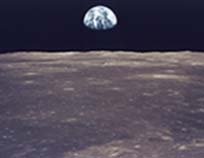 The tides on Earth are generated by the Moon's gravitation. There are two tidal bulges, one in the direction of the Moon, and one in the opposite direction. The buildup of these bulges and their movement around the earth causes an energy loss due to friction. The energy loss decreases the rotational energy of the Earth. The tides on Earth are generated by the Moon's gravitation. There are two tidal bulges, one in the direction of the Moon, and one in the opposite direction. The buildup of these bulges and their movement around the earth causes an energy loss due to friction. The energy loss decreases the rotational energy of the Earth.
Since the Earth spins faster than the Moon moves around it, the tidal bulges are dragged along with the Earth's surface faster than the Moon moves, and move "in front of the Moon". Because of this, the Earth's gravitational pull on the Moon has a component in the Moon's "forward" direction with respect to its orbit. This component of the gravitational forces between the two bodies acts like a torque on the Earth's rotation, and transfers angular momentum and rotational energy from the Earth's spin to the Moon's orbital movement.
Because the Moon is accelerated in forward direction, it moves to a higher orbit. As a result, the distance between the Earth and Moon increases, and the Earth's spin slows down. Measurements reveal that the Moon's distance to the Earth increases by 38 mm per year (lunar laser ranging experiments with laser reflectors are used to determine this). Atomic clocks also show that the Earth's day lengthens by about 15 �s every year.
However, the formation of tidal bulges on Earth is irregular and not directly related to the frictional energy loss which accompanies the tides. For example, continents on Earth may cause an increase in frictional energy losses and hamper the buildup of tidal bulges.
The energy loss of the Earth's spin (loss of rotational energy of the Earth) is related to both the energy transfer to the Moon, which depends on the geometry of the mass distributions on Earth (causing a gravity component which pulls the Moon forward), and also to frictional losses, which depends on the properties of the material moving around within tides. The transfer of angular momentum to the Moon's orbit, in contrast, depends only on the geometry of the mass distribution. In general, the angular momentum transferred to the Moon will not correspond to an equivalent energy transfer. There will be a surplus or a deficit in the transfer of angular momentum to the Moon, compared to the energy transfer.
Since both angular momentum and energy are conserved, there must be a mechanism on earth to store a surplus or a deficit of angular momentum. Candidates for this mechanism are the Earth's magnetic field and internal material currents of the Earth.
The lunar surface is also subjected to tides from earth, and rises and falls by around 10 cm over 27 days. The lunar tides comprise a mobile component, due to the Sun, and a selenographically fixed one, due to Earth (the Moon keeps the same face turned to the Earth, but not to the Sun). The vertical motion of the Earth-induced component comes entirely from the Moon's orbital eccentricity; if the Moon's orbit were perfectly circular, there would be solar tides only. The magnitude of the Moon's tides corresponds to a Love number of 0.0266, and supports the idea of a partially melted zone around its core. Moonquake waves lose energy below 1000 km depth, and this may also show that the deep material is at least partially melted. The Earth�s Love number is 0.3, corresponding to a movement of 0.5 metres per day; for Venus the Love number is also 0.3.
Origin & History The inclination of the Moon's orbit makes it implausible that the Moon formed along with the Earth or was captured later; its origin is the subject of some scientific debate.
Early speculation proposed that the Moon broke off from the Earth's crust due to centrifugal force, leaving an ocean basin (presumed to be the Pacific) behind as a scar. This concept requires too great an initial spin of the Earth. Others speculated the Moon formed elsewhere and was captured into its orbit. Two of the other theories include the coformation or condensation theory and the impact theory, which speculates that the Moon formed from the debris that resulted from a collision between the early Earth and a planetesimal.
The Coformation or Condensation hypothesis posits that the Earth and the Moon formed together at about the same time from the primordial accretion disk, the Moon forming from material surrounding the coalescing proto-Earth, similar to the way the planets formed around the Sun. Some suggest that this hypothesis fails to adequately explain the depletion of iron in the Moon.
Recently, the Giant Impact theory has been considered a more viable scientific theory for the moon's origin than the coformation or condensation theory. The Giant Impact theory holds that the Moon formed from the ejecta resulting from a collision between a very early, semi-molten Earth and a planet-like object the size of Mars, which has been referred to as Theia. The material ejected from this impact would have gathered in orbit around earth and formed the moon. This hypothesis is bolstered by two main observations: First, the composition of the moon resembles that of the earth crust, whereas it has relatively few heavy elements that would have been present if it formed by itself out of the same material from which earth formed. Second, through radiometric dating, it has been determined that the moon's crust formed between 20 and 30 million years after that of the earth, despite its smallness and associated larger loss of internal heat.
The geological epochs of the Moon are defined based on the dating of various significant impact events in the Moon's history. Analysis of craters and Moon rocks show that there was a late heavy bombardment by asteroids around the period 4000 to 3800 million years ago.
Tidal forces deformed the once molten Moon into an ellipsoid, with the major axis pointed towards Earth. Physical Characteristics Composition More than 4.5 billion years ago, the surface of the Moon was a liquid magma ocean. Scientists think that one component of lunar rocks, KREEP (K-potassium, Rare Earth Elements, and P-phosphorus), represents the last chemical remnant of that magma ocean. KREEP is actually a composite of what scientists term "incompatible elements": those which cannot fit into a crystal structure and thus were left behind, floating to the surface of the magma. For researchers, KREEP is a convenient tracer, useful for reporting the story of the volcanic history of the lunar crust and chronicling the frequency of impacts by comets and other celestial bodies.
The lunar crust is composed of a variety of primary elements, including uranium, thorium, potassium, oxygen, silicon, magnesium, iron, titanium, calcium, aluminium and hydrogen. When bombarded by cosmic rays, each element bounces back into space its own radiation, in the form of gamma rays. Some elements, such as uranium, thorium and potassium, are radioactive and emit gamma rays on their own. However, regardless of what causes them, gamma rays for each element are all different from one another � each produces a unique spectral "signature", detectable by a spectrometer.
A complete global mapping of the Moon for the abundance of these elements has never been performed. However, some spacecraft have done so for portions of the Moon; Galileo did so when it flew by the Moon in 1992. The overall composition of the Moon is believed to be similar to that of the upper parts of the Earth other than a depletion of volatile elements and of iron. Selenography When observed with earth based telescopes, the moon can be seen to have some 30,000 craters having a diameter of at least 1 kilometers, but close up observation from lunar orbit reveals a multitude of ever smaller craters. Most are hundreds of millions or billions of years old; the lack of atmosphere or weather or recent geological processes ensures that most of them remain permanently preserved. In the lunar terrae, it is indeed impossible to add a crater of any size without obliterating another; this is termed saturation.
The largest crater on the Moon, and indeed the largest known crater within the solar system, forms the South Pole-Aitken basin. This crater is located on the far side, near the south pole, and is some 2,240 km in diameter, and 13 km in depth.
The dark and relatively featureless lunar plains are called maria, Latin for seas, since they were believed by ancient astronomers to be water-filled seas. They are actually vast ancient basaltic lava flows that filled the basins of large impact craters. The lighter-colored highlands are called terrae. Maria are found almost exclusively on the Lunar nearside, with the Lunar farside having only a few scattered patches.
Blanketed atop the Moon's crust is a dusty outer rock layer called regolith, the result of rocks shattered by billions of years of impacts. Both the crust and regolith are unevenly distributed over the entire Moon. The crust ranges from 60 km (38 mi) on the near side to 100 km (63 mi) on the far side. The regolith varies from 3 to 5 m (10 to 16 ft) in the maria to 10 to 20 m (33 to 66 ft) in the highlands.
In 2004, a team led by Dr. Ben Bussey of Johns Hopkins University using images taken by the Clementine mission determined that four mountainous regions on the rim of the 73 km wide Peary crater at the Moon's north pole appeared to remain illuminated for the entire Lunar day. These unnamed "mountains of eternal light" are possible due to the Moon's extremely small axial tilt, which also gives rise to permanent shadow at the bottoms of many polar craters. No similar regions of eternal light exist at the less-mountainous south pole, although the rim of Shackleton crater is illuminated for 80% of the lunar day. Clementine's images were taken during the northern Lunar hemisphere's summer season, and it remains unknown whether these four mountains are shaded at any point during their local winter season. Presence of Water Over time, comets and meteorites continuously bombard the Moon. Many of these objects are water-rich. Energy from sunlight splits much of this water into its constituent elements hydrogen and oxygen, both of which usually fly off into space immediately. However, it has been hypothesized that significant traces of water remain on the Moon, either on the surface, or embedded within the crust. The results of the Clementine mission suggested that small, frozen pockets of water ice (remnants of water-rich comet impacts) may be embedded unmelted in the permanently shadowed regions of the lunar crust. Although the pockets are thought to be small, the overall amount of water was suggested to be quite significant � 1 km�.
Some water molecules, however, may have literally hopped along the surface and gotten trapped inside craters at the lunar poles. Due to the very slight "tilt" of the Moon's axis, only 1.5�, some of these deep craters never receive any light from the Sun � they are permanently shadowed. Clementine has mapped craters at the lunar south pole which are shadowed in this way. It is in such craters that scientists expect to find frozen water if it is there at all. If found, water ice could be mined and then split into hydrogen and oxygen by solar panel-equipped electric power stations or a nuclear generator. The presence of usable quantities of water on the Moon would be an important factor in rendering lunar habitation cost-effective, since transporting water (or hydrogen and oxygen) from Earth would be prohibitively expensive.
The equatorial Moon rock collected by Apollo astronauts contained no traces of water. Neither the Lunar Prospector nor more recent surveys, such as those of the Smithsonian Institution, have found direct evidence of lunar water, ice, or water vapor. Lunar Prospector results, however, indicate the presence of hydrogen in the permanently shadowed regions, which could be in the form of water ice. Magnetic Field Compared to that of Earth, the Moon has a very weak magnetic field. While some of the Moon's magnetism is thought to be intrinsic (such as a strip of the lunar crust called the Rima Sirsalis), collision with other celestial bodies might have imparted some of the Moon's magnetic properties. Indeed, a long-standing question in planetary science is whether an airless solar system body, such as the Moon, can obtain magnetism from impact processes such as comets and asteroids. Magnetic measurements can also supply information about the size and electrical conductivity of the lunar core � evidence that will help scientists better understand the Moon's origins. For instance, if the core contains more magnetic elements (such as iron) than Earth, then the impact theory loses some credibility (although there are alternate explanations for why the lunar core might contain less iron). Atmosphere The Moon has a relatively insignificant and tenuous atmosphere. One source of this atmosphere is outgassing � the release of gases, for instance radon, which originate deep within the Moon's interior. Another important source of gases is the solar wind, which is briefly captured by the Moon's gravity. Eclipses The angular diameters of the Moon and the Sun as seen from Earth overlap in their variation, so that both total and annular solar eclipses are possible. In a total eclipse, the Moon completely covers the disc of the Sun and the solar corona becomes visible to the naked eye.
Since the distance between the Moon and the Earth is very slightly increasing over time, the angular diameter of the Moon is decreasing. This means that several million years ago the Moon always completely covered the Sun on solar eclipses so that no annular eclipses occurred. Likewise, in several million years the Moon will no longer cover the Sun completely and no total eclipses will occur.
Eclipses happen only if Sun, Earth and Moon are lined up. Solar eclipses can only occur at new moon; lunar eclipses can only occur at full moon. Specifications Orbital Characteristics Semi-Major Axis 384,400 km (0.0026 AU)
Orbital Circumference 2,413,402 km (0.016 AU)
Eccentricity 0.0554
Perigee 363,104 km (0.0024 AU)
Apogee 405,696 km (0.0027 AU)
Revolution Period 27.321 66155 days (27 d 7 h 43.2 min)
Synodic Period 29.530 588 days (29 d 12 h 44.0 min)
Avg. Orbital Speed 1.022 km/s
Max. Orbital Speed 1.082 km/s
Min. Orbital Speed 0.968 km/s
Inclination varies between 28.60� and 18.30� (5.145 396� to ecliptic)
Longitude of the Ascending Node 125.08�
Argument of Perigee 318.15�
Is a Satellite of Earth Physical Characteristics Equatorial Diameter 3,476.2 km (0.273 Earths)
Polar Diameter 3,472.0 km (0.273 Earths)
Oblateness 0.0012
Surface Area 3.793�107 km2 (0.074 Earths)
Volume 2.197�1010 km3 (0.020 Earths)
Mass 7.347 673�1022 kg (0.0123 Earths)
Mean Density 3.344�103 kg/m3
Equatorial Gravity 1.622 m/s2 (0.1654 gee)
Escape Velocity 2.38 km/s
Rotation Period 27.321 661 days (synchronous)
Rotation Velocity 16.655 km/h (at the equator)
Axial Tilt varies between 3.60� and 6.69� (1.5424� to ecliptic)
Right Ascension of North Pole 266.8577� (17 h 47 min 26 s)
Declination 65.6411�
Albedo 0.12
Magnitude -12.74
Min. Surface Temp. 40 K
Mean Surface Temp. 250 K
Max. Surface Temp. 396 K Crust Compositions Oxygen 43%
Silicon 21%
Aluminum 10%
Calcium 9%
Iron 9%
Magnesium 5%
Titanium 2%
Nickel 0.6%
Sodium 0.3%
Chromium 0.2%
Potassium 0.1%
Manganese 0.1%
Sulfur 0.1%
Phosphorus 500 PPM
Carbon 100 PPM
Nitrogen 100 PPM
Hydrogen 50 PPM
Helium 20 PPM Atmospheric Characteristics Atmospheric Pressure 3�10-13 kPa
Helium 25%
Neon 25%
Hydrogen 23%
Argon 20%
Methane 20%
Ammonia Trace
Carbon Dioxide Trace ** Information provided by Wikipedia, the free online encyclopedia. **
Permission is granted to copy, distribute and/or modify this document
under the terms of the GNU Free Documentation License, Version 1.2
or any later version published by the Free Software Foundation;
with no Invariant Sections, no Front-Cover Texts, and no Back-Cover Texts.
A copy of the license is included in the section entitled "GNU
Free Documentation License". |