Uranus Information 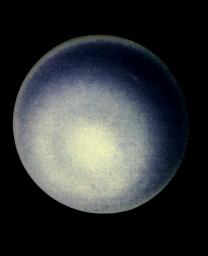 Uranus (pronounced either /ˈjuɹənəs/ or /jəˈɹeɪnəs/) is the seventh planet from the Sun. It is a gas giant, the third largest by diameter and fourth largest by mass. It is named after Uranus, the Greek god of the sky, and progenitor of the other gods. Its symbol is either ♅ (Unicode U+2645, mostly astrological) or Astronomical symbol for Uranus (mostly astronomical). Uranus (pronounced either /ˈjuɹənəs/ or /jəˈɹeɪnəs/) is the seventh planet from the Sun. It is a gas giant, the third largest by diameter and fourth largest by mass. It is named after Uranus, the Greek god of the sky, and progenitor of the other gods. Its symbol is either ♅ (Unicode U+2645, mostly astrological) or Astronomical symbol for Uranus (mostly astronomical).
NASA's Voyager 2 is the only spacecraft to have visited the planet and no other visits are planned. Launched in 1977, Voyager made its closest approach to Uranus on January 24, 1986, before continuing on its journey to Neptune.
The Chinese, Korean, Japanese, and Vietnamese cultures have since named the planet sky king star.
Physical Characteristics Composition Uranus is composed primarily of rocks and various ices, with only about 15% hydrogen and a little helium (in contrast to Jupiter and Saturn which are mostly hydrogen). Uranus (like Neptune) is in many ways similar to the cores of Jupiter and Saturn minus the massive liquid metallic hydrogen envelope. It appears that Uranus does not have a rocky core like Jupiter and Saturn but rather that its material is more or less uniformly distributed. Uranus' cyan color is due to the absorption of red light by atmospheric methane. The surface temperature of Uranus's cloud cover is approximately 55 K (-218 �C or -360 �F). Axial Tilt 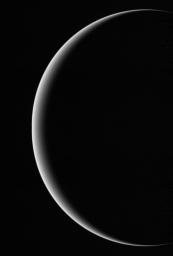 One of the most distinctive features of Uranus is its axial tilt of ninety-eight degrees. Consequently, for part of its orbit one pole faces the Sun continually whilst the other pole faces away. At the other side of Uranus' orbit the orientation of the poles towards the Sun is reversed. Between these two extremes of its orbit the Sun rises and sets around the equator normally. One of the most distinctive features of Uranus is its axial tilt of ninety-eight degrees. Consequently, for part of its orbit one pole faces the Sun continually whilst the other pole faces away. At the other side of Uranus' orbit the orientation of the poles towards the Sun is reversed. Between these two extremes of its orbit the Sun rises and sets around the equator normally.
At the time of Voyager 2's passage in 1986, Uranus' south pole was pointed almost directly at the Sun. Note that the labelling of this pole as "south" is actually in some dispute. Uranus can either be described as having an axial tilt of slightly more than 90�, or it can be described as having an axial tilt of slightly less than 90� and rotating in a retrograde direction; these two descriptions are exactly equivalent as physical descriptions of the planet but result in different definitions of which pole is the North Pole and which is the South Pole.
One result of this odd orientation is that the polar regions of Uranus receive a greater energy input from the Sun than its equatorial regions. Uranus is nevertheless hotter at its equator than at its poles, although the underlying mechanism which causes this is unknown. The reason for Uranus' extreme axial tilt is also not known. It is speculated that perhaps during the formation of the planet it collided with an enormous protoplanet, resulting in the skewed orientation.
It appears that Uranus' extreme axial tilt also results in extreme seasonal variations in its weather. During the Voyager 2 flyby, Uranus' banded cloud patterns were extremely bland and faint. Recent Hubble Space Telescope observations, however, show a more strongly banded appearance now that the Sun is approaching Uranus' equator. By 2007 the Sun will be directly over Uranus's equator.
Magnetic Field Uranus' magnetic field is odd in that it is not centered on the center of the planet and is tilted almost 60� with respect to the axis of rotation. It is probably generated by motion at relatively shallow depths within Uranus. Neptune has a similarly displaced magnetic field, suggesting that this is not necessarily a result of Uranus' axial tilt. The magnetotail is twisted by the planet's rotation into a long corkscrew shape behind the planet. The magnetic field's source is unknown; the electrically conductive, super-pressurized ocean of water and ammonia once thought to lie between the core and the atmosphere now appears to be nonexistent. Planetary Rings Uranus has a faint planetary ring system, composed of dark particulate matter up to 10 metres in diameter. This ring system was discovered in March 1977 by James L. Elliot, Edward W. Dunham, and Douglas J. Mink using the Kuiper Airborne Observatory. The discovery was serendipitous; they planned to use the occultation of a star by Uranus to study the planet's atmosphere, but when they analysed their observations they found that the star had disappeared briefly from view five times both before and after it disappeared behind the planet. They concluded that there must be a ring system around the planet; it was directly detected when the Voyager 2 space probe passed Uranus in 1986. Natural Satellites Uranus has 27 known moons. The first two moons (Titania and Oberon) were discovered by William Herschel on March 13, 1787. Two more moons (Ariel and Umbriel) were discovered by William Lassell in 1851. In 1852, Herschel's son John Herschel gave the four then-known moons their names. In 1948 Gerard Kuiper discovered the moon Miranda.
The flyby of the Voyager 2 space probe in January 1986 led to the discovery of a further 10 moons, and another satellite S/1986 U 10 was later found after studying old Voyager photographs. Eleven additional moons have since been identified using telescopes.
Unlike most planetary moons, which are named from antiquity, all the moons of Uranus are named after characters from the works of Shakespeare and Alexander Pope. The Uranian moons are listed here by orbital period, from shortest to longest. Moons massive enough for their surfaces to have collapsed into a spheroid are highlighted in light purple. Irregular (captured) moons are shown in light grey. Notes: * Awaiting confirmation and naming; ** Negative orbital periods indicate a retrograde orbit around Uranus (opposite to the planet's rotation).Name (spheroidal moons in bold)
(Pronunciation key) | Mean diameter (km) | Mass (kg) | Mean orbital
radius (km) | Orbital period (day) | Discovery date |
|---|
| Uranus VI | Cordelia | kor-dee'-lee-ə | 40 � 6 | 4.5 � 1016 ? | 49,770 | 0.335034 | 1986 | | Uranus VII | Ophelia | oe-fee'-lee-ə | 43 � 8 | 5.4 � 1016 ? | 53,790 | 0.376400 | 1986 | | Uranus VIII | Bianca | bee-aang'-kə | 51 � 4 | 9.3 � 1016 ? | 59,170 | 0.434579 | 1986 | | Uranus IX | Cressida | kres'-ə-də | 80 � 4 | 3.43 � 1017 ? | 61,780 | 0.463570 | 1986 | | Uranus X | Desdemona | dez'-də-moe'-nə | 64 � 8 | 1.78 � 1017 ? | 62,680 | 0.473650 | 1986 | | Uranus XI | Juliet | jew'-lee-et' | 94 � 8 | 5.57 � 1017 ? | 64,350 | 0.493065 | 1986 | | Uranus XII | Portia | por'-shə | 135 � 8 | 1.68 � 1018 ? | 66,090 | 0.513196 | 1986 | | Uranus XIII | Rosalind | roz'-ə-lind | 72 � 12 | 2.54 � 1017 ? | 69,940 | 0.558460 | 1986 | | Uranus XXVII | Cupid | kew'-pid | ~ 12 | Unknown | 74,800 | 0.618 | 2003 | | Uranus XIV | Belinda | be-lin'-də | 81 � 16 | 3.57 � 1017 ? | 75,260 | 0.623527 | 1986 | | Uranus XXV | Perdita | pər'-di-tə | ~ 20 | Unknown | 76,420 | 0.638 | 1986 | | Uranus XV | Puck | puk' | 162 � 4 | 2.89 � 1018 ? | 86,010 | 0.761833 | 1986 | | Uranus XXVI | Mab | mab' | ~ 16 | Unknown | 97,734 | 0.923 | 2003 | | Uranus V | Miranda | mə-ran'-də | 471.6 � 1.4 | (6.6 � 0.7) � 1019 | 129,390 | 1.413479 | 1948 | | Uranus I | Ariel | arr'-ee-əl | 1157.8 � 1.2 | (1.35 � 0.12) � 1021 | 191,020 | 2.520379 | 1851 | | Uranus II | Umbriel | um'-bree-əl | 1169.4 � 5.6 | (1.17 � 0.13) � 1021 | 266,300 | 4.144177 | 1851 | | Uranus III | Titania | ti-taan'-yə | 1577.8 � 3.6 | (3.53 � 0.09) � 1021 | 435,910 | 8.705872 | 1787 | | Uranus IV | Oberon | oe'-bər-on | 1522.8 � 5.2 | (3.01 � 0.07) � 1021 | 583,520 | 13.463239 | 1787 | | Uranus XXII | Francisco | fran-sis'-koe | ~ 12 | 1.3 � 1015 ? | 4,276,000 | -266.6** | 2001 | | Uranus XVI | Caliban | kal'-ə-ban | ~ 98 | 7.3 � 1017 ? | 7,231,000 | -579.7** | 1997 | | Uranus XX | Stephano | stef'-ə-noe | ~ 20 | 6 � 1015 ? | 8,004,000 | -677.4** | 1999 | | Uranus XXI | Trinculo | tring'-kew-loe | ~ 10 | 7 � 1014 ? | 8,504,000 | -759.0** | 2001 | | Uranus XVII | Sycorax | sik'-or-aks | ~ 190 | 5.4 � 1018 ? | 12,179,000 | -1288.3** | 1997 | | Uranus XXIII | Margaret | mar'-grit | ~ 11 | 1.3 � 1015 ? | 14,345,000 | 1694.8 | 2003 | | Uranus XVIII | Prospero | pros'-pər-oe | ~ 30 | 2.1 � 1016 ? | 16,256,000 | -1977.3** | 1999 | | Uranus XIX | Setebos | set'-ə-bus | ~ 30 | 2.1 � 1016 ? | 17,418,000 | -2234.8** | 1999 | | Uranus XXIV | Ferdinand | fər'-də-nand | ~ 12 | Unknown | 20,901,000 | -2823.4** | 2001 | Sources: NASA/NSSDC and University of Hawaii. These sources give no information on the masses for the small satellites; some data have changed greatly so it is unlikely that these old values are correct. Specifications Orbital Characteristics Semi-Major Axis 2,870,972,220 km (19.191 263 93 AU)
Orbital Circumference 18.029 Tm (120.515 AU)
Eccentricity 0.047 167 71
Perihelion 2,735,555,035 km (18.286 055 96 AU)
Aphelion 3,006,389,405 km (20.096 471 90 AU)
Orbital Period 30,707.4896 days (84.07 a)
Synodic Period 369.65 days
Orbital Speed 6.795 km/s
Max. Orbital Speed 7.128 km/s
Min. Orbital Speed 6.486 km/s
Inclination 0.769 86� (6.48� to Sun's equator)
Longitude of the Ascending Node 74.229 88�
Argument of the Perihelion 96.734 36�
Number of Satellites 27 Physical Characteristics Equatorial Diameter 51,118 km (4.007 Earths)
Polar Diameter 49,946 km (3.929 Earths)
Oblateness 0.0229
Surface Area 8.084�109 km2 (15.849 Earths)
Volume 6.834�1013 km3 (63.086 Earths)
Mass 8.6832�1025 kg (14.536 Earths)
Mean Density 1.318 g/cm3
Equatorial Gravity 8.69 m/s2 (0.886 gee)
Escape Velocity 21.29 km/s
Rotation Period −0.718 333 333 days (17 h 14 min 24.000 00 s) 1
Rotation Velocity 2.59 km/s = 9320 km/h (at the equator)
Axial Tilt 97.77�
Right Ascension of North Pole 77.31� (5 h 9 min 15 s)
Declination +15.175�
Albedo 0.51
Cloudtop Avg. Temp. 55 K
Min. Surface Temp. 59 K
Mean Surface Temp. 68K
Max Surface Temp. N/A K
Adjective Uranian Atmospheric Characteristics Atmospheric Pressure 120 kPa (at the cloud level)
Hydrogen 83%
Helium 15%
Methane 1.99%
Ammonia 0.01%
Ethane 0.00025%
Acetylene 0.00001%
Carbon Monoxide Trace
Hydrogen Sulfide Trace ** Information provided by Wikipedia, the free online encyclopedia. **
Permission is granted to copy, distribute and/or modify this document
under the terms of the GNU Free Documentation License, Version 1.2
or any later version published by the Free Software Foundation;
with no Invariant Sections, no Front-Cover Texts, and no Back-Cover Texts.
A copy of the license is included in the section entitled "GNU
Free Documentation License". |