Galaxies What Is A Galaxy? 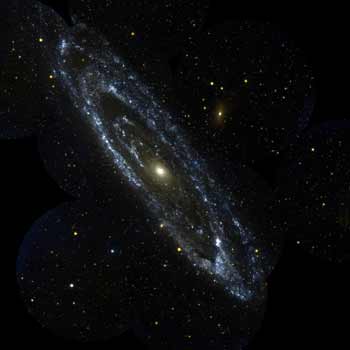 A galaxy is a vast gravitationally bound system of stars, interstellar gas and dust, plasma, and (possibly) unseen dark matter. Typical galaxies contain 10 million to one trillion (107 to 1012) stars, all orbiting a common center of gravity. In addition to single stars and a tenuous interstellar medium, most galaxies contain a large number of multiple star systems and star clusters as well as various types of nebulae. Most galaxies are several thousand to several hundred thousand light years in diameter and are usually separated from one another by distances on the order of millions of light years. A galaxy is a vast gravitationally bound system of stars, interstellar gas and dust, plasma, and (possibly) unseen dark matter. Typical galaxies contain 10 million to one trillion (107 to 1012) stars, all orbiting a common center of gravity. In addition to single stars and a tenuous interstellar medium, most galaxies contain a large number of multiple star systems and star clusters as well as various types of nebulae. Most galaxies are several thousand to several hundred thousand light years in diameter and are usually separated from one another by distances on the order of millions of light years.
Although so-called dark matter and dark energy appear to account for well over 90% of the mass of most galaxies, the nature of these unseen components is not well understood. There is some evidence that supermassive black holes may exist at the center of many, if not all, galaxies.
Intergalactic space, the space between galaxies, is filled with a tenuous plasma with an average density less than one atom per cubic meter. There are probably more than 1011 galaxies in the visible universe.
Types of Galaxies
Galaxies come in three main types: ellipticals, spirals, and irregulars. A slightly more extensive description of galaxy types based on their appearance is given by the Hubble sequence. While the Hubble sequence does encompass all galaxies, it is entirely based upon visual morphological type. Hence, it may miss certain important characteristics of galaxies such as star formation rate.
Our own galaxy, the Milky Way, sometimes simply called the Galaxy (with uppercase), is a large disk-shaped barred spiral galaxy about 30 kiloparsecs or 100,000 light years in diameter and 3,000 light years in thickness. It contains about 3�1011 stars and has a total mass of about 6�1011 times the mass of the Sun.
In spiral galaxies, the spiral arms have the shape of approximate logarithmic spirals, a pattern that can be theoretically shown to result from a disturbance in a uniformly rotating mass of stars.
Like the stars, the spiral arms also rotate around the center, but they do so with constant angular velocity. That means that stars pass in and out of spiral arms. The spiral arms are thought to be areas of high density or density waves. As stars move into an arm, they slow down, thus creating a higher density; this is akin to a "wave" of slowdowns moving along a highway full of moving cars. The arms are visible because the high density facilitates star formation and they therefore harbor many bright and young stars.
A new set of galaxies, classified as Ultra Compact Dwarf Galaxies, were discovered in 2003 by Michael Drinkwater of the University of Queensland.
Larger Scale Structures
Only a few galaxies exist by themselves; these are known as field galaxies. Most galaxies are gravitationally bound to a number of other galaxies. Structures containing up to about 50 galaxies are called groups of galaxies, and larger structures containing many thousands of galaxies packed into an area a few megaparsecs across are called clusters. Clusters of galaxies are often dominated by a single giant elliptical galaxy, which over time tidally destroys its satellite galaxies and adds their mass to its own. Superclusters are giant collections containing tens of thousands of galaxies, found in clusters, groups and sometimes individually; at the supercluster scale, galaxies are arranged into sheets and filaments surrounding vast empty voids. Above this scale, the universe appears to be isotropic and homogeneous.
Our galaxy is a member of the Local Group, which it dominates together with the Andromeda Galaxy; overall the Local Group contains about 30 galaxies in a space about one megaparsec across. The Local Group is part of the Virgo Supercluster, which is dominated by the Virgo Cluster (of which our Galaxy is not a member).
** Information provided by Wikipedia, the free online encyclopedia. **
Permission is granted to copy, distribute and/or modify this document
under the terms of the GNU Free Documentation License, Version 1.2
or any later version published by the Free Software Foundation;
with no Invariant Sections, no Front-Cover Texts, and no Back-Cover Texts.
A copy of the license is included in the section entitled "GNU
Free Documentation License". |