Neptune Information 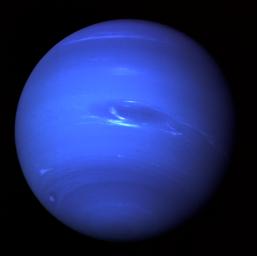 Neptune is the eighth or, due to Pluto's eccentric orbit, occasionally the ninth planet farthest from the Sun, and the outermost gas giant in the solar system. Although the smallest of the gas giants, Neptune is more massive than Uranus: its stronger gravitational field has compressed it to a higher density. Neptune is the eighth or, due to Pluto's eccentric orbit, occasionally the ninth planet farthest from the Sun, and the outermost gas giant in the solar system. Although the smallest of the gas giants, Neptune is more massive than Uranus: its stronger gravitational field has compressed it to a higher density.
Faint dark rings have been detected around the blue planet, but are less substantial than those of Saturn. When these rings were discovered, it was thought that they might not be complete, but this was disproved by Voyager 2. Neptune also has 2,000 km/h winds of hydrogen, helium, and methane that gives the planet its blue appearance. At the time of the 1989 Voyager 2 flyby, it had in its southern hemisphere a Great Dark Spot comparable to the Great Red Spot on Jupiter. Neptune possesses nine confirmed moons and four awaiting confirmation. Neptune's largest moon, Triton, is notable for its retrograde orbit, extreme cold (38K), and extremely tenuous (14 microbar) nitrogen/methane atmosphere.
Neptune is named after the Roman god of the sea. It is represented in Unicode by a stylized version of the god's trident (Ψ). The Chinese, Korean, Japanese, and Vietnamese cultures have since named this planet sea king star, 海王星.
Discovered on September 23, 1846, Neptune has been visited by only one spacecraft, Voyager 2, which flew by the planet on August 25, 1989. In 2003, there was a proposal to NASA's "Vision Missions Studies" to implement a "Neptune Orbiter with Probes" mission that does Cassini-level science without fission-based electric power or propulsion. The work is being done in conjunction with JPL and the California Institute of Technology.
Physical Characteristics 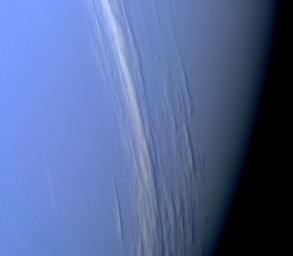 Orbiting so far from the sun, Neptune receives very little heat � in fact the uppermost regions of the atmosphere are −218 �C (55 K). Because Neptune is a gas giant, there is no solid surface; as one ventures deeper and deeper inside the layers of gas, however, the temperature rises steadily. It is thought that this may be leftover heat generated by infalling matter during the planet's birth, now slowly radiating away into space. Neptune's atmosphere has the highest wind speeds in the solar system, up to 2000 km/h, thought to be powered by this flow of internal heat. Orbiting so far from the sun, Neptune receives very little heat � in fact the uppermost regions of the atmosphere are −218 �C (55 K). Because Neptune is a gas giant, there is no solid surface; as one ventures deeper and deeper inside the layers of gas, however, the temperature rises steadily. It is thought that this may be leftover heat generated by infalling matter during the planet's birth, now slowly radiating away into space. Neptune's atmosphere has the highest wind speeds in the solar system, up to 2000 km/h, thought to be powered by this flow of internal heat.
The internal structure resembles that of Uranus. There is likely to be a core consisting of (molten) rock and metal, surrounded by a mixture of rock, water, ammonia, and methane. The atmosphere, extending perhaps 10 to 20 percent of the way towards the center, is mostly hydrogen and helium at high altitudes, but has increasing concentrations of methane, ammonia, and water as it approaches and finally blends into the liquid interior. The pressure at the centre of Neptune is millions of times more than that on the surface of Earth. Comparing its rotational speed to its degree of oblateness indicates that it has its mass less concentrated towards the center than does Uranus.
Neptune also resembles Uranus in its magnetosphere, with a magnetic field strongly tilted relative to its rotational axis at 47� and offset at least 0.55 radii (about 13,500 kilometres) from the planet's physical center. Comparing the magnetic fields of the two planets, scientists think the extreme orientation may be characteristic of flows in the interior of the planet and not the result of Uranus' sideways orientation.
One difference between Neptune and Uranus is the level of meteorological activity. Uranus is visually quite bland, while Neptune's high winds come with notable weather phenomena. The Great Dark Spot, a cyclonic storm system the size of Eurasia, was captured by Voyager 2 in the 1989 flyby. The storm resembled the Great Red Spot of Jupiter, but was shown to have disappeared in June 1994. However, a newer image of the planet taken by the Hubble Space Telescope on November 2, 1994, revealed that a smaller storm similar to its predecessor had formed over Neptune�s Northern Hemisphere. Unique among the gas giants is the presence of high clouds casting shadows on the opaque cloud deck below.
Planetary Rings Neptune has a faint planetary ring system of unknown composition. The rings have a peculiar "clumpy" structure, the cause of which is not currently understood but which may be due to the gravitational interaction with small moons in orbit near them.
Evidence that the rings are incomplete first arose in the mid-1980s, when stellar occultation experiments were found to occasionally show an extra "blink" just before or after the planet occulted the star. Images by Voyager 2 in 1989 settled the issue, when the ring system was found to contain several faint rings. The outermost ring, Adams, contains three prominent arcs now named Libert�, Egalit�, and Fraternit� (Liberty, Equality, and Fraternity). The existence of arcs is very difficult to understand because the laws of motion would predict that arcs spread out into a uniform ring over very short timescales. The gravitational effects of Galatea, a moon just inward from the ring, are now believed to confine the arcs.
Several other rings were detected by the Voyager cameras. In addition to the narrow Adams Ring 63,000 km from the centre of Neptune, the Leverrier Ring is at 53,000 km and the broader, fainter Galle Ring is at 42,000 km. A faint outward extension to the Leverrier Ring has been named Lassell; it is bounded at its outer edge by the Arago Ring at 57,000 km.
New Earth-based observations announced in 2005 appeared to show that Neptune's rings are much more unstable than previously thought. In particular, it seems that the Libert� ring might disappear in as little as one century. The new observations appear to throw our understanding of Neptune's rings into considerable confusion. ght disappear in as little as one century. The new observations appear to throw our understanding of Neptune's rings into considerable confusion. | Name of ring | Radius (km) | Width (km) | Notes |
|---|
| 1989 N3R ('Galle') | 41,900 | 15 | Named after Johann Galle | | 1989 N2R ('Leverrier') | 53,200 | 15 | Named after Urbain Le Verrier | | 1989 N4R ('Lassell') | 55,400 | 6 | Named after William Lassell | | Arago Ring | 57,600 | - | Named after Fran�ois Arago | | Libert� Ring Arc | 62,900 | - | "Leading" arc | | �galit� Ring Arc | 62,900 | - | "Equidistant" arc | | Fraternit� Ring Arc | 62,900 | - | "Trailing" arc | | Courage Ring Arc | 62,900 | - | | | 1989 N1R ('Adams') | 62,930 | <50 | Named after John Couch Adams |
Neptune's Natural Satellites Neptune has 13 known moons. The largest by far, and the only one massive enough to be spheroidal, is Triton, discovered by William Lassell just 17 days after the discovery of Neptune itself. Unlike all other large planetary moons, it has a retrograde orbit. It is close enough to Neptune to be locked into a synchronous orbit, and is slowly spiraling inward. Triton is the coldest object that has been measured in the solar system.
Neptune's second known satellite, the irregular moon Nereid, has one of the most eccentric orbits of any satellite in the solar system.
From July to September 1989, Voyager 2 discovered six new Neptunian moons. Of these, the irregularly shaped Proteus is notable for being as large as a body of its density can be without being pulled into a spherical shape by its own gravity. Although the second most massive Neptunian moon, it is only one quarter of one percent of the mass of Triton. Neptune's innermost four moons, Naiad, Thalassa, Despina, and Galatea, orbit close enough to be within Neptune's rings. The next farthest out, Larissa was originally discovered in 1981 when it had blocked a star. This was attributed to ring arcs, but when Voyager 2 observed Neptune in 1989, it was found to have been caused by the moon. Five new irregular moons discovered between 2002 and 2003 were announced in 2004.
As of 2005, there are two known Trojan asteroids of Neptune which have the same orbital period as the planet. They lie in the elongated, curved regions around the L4 and L5 Lagrangian points 60� ahead of and behind Neptune. These are 2001 QR322 and 2004 UP10.In 2005, three more suspected Neptune Trojans were spotted: 2005 TN53, 2005 TN74, and 2005 TO74. Better orbits are required before they can be truly labeled as Neptune Trojans.
Neptune has 13 known moons. The largest by far is Triton, discovered by William Lassell just 17 days after the discovery of Neptune itself. Two moons discovered in 2002 and 2003, Psamathe and S/2002 N 4, have the largest orbits of any moons discovered in the Solar system to date. They take 25 years to orbit Neptune at an average of 125 times the distance between Earth and the Moon.
The Neptunian moons are listed here by orbital period, from shortest to longest. Triton, which is not only massive enough for its surface to have collapsed into a spheroid, but is comparable in size to our own moon, is highlighted in purple. Irregular (captured) moons are shown in grey. (Triton is also thought to be captured.) Name (spheroidal moon in bold)
(Pronunciation key) | Diameter (km) | Mass
(1016 kg) | Mean orbital radius (km) | Orbital period** (d) |
|---|
| Neptune III | Naiad | nye'-ad | 58 | ~19 | 48,227 | 0.294 | | Neptune IV | Thalassa | thə-las'-ə | 80 | ~37 | 50,075 | 0.311 | | Neptune V | Despina | des-pee'-nə | 148 | ~210 | 52,526 | 0.335 | | Neptune VI | Galatea | gal'-ə-tee'-ə | 158 | ~370 | 61,593 | 0.429 | | Neptune VII | Larissa | lə-ris'-ə | 193 (208 � 178) | ~490 | 73,548 | 0.555 | | Neptune VIII | Proteus | proe'-tee-əs | 418 (436 � 416 � 402) | ~5,000 | 117,647 | 1.122 | | Neptune I | Triton | trye'-tən | 2700 | 2,140,000 | 354,800 | -5.877 | | Neptune II | Nereid | neer'-ee-id | 340 | ~3,100 | 5,513,400 | 360.14 | | S/2002 N 1* | 60 | ~9 | 15,728,000 | -1879.71 | | S/2002 N 2* | 38 | ~9 | 22,422,000 | 2914.07 | | S/2002 N 3* | 38 | ~9 | 23,571,000 | 3167.85 | | Neptune X | Psamathe | sam'-ə-thee | 28 | ~1.5 | 46,695,000 | -9115.91 | | S/2002 N 4* | 60 | ~9 | 48,387,000
(0.32 AU) | -9373.99 |
* Awaiting confirmation and naming.
** Negative orbital periods indicate a retrograde orbit around Neptune (opposite to the planet's rotation) Specifications Orbital Characteristics Semi-Major Axis 4,498,252,900 km (30.068 963 48 AU)
Orbital Circumference 28.263 Tm (188.925 AU)
Eccentricity 0.008 585 87
Perihelion 4,459,631,496 km (29.810 795 27 AU)
Aphelion 4,536,874,325 km (30.327 131 69 AU)
Orbital Period 60,223.3528 days (164.88 a)
Synodic Period 367.49 days
Avg. Orbital Speed 5.432 km/s
Max. Orbital Speed 5.479 km/s
Min. Orbital Speed 5.385 km/s
Inclination 1.769 17� (6.43� to Sun's equator)
Longitude of the Ascending Node 131.721 69�
Argument of the Perihelion 273.249 66�
Number of Satellites 13 Physical Characteristics Equatorial Diameter 49,528 km (3.883 Earths)
Polar Diameter 48,681 km (3.829 Earths)
Oblateness 0.0171
Surface Area 7.619�109 km2
Volume 6.254�1013 km3 (57.74 Earths)
Mass 1.0243�1026 kg (17.147 Earths)
Mean Density 1.638 g/cm3
Equatorial Gravity 11.15 m/s2 (1.14 g) at 1 Bar
Escape Velocity 23.5 km/s
Rotation Period 16.11 hours (16 h 6 min 36 s)
Rotation Velocity 2.68 km/s (9660 km/h) at the equator
Axial Tilt 28.32�
Right Ascension of North Pole 299.33� (19 h 57 min 20 s)
Declination 42.95�
Albedo 0.41
Min. Surface Temp. 50 K
Mean Surface Temp. 53 K
Max. Surface Temp. N/A K
Adjective Neptunian Atmospheric Characteristics Surface Pressure 100 MPa
Hydrogen 80% �3.2%
Helium 19% �3.2%
Methane 1.5% �0.5%
Hydrogen Deuteride 192 ppm
Ethane 1.5 ppm ** Information provided by Wikipedia, the free online encyclopedia. **
Permission is granted to copy, distribute and/or modify this document
under the terms of the GNU Free Documentation License, Version 1.2
or any later version published by the Free Software Foundation;
with no Invariant Sections, no Front-Cover Texts, and no Back-Cover Texts.
A copy of the license is included in the section entitled "GNU
Free Documentation License". |