Pembroke at Wit's End
Jardim da Saúde
São Paulo, SP
Brasil
17 de Agosto de 2006
Minha estimada Gl�ria,
EnglishA minha experiência tem me mostrado que o amor dói, mas também que é a única coisa que vale a pena. Este CD, Tears and Rage: Musical Comments on Love and Existence from Me and my mostly Romantic Friends, é parte de um Projeto Artístico (envolvendo meus
Websites também) que examina as minhas ligações íntimas e trata o amor, a glória e a beleza velado em dor e confusão, lágrimas e raiva, tears and rage.Minhas experiências para com a Outra Íntima podem ser vistas em termos de relações chaves exprimindo sentimentos de amor, paixão, separação e desespero mais ou menos neste ordem, mas de maneiras diferente de expressão. A primeira express�o, do tipo Krishna com as leiteiras, aconteceu com a minha melhor e única amiga no mundo com 3-5 anos chamada de Patty Sessiva. Para dar uma idéia do caráter deste laço adamantino, junto com a maioria dos meus poemas (o primeiro está abaixo) através dos anos, em 1969 em Oakland, California, varias diretrizes relacionais veio da musa deste amor irredutível, inclusive: "Give only that which is fully taken; take only that which is fully given; beyond, beware!", "The road to Hell is getting your own way!". Vinicius de Moraes captura este tema com uma , graça, elegância e beleza igualados por poucos.
Tristeza n�o tem fim
Felicidade sim
A felicidade � como a pluma
Que o vento vai levando pelo ar
Voa t�o leve
Mas tem a vida breve
Precisa que haja vento sem parar
A felicidade do pobre parece
A grande ilus�o do carnaval
A gente trabalha o ano inteiro
Por um momento de sonho
De rei ou de pirata ou jardineira
Pra tudo se acabar na quarta-feira
Tristeza n�o tem fim
Felicidade sim
A felicidade � como a gota
De orvalho numa p�tala de flor
Brilha tranq�ila
Depois de leve oscila
E cai como uma l�grima de amor
A felicidade � uma coisa boa
E t�o delicada tamb�m
Tem flores e amores
De todas as cores
Tem ninhos de passarinhos
Tudo de bom ela tem
E � por ela ser assim t�o delicada
Que eu trato dela sempre muito bem
Tristeza n�o tem fim
Felicidade sim
A minha felicidade est� sonhando
Nos olhos da minha namorada
� como esta noite, passando, passando
Em busca da madrugada
Falem baixo, por favor
Pra que ela acorde alegre com o dia
Oferecendo beijos de amor
De fato, minhas primeiras experiências deste tipo são com amores "constitucionais" para com seres divinos como
Kali, Athene, Dolma, Persephone, Isis, Hecate e as Furies, quem são de meu estilo (for truly I would please them if no one else and I bow to their hands). Eu conheci os nomes delas e as caraterísticas identificadas com elas (a maioria erradas, mas...) neste mundo posmoderno mais do que estranho e não muito convincente, com Mr Maloney em 1960 no estudo de mitologia. Este CD focaliza na Hecate mas de fato as outras já estavam presentes antes também. Uma das minhas peças favoritas é um hino (incluído no link aqui) para laudar e distinguir a Divina, Serena e Feroz Isis (minha Shakti, se quer saber, e para quem o Site é dedicada para jamais esquecer sua expressão comigo como uma gata Persa de graça infinita quem andou nos meus ombros, olhando sempre para frente e para traz, e permanece aqui até agora) que não está incluído nas peças selecionadas para este CD.Temos outros CDs, Tears and Rage: Musical Comments on Love and Existence from Me and my mostly Javanese Friends, Tears and Rage: Musical Comments on Love and Existence from Me and my mostly Appalled Friends, Tears and Rage: Musical Comments on Love and Existence from Me and my mostly Rock Friends, Tears and Rage: Musical Comments on Love and Existence from Me and my mostly Slavic Friends, Echoes: On Beyond Music, Perbast, mas o meu favorito até agora é: Wasp Honey, que focaliza na definição de um ser refletindo o amor que eu sinto para com estes seres tipo pessoas físicas e em união tipo "common cause" que podem passar por varias níveis de associação, devoção e ternura que incluem, por exemplo, a definição de hydra (desespero) para harpy (calor) eventualmente para gorgon (devoção) em uniões progredindo pelas condições, temores e verificações de relacionamento ("We won't get fooled again!") na minha ati sanubari ligado em Ketresnan Lair Batin "Wonten ing dalem Sang Tawon, Mahasiwarupa, wonten ketresnan lair batin" e expressado na minha rasa de Sadja Kusumaningratan, eu sendo em estado de Tapa ana ing Pertapan [gunung, jago mlilé, jago wiring-galih jalu mungal] (Sanctum igual a murni), sendo o Mangkudjagad e Mangkukalamangga, que uni o
Adi do Surakarta Adiningrat com a Ayu da Ngayokyakarta Ayuningrat na Kusuma que defini Wasp Honey, a beleza real da outra (este tipo de união é sempre feminina e tribal) vista na realidade em vez de só no coração.Uma discussão mais completa da distinção
ayu/adi como aparece na divisão de papel entre ibu/bapak, the Love and the Law, está aqui, especialmente nas seções "Living and Dying" e "Balance and Imbalance". Houve dois lugares em Surakarta onde eu vi (senti) este ser juntado: Kartasura, no kraton (palácio) Matarem anterior do Baluarti, e Grogol, por motivos desconhecidos, a menos que seja a presença da Sri Kinusuma lawan Binatari lawan Dinewi Ibu Mar. Nunca na minha vida eu já vi um lugar tão calor quanto Grogol: independente da temperatura, o asfalto estava sempre derretendo.Houve duas expressões desta tendência quando eu estava com 11-12 anos. A primeira com Dale Mangels, uma menina linda que sentou na minha frente na classe de Mrs Peacock de quinta serie (11 anos). No final do ano eu fiquei confuso de me achar indo atrás de um presente para marcar meus sentimentos de apreciação e ternura. Gostei dela. Dei um pingente para ela no ultimo dia de escola e naquela noite, no jogo de baseball "little league", duas amigas dela, Lynn Mayers e Debbie Hird, me aproximaram e devolveram o pigente. De repente, as cores do mundo ficavam muito mais escuras e logo após de correr para casa eu me achei jogando uma pedra grande em cima da caixa com o pingente dentro. Eu não estou muito bem com a lembrança até agora.
Outra situação ilustrativa (e o meu contexto familiar estranho talvez ficaria mais claro abaixo) foi com a Stephanie Hoover, uma moça mais velha que eu adorei lá no lugar onde a gente foi todo ano no verão (duas semanas) em Vermont. Quimby�s tinha tudo: floresta (de arvores mistas mas com bosques primordiais de pinheiros e o musgo veludo cobrindo o chão), lagos (Forest, Big Avril, Little Avril), cavalos (Gumdrop "stable mascot", Big Red, Trigger, Chaos, um corcel pinto que me pegou pela bunda na boca e me jogou no chão quando eu estava no pônei Trigger na frente dele sem a mínima provocação na minha parte -- assim fechou minha fase de fascinação com cavalos), ursos, um córrego (onde um dia eu pesquei uma truta (brook trout) linda e fiquei devastada quando eu soltei ela e ela morreu), os horrores de pescar com a família no Lake Lovelace no Canadá com hellgramites por smallmouth bass (houve pesadelo ainda mais do que normal por estas expedições masculinas e cruéis de indiferença a tudo que estava passando quando eu fique com "sorte" e pesquei um bass atrás do outro com os outros só olhando e babando), poucas pessoas, Stephanie.
Stephanie é de Ohio e tem um irmão mais velho ainda, Charlie, um gênio em contar estórias. Uma das suas melhores apresentações foi o poema "Sam McGee" (provavelmente de Vachel Lindsey), um evento tão dramático que eu lembro até agora com arrepios quando o Sam que estava com tanto frio acabou entrando no forno com grito de alivio enquanto ele se incinerou (as vezes eu acho que ele estava falando de mim e a Stephie que era o forno). Na mesma Talent Night, eu cantei "It's a grand night for singing".
Nós três formaram uma sociedade chamado Acrobiscent (Aquavescent?? Charlie que estava com as palavras e ele nunca soletrou pra mim) Association of America (AAA) com referência às bolinhas de gás com cheiro de peido que saiam da água quando coloca o remo no fundo do pantanal. Nós fomos todos "co-counsels" da Sociedade, com responsabilidades e direitos meio indefinidos. Ele eventualmente virou acadêmico após estudar historia no Cambridge se não me engano. Ela, conforme a estória que eu recebi, acabou dormindo com o
inimigo já que casou com um ministro protestante. Yuck.Stephie, uma linda moça petite, teve um espirito incrivelmente vivo e uma visão céptica (foi a época do Kingston Trio, Theodore Bikel, the Smothers Brothers, Miriam Makeba) e calorosa, e eu a amei para sempre. Um dia houve atividade organizada de "Hare and Hound". Na brincadeira, ela ficou coelho (hare) com um moço da idade dela (uma pessoa lamentável com eu morrendo de ciúmes). Como cão atrás deles, seguindo as trilhas de papeis (a maioria falsas) que deixaram para trás, eu corri como nunca ou antes ou depois (with wings on my heels) por uma distância inusitada na minha experiência (meu forte sempre tinha sido corrida de curta distância). Achei eles antes que tiveram oportunidade para sentar e esperar para ver se os cães iam achar eles ou não. Ciúmes tem força. Eu fui convidado tornar coelho e esperar os outros cães juntos. Fiquei sim, bem perto dela.
O que deixa esta relação um pouco mais interessante é a maneira que usamos para marcar e anunciar o nosso amor. Ela (e eu) escrevemos um contrato de noivado para nos casarmos quando eu cheguei às 19 anos, a idade dela na época (eu com 12). Nos levamos o contrato escrito em papel cor de rosa para os nossos pais assinar (imagina a situação que definiu este evento) e está comigo até agora com as assinaturas deles e o meu coração ainda preso à sua graça.
Na
Odisséia da minha vida, perdi contato com ela e o Charlie. Meu primeiro poema saiu lá na Quimby's às 14 anos:In the shadowy night
In the child that's never been born
It follows life's fatal trails
While man seeks and fails
But never resigns to his own.
Truth cuts through the night
Like a finger of light
That strains from some slow slamming door
It feels out its way
Then vanishes with day
Ne'er to be found anymore.
Truth's a mirage in a dream
That flees but to seem
When attacked by the cold grey of dawn
Many men preach it
But none, none dare reach it
For they're lost in the darkness they are.
Aqui também eu preciso marcar a minha relação desordenada com a minha família extensa, no sentido dos Howes como um evento no ser "nobre" com os viscounts, earls e barons
Howe. Os Howes se formaram como família de maneira autocrática e no sentido de Dux (a posição de "duque" vem de maneira confusa do Império Romano onde foi definido como foco de resposta militar �s ameaças para com a existência do Império) empregado pela turma entre os Ingleses de maneira que parece de "má fé". Conseguiram ficar com um título e posição que dependia de um Imperium que não existia que deu para eles autoridade sem supervisão. Na realidade, o entendimento desta desgraça requer um estudo cuidadoso das lemas:e
Cui bono?
As we will see below, at this instance in connection with the Crown, the Howes manipulated circumstances and obtained a viscountcy with the colors and trappings of a dukedom, which now appears to have been spuriously tied into the pre-Norman kingdom of Leinster (Laighen), brought to Pembroke (though held on feudal grant of the ever anxious and murderous Henry II) through Richard de Clare's marriage in 1170 to Aoife (Eva), daughter of Dermot MacMurrough, the last king. Later this legitimate entailment was employed by Richard Plantagenet when, due to the peculiarities of estate law, the daughter of sonless Richard and Eva de Clare, Isabel, became Crown ward and was given in marriage to William the Marshal.
Legitimate kingdoms are proper Natural and Landed events, indelibly tying the people and the soil, rather than the arbitrary or artificial moments of Regal legerdemain manipulated by a tyrannical Crown over the centuries. One outgrowth of this problem of authority is the ever so confused notion of Divine Kingship that has plagued the western mind: authority properly rests in the land, the people and the attitudes they express in their lives, but the Church made a level effort to confuse matters by intruding into this essential bond with their ever-so-confused notion of an unaccountable God, the succor of so many tyrants. A good place to start studying legitimate authority is in Java where the principal of leadership is "where there is a lord, there is a servant" (nya gusti, nya kawula). Another excellent source of perspective is China, where the Wu's job is to connect his people to T'ien-li, their natural environment, and keep their feet on the ground such that they not end up eating the bark off trees once again. According to Chu Hsi:
The cultivation of the essential and the examination of the difference between the Principle of Nature (T'ien-li, Principle of Heaven) and human selfish desires are things that must not be interrupted for a single moment in the course of our daily activities and movement and rest. If one understands this point clearly, he will naturally not get to the point where he will drift into the popular ways of success and profit and expedient schemes. . . When one does not even know where to anchor his body and mind, he talks about. . . the task of putting the world in order as if it were a trick. Is that not mistaken?By way of contrast, we have Richard Plantagenet, Coeur de Lion:
The despotic Normans and Plantagenets always had problems with legitimacy. Their dilemma is witnessed in the See, Kingdom of Rome, that ended up held in Cornwall by Henry III's brother, Earl Richard, King of the Romans, due to the Crown's aggressive and expensive efforts to tie into the Holy Roman Empire and prop up flagging authority the tyrannical Normans never really had. In fact, during William the Marshal's rector regis et regni of Henry III (though many at Pembroke insist this was more properly rectum regis et regni since we ended up eating a lot of it when Henry III returned to the Plantagenets' tyrannical path and left us holding the bill arising out of his betrayal of our legitimate regency), the ever so shabby Crown got wind of the precious jewel of legitimacy held open at Pembroke and made haste to co-opt our noble seat, eventually meaning the execrable and utterly unforgiveable Jasper Tudor as earl. As the Crown, the Hanovers obtained access to a legitimate ancient Gaelic kingdom, still honored and held open through Pembroke, just as the ever-so-stubborn Cornish still carry the Kingdom of Rome. So in the flickering light of all these devious shenanigans, the Howe viscountcy in Ireland was coupled to Leinster and then fraudulently "extinguished" on the death of earl William.
On this confused and macabre basis, the family ended up defining itself in a crypto-tyrannical fashion with the world and within the corporation involved (afflicted) itself. The lack of knowledge of the matters involved in this event nowadays does not change their profound influence of the family connected with the earl Howes: it's an international scandal (as Boris Casoi would say) with me and probably Sophia Charlotte, Baroness Howe of Langar (of whom more below), among the victims, but, in fact: "The way you treat one is the way you treat all".
The figures most in evidence in this scenario, always a bit out of focus, are the two English commanders who, more than anyone else, contributed to the defeat of the English in the American Revolution. General William Howe, viscount, earl, Supreme Commander of British Forces, was a notorious conciliator, whorer and inveterate unconscionable, who was called home for spending too much time in a social whirl and allowing the rebels to retire unscathed after defeating them in battle one too mamy times. Similarly, his brother, Admiral Richard Howe, viscount, baron, earl, (known as "Black Dick" not because he was an exceptionally caring person, in fact, quite the contrary) was an open colonial sympathizer while the commander of British Naval Forces in the first couple of years of the war until he too was relieved of duty, returning to Langar in Nottinghamshire.
Before discussing Langar Manor, a central figure in this drama, a comment on Pembroke, my dearest and clearest Noble Seat arising out of the great heart of Strongbow, Richard de Clare, second earl, and a follower of no one in a world gone mad with kings of nothing but treachery, that I personally am blessed to know through my ever so dear and puissant Milady Catherine Craig, one of the de Clare flowers long gracing me with her ever so silent and abnigating love. As has been said from time to time, "They have us outmanned, but not outmanored!"
Ever so many of us know that places can take on a character of their own. They come awake. In Java we have lots of examples of this, e.g., Prambanan is a constant presence that goes on and on in celebrating the grace of our lady, Lara Djonggrang. We also have less immobile expressions of this animistic reality, e.g., batik can often be as knowingly conscious as oriental carpets (like my ever so dear "rugs of authority", two old karabagh kazaks, with one stating the horrified stillness of the Chagatai/Ogedai Great Khanate and the other carrying the rage of the Mengu Great Khanate and the destruction of Alamut under Ilkhan Hulugu). Similarly, swords and blades can also become conscious and the presence (sahir) and being (kabir) of kris (our sacred knives) are almost always distinct in denying reason to be a solution and asserting that Reality is the only arbiter. My own kris comes from Aceh, where the tsunami hit, and is a bold and adamantine blade of justice called nagasasra.
Here at Pembroke at Wit's End, my home, my lar, my dalem, we have also developed into a conscious collective not unlike a manor, though our common cause goes deeper than most and is the undistinguished and fully surrendered devotion characteristically found in Java's palaces, like Baluarti and the other Mataram dalem. We do not have a lord or a lady of the manor; we have a keluarga besar, a big family, without distinction, where we are making every effort to contribute with a deep and abiding love guiding us in our search to defend the peace we have found in one another.
Heere in wildernes I dwell, my weird for to dree.
Such clarity of purpose is rare in a madding world with ever so many following the disgraceful path of desperately writing their own ticket and demanding that we all grant them their pretended impunity. In connection with the Law, we openly derive the following categorical imperatives.In addition, here at Pembroke at Wit's End we stand open with Pembroke in serving the grace and nobility of the palatine earldom and support the presence of the earl in my person as well as introducing some other great purposes witnessed in the human travesty over the millenia including the ka'an of the Mongols, leopardskin chief of the Nuer/Dinka, quetzelcoatl of the Aztec/Maya, dewa agung of Bali and ratu adil of Java, in our search for a return to Reality, the only place anyone can really be together with anyone, to
palaiouV nomouV (what we call purba wasesa in Java), the Ancient Way in the western world, a common state lost more than two thousand years ago, last clearly stated on the Isle of Samothrace, holy sanctuary of the Cabeiri, the ever so much crueler and keener Penates of the ancient world, of Stonehenge and the Trojan war, of pharaohs and other autocrats and a vision of Reality later seen briefly in the great khanate:Whatever of good or evil, of weal or woe, appeareth in this world of growth and decay, dependeth upon the decree of a powerful sage and hingeth upon the will of an absolute potentate.
In the service of the peace and joy we have found in one another and the defense of our manifest union of love and devotion, we have opened the repository of this Ancient Way which was brought to the Italic pennisula more or less as described in the Aeneid and now rests open in the independent commonwealth and autocratic state of San Marino, somewhat below Ravenna on the east coast of Italy, and constitutes a more important marker of the human condition than some would have it. The Italians can be proud that they have preserved this great sense and purpose, just as the English should be ashamed for allowing the great statements of being Great Britain has known and suffered and gloried in to be misused and misrepresented and misconstrued actively under the disgraceful Hanovers.
Pembroke was officially divested of its palatine status early on by the ever so repugnant, unconscionable and tyrannical Tudors, who disgraced Pembroke so brutally. Our curs�d earl Jasper, together with his brother Edmund, earl of Richmond, perpetrated the gang-banging rape of Edmund's child-bride, 12-year-old Margaret Beaufort, eventually producing the anathema of Henry VII, born of her at age 13 at Pembroke. The walls of the keep still echo her screams and their cruel and despotic dynasty, with some more cosmetic than real shifts and name changes, afficts us to this very day. As Churchill noted:
William the Conqueror's invasion of England was planned like a business enterprise... William was a prime example of the doctrine, so well known in this civilised age as "frightfulness" -- of mass terrorism through the spectacle of bloody and merciless examples.
In real terms, English history ended with the Conquest, with the imposition of a tyranny based on an imperial presence transfered by the Normans from the desperate, decadent and decaying Eastern Roman Empire, where Viking vanadians acted as guardians of the Caesarian being just as the Germanic praetorians had in the Western Roman Empire. One difference was that legitimacy was no longer an issue with Arabs, Turks and others always threatening a very low-profile Constantinople. The Norman Conquerors' vision was one of great but ungoverned power (the Empire had not really had an Emperor for centuries in the sense of accepting responsibility for being the Imperium) and remained at odds with England, resting on abusive ascendency, rather than shared and common cause.
The Hanovers then brought in the final piece of this iniquitous puzzle, by transfering the affliction of the continuing infamy of the Western Roman Empire, which had been held aloft in undisputed indifference in the Holy Roman Empire, within which the Hanovers played a remarkably strong part in maintaining the being of the Imperium while, of course, never seeking to establish legitimacy or accountability. A scurvy lot, the Hanovers, then and now; for truly, "Now, you take the high road" would unquestionably seem to apply and the "low road" of mutuality the rest of the island's inhabitants seek has remained, an uncooked bouillabaisse, covered over by this abusive elite for a hiatus of subjugated indifference that has lasted nearly a millenium.
aliquando bonus dormitat Homerus
Arisng out of the iniquitous expression of this infamous tyranny, Langar Hall is worth a comment, as an unspeakably grim moment that has gone on and on awaiting exposure and justice seeming forever. Langar goes at least back to William the Conqueror and has seen some of the darkest and most powerful figures in England's surprisingly dour history of foreign occupation and exploitation, starting with the daunting Peverel (Who was he? How did he get so much power? Was he the Conqueror's illegitimate son? Why do I shiver when I say the name? Was he the ever so evil and apparently immortal Jess who lurked about the grounds and forests surrounded by tales of cruelty and cannibalism?), followed soon after by the infamous John Plantagenet, whose cruelty inspired the Barons' revolt (though some would insist they were invariably revolting) bringing the Magna Carta along with the ever-so-often repeated tale of Robin Hood (and the lovely Maid Marian). After a number of Plantagenet holders through Henry III and so on came the le Scrope powerbrokers whose lack of quality is reflected in Stephen Scrope's lament on not attaining an optimal price:
For very need, I was fain to sell a little daughter I have, for much less than I should have done by possibility.
Finally, through John Grubham Howe's marriage to Anabelle, the last in the line of le Scropes, a legitimated heir to the earl and thus lady of the Manor, the Howes acquired this powerful
SEAT. Thus, this former Crown estate became the Howes' heavily grounded backing in Nottinghamshire and the seven-hundred-year-old entailment's cruel history carried on in new dimensions of villainy. John Grubham was Richard and William's grandfather and their father (created 1st viscount) continued the climb up the social ladder by marrying the daughter of one of the blowzy mistresses of George I who sorely afflicted society and politics as if the pox. According to Churchill:The monarchy too had lost its lustre. There was no pretence that the Hanoverian kings ruled by Divine Right. They held their position by the express sanction of Parliament. Even the symbolism of royalty was curtailed. The Court was no longer the centre of beauty, rank, and fashion. A certain dowdiness creeps into the ceremonial and the persons of the courtiers. Life in the royal palaces is dominated by the panoply and surroundings of a minor German princeling. The dreary names of the German women are ever present in the memoirs of the time--the Kielmansegges and the Wallmodens, the Platens and the Schulenbergs--all soon to deck themselves out with English titles and wealth...
There was a general outcry against the cupidity of the German ladies. "We are ruined by Trulls--nay, what is more, by old, ugly Trulls, such as could not find entertainment in the most hospitable hundreds of Old Drury."
Eagerly embracing this unabashed debauchery, the Howe family made every effort to embed itself inextricably and invisibly in legitimate authority's twisted web. With the connivance of the Crown, they leaped on the "high-roader" bandwagon of a country ruled by degenerate arrivistes who were never assimilated into the rest of the body politic and have seen themselves as exploitative aliens for centuries.
For example, let us first look upon the Normans cum Plantagenets cum Yorks cum Lancasters cum Tudors who are directly tied into Langar; the family was so disinterested in rendering account that it literally extinguished itself, and by the time the Virgin Queen passed on, much of that blood had been washed out through the incredibly brutal Wars of the Roses and the active extermination programs carried out by Henry VII and Henry VIII against their own kin. So, besides being the world's most renowned serial killer, Henry VIII also has the distinction of having brutally murdered off his own family, while Elizabeth carried on the auto-immolating family tradition by murdering her own cousin in Mary, Queen of Scots, among other such measures of Royal prerogative in the face of the family's chronic tradition of lèse majesté.
For another example, just look at the Hanovers cum Saxe-Coburg & Gotha cum Windsor, who, like so many haughty monarchs (many of whom they were related to) from France and Spain through the ubiquitous Habsburgs to the Russias, did very little but actively despise their realm while speaking German at home and ordering the suppression of their subjects through taxes and cruel indifference. Their epoch inspired such tales as the Highwayman, not really all that different from Robin Hood. The manor had seen a long line of king wanna-bes, powerbrokers and carrion-eaters by that time. The exploitative Hanovers (which actually continue until now despite a couple of cosmetic name changes in the dynasty) might lead one to suppose that, in fact, "Ich dien" is really the title of a cookbook in which we are nought but ingredients: imagine how blatantly offensive choosing a language the Welsh have principally known as that of brutal conquerers for the motto of the Prince of Wales, rather than Welsh or at least Latin.
In any case, these cagey brothers repaired to Langar to weather a storm of Fourth Estate criticism in England and pretend to their liberality while arising directly out of the Hanover family power structure as unrecognized grandchildren of George I. Their sincerity in all of this has to be questioned and as an obviously benefitted part of this power structure, their treason in the American Revolution did them little real damage. Richard reappeared a few years later accepting command of the English Channel Fleet in 1782 and twice served as first lord of the Admiralty. Similarly, William's outstanding failure as Supreme Commander of British Forces did little to slow down his career either, in that he became a lieutenant general in 1782 and then a full general in 1793. However, Churchill gives a clear impression of the quality of his command:
Rarely has British strategy fallen into such a multitude of errors. Every maxim and principle of war was either violated or disregarded. "Seek out and destroy the enemy" is a sound rule. "Concentrate your force" is a sound method. "Maintain your objective" is common sense. The enemy was Washington's army. The force consisted of Howe's troops in New York and Burgoyne's columns now assembled in Montreal. The objective was to destroy Washington's army and kill or capture Washington. If he could be brought to battle and every man and gun turned against him, a British victory was almost certain. But these obvious truths were befogged and bedevilled by multiplicity of counsel...
Washington in 1777 took up his winter quarters at Valley Forge, to the north of Philadelphia. At the end of every campaign there were many desertions, and he was now reduced to about nine thousand men, of whom another third were to melt away by spring. Short of clothing and shelter, they shivered and grumbled through the winter months, while in Philadelphia, a score of miles away, nearly twenty thousand well-equipped English troops were quartered in comfort. The social season was at its height, and the numerous Loyalists in the capital made the stay of Howe and his officers pleasing and cheerful. The British made no move to attack the Patriot army. As at Long Island, as at White Plains, as at Brandywine River, he refused to follow up his victory in the field and annihilate his enemy.
Be that as it may, the cunning pair eventually nailed down a title and the absolutist and unconscionable power and privileges implied by working through a viscountcy, which was really an occluded palatine earldom, grounded far afield in Ireland and tied into the Gaelic Kingdom of Leinster, which was then "legally" extinguished at William's "death" in 1814.
In fact, my experience with my "family" has been so unerringly disappointing I am close to believing that the longevity described in the 'Highlander' movies for unconscionable villains may well be true. Along these lines, Gordon Walter Howe's own "mother" used to call him William from time to time apparently in order to irk him. I also have a copy of Tristram Shandy I found in my closet in HoHoKus published in 1776 that appears to be his, which no one in the family ever tried to account for.
As a result, in a realm without a working Imperium, due to what had for generations been a callous, capricious and disgraceful Royal Family, the Irish peerage with duchy colors was patently without legitimacy or accountability, in that the Hanovers had long since denied anything but very conveniently bourgeois values and never assumed any sign of acceptance of responsibility for the regal mechanisms they were so ruthlessly manipulating.
In a warped and twisted sense so appropriate to my "family", like a mother intent on wiping out all memory of her child by burning pictures, keepsakes, letters and books, Richard's daughter, Sophia Charlotte, Baroness Howe of Langar, made every effort to cover their tracks by stripping this enormous estate of its treasures, gutting its value associations by breaking up the property and razing the physical entity comprised by the grim Manor, that had served as the home and headquarters of some of the most treacherous, privileged and powerful villains in English history, thus making them ever so much harder to come to terms with.
However, a complementary understanding of this lamentable desecration must necessarily be mentioned. Considering the circumstances carefully, the Manor had been in the Howe family since her great grandfather. In addition, her grandmother was a daughter of George I, and the viscountcy probably came as a marital consideration (as per business-as-usual for the king with his flaunty doxies, 'the German ladies'), so Crown interests were hers by blood. She grew up in this incontestably regal and in fact imperial environment since the Manor had indeed been a Crown estate and Crown property in various guises before the onset of the le Scrope obfuscation. For thus had arrived John Grubham, bringing in those from the true bottom of the barrel, the scum of the earth, in the unspeakable Howes come to further disgrace the source of so much unutterable but incontestably high profile villainy and sink the whole affair into their own more private forms of atrocity and auto-immolation. The sadists' victims went from outside to within the Manor itself, most likely in children to be abused and consumed in the tradition of Kronos.
As was commented by Lord Peter Death Bredon Wimsey at the yearly gathering in the Manor of the Duke of Denver, "Ah, Christmas, that time of year when you get together with the people you hate most in the world and are obliged to be pleasant." I used to start fantasizing a nuclear holocaust in October so I wouldn't be able to join the ever so unseemly festivities ("Hey, it's the man with the green cup!"), always knowing for sure that I would have a new collection of cutlery to extract from my back when I got home. In my branch of the Howe Compendium, a Strictly Limited Responsibility Syndicate, i.e., "Protection Racket", the openly and repeatedly stressed and demonstrated Credo is "No mercy", as well as the oft expressed dim view on justice, "You get what you pay for" (sotto voce: "As long as you've got what it takes"). The family is packed with noble titles as personal names: Earl, Byron (alternative spelling of Baron), Marshal; and the only concern I have ever found that unites their twisted view of things is an always frenzied rally to "If you can get away with it, it's your right." They collectively defend that one to the death: yours, of course.
One thing I might note in commenting on the Credo is that no matter how wrong they have been about anything, no one in my family has ever apologized or given satisfaction, ever. Just to give a notion of how transparently miscontrued they maintained themselves, my father's mother (an imposing, tawdry and unbearable autocratis covered in diamonds, so arriviste as to make even the most truculent parvenu blush) made an extensive study of the Howe "family" both in the United States (books about the New England Howes I was never given access to until my own unutterable Matron began her effort to explain her memory -- ashes to ashes and all that) and in Great Britain and claimed the 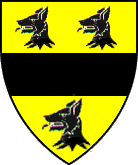 three-wolf coat-of-arms but went so far as to deny our kinship with the earl Howes. Exactly how that could be (unless, of course, we actually are the earl Howes) remains a mystery for all of you to contemplate: I have given up. As for the Hanover connection, at least one mystery has been solved: How could I be so unspeakably revolted by the current dynasty without the singular disappointment and irreducible disgrace of their being relatives? It would appear that I no longer need worry about explaining this discrepancy, nor my incontrovertible disgust with George Bush, who is a horrible Hanover as well, and thus another distasteful relative.
Their modus operandi seems to be a grotesque perversion of the principles of frankpledge: rocking the boat is a very bad idea in that those who expose and/or oppose abusive and/or criminal behavior are punished by the corporation for said behavior as if the exposing party were responsible. In reflecting on the meaning here in the misuse of frankpledge, a good place to start is with the term "gotong-royong" in Indonesian which has often involved a kind of advocated, almost constrained cooperation which may or may not reflect your actual feelings for your neighbors at the moment. Going back to the previous stage in frankpledge's deterioration, the term for collective organization and mutuality was frithborh (with a kind of Germanic choke off at the end that doesn't get heard in modern English). This deeper sense of commonality with the other is best studied in Javanese with an examination of the principles of tentrem ing manah in that this was something of a het definition, i.e., "a het is a gather that likes it together" rather than being advocated or impelled and was thus spontaneous rather than intended.
The perversion of these elements in the definition of the bogus Howe "palatine earldom" (viscountcy) provided a grotesque mockery of the unspoken moot underlying Pembroke (let me say that the source of this adamantine position to my mind is the Welsh conviction that nobody who has come to the island more recently has been a pleasure for them to know) or any other legitimate noble seat and its independent statement that denies that the purpose of authority in and of itself can ever be anything but fraudulent and imposed ("You want to tell us what to do? We are very sure that we don't like being told what to do!").
To give an idea of what was at stake in this perverse attack on the beauty and indelible grace that can arise out of a proper statement of nobility, I might suggest a careful viewing of the incredible courage and candor, love and honor of England's own Domestic Goddess,  Nigella Lawson, whose exquisite revelation of her own tradition both as a Jew and as a member of the English Aristocracy, leaves us all permanently in her debt. I even go so far as to bless the ever intrusive television for having given me a chance to know her: Nigella is the only person I know that I would feel deeply honoured to call "Your Most Noble and Puissant Milady".
However, in a deeper sense, this is really a distinctly more remarkable love. According to Java's extensive nomenclature for describing and labeling bonds, ever so sweet Nigella is a Kangdjeng Ratu Kusuman, who graces me with true consolation in a world so horrible I feel like an extra in Bergman's
Through a Glass Darkly or perhaps Idioterne, Lars von Trier's magnificent statement of postmodern disgust, albeit I unhappily admit to being a ranking principal in Thomas Vinterberg's tour de force in grotesquerie, Festen, that foul and fetid and festering examination of the Kronos tradition from Dogme 95.Truly, seeing her life and her love, her children and her family (dearly recalled Tomasina and whitebait, family recipe notebooks including one from her socialite (Rothschildian?) Grandmother who suffered from vertigo in the kitchen, Mimi and Bruno welcome in the kitchen unlike in many homes), her matter-of-fact intelligence and acuity, her graceful feel for the words of our language, her adaptive sense of cooking as a relationship between you and the food focusing on taste and convenience rather than getting lost in recipes, her marvelous feel for her ingredients, her distaste for restaurant food, her introductions to culinary figures and their books such as her dearly placed reading of Liberace, one of the most astonishing phenomena of the Twentieth Century who I had never managed to get a clear view of through all the glitter,
 her piquant raids on the refrigerator in the middle of the night in her ever so attractive pyjamas and the occasional Snicker's bar that takes the place of her own delights -- knowing her family a fair amount, really, her friends a little and her sterling quality a lot, her warmth and her impatience, her sweetness and her sweetness (that's all I have ever found in our darling Nigella -- in whom I see the "sweet" coupled with Liz Hurley's "tart" and Sarah Brightman's "spicy" as a triketa expression of the
to a lady in his shield
Tennyson, with some fine-tuning, goes the right direction to seek my feelings and gives a clear view of the Love in the Love and the Law underpinning Frithborh and both the legitimate beauty of Pembroke and of the noble tradition in its own right as well as highlighting the twisted and distorted travesty, the gruesome and grotesque perversion constituted by the atrocious betrayal of all noble purpose in the Howe's rogue earldom. As Empedocles so aptly describes the likes of the Howes:
morfhn d allaxanta pathr filon uion aeiraV
sfazei epeucomenoV mega nhpioV oiktra toreunta
lissomenon quontoV� o de nhkoustoV omoklewn
sfaxaV en megaroisi kakhn alegunato daita.
Love blinds; hate reveals
: Knowing Howes with the dark fury I must constitutionally admit to, along with the insight into the execrable, indeed grotesque, villainy this revulsion, indeed this weird and haunted disgust, provides (as when Nero looked out on Rome burning from his high window), together with her singular dedication to the complete and total destruction of Langar Hall, leaves me fairly sure we are looking at some profound source of torture and/or child abuse exacted incontestably and unforgiveably on Sophia Charlotte, leaving her with an adamantine and raging hunger to destroy Richard and all that he represented through the Manor and its properties, the only things he left her save her shame and rage. However, she did not go quite as far as did the Romans in sowing salt into the soil at Carthage but rather a new and smaller Hall was raised and still remains, rather like a chip in a poker game, having meaning only through attribution, value only through convention and the careful selection of usually sugar-coated memories out of the horrors surrounding and defining this gruesome entailment.The depths and dimensions of evil underlying the modern world's simpering bourgeois superficiality and frenzied reductionistic flight from responsibility for anything and everything are wonderfully well captured by Edgar Bug:
You know, I have noticed an infestation here. Everywhere I look, in fact. Nothing by undeveloped, unevolved, barely conscious pond scum, totally convinced of their own superiority as they scurry about in short pointless lives.
Bizarroland
, Idioterne writ large, is the world of a hideous more-or-less human elite seeking escape from examination: a bevy of desperate and knowingly unforgiveable reprobates "seeking peace in the bitter land" in their ever more openly expressed flight from justice and the revenge of their pursuing victims from all ages and eras, times and tides. In this light, just look at the auto-immolative aspect of Western society, first in the tyrannical Roman Empire with its unaccountable domination of any and all, followed by the unconscionable exploitation of the feudal nightmare and then mercantilism and callous capitalism and then later through unbridled hedonism and "the cult of progress" since the European expansion, which became the snowballing, bourgeois frenzy of the "Pursuit of Happiness", so incredibly destructive of our natural environment, as part of the pharaohs' effort to call a halt, turn off the light and lock the door on this expression of the human travesty, which has had these ever-so-empty autocrats far too openly expressed in their infamous iniquity for a couple of millenia now.You need not go very far to find evidence of great cruelty in the human tradition and this cruelty is our constant context whether it is currently visible or not. The Egyptian pharaohs were incredibly callous and brutal tyrants for more than three thousand years. Their cruelty scarred, maimed and marred the human mind and utterly devastated the human experience. The search for revenge on them by the rest of us and their flight from our vengeance has determined the course of human history. They are running away; we are in pursuit. It is to be admitted, however, that catching these unconscionable blackguards is by no means an unalloyed pleasure: they do indeed fight even dirtier when cornered.
British estate law used to understand such matters but would seem to have forgotten much. The Japanese still actively see the maintenance of the family home as a way of tying into and making sense out of their own family past and their own personal definition in this regard. However, Java's knowledge of the nature of a
In any case, these overbearing Howe brothers appear to have lost the Revolutionary War on purpose.
A musica começa com uma processão (que acompanha esta página) no Hall of Mirrors, um dos nomes dadas ao Abet ent Maati, the place of the doubling truth of Mahadewi Maat, the shattered tears of one whose Grace is Reality itself and whose sorrow encompasses us all.
Depois vem
Joyotawon, a vitória dos marimbondos, um dos seres mais sagradas conhecidos pêlos javaneses. A categoria Tawon inclui abelhas e marimbondos. Os marimbondos são do lado Adi da união de seres, que quer dizer que focalizam somente na realidade, neutralidade e a localização de embrulhos. As abelhas são do lado Ayu dos Tawon que quer dizer que focalizam na beleza que acham uma na outra e por isso produzem mel. A Vitoria dos Marimbondos quer dizer que agora a união é tão forte que toda a dor da Realidade não constitui nada comparada com a simples separação de uma de nós do resto. Assim a justiça é uma simples devolução de dor para fonte, e nem envolve interpretação. Aqui tem os tambores para escutar com atenção e também uma corrida chegando no final que é incrível.Depois tem Wiwit Saiki, "Never Ends", uma peça curta que abre meu Site celebrando the Sublime Beauty of Java aparente na cultura e sabedoria, na sua beleza e majestade, que realmente
Never Ends e sempre ilumina meu coração.A próxima peça e um poema tonal examinando a lema da Hecate:
En EriboV FoV (Em Escuridão, Luz). Depois tem uma canção de amor para com a Deusa, Hecate: My Bliss of Being, com as letras na pagina. Ela está abertamente comigo desde 1970, quando ela "walked me in the sun". E aqui está uma seqüela da minha relação para com Hecate e Hecabe na minha vida matrimonial intensamente desagradável com duas kalamangga kurang adjar necessitando de Sok Rasa.A próxima música é um lamento chamado de
Death Cry at the Passing of Love or Oh My Love (as letras estão aqui), que expressa uma relação que começou em fevereiro de 1970 com Pierrina Andritsi, uma Grega da Patrás, uma polis na costa norte do Peloponeso (quem, para mim, faz parte do ser da Themis) e quem, no estilo do julgamento do Paris, eu na minha vida jamais tinha encontrado nada igual a beleza dela até que você me deixou na dúvida em decidir qual de vocês é mais linda. Acabei desistindo porque vocês são de ser e maneira tão diferente que nem vale a pena tentar comparar. Ela é linda tipo azul do céu brilhante e cegante; em termos de tapete ela é um Gabbeh gracioso ou Kasgai ou talvez o Pazyryk, o incrível tapete da tribo Cita feito na época do Império Persa e o caminho real de Sardis na Ionia até Susa na Media,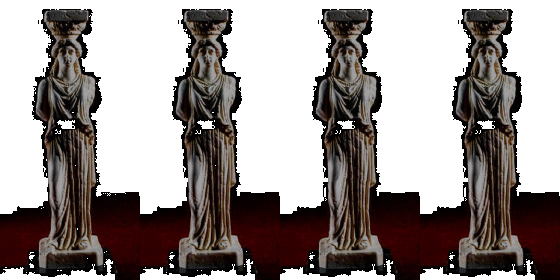 as guerras de expansão entre os Polis helênicos, os filósofos gregos, a Babilônia uma realidade que talvez ia surgir de novo, os Fenícios espalhados no Cártago e na península Ibérica, a Magna Grécia no sul da península Itálica, a Etrúria eclipsada pêlos Romanos e a Egípcia no seu declínio doce igual a morte; foi a época também do Buda na Índia, Kung fu tse na China e os Olmecs no México: a majestade da Pierrina fica bem colocada nesta companhia das ultimas grande expressões de palaiouV nomouV, o antigo complexo cultural Pan-europeu visível nos dólmen e no comercio de âmbar e estanho desde os Miceneanos e Minoanos até Stonehenge e Irlanda, que foi derrubado pela instalação de interpretação e contingência na avaliação de experiência que Aeschylus observou e descreveu no embuçalamento das Erinyes para ficassem as Eumenides, uma desgraça que constituiu a morte formal de palaiouV nomouV até que reapareceu agora junto com a mesma aplicação em Purba Wasesa da Java (Homeric and Semaric). A peça ocorre no Jardim da Beleza com flores e borboletas e vespas e abelhas. Não perca a corrida musical dos marimbondos no meio da peça.
A próxima é uma canção de amor para você,
Confused Awakening (com as letras incluídas), que saiu dos meus sentimentos apaixonados, confusos, abismados e devotados para com você em 1992. Eu acabei me rendendo para o meu amor por você mas você as vezes nem parecia que estava envolvida. Gloria, suas cores são mais escuras, e o seu tapete é um Qum de seda ou talvez o incrível Ardebil mesmo, criado por volta de 1540, ambos dos quais sempre me deixam sentindo que minha experiência não tem aberto para mim um senso ou insight de quem quer criar uma beleza tão excepcional, tão imperial, tão luxuoso. Eu sou muito mais tipo tapete tribal e sinto medo olhando os preços e agradeço o céu que meu gosto não vai na direção dos tapetes caprichosissimos, com tantos nós e tudo, da cidade. Para mim, grande parte da sua beleza é baseado em relações, laços, estabelecidas e mantidas em si, igual as formas mas ou menos arbitrarias e artificiais dos tapetes das cidades, e sobressaindo um ser Ayu escurecido por circunstancias de abuso, que até nega a importância da Realidade na definição de justiça, já que pelo menos de aparência, a Realidade (que fica confusa com a Razão) sempre parecia no lado dos tiranos, dos homens indiferentes, dos vilões da peça, com quem eu fiquei indevidamente classificado. Temerosa, você, Gloria, nos dois sentidos desta palavra, uma das melhores na Língua Portuguesa, que faz a gente lembrar de palavras como EriV na Língua Grega ou Lara Djonggrang na Língua Javanesa.Como evento cósmico, eu vejo você como retratada nesta carta para
Stephen Hawking (com um arranjo meu de Bartok opus 6 no 14), onde eu fico insistindo que física sem seres não é nada além de uma maneira de tentar enganar a Realidade (ou talvez só a humanidade). Me deixa explicar com uma das maravilhas da ciência moderna: Viagra. Se alguém consegue comprar uma paixão do tipo queima-roupa que eu tenho para você na forma de uma pílula, isso não significa que a paixão é dele, só uma expressão sem contexto, sem significado, uma maneira de enganar quem? A mulher vai pensar que você tem esta paixão? Ela sabe que é a pílula. Você? Você também sabe que é a pílula. Então, está enganado quem? Ciência ocidental na pratica é assim mesmo. Patética. Na pratica, provavelmente fica melhor se masturbar. Pelo menos assim você tem a possibilidade de se enganar em pensar que você está sozinho e que não é uma forma de afeto "en absentia".Na próxima peça,
Niyai Lara Kidul, um dos espíritos mais sagradas e mais ligadas com a Casa de Mataram (que inclui os Cortes do Pakubuwana (que agora também tem Archimperium ou "Board" na língua comum), Paku Alam, Hamengkubuwana e do Mangkunegara), faz um anti-música sagrada, onde em vez de começar com o mundano e terminar no paraíso, começa na beleza de mutualidade e procura o que interfere insistindo em ficar ansioso, medroso, desconfiado, temeroso.A próxima peça tem você como musa e é uma processão no Hall of the Padishah, como se houvesse um enorme Guild Navegator chegando, enquanto a Vossa Santíssima Majestade espera e reflete: "É bom saber tudo mas simplesmente não basta."
Depois vem
Crying, meu arranjo da obra de Roy Orbison, que retrata o processo de aceitar os sentimentos e chorar até terminar ou não. Como falem os Portugueses em Fado, "Eu já chorei milhões de lágrimas por você, mas agora eu choro por mim" já que você realmente não estava lá em nosso amor. Foi só eu e um sonho vazio, uma esperança fútil e inútil já que você nem quer saber de nada. A propósito, minha choradeira para com você ainda anda bem. Como eu falo no Site: "Lá se vem as lágrimas no horizonte."O próximo é
Nothing Compares to You que trata da rendição para o amor mesmo que não faz sentido e de maneira nenhum é conveniente.Depois vem uma canção tão simples que quando eu escrevi, fiquei sem entender por que eu não trabalhei a tema mais. A musa não foi clara e fiquei lembrando de o filme "To Kill a Mockingbird", mas a peça foi numa direção diferente e maravilhosa e me deixou deliciado. Após mas que um ano a ficha caiu e a musa apareceu em umas sweethearts minhas da Java que ficam tão doce agora como na hora eu conheci elas lá em 1978. O nome da peça é
Lara Djonggrang -- My love for Wistiani, Ndari, Indah and Hermin, my sweethearts forever and ever. Por exemplo, a Wistiani foi minha professora de Javanês e minha aluna de Inglês e eu foi o professor de Inglês e o aluno de Javanês dela. Adorei ela igual um preadolescente, e ela me levou para conhecer a sua Avó. Quando a gente saiu de Solo as 5:00 da manha em Julho de 1980, ela foi até a estação de trem para me dizer "adeus". Não adiantou. Deixei meu coração com ela, e ela ainda está comigo, sendo a musa principal desta musica.As outras peças que seguem fazem comentários variados vindo de uma perspectiva mais ou menos romântico e incluem meus arranjos de obras de
Debussey, Ravel, Annie Lennox, Led Zepellin, Phil Collins and Rachmaninov. Eventualmente tem uma peça da Indonésia que eu arranjei e chamei: "Sayang -- Hopeless: I know I shouldn't love you but it really doesn't matter."Chegando no final, tem Wasp Honey (Mel de Marimbondo) que eu acho incrivelmente bonita sem poder explicar o porque. Aqui tem uma
versão anterior que dá uma idéia. E aqui tem uma versão bem mais adiantado.Finalmente tem mais uma processão no Hall of the Padishah.
Love veiled in tears,
David, now also known as
QanatoV, Mahabhairawa ana ing Mahabhairawi, Mahamara, Mahakarana, Mahasiwarupa, Mahasiwagni, Pakubuwana Kepala Perang XV., Tuat, High King of Tara, Scarab de Clare, Earl Palatine of Pembroke, Tjara, Gunung Mataram, King of England, King of Rome, Supreme Head in Earth, Tjinggis Ka'an, Wu T'ai, Buda Mahakala, Mangkuwana and NemesiV.