THE THIRD HITTITE EMPIRE
An Alternate History Timeline
by Robert Perkins
PART NINE: 600-700 AD
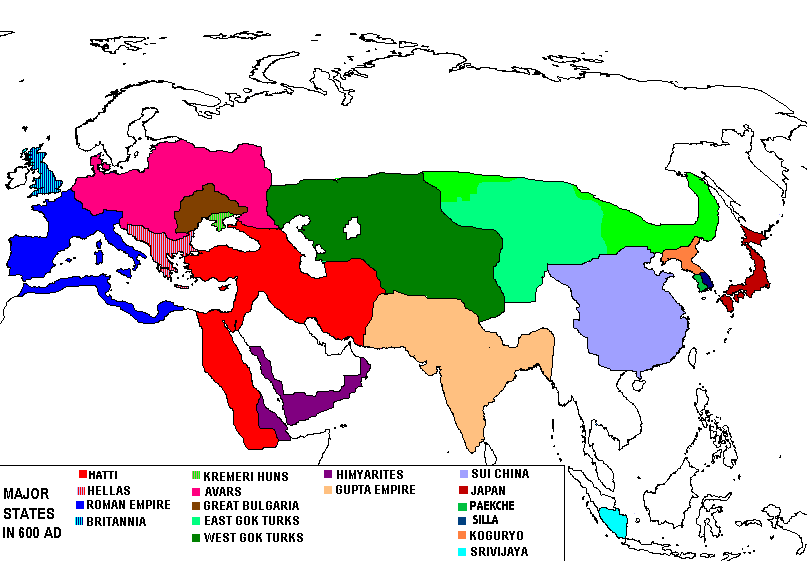
c. 600 AD onward--The continuing impact of the destruction of the Marib Dam, among other factors, has lead to the gradual breakup of the Himyarite Kingdom into several competing city states. These cities still officially acknowledge the authority of the Himyarite King, but in fact are independent in all but name.
600 AD onward--Beginning of the Scientific Revolution in the Hittite Empire. As mentioned previously, the rise of the Universities and the growth of private libraries among the bourgeoisie of the Hittite Empire has stimulated learning. This, combined with the decimation of the population by the Yellow Plague (and later the Second War of Religion) leads various inventors to begin creating labor-saving devices which will eventually revolutionize the world. Progress will be slow at first, but will accelerate as time goes on.
600 AD--The Pallava Dynasty, which has ruled the city of Kanchi in southern India as vassals of the Gupta Emperor for centuries, asserts it’s independence from the Gupta Empire. Over the course of the next few decades they will expand their rule over all of southern India. Also at this time, Buddhist texts are translated into Tibetan, and Muhammad returns to his home in Mecca after completing his studies at the seminary in Damascus. He begins preaching in protest of the Yahwist persecutions of Christians in the region, while also, gradually and without his conscious knowledge, being influenced by those same Yahwists.
c. 600 AD--The stirrup, which had been invented in northern China about 320 AD, is introduced as standard equipment for the Hittite cavalry after Hittite merchants and diplomats bring back reports of it’s use in Chinese armies. This gives Hittite cavalry a great advantage over that of the neighboring peoples.
601 AD--Death of King Hili III of Hatti. He is succeeded by his son, who reigns as King Muwatalli VI. Muwatalli is not the statesman his father was, and at the death of King Hili, the fragile peace between the different religious factions within the Hittite Empire begins to crumble. Within a year, full-scale civil war has broken out...The Second War of Religion. Also in this year, the Gok Turks under the command of Tardu lay siege to China's capital at Chang-an (Xian).
602-620 AD--The Second War of Religion. A fragile peace between the various
religious factions within the Hittite Empire which had existed through the
long reign of King Hili III crumbles at his death. His son, Muwatalli, is a
fervent Kuruntite Christian, and has none of his father’s tact when dealing
with leaders of other religious factions. His heavy-handed discrimination
against the other sects and religions in the Hittite realm leads to the
outbreak of revolt within months of his succession to the throne, and within a
year, to full scale civil war. The war rages for 18 years, and almost destroys
the Hittite Empire. Two Great Kings of Hatti will be overthrown in the course
of these bitter civil wars, and many other members of the royal family will be
killed. Finally, in 618 AD, King Tuwatis III comes to the throne. The new King
is no zealot when it comes to religion, and has a gift for reaching what seem
to be unreachable compromises. Furthermore, he cultivates the support of the
educated bourgeoisie within the empire by promising political reforms,
including a written constitution guaranteeing greater political freedom within
the empire and the guarantee of basic liberties to the people of the empire.
The bourgeoisie throw their support behind the new king, and with their aid,
Tuwatis is able to bring the various factions to the negotiating table, ending
the civil war, in 620 AD. Over the course of several months of often heated
negotiations, a constitution is hammered out. The Great King agrees to share
power with a legislative body, called the Council of 400, which will be
composed of representatives elected by the various provinces of the Empire,
with the Hittite Provinces to hold half the seats, and non-Hittite provinces
to divide the remaining half. The Council will have the right to review and
veto new taxes and other legislation proposed by the Great King, as well as
approve or disapprove of declarations of war. The Council also gains the power
to approve or disapprove any amendments to the constitution itself. For the
first time, the rights of the people are specified and enshrined in the
constitution itself. The Great King retains the right to conduct foreign
policy, to propose new taxes and legislation and to spend state revenues. The
document enshrines two key principals...freedom of religion and separation of
church and state...as central features of the new regime. Religious liberty
will be guaranteed to all, and no sect will be favored over others. The new
document will stand the test of time, and will come to be a model which many
future nations will emulate.
602 AD--Tibet is unified under Namri Songsen. Bayan, Khagan of the Avars, dies. At his death, the Avars fall to bickering among themselves, and several weak Khagans will rise to power over the next 180 years. In the meantime, the surrounding states enjoy an interval of relative peace. Not complete peace, to be sure...even under relatively weak Khagans, the Avars will still manage to pursue some aggressive action over the ensuing period.
603 AD--Death of the Emperor Rama Gupta II of India. He is succeeded by Chandra Gupta V.
604 AD--Prince Shotoku issues a Chinese-style constitution (Kenpo Jushichijo), based on Confucian principles, which de facto inaugurates the Japanese empire. Also in this year, the Emperor Wen Ti of China dies, and is succeeded by Yang Ti.
605 AD--King Muwatalli VI of Hatti is overthrown by his cousin, who reigns as
King Hantili V. Hantili is an able schemer and plotter, but a total failure as
a ruler, and the civil war rages on. Also in this year, Prince Shotoku
declares Buddhism and Confucianism the state religions of Japan. Emperor Yang
Ti of Sui China orders the capital moved from Chang-an to Luoyang. Also in
this year, a violent storm shatters Mecca's Kaaba, a cube-like structure
housing a shrine to inter-tribal Arabic pagan gods. Since Mecca was in the
crossroads of major international trade routes, the Kaaba and its precincts
also served as a place of sanctuary for caravan pagan worship, tribal and
tradesmen poetry contests, and an oracle. The Kaaba also represented the solar
system, for it housed a zodiac "machine" of daily shrines that
consisted of over 360 idols, each of which was probably a symbol representing
a complex astronomical relationship between each day of the year, the months,
and survival rituals tied to seasonal events. Also housed in the shrine is a
piece of black meteorite which has been held sacred by the pagans in the
region for centuries. Some of the locals believe that this stone has the power
to cleanse worshippers of their sins by absorbing them into itself. The city
elders violently disagree on who should replace the sacred black stone into
the east wall of the Kaaba. After much debate, they take an oath that the next
person to enter the gates will do so, and this happens to be none other than
Father Muhammad, one of the local Christian priests. Muhammad declares that
the black stone has no power to absorb sin on it’s own, but is a
representation of the power of redemption through the sacrifice of Jesus
Christ. Therefore, Muhammad agrees to replace the stone, but only on one
condition...the pagan idols must be removed and destroyed, and the shrine
rededicated as a Christian Church. The city elders, most of which are pagans,
are very upset by this demand, but they are bound by their oath, and do as
Muhammad commands.
605-611 AD--The Emperor Yang Ti of China builds the Grand Canal. This will be one of the greatest engineering projects in human history. The canal will stretch an astounding 1,115 miles, and in many places it will be over 100 feet wide, with the sides faced in stone. The canal will also be spanned by many fine stone bridges. The project will consume six years and require the work of no less than 3,000,000 laborers. The resentment caused by the tyrannical methods used by Yang Ti to accomplish this project will lead to the fall of the Sui Dynasty shortly after his reign.
606 AD--Sapalume, a Hittite inventor working at Kanesh, invents the first successful mechanical reaper. He finds a ready market among landowners who have seen their agricultural labor forces decimated by plagues and warfare over the past century.
607 AD--Shotoku builds the Buddhist temple Horyuji in the Asuka valley in
Japan. Also in this year, word of Muhammad’s exploit in converting the Kaaba
at Mecca into a Christian shrine reaches Hattusas. The Kuruntite Archbishop of
Hattusas, generally held to be the head of the Kuruntite Church, names
Muhammad as the Bishop of Mecca.
610 AD--In the preceding years, Bishop Muhammad of Mecca has taken to spending nights of meditation in a cave on Mount Hira, north of Mecca. One night, he has a vision of the Archangel Gabriel, who gives him a cryptic message..."Read in the name of your Lord the Creator. He created man from something which clings. Read and your Lord is the Most Honored. He taught man with the pen; taught him all that he knew not." Muhammad is deeply disturbed by this vision, and when he returns to Mecca, he discusses it with a close friend, a rich widow by the name of Kadijah (Kadijah had, fifteen years before, fallen in love with Muhammad and offered him marriage, but because Muhammad had taken vows of celibacy upon his ordination as a Christian priest, he had rejected her offer. Kadijah remained a very close friend and confidante of Muhammad, however, and has never married since) who was one of his first converts to Christianity. Kadijah convinces Muhammad that the vision is true, and offers him an interpretation...perhaps Muhammad is supposed to take a more active part in spreading the Word of God among the pagans and Yahwists of the area? Perhaps by translating the Bible into Arabic, and by bringing a printing press to Mecca, so the Word of God can be distributed to the masses? Upon reflection, Muhammad agrees that this is what it must mean. He begins making preparations to carry out the wishes of the Archangel Gabriel. Also in this year, the Avars invade Italy. They are defeated by the forces of the Roman Emperor Decimus I and forced to retire to their own lands.
611-613 AD--Bishop Muhammad travels to Hattusas, to confer with the head of the Kuruntite Church, regarding the vision he had of the Archangel Gabriel on Mount Hira. Archbishop Kuzi agrees with Muhammad’s interpretation of the vision, and agrees to finance the project. Muhammad works with a team of scholars over the next two years in translating the Bible into Arabic, and with his assistance, a printing press capable of printing in the most widely used Arab alphabet is produced, which accompanies him back to Mecca.
612-614 AD--War between Sui China and Koguryo. Emperor Yang-ti of Sui China with 1 million troops invades Koguryo in 612 AD, but Korean General Ulchi Mundok after several months pushes the Chinese into a retreat. In one of the battles between Koguryo and the Sui Chinese, the Koreans ambush the Chinese at the Sulsa river leaving only 2700 Chinese alive out of 300,000 troops. Repeated invasions in 613 and 614 AD fare no better. Combined with resentment over the harsh measures used by Yang Ti to accomplish his public works projects, the defeats in Koguryo will spell the doom of the Sui Dynasty. A new dynasty, the Tang, soon arises in Chang-an and begins to challenge the Sui for supremacy in China.
612 AD--First inscriptions in the Khmer language in Cambodia. Also in this year, inspired by the success of the Sapalume reaper, another Hittite, Piyamaradu, invents a mechanical threshing machine. It too, finds a ready market.
614 AD--Bishop Muhammad’s printing press in Mecca is producing Arabic Bibles in large numbers. Muhammad establishes a school where local people are given Bibles and taught to read. The number of Christians in the region increases dramatically as a result, drawn primarily from the pagan minority population. The Yahwist majority views these developments with deep suspicion.
617 AD--Death of the Emperor Yang Ti of China. He is succeeded by Kung Ti.
618 AD--King Hantili V is overthrown by his cousin (and son of Muwatalli VI), who reigns as King Tuwatis III. Tuwatis will be known as "The Peacemaker," and his wise policies will end the Wars of Religion in the Hittite Empire. Also in this year, Li Yuan overthrows the Emperor Kung Ti of the Sui dynasty and becomes the first Tang emperor of China, with his capital in Chang-an. He reigns as the Emperor Kao Tsu.
619-626 AD--Avar invasions of the Republic of Hellas. The
Greeks mobilize the recently settled Slavic tribes (Serbs and Croats) to their
aid, and also call for assistance from the Hittite Empire (which, despite
being in a state of civil war at the time, renders some limited aid). Thus
bolstered, the Greeks manage to repel the Avars and maintain their border on
the Danube. However, the invasions are quite destructive, and Hellas will be
quite some time in recovering.
622 AD--Death of Roman Emperor Decimus I. He is succeeded by his son, Marcus
Gnaeus Strabo, who reigns as the Emperor Marcus II. Also in this year, the
success of Bishop Muhammad in making conversions to Christianity has the local
Yahwists deeply concerned, and they riot outside his church (the Kaaba) in
Mecca. The Yahwist mob invades Muhammad’s print shop (next door to the
church), kills the printers and destroys the press. They then enter the church
itself, looking for Muhammad. Muhammad, however, escapes and flees to the city
of Yathrib (OTL Medina). Muhammad finds that Yathrib is a divided city.
Different clans and religions are eternally quarrelling and bickering there.
Muhammad offers to act as a mediator, all parties agree to a pact drawn up by
Muhammad and his followers, and Muhammad brings unity to the city. Most of the
tribes in the city convert to Kuruntite Christianity, and Muhammad is chosen
by the city elders to be ruler over the city. This, of course, angers the
Yahwist tribes among the city population, who withdraw from the city. Joining
with their compatriots in Mecca, the Yahwists begin to war against Muhammad
and Yathrib.
622-630 AD--War between Mecca and Yathrib. The Yahwist tribes of Mecca and the surrounding area make war on Muhammad’s Christian city of Yathrib. Muhammad declares a Holy War, and over the next eight years, a series of see-saw campaigns takes place.
In 624 AD, a pivotal event occurs which will have dramatic impacts on future history. In that year, word of the activities of Muhammad, who has been engaging personally in battle with his Yahwist foes in Arabia and has personally shed blood...which is forbidden to priests of the Kuruntite Church...reaches Archbishop Kuzi in Hattusas. Kuzi issues a decree which effectively de-frocks Muhammad and orders him to come to Hattusas, there to present himself for trial. When word of this edict reaches Muhammad, he flies into a rage, and shortly afterward has another "visit from the Archangel Gabriel," who tells him to throw off the authority of the Kuruntite Church, and establish the One True Church. Declaring his surrender to the Will of God as expressed by the Archangel Gabriel, Muhammad declares that henceforward, his church will not acknowledge the authority of the Archbishop of Hattusas, and will function as a separate entity under the direction of Muhammad. Muhammad will have other visions of the Archangel Gabriel over the years which will lead him to make some doctrinal changes for his newly independent church as well, creating, in essence, a new faith. Although Muhammad himself does not promote this, his followers gradually begin to use a new term...Islam, meaning "submission to God"...in referring to their faith, and to call themselves "Muslims," meaning "those who have submitted."
As the war goes on, Muhammad’s armies brutally attack several Yahwist tribes, with the worst such incident being the massacre of the Banu Qurayza in 627 AD. Other Yahwist tribes are forced to convert to Christianity or are exiled. This finally breaks the back of the Yahwist resistance, and Muhammad takes Mecca itself in 630 AD. He cleanses the Kaaba, which had been defiled by the Yahwists, and re-dedicates it as a centre of Christian worship. Muhammad calls on the Yahwists of Mecca to convert, but desiring to end the war, offers amnesty and protection to those who will not, with those Yahwists who will not convert being allowed to practice their religion in peace upon payment of a poll tax. The majority of the Yahwists convert to Christianity, and Bishop Muhammad honors his agreement with the remainder.
625 AD--Pulikesin declares the independence of the Chalukyan kingdom from the Gupta Empire. He expands the rule of his own dynasty throughout central India.
626 AD--The Avars invade Hellas again, but are decisively defeated at Byzantium.
627 AD--The Emperor Kao Tsu of Tang China is deposed and the throne is usurped by his brilliant son, Li Shih-min, who reigns as the Emperor T’ai Tsung. T’ai Tsung will have an enormously successful reign, and among other accomplishments, will establish the system of civil service examinations, based on the Confucian Classics, which will choose Chinese bureaucrats for many centuries to come. He will also establish law and order in China to such an extent that it will be un-necessary for people to lock their doors at night, and items lost on the road will remain untouched by others. He will become, in the eyes of later Chinese, the very epitome of what an Emperor should be, and the model against which all future Emperors are measured.
627 AD onward--Emboldened by the stinging defeat inflicted on the Avars by the Greeks at Byzantium, revolts flare up throughout the Avar Empire as native peoples throw off the Avar yoke. The weak Avar Khagans of the period are unable to re-establish control, and by the end of the century, the Avar Khagans rule only a small area in the plains of south-central Europe. In the other former Avar lands, a patchwork of small, squabbling states arises, essentially leaving a power vacuum over much of the area as Romanized Germans, remnants of un-Romanized Germanic peoples such as the Goths, as well as Alans, Slavs, and other native peoples vie for control. Powerful local landowners and warlords revive the semi-feudal system which had begun to appear in the latter stages of the old Roman Republic and which had never totally disappeared during the time of Hunnic and Avar rule, fortifying their lands and raising private armies, with those less powerful surrendering their lands (sometimes voluntarily, often not) to the grandees and working as tenant farmers in exchange for protection.
629 AD--The Chinese monk Xuanzang (Huang Tsang) travels to
India. Tibet expands to Nepal under Songsen Gampo. The Chinese Tang, at the
order of Emperor T’ai Tsung, begin anti-Turk campaigns. The eastern Gok Turk
Kaganate is defeated by the Tang Chinese.
630 AD--The western Gok Turk Kaganate is defeated by the Tang Chinese and breaks up, with many of the subject tribes declaring independence. One of these is the Khazars, a nomadic Turkish-speaking tribe which emerges from the break-up of the western Gok Turkish empire and settles in southern Russia with capital at Balanjar (Verkhneye Chir-Yurt). Also at this time, Songsen Gampo of Tibet introduces Buddhism to Bhutan.
630-632 AD--Muhammad leads his Christian armies against the other tribes of Arabia and forces them into submission. By early 632, most of Arabia is under his rule.
632 AD--Archbishop Muhammad of the Islamic Church, as it has come to be called, dies. He is succeeded by his close friend and ally, Abu Bakr. He takes the title of Caliph (Successor). Unlike in OTL, there is no schism within Islam at this time and no equivalent to the "Shia" movement arises within Islam. This is because Muhammad, who until the end of his life maintained his vows of celibacy and never married, thus had no daughters, and his cousin Ali never became Muhammad’s son-in-law. Thus, no faction ever grew up around Ali based on his marriage to the Muhammad’s daughter, which never happened in the ATL, and thus no "Shia" movement. Ali will, however, because of his blood relation to Muhammad and the role he played in Muhammad’s victories, still have a claim to the Caliphate which will eventually lead to his succession to that office later in the century. Abu Bakr begins planning to attack the "heretics" (as he regards them) to the north.
633 AD--The Islamic Caliph, Abu Bakr, leads an Arab army north into Mesopotamia. The fanatical Arab warriors defeat the Hittite army outside Babylon and overwhelm Hittite resistance in the region within a year.
634-635 AD--In 634 AD, Caliph Abu Bakr leads an Arab invasion of the Hittite provinces of Israel and Syria. In Israel, the Hebrews (having heard of the massacres of Yahwists carried out by Muhammad during the war between Mecca and Yathrib a few years earlier, and having been granted complete religious freedom by the new Hittite King Tuwatis III, rally behind the Hittites, and the Arabs are repulsed. Abu Bakr is killed in battle outside of Jerusalem in late 634, and is succeeded as Caliph by Omar ibn al-Khattab. Caliph Omar leads a second invasion of the region the following year, but is no more successful.
636-650 AD--Caliph Omar, following the defeats of the attempted invasions of the Hittite provinces of Israel and Syria, decides to expand the Caliphate eastward, a policy which his successors will continue. Moving from Mesopotamia, Arab armies sweep into Persia, where they defeat all resistance and conquer all the way to the Oxus and Indus Rivers by 650 AD.
640 AD--The Khazars introduce a system of dual kingship (khagan and bek). The Khagan is the supreme political ruler, the Bek is the supreme military ruler.
642 AD--Naval fighting in the Red Sea between Hittite and Arab fleets goes decisively against the Hittites, allowing the Muslims to establish control over the Red Sea.
643 AD--Buddhist pilgrim Hiuan-tsang (Xuanzang) brings Sanskrit manuscripts from India to China.
643-650 AD--Arab armies, transported by sea, invade the Hittite provinces of Egypt, Kush, and Axum. All Hittite resistance in these provinces is defeated by 650 AD.
644 AD--Caliph Omar is murdered, and is succeeded by Uthman ibn Affan.
645 AD--Prince Shotoku is succeeded by Kotoku Tenno, who
strengthens imperial power over Japanese aristocratic clans (Taika Reform),
turning their states into provinces. The Hittites, forced out of Egypt, begin
constructing strong defensive lines across the desert from the Gulf of Aqaba
to the Red Sea. Defenses along the entire southern and eastern borders of the
empire will be strengthened over the next few decades.
647 AD--The Gupta Emperor Chandra Gupta V is defeated and killed in battle by
the Chalukyas (based in Karnataka) at Malwa (central India). With his death,
the power of the Guptas is broken, and the Gupta Empire falls apart. Northern
India collapses into a patchwork of small, competing states, dominated (but
not directly ruled by) the Chalukyas.
648 AD--Recognizing the threat which is materializing on his eastern border as the Hittites are kicked out of Egypt, Emperor Marcus II of Rome negotiates a treaty of alliance with King Tuwatis III of Hatti against the Arabs. Marcus, who is a devout follower of the Roman Orthodox brand of Christianity, is encouraged in taking this action by the new Hittite religious toleration laws, which guarantee protection to followers of Roman Orthodoxy within the Hittite Empire (relations between the Roman Empire and Hatti had considerably chilled during the Wars of Religion, when the dominant Kuruntites had viciously persecuted their Roman Orthodox brethren). But the treaty comes too late for the Hittites in their African provinces...the Arabs succeed in establishing complete control there before the Romans can effectively intervene.
650 AD--The Pallavas, ruling from their capital at Kanchipuram (Tamil Nadu), are defeated by the Chalukyas and forced to abandon their capital. The Tang dynasty extends the boundaries of China west into Afghanistan, north into Siberia, east into Korea and south into Vietnam, golden age of art and literature (ideal of the universal man, combining the qualities of scholar, poet, painter, statesman). Also in this year, the Emperor T’ai Tsung of Tang China dies, and is succeeded by his weak-willed son, Li Chih, who reigns as the Emperor Kao Tsung. Kao Tsung is seduced by one of his father’s concubines, Wu Mei, who effectively rules as the power behind the throne.
650 AD onward--Wars between the Arabs and the Roman Empire. Shortly after subduing the Hittite provinces of Egypt, Kush, and Axum, Arab armies move west, invading the Roman Empire’s African provinces. By the end of the century, Roman control is limited to a few heavily fortified cities on the northern coast such as Carthage and Tingis.
651 AD--The Tang Chinese destroy the vestiges of the Western Khaganate of the Gok Turks.
655 AD--Hittite invasion of Egypt. Roman Emperor Marcus II has called for aid from his Hittite allies, and King Tuwatis III sends an army into Egypt in an attempt to relieve some of the pressure on his ally. The Hittites are defeated near Pelusium, however, and retire to Palestine.
656 AD--Caliph Uthman is murdered, and is succeeded by Ali, a cousin of Muhammad.
657 AD--Jayavarman I founds the Khmer dynasty in Cambodia.
658 AD--Death of Roman Emperor Marcus II. He is succeeded by his son, Gaius Flavius Strabo, who reigns as the Emperor Gaius II.
660 AD--Death of King Tuwatis III "the Peacemaker" of Hatti. He is succeeded by his son, who reigns as King Wasuruma IV. In Damascus, a Greek inventor named Kallinikos invents a highly inflammable liquid substance which burns even in water and cannot be extinguished. He demonstrates this, along with a pumping device which he invents as a projector for the inflammable liquid, before king Wasuruma IV of Hatti, who is very impressed. Wasuruma orders projectors for the new substance, called "Fire of Kallinikos" in honour of it’s inventor, incorporated into the defenses of Hittite fortifications as well as mounted onto Hittite warships.
661 AD--Mu’awiya ibn Abi Sufyan, chief of the Ummayad clan and a relative of the murdered Caliph Uthman, revolts against the rule of Caliph Ali. Ali is killed in battle against Mu’awiya’s forces later that year, and Mu’awiya declares himself the new Caliph. Mu’awiya has Ali’s sons, Hassan and Hussein, murdered forthwith, and the rest of Ali’s family hunted down and killed as far as they can be found. There is some outrage at these acts among the population, but Mu’awiya is able to maintain control and establish his dynasty, which will hold the Caliphate for the next century.
668 AD--Death of King Wasuruma IV of Hatti. He is succeeded by his son, who reigns as King Arnuwanda VII. Also in this year, the Korean kingdom of Silla, with the help of the Tang Chinese, conquers Koguryo and Paekche, thereby uniting the whole of Korea, with their capital in Kyongju. Also in this year, the Khazars destroy the kingdom of Great Bulgaria, killing Khan Kubrat in the process. The Khazars then drive the Bulgars westward and northward. Some settle along the central Volga River, where they become the Volga Bulgars. The others, under their new Khan Asparukh, head toward the Danube.
669-690 AD--Arab invasions of Anatolia. Caliph Mu’awiya and his son Yazid launch nearly annual invasions of the Hittite homeland in Anatolia. These are, more often than not, defeated near the border by the Hittite armies, often with the aid of the recently introduced "Fire of Kallinikos." But some manage to break through Hittite defenses and penetrate far into Hittite territory, where they cause much damage.
670 AD--The Pallavas build a new capital city at Mamallapuram. Also in this year, a Hittite merchant named Hapalsulupis brings back to Hatti the formula for a mysterious substance he saw used in certain celebrations in China. The mysterious powder...a mixture of nitrates, sulphur, and charcoal...makes a loud noise when fire is applied to it, and is even capable of shattering the heavy jars in which it is being held. It is viewed as an oddity, with no immediate practical applications beyond use in celebrations.
673 AD--Death of Roman Emperor Gaius II. He is succeeded by his son, Flavius Septimus Strabo, who reigns as the Emperor Flavius I.
680 AD--Death of Caliph Mu’awiya. He is succeeded by his son, Yazid. Yazid will continue his father’s campaigns against Hatti.
681 AD--The Bulgars under Kubrat's son Asparuch cross the Danube. They defeat the army of the Republic of Hellas near Pella, and occupy all of Thrace and parts of Macedon. The Republic of Hellas will be unable to expel them, and will shortly sign a treaty formally ceding the area to the Bulgars.
682 AD--Elterish rebels against the Tang Chinese and founds
a second Gok Turk Khaganate in the East.
683 AD--The Khazars raid Armenia and Georgia. King Arnuwanda VI of Hatti is killed in battle against them, but succeeds in repelling them from Hittite territory. He is succeeded by his son, who reigns as King Hattusili IV.
684 AD--Death of the Emperor Kao Tsung of Tang China. He is succeeded by his son by Empress Wu Mei, Li Che, who reigns as the Emperor Chung Tsung. However, Empress Wu Hou is still the power behind the throne, and within a month she deposes him in favor of his younger brother, Li Tan, who takes the throne as the Emperor Jui Tsung. Jui Tsung lasts a bit longer on the throne than his elder brother, but before the end of the year Empress Wu Mei deposes him as well. From then on, she will rule directly, first as regent for her deposed sons (who she does not murder, but sends into seclusion), and then, eventually, in her own name. Her reign will be characterized by Machiavellian cleverness and brutal despotism as she ruthlesses suppresses her opponents in the royal family and the nobility.
686 AD--The Srivijaya kingdom expands over Sumatra (Indonesia) and the Malay peninsula. The Mongolian tribe of the Kitan from Manchuria raid China.
690 AD--Empress Wu Mei throws off all pretense of ruling in the name of her sons and declares herself Emperor of China, changing her name to Wu Chou. She declares the establishment of the Chou Dynasty. Also in this year, Caliph Yazid is killed when he is sprayed with "Fire of Kallinikos" as he besieges the city of Azatiwataya in Anatolia. His horrifying death takes the heart out of the Arabs, who retreat in disorder. Pursued by the Hittite main army, the Arabs are caught and decisively defeated as they attempt to retreat across the Euphrates. Yazid’s successor, Mu’awiya II, witnessed his father’s gruesome death, and, perhaps taking this as an omen, takes a far less aggressive stance vis-a-vis Hatti. Hatti will enjoy a period of relative peace as a result.
691-695 AD--Abd al Malik ibn Marwan, the head of a secondary branch of the Ummayad clan, leads a revolt against Caliph Mu’awiya II. Mu’awiya is defeated and killed in battle near Yathrib in 695 AD, and Abd al Malik assumes the Caliphate. Abd al Malik’s reign is spent mostly in finishing the conquest of north Africa from the Romans (except for Carthage and Tingis). He continues to follow a relatively peaceful policy vis-a-vis Hatti, although there is some minor cross-border raiding.
694 AD--Khapghan extends the Gok Turk empire over Transoxania, thus unifying eastern and western Turks for the first time in over a century.
699 AD--Aristobulos of Ephesus, a Greek inventor living in the Hittite Empire, puts together several ideas which had been put forth by earlier inventors over the past several centuries and designs a workable steam engine. It is sold initially to mine owners who need it to pump water out of their mines. It is a very inefficient engine, but other inventors will refine the design over the next century.
Copyright 2005 by Robert Perkins. All rights reserved. Last updated 11 September 2005.