THE THIRD HITTITE EMPIRE
An Alternate History Timeline
by Robert Perkins
PART EIGHT: 200-100 BC
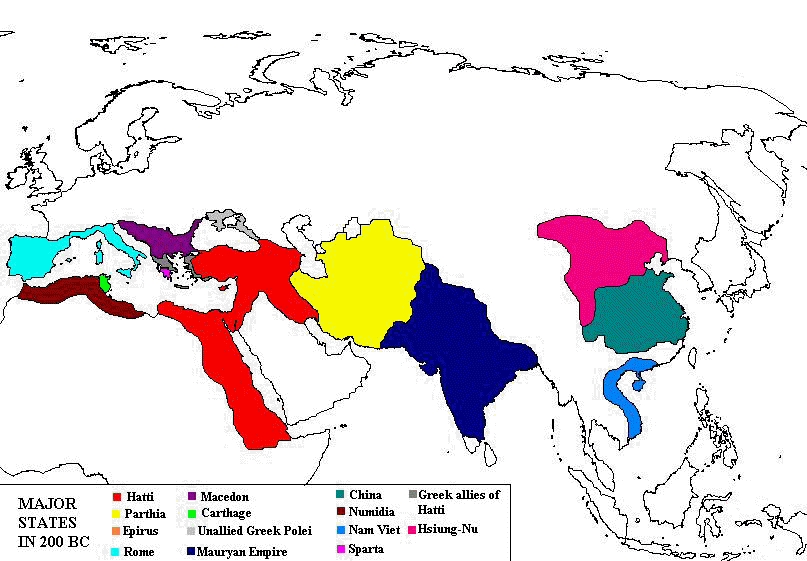
c. 200 BC--The Buddhist missionaries sent out by Mauryan Emperor Ashoka are making converts in Central Asia, China, and southeast Asia. They are not making much headway in India itself, however, where Hindu extremism still prevents the growth of other religions in the region. Also at about this time, Germanic tribes (which had entered Scandinavia as early as 2,000 BC and had been living in northeastern Germany as early as 1,000 BC), begin moving to the south and west, where they come into conflict with the Celtic peoples currently inhabiting those areas.
200 BC - Destruction of Roman town of Placentia by confederation of Gallic tribes (Insubres, Cenomani and Boii). Also in this year, the Hsiung Nu lay siege to the Han Chinese Emperor at Pincheng; he barely escapes.
200-197 BC--First Macedonian War. Rome has not forgotten that Phillip IV of Macedon allied himself to Hannibal, and in 200 BC, they take their revenge. Roman armies invade Macedon, and over a three year period, Macedon is defeated. Cumbersome Macedonian Phalanxes are defeated repeatedly by flexible Roman legions, culminating in the battle of Cynoscephalae in 197 BC. After this disaster, Phillip IV sues for peace, and the Romans grant it, imposing harsh terms...Phillip’s empire is stripped from him, and he remains king only in Macedon proper. He is required to pay 1000 gold talents to Rome, and disband his navy as well as most of his army. Rome annexes the northern and eastern provinces (Illyria, Istria, Thrace) and restores independence to Epirus.
197-133 BC--The Spanish Wars. In the aftermath of the Second Punic War, Rome annexed the former Carthaginian provinces in the Iberian Peninsula. After the war Rome divided Spain into two provinces, known as Hispania Citerior (Near Spain) and Hispania Ulterior (Far Spain). Both of these provinces are rich in silver and other precious metals, and their governors do not hesitate to extort extra wealth from the local inhabitants. During the Second Punic War the native tribes (such as the Celtiberians, the Turdetani, the Lusitanians, and others) had vacillated between supporting the Carthaginians and the Romans. Now they turn fully against the Romans. Supported by cavalry and armed with javelin, sling, and short stabbing sword and wearing light armor, these fierce and valiant peoples prove a major threat to Roman power in Hispania. The result is an ongoing campaign of attrition, atrocity and massacre that will be an like an ulcer, consuming a major portion of Roman resources for over sixty years, until the Romans finally subdue the last of the native tribes in 133 BC.
200-195 BC--In Carthage, Hannibal Barca becomes Suffete and proves a successful political leader. He forces state reform, reducing corruption and introducing new methods of election. He also initiates programs to improve agriculture and increase trade with Greece, north Africa, and Hatti in an effort to increase state revenues. But Hannibal’s reforms lead the Romans to suspect that he is planning a Carthaginian resurgence aimed at Rome, and Hannibal is forced into exile in 195 BC.
198 BC--Death of King Suppiluliuma V of Hatti. He is succeeded by Anitta II.
198-134 BC--The Han Chinese Emperors give the Hsiung Nu gifts & princesses in exchange for peace. It doesn’t always work.
188 BC--King Agesipolis III of Sparta concludes a treaty of alliance with Rome, aimed at both Macedon and Hatti.
195 BC onward--The annexation of Macedon’s imperial territories means that Rome now has a coastline on the Aegean and the Black Sea...directly opposite the Hittite coast. This does not make the Great King of Hatti happy. Until now, Rome has been a distant rumour on the horizon, but now it poses a clear and imminent threat. Furthermore, the ease with which Rome’s flexible legions pummeled the Macedonian Phalanx in the recent war serves notice to the Hittites that their own army...which organized around a Macedonian-style infantry Phalanx...is in danger of being rendered obsolete. Therefore, in 195 BC King Anitta II of Hatti sends agents in search of Hannibal Barca, the former Carthaginian general who gave Rome so much trouble during the Second Punic War. Hannibal is now a fugitive, on the run from Roman vengeance, and he eagerly accepts the Great King’s offer of protection and employment when he is located by the Hittite agents. The agents bring him to Hatti, where King Anitta hires him to reorganize and retrain the Hittite army to fight that of Rome. Hannibal is very familiar with the Roman legionary system of organization (having observed it in action over so many years), and oversees the reorganization, re-equipment, and re-training of the Hittite infantry according to that system. Hannibal is very impressed with the Hittite cavalry...always the strongest part of the Hittite army...and makes very few changes in it’s organization or equipment. He also retains the corps of foot archers, recognizing the advantage of fire support they provide to the heavy infantry. At Hannibal’s suggestion, Hittite warships are also modified so as to be better able to meet Roman ships on even terms in battle. In order to prevent the Roman Corvus from being deployed effectively against Hittite ships, the decks of Hittite warships are covered with a thin plate of iron...this will prevent the iron spike of the corvus from fixing itself into the deck, thus binding the ships together and allowing boarding to occur. A complement of marines and archers is also added to the crews of the Hittite vessels.
195 BC--In the aftermath of the recent war between Rome and Macedon and the news of the signing of a treaty of alliance between Sparta and Rome, the independent city states of the Greek mainland which are allied to Hatti begin to feel threatened by Roman power. The Greek cities, lead by Athens, appeal to King Anitta II of Hatti for an amendment to the treaty of alliance between them to extend Hittite protection against Rome and Sparta as well as Macedon. King Anitta agrees, and a new treaty is signed before the end of this year.
197 BC--The coalition of Gallic tribes who destroyed Placentia is defeated by two Roman armies.
191 BC--Death of King Artabanus I of Parthia. He is succeeded by Priapatius. Also in this year, the Boii (a Celtic tribe living in northern Italy) are defeated by a Roman army under P. Cornelius Scipio Nasica, son of Gn. Scipio and cousin of Scipio Africanus. The Boii drift north into the Danube regions, where one of their settlements will eventually be known as Bohemia.
191-185 BC--The Ligurian Wars, in which Rome subdues the piratical Ligurians and Celts of northwestern Italy and southeastern France, who had been raiding Roman towns and shipping in the region.
189 BC--Death of King Agesipolis III of Sparta. He is succeeded by Leonidas III. Leonidas has ambitions for expanding Spartan power in Greece, and the new alliance between Sparta and Rome will give him the encouragement he needs to act...
187 BC--Death of King Anitta II of Hatti. He is succeeded by Huzziya III.
187 BC-320 AD--The collapse of the Mauryan Empire in India leads to a "Dark Age" from the point of view of rulers and politics. India breaks up into small, warring states, whose rulers leave little record of themselves. However, the period is a golden age for art, literature, and commerce. For example, the 1st century AD will be a period of active sea trade with the West, with fleets sailing annually from the Red Sea and Persian Gulf ports of the Hittite Empire to India.
185-175 BC--The War for Hellene Freedom. In late 185 BC, King Leonidas III of Sparta declares war on Athens and invades Attica, laying siege to the city. The Athenians immediately invoke their threaty with Hatti and the other independent Greek states, and King Huzziya III of Hatti sends an army under the command of Hannibal Barca to the succor of Athens. The Hittite army lands at Marathon in the spring of 184 BC, and is attacked almost immediately by the Spartans under King Leonidas. At the battle of Marathon, the Spartans are defeated, and King Leonidas is forced to abandon his siege of Athens and retreat back to the Peloponnesus.
By this time, the forces of the other allied Greek cities have converged on Athens, and together with the Hittite army, they now invade Spartan territory. The Spartans have fortified the Isthmus of Corinth, however, and the allies find that they cannot force their way into the Peloponnesus. Hannibal considers an amphibious operation, but the Spartan navy defeats a Hittite fleet in 183 BC and puts an end to that idea. Hannibal instead conducts siege operations, and in 181 BC manages to breach the Spartan isthmian fortifications and enter the Peloponnesus, where he lays siege to the cities of Corinth and Argos.
At this point, Spartan King Leonidas II invokes his treaty of alliance with Rome, and the Roman Senate declares war on Hatti in 180 BC. Rome demands that King Phillip IV of Macedon allow passage of Roman armies over Macedonian soil, which the old king, not wanting another confrontation with Rome, agrees to do under protest. Roman armies move south across Macedon and lay siege to the Hittite-allied cities in northern Greece, another Roman army crosses from Italy to land in the Peloponnesus in support the forces of Sparta, and a Roman fleet joins that of Sparta off Corinth.
In 179 BC, King Phillip IV of Macedon dies and is succeeded by Perseus. Perseus was enraged by his father’s meek acquiescence to the Roman demand for free passage over Macedonian territory, and upon taking the throne immediate abrogates the agreement and declares war on Rome. King Huzziya III of Hatti quickly signs a treaty of alliance with Perseus, and by the end of that year a second Hittite army has landed in Thessaly to support the forces of Macedon. The Macedonians under King Perseus and the Hittite northern army under Crown Prince Telepinu move to raise the sieges of the northern Greek cities in 178 BC. They meet the northern Roman army outside the town of Pharsalus and virtually annihilate it, and then move north to capture the Roman provinces of Illyria and Thrace (recently taken by the Romans from Macedon). But do not get very far before news comes of the truce agreed upon by Hannibal (see below) and they never enter any of the Roman provinces.
Meanwhile, later that same year, Hannibal leads the southern Hittite and Greek allied armies to a decisive victory over the combined Roman and Spartan armies at the Battle of Mycenae. Hannibal marches straight on Sparta, and King Leonidas (over the protests of the Roman commander in the Peloponnesus) sues for peace. Hannibal agrees to a temporary truce, sends a fast galley to carry the peace proposal to King Huzziya of Hatti, who agrees but with conditions... Sparta must abandon it’s alliance with Rome, give up any claims it has to territory outside of the Peloponnesus, surrender it’s navy and dismantle the fortifications on the Isthmus of Corinth.
King Leonidas, upon receiving these conditions in early 177 BC, rejects the demands and decides to fight it out. He is encouraged in this decision by the landing near Sparta of another Roman army, under the command of Lucius Aemilius Paullus, in the final month of 178 BC, and together, the Spartans and Romans launch a counterattack. At the Battle of Argos in March 176 BC, the Spartan and Roman army is victorious and in the battle, Hannibal is severely wounded (putting him effectively out of action for the rest of the war). The Hittites and allied Greek forces retreat from the Peloponnesus into Attica, pursued by the Romans and Spartans, who once again lay siege to Athens in April of 176.
Meanwhile, in 177 BC, the Romans had decided to expand the war, and enticed King Massinissa of Numidia to attack the Hittite provinces in Egypt. A Roman army is sent by sea to join Massinissa near the city of Cyrene, but the Roman fleet is met by a Hittite fleet off the Cyrenacian coast. The Roman naval flotilla escorting the transports is defeated, with nearly all of the Roman warships being sunk or captured, and then the Hittites fall on the defenseless transports. 60,000 Roman soldiers drown when their ships are rammed and sent to the bottom. And on land, the Hittite army defending Egypt makes mincemeat of Masinissa’s army and pursues the tattered remnants back into Numidian territory.
In 176 BC, Carthage (which has been suffering from Numidian aggression and raiding since the end of the Second Punic War, and which has obvious reasons to desire bad things to happen to Rome) and Hatti agree on an alliance, and Carthage declares war against Rome and Numidia. Together, Carthaginian and Hittite forces conquer Numidia (Massinissa is killed in August 176 in battle outside his capital city) before the end of the year.
Meanwhile, back in Greece, Crown Prince Telepinu and King Perseus of Macedon have come down to relieve the siege of Athens, which they accomplish in July 176 BC after winning a battle outside of Thebes. They are also helped in this by a Graeco-Hittite naval victory over the Roman and Spartan fleets off the island of Euboea in June 176, which allows a seaborne route of supply for the city to be opened. Roman and Spartan forces retreat back to the Isthmian fortifications.
In the aftermath of the Hittite and allied victories of 176 BC, King Huzziya of Hatti (who can see that the escalating cost of the war is weakening his empire) consults with his allies, and then sends out embassies to Rome and Sparta, seeking an end to the war. The terms he offers are as follows...1) Sparta to agree to guarantee the freedom of the Greek cities allied to Hatti, in exchange for recognition of Sparta’s claims to the cities in the Peloponnesus. Sparta can retain it’s alliance with Rome and retain it’s navy and the Isthmian fortifications; 2) Rome to withdraw from Greece; 3) Carthage to be freed from the conditions of the treaty which ended the Second Punic War, and to be ceded the lands of Numidia (which had belonged to Carthage before the Second Punic War). Carthage renounces all claim to territory in Spain and Gaul, as well as Sicily, Sardinia, and Corsica; 4)Rome guarantees the freedom and independence of the Greek states which are allied to Hatti. After some negotiation, these terms are accepted in early 175 BC, ending the war.
181 BC--The Sardinians revolt after the Romans end the piracy of the Ligurians, but it is quickly put down by an expeditionary force sent to Sardinia. It is thought that they revolted because they were a part of the piracy.
176 BC--The Hsiung-nu attack eastern China. Also in this year, King Priapatius of Parthia dies, and is succeeded by Phraates I.
175 BC--In the aftermath of the War for Hellene Freedom, Hannibal Barca returns to Carthage, where he tries to stage a political comeback. He is murdered by a jealous political rival (possibly in collusion with agents of Rome) later that year.
175-170 BC--During the War for Hellene Freedom, the non-aligned Greek city states of the Black Sea Coast had tacitly backed Rome, supplying Roman troops and contributing some naval vessels to the Roman fleet. And Hatti is also being troubled at this time by raiding Sarmatians coming down out of the Caucasus regions to pillage and loot in northern Anatolia. Therefore, in 175 BC, King Huzziya III of Hatti launches a campaign to resolve both of these problems. Hittite armies move north and conquer most of the Caucasus region, pushing back the Sarmatians and bringing the Greek cities on the eastern shore of the Black Sea under Hittite control.
172 BC--Death of King Leonidas III of Sparta. He is succeeded by Eudamidas IV.
171 BC--King Phraates I of Parthia dies, and is succeeded by Mithridates I.
170 BC--The unhappiest party to the treaty which ended the War for Hellene Freedom was King Perseus of Macedon. Perseus had joined the Graeco-Hittite alliance in the hope that he might recover his former provinces in Thrace and Illyria, but did not. In 170 BC, therefore, he attempts to entice King Huzziya III of Hatti into a joint war of conquest against Rome (offering Hatti part of Thrace in return for Hittite assistance in recovering Thrace and Illyria). Huzziya flatly refuses, and Perseus, in anger, declares that the alliance between Hatti and Macedon is void.
168-164 BC--Second Macedonian War. King Perseus of Macedon decides to take back the provinces of Illyria and Thrace, which were taken from Macedon by Rome in the First Macedonian War. Roman armies move southward, and Macedon is conquered. Perseus is finally defeated and captured in 164 BC. He is taken to Rome, where he marches in chains in the triumph of the victorius general, and then is ceremonially strangled. Macedon becomes a province of the Roman Empire.
165-147 BC--Wars of King Mithridates I of Parthia against Hatti. In 165 BC, King Mithridates I of Parthia invades the Hittite provinces in Mesopotamia. He defeats a Hittite army near the town of Opis in 164 BC (killing King Huzziya III in the process) and siezes all of Mesopotamia within a year. He then campaigns against Syria and Armenia (the former lands of Urartu, which have, for some time, been inhabited by Armenian tribes under the control of the Hittites), but is unable to defeat the Hittite armies in those regions. And the Hittites, despite repeated attempts to re-take Mesopotamia, are not able to do so (due largely to simultaneous involvements against Rome). A treaty recognizing the Parthian annexation of Mesopotamia is finally signed in 147 BC, establishing the borders between the two empires.
164 BC--Death of King Huzziya III of Hatti in battle against the Parthians. He is succeeded by Telepinu IV.
155-146 BC--Third Punic War. Rome was not happy when Carthage was freed from the terms of the treaty which ended the Second Punic War as a result of Carthage’s participation in the war for Hellene freedom. She has watched with growing alarm as Carthage has rebuilt it’s navy, re-captured a major share of trade in the western Mediterranean, and Rome strongly suspects (correctly, as it happens...although the Romans have not been able to prove it yet) that Carthage is involved in the ongoing rebellions against Roman authority in Hispania.
In 150 BC, the Roman Senate decides to "put an end to the Carthagininian menace" once and for all, and declares war. The Roman navy defeats that of Carthage in 149 BC, and a Roman army is landed outside the city, which is placed under siege. Carthage invokes it’s alliance with Hatti, and the Hittites honor their agreement by declaring war on Rome (desirous to prevent the war from expanding, King Muwatalli V of Hatti advises his Greek allies to remain neutral, so long as they are not attacked by Rome). A Hittite fleet moves against the Roman fleet of Carthage, but the battle is essentially a draw, and both fleets retire to repair and refit. Meanwhile, a Hittite army advances along the coast from Cyrene toward Carthage. It arrives there in 148 BC, defeats the Roman army besieging the city, and lifts the siege. But although defeated, the Roman army is not destroyed, and the Romans have been negotiating with the tribes of Numidia (which have not reconciled themselves to being ruled by Carthage again), and many of these have declared for Rome. And the sea route from Rome to Africa is still open. So the war in Africa continues.
Meanwhile, another naval battle is fought in the Black Sea, and in this one, the Romans prevail. Shortly afterward, in late 148 BC, two Roman armies are transported over to Anatolia from Thrace. One army advances on Hattusas, which they place under siege, while the other moves against Sardis and Gordium (Gordium falls, but Sardis resists strongly and is placed under siege). A Hittite army commanded by King Muwatalli V is defeated near Hattusas, and Muwatalli himself is killed. The new king, Talmi Tesub III, quickly decides to sue for peace with King Mithridates I of Parthia, ending the war between Hatti and Parthia and allowing Talmi Tesub to concentrate his forces against Rome, and a treaty is signed in April 147 BC.
In June 147 BC, the Hittite Aegean fleet defeats the Roman fleet, severing the Roman supply route from Thrace into Anatolia. Talmi Tesub leads a new Hittite army into Anatolia, and in successive battles, defeats the Roman armies besieging Hattusas and Sardis. Defeated, cut off from their source of supply, and in a hostile country, both Roman armies in Anatolia surrender in early 146 BC.
But in the meantime, the war in Africa has not gone well for Carthage and Hatti. In mid-147 BC, a second naval battle off Carthage has lead to a decisive defeat for the Hittite fleet, which ends the last immediate hope of cutting the Roman supply line for their army in Africa. A second Roman army has been landed, and the combined Roman forces, with their Numidian allies, have defeated the Carthaginian and Hittite armies in battle near the city of Utica. Carthage has, once again, been placed under siege, and in 146 BC, the city falls to the Romans. The Romans raze the city to the ground, sell the population into slavery, and sow the ground with salt so that nothing will grow there again. Upon hearing the news of the fall of Carthage, King Talmi Tesub III of Hatti sues for peace. And, bearing in mind the fate of it’s armies in Anatolia, Rome agrees. The Third Punic War ends.
150 BC--Death of King Telepinu IV of Hatti in battle against Parthia. He is succeeded by Muwatalli V.
c. 150 BC--Metal coinage comes into use among
the Celtic tribes of Britain; widespread contact with continent.
148 BC--Death of King Muwatalli V of Hatti in battle against Rome. He is succeeded by Talmi Tesub III.
147 BC--Death of King Eudamidas IV of Sparta. He is succeeded by Agesilaus III.
145 BC--Rome doublecrosses it’s Numidian allies and annexes Carthage’s north African territories.
141 BC--Wu Ti comes to the throne of the Han Chinese Empire. Wu Ti will be known as "The Martial Emperor" because of his highly successful military campaigns.
140 BC--Han Chinese Emperor Wu Ti begins campaigning against the Hsiung Nu.
c. 140 BC onwar--Political chaos in Rome. In the last hundred years, Rome has been involved in numerous wars. Since legionaires are required to serve in a complete campaign no matter how long it is, soldiers often are forced to leave their farms for long periods in the hands of wives and children. As estates in this situation go steadily into bankruptcy and are bought up by the wealthy upper class, latifundi (large estates) are formed. When the soldiers return from the legions, therefore, they have nowhere to go, so they end up in Rome, join the mob of thousands of unemployed who roam the city. As a result, the number of men with enough assets to qualify for army duty is rapidly shrinking, weakening the military power of Rome just as it’s empire is expanding, requiring more troops to protect it. These unemployed men also occasionally riot in Rome, and various demogogue politicians begin to see them as a potential base of power to fuel their own rise to political dominance in Rome.
139 BC--Death of King Mithridates I of Parthia. He is succeeded by Phraates II.
138-125 BC--Zhang Qian, a diplomat during the
Han dynasty, is sent from the capital city of Chang'an (Xi'an) to create
alliances with and develop a trading route to the West. His success leads to
the establishment of the first commercial land route between East and
West...the Silk Road. The Silk Road consists of several different branches
that follow a path of oasis towns around the edges of foreboding deserts and
harsh mountain ranges, and then reconnect in the city of Kashgar. Most trade
is done over relatively short distances by middlemen who receive a share of
the profits; between Rome (the western terminus) and China (the eastern
terminus), goods are sold and bartered several times for other objects as the
traders make their way from one end of the route to the other. As regional
governments legally can tax foreign traders passing through their territories,
local factions periodically battle to gain control of commercial interests
along their portion of the Silk Road.
Although known as the "Silk" Road, the route transports and trades
many other items than the delicate and colorful silk. By these exchanges,
across thousands of miles and hundreds of cultures, the Silk Road opens up
both East and West to new peoples, ideas, and religions. At this same time,
Buddhist and other missionaries and pilgrims begin travelling on the Silk Road
between India, Central Asia, and China. Musicians also travel the route, which
allows for a thorough, and at times surprising, dissemination of national
styles and cross-fertilization of instruments.
137-130 BC--Kushite revolts against Hatti. Encouraged by Roman agents, revolts break out in Napata, Meroe, and Axum. The Hittite garrisons are temporarily thrown out, but Hatti is able to re-establish control by 130 BC.
133 BC--Slave revolts in Sicily. Partly inspired by Hittite agents, the slaves of Sicily revolt against Rome. Also in this year,
132 BC--Death of King Talmi Tesub III of Hatti. He is succeeded by Zidanta V.
131 BC--Death of King Agesilaus III of Sparta. He is succeeded by Polydorus II.
c. 130 BC onward--Pressure from the Yue-Chi (a tribe of Indo-Iranian or possibly Turkic origins who had been defeated and forced to the south and west by the Hsiung-Nu back in 220 BC) forces the Saka tribes (tribes related to the Scythians who lived in the region now called Uzbekistan) to migrate to the southwest. They fight the Parthians and conquer the regions of Bactria, Gedrosia, and Arachosia, founding their own kingdom.
127 BC--Tibetan kingdom of Nyatri Tsenpo unifies the Tibetan tribes. Also in this year, King Phraates II of Parthia is killed in battle against the Saka. He is succeeded by Artabanus II.
124 BC--King Artabanus II of Parthia is killed in battle against the Saka. He is succeeded by Mithridates II. Mithridates will enjoy a very long reign and be an aggressive king, defeating the Saka and conducting wars with Hatti as well.
124-90 BC--Wars of King Mithridates of Parthia against the Saka. The Parthians under King Mithridates engage in yearly campaigns against the Saka, gradually re-taking the provinces which the Saka had wrested from the Parthians and forcing the Saka into submission to the Parthian Empire.
121 BC--The emperor Wu Ti of the Han dynasty defeats the Hsiung Nu after lengthy campaigns. Hsiung Nu empire falls into civil war (it will collapse completely by 58 BC).
121-101 BC--Campaigns leading to Han control of Hexi Corridor and victories as far west as Fergana.
121-119 BC--The Great Wall of China is extended to the Jade Gate (near modern Dunhuang, in northwestern China).
120-111 BC--War between Hatti and Parthia. In 120 BC, King Zidanta V of Hatti decides to take advantage of the absorption of the Parthian Empire in it’s war with the Saka to invade Mesopotamia. Thus begins a nine-year series of see-saw campaigns which mostly brings neither side much advantage. But Hatti is able to re-occupy northern Mesopotamia and hold onto it by 111 BC, when a treaty is finally agreed upon, ending the war. Parthia retains southern Mesopotamia, however.
115 BC--The Himyaritic Kingdom is founded on the Bab el Mandeb on the southwestern
corner of the Arabian peninsula. Unlike the other south Arabian kingdoms, which are
oriented inland and focus on the caravan trade exclusively, the Himyarites are a coastal
people and begin trading frankincense directly with the Hittites across the Red Sea, in
ports on the coast of Axum and Egypt. This cuts out the Nabataean middle-men who so
dramatically raise the price of frankincense and myrrh obtained via the caravan trade. The
Great Kings of Hatti form an alliance with the Himyarites and support them as they war
against the other kingdoms of south Arabia.
111 BC--The armies of the Han Chinese Emperor
Wu Ti destroy the Kingdom of Nam Viet. China occupies northern Vietnam. The
rest of Vietnam falls into chaos and splits into competing city states.
109 BC--Death of King Polydorus II of Sparta. He is succeeded by Cleomenes IV.
108 BC--Death of King Zidanta V of Hatti. He is succeded by Tuwanuwa V.
c. 100 BC--Rice and
iron are imported into Japan by the migration of the Yayoi (related to the
Mongols), who also bring a new language and a new religion, which evolves into
Shintoism. Also at this time, India is mainly
divided among the Sakas in the northwest, the Andhras in the east and the
Sungas in the south.
Copyright 2004 by Robert Perkins. All rights reserved. Last updated 15 September 2004.