THE THIRD HITTITE EMPIRE
An Alternate History Timeline
by Robert Perkins
PART NINE: 100 BC-1 AD
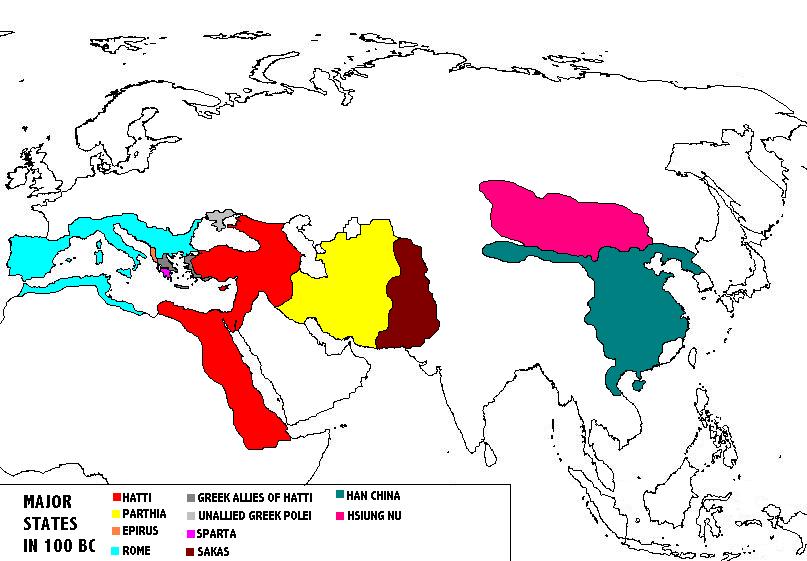
95
BC--King Mithridates II of Parthia defeats the Saka, who become a subject
state of the
Parthian Empire.
94 BC--Gotarzes, a Parthian general, revolts against King Mithridates II (with
Hittite aid)
and establishes a rival kingdom in Babylonia and Persis. Beginning of a period
of civil
war in the Parthian Empire.
91 BC--Death of King Tuwanuwa V of Hatti. He is succeeded by Labarnash II.
Labarnash is a militarily gifted and diplomatically crafty ruler, and his wise
policies will
serve Hatti well during his long reign. Also in this year, a Roman Tribune of
the Plebs
named Marcus Livius Drusus is assassinated following a political rally in the
Roman
Forum. Drusus had been attempting to push through legislation similar to the
Gracchi:
agrarian reform, the founding of colonies, and an increase in the corn-dole
for the poor.
But to appease the Senate, whom he knew he had to appease, Drusus also
proposed to
give the courts back to the senators (Gaius Gracchus had given court control
to the
Equites in 123 BC) and increasing the Senate's membership from 300 to 600,
which
should also appease the Equites who would become the new senators.
Unfortunately for
Drusus, in these proposals trying to appease everyone, they appeased no one.
Neither the
Senate nor the Equites supported it. Then, Drusus had broached a sensitive
topic in
Rome: he proposed Roman citizenship for all of the Italian allies (socii).
Citizenship had
been an issue with the Gracchi, it had reared its head with Marius and the
army, and now
it becomes the vital issue of the time. The allies (socii) have fought Rome's
wars--they
risk their lives to protect the welfare of Roman citizens and Rome itself. And
while they
shed blood to protect Rome, they serve under the authority of Roman
commanders. Allies
have no legal rights in this regard, and the Romans under the current system
have their
way with the lower class, non-citizen allied soldiery. After the assassination
of Drusus,
the socii, whose rights he was championing, become inflamed and they revolt
against
Rome. Thus begins the Social War.
90-88 BC--The "Social War" between Rome and it’s Italian allies,
who are demanding
greater citizenship rights. In response, Rome undercuts the military rebellion
by extending
citizenship to all of Italia south of the Po River. Roman citizenship and the
right to vote
is limited by the requirement of physical presence in Rome on voting day, but
nevertheless, the allies have essentially gotten what they wanted, and most of
them give
up the rebellion. But not all, and Rome spends the next two years defeating
the cities still
in revolt. In the end, the rebellion is crushed by Lucius Cornelius Sulla,
Gaius Marius,
and Pompey Strabo.
90 BC--Death of King Mithridates II of Parthia in battle against the forces of
Gotarzes I.
He is succeeded by his son, who reigns as King Orodes I.
89-82 BC--War between Hatti and Parthia. Seeking to take advantage of the
civil war
then raging in the Parthian Empire, King Labarnash II of Hatti makes an
alliance with
King Maues of the Saka, and together Hatti and the Saka attack Parthia from
the east and
the west. King Gotarzes of Babylonia/Persis is the first to fall, being
defeated and killed
in battle with the Hittites in 87 BC. King Orodes II of Parthia manages to
hold off the
two-front onslaught of the Hittites and Saka until 82 BC, when he is finally
defeated and
killed outside the city of Ecbatana, ending the Arsacid Dynasty. The Parthian
Empire
ceases to exist. Hatti absorbs southern Mesopotamia and Elymais (former Elam),
while
the Saka take the eastern provinces of Bactria, Aria, Drangiana and Chorasmia.
Parthia
itself, Media, and Persis are left as independent buffer states, with puppet
dynasties
imposed by mutual agreement of Hatti and the Saka.
88 BC--Death of King Cleomenes IV of Sparta. He is succeeded by Lycurgus I.
87-76 BC--First Roman Civil War. Following the Social War, rivalry between
Gaius
Marius (who is now champion of the Populares, the party which promotes the
ideals and
reforms of the Gracchi in Rome) and Lucius Cornelius Sulla (a supporter of the
old
conservative Senatorial power clique) leads to civil war between the two
factions.
Although Marius and his supporters are temporarily successful in seizing power
in Rome,
Sulla (who realizes the potential power which the military reforms made by
Marius
during the Jugurthine War gives to commanders by making troops loyal to their
commander rather than to the Roman State) takes the unprecedented step of
leading his
legions against Rome itself, seizing control of the city by military force and
declaring
himself Dictator. Marius, and his colleague Lucius Cornelius Cinna, thereupon
swear an
oath not to begin a revolution against Sulla’s rule, but almost immediately
begin planning
to renege on the oath, which was administered under duress.
In 86 BC, Cinna slips away from Rome and raises an army among the recently
defeated Italian allies, many of whom are still not happy with the
representation given to
them following the Social War. Sulla’s forces are temporarily defeated and
forced to
retreat from Rome, and the triumphant Marians begin a reign of terror in which
many of
Sulla’s followers in Rome are massacred. Marius dies soon afterward, leaving
Cinna
(with his new co-Consul Lucius Valerus Flaccus) in command of Rome. Shortly
afterward, an up-and-coming young politician named Gaius Julius Caesar marries
Cornelia, daughter of Cinna, in an attempt to ally himself with the new
powers-that-be.
However, Sulla is not through yet, and, supported by Gnaeus Pompeius (son of
Pompey Strabo) and Marcus Licinius Crassus (the richest man in Rome), returns
with a
new army in 84 BC. Cinna’s army is defeated and Sulla re-takes Rome. In
retaliation for
the Marian reign of terror, Sulla executes many Marians (Gaius Julius Caesar
flees Rome
for a time to avoid this fate, but will later return and make his peace with
Sulla), banishes
many others from Rome, and reforms the Roman constitution, reducing the power
of the
Tribunes of the Plebs, increasing the power of the Senate, and in general,
rolling back
many of the reforms passed by the Populares over the past century.
But the cause of the Populares is taken up by Quintus Sertorius, who leads the
largest
remnants of the Marian party to Hispania in 83 BC, where he establishes
himself as the
virtual ruler of that province. Sertorius follows very statesmanlike policies
in Hispania,
and manages to rally the populace behind him. His announced object is to build
up a
stable government in the country with the consent and co-operation of the
native people.
He establishes a senate of 300 members, drawn from primarily from Roman
emigrants,
but with a sprinkling of the best Spaniards, and surrounds himself with a
Spanish
bodyguard. For the children of the chief native families he provides a school
where they
receive a Roman education and even adopt the dress of Roman youths, thus
binding them
closely to his regime. The various tribes of Hispania are very
enthusiastically supportive
of him, and Sertorius is able (with financial and military support from King
Labarnash II
of Hatti, with whom Sertorius negotiates successfully) to raise a powerful
army from the
warlike tribes of Hispania. Although Sertorius loses some battles, he wins
more often,
and is able to maintain his army in being, despite the best efforts of the
Roman armies
(under the command of Gnaeus Pompeius and Quintus Caecilius Metellus Pius)
sent
against him by Sulla.
Sulla dies in 78 BC, and leaves no clear successor. Renewed civil war breaks
out
between the pro-Sulla faction, lead now by Quintus Lutatius Catulus, and the
faction of
Marcus Aemilius Lepidus, who opposes the constitutional reforms of Sulla.
Gnaeus
Pompeius returns to Italy from Hispania, and in cooperation with Catulus,
defeats
Lepidus in 77 BC (Lepidus flees to Sardinia, where he dies the same year).
Thus the
pro-Sulla faction is able to retain power in Rome.
The following year (76 BC), Gnaeus Pompeius returns to Hispania to campaign
against Sertorius. He is initially successful, but is finally again defeated
outside
Saguntum, and Sertorius drives Roman forces from Hispania. Sertorius shortly
afterward
declares the independence of Hispania from Rome, which is greeted with wild
enthusiasm by the native inhabitants. King Labarnash II of Hatti immediately
recognizes
the independence of Hispania, and soon makes a formal alliance with Sertorius.
Not
wanting to end up in a two-front war, Rome signs a treaty with Sertorius
before the end of
the year, recognizing the independence of Hispania. The civil war at last
comes to an
end.
87 BC--Death of the Han Chinese Emperor Wu Ti. The Emperor Chao Ti assumes the
throne. Emperor Wu Ti’s reign has seen great changes in Chinese society that
will mark
the civilization for centuries to come. For example, Wu Ti has decided that
Taoism is no
longer suitable as a state philosophy for China, and has officially declared
China to be a
Confucian state. However, like the emperors before him, he has combined
Legalist
methods with the Confucian ideal. This official adoption of Confucianism has
led to not
only a civil service nomination system, but also to a requirement of
compulsory
knowledge of Confucian classics of candidates for the imperial bureaucracy, a
requirement that will last for centuries to come. Confucian scholars thus gain
prominent
status as the core of the civil service.
Wu Ti has also reformed the land ownership and tax systems, effectively
legalizing the
privatization of lands. Land taxes are now drawn based on the sizes of fields,
and no
longer on the amount of the harvest. This has had an unintended effect of
creating a class
of wealthy landowners and reducing most of the population to a state of near
serfdom.
Wu Ti’s reform of the tax system, on paper, guarantees the government a
steady flow of
revenue from year to year. But in practice, since peasants depend on their
harvest for
their income, they can not always pay the standard taxes assessed on their
land under the
new system. Thus, small peasant freeholders find themselves forced to sell
their land to
wealthy merchants and nobles who can pay the taxes. And since the peasants
have no
place else to go, they are forced to stay and till the land for the new
owners, effectively
reducing themselves to serfdom in the process. This will provide the seed for
peasant
revolts which will disrupt Chinese society time and time again in the
centuries to come.
And the newly created class of wealthy landowners will also come to be a
threat to the
Imperial throne as the landowning families become allied with each other
through
marriage and gradually gain power over the selection of officials.
85 BC--The Second League of Delos is formed. Over the past two-and-a-half
centuries,
the Greek Polei which are allied to Hatti have become ever more closely linked
economically, and there have, for some time, been many who argue that these
links
should also be moved into the political realm as well. In 85 BC,
representatives from
these states meet on the holy island of Delos to discuss the possibility of
unification.
They reach an agreement to form a new League of Delos...in essence, a
federal-style
government for the city-states of Greece. The federal government of the league
will be in
the form of an assembly, in which each polis has one vote, which will meet
four times per
year on Delos in order to discuss and legislate on matters pertaining to the
whole league.
An Archon, selected by the Delian Assembly for a one year term, will hold
executive
power and command the armed forces of the League. Local government in the
individual
polei will continue as before (almost all of the cities have some form of
democratic
assembly), and the League will not have power to interfere in the internal
affairs of any
member polis. The League will have the power to collect taxes from the
individual polei,
and the individual polei will no longer be permitted to maintain their own
military forces,
which now become the responsibility of the League (it is stipulated that the
military may
not be used against any member polis without a 4/5 majority vote of the Delian
Assembly). Member polei are each assigned a quota of troops and warships, to
be
equipped and trained in a uniform manner specified by the League, to serve
with the
League military forces, where they will be commanded by officers selected by
the
Archon.
82 BC--Romans inflict a final defeat on the Celts in Italy; Roman province of
Gallia
Cisaplina formed.
80 BC--Gaius Julius Caesar leaves Rome for military service with the forces of
Gnaeus
Pompeius in Hispania. As a result of his service, Caesar wins the corona
civica (award
for personal heroism. For the rest of his life he will be awarded public
honors (such as
being able to wear his laurel crown on all public occasions). He is also
permitted to sit in
the Senate without age restriction.
75 BC--Leaving Rome to study rhetoric in Rhodes, Gaius Julius Caesar is
captured by
pirates and held for ransom. Caesar, when released, returns and crucifies all
the pirates.
He then continues on to Rhodes to study under famous rhetorician Apollonius
Molon.
74 BC--In Rome, the inevitable reaction against the arch-conservative policies
of the
pro-Sulla faction has begun to set in, and concessions are being made. This is
hastened
when Gnaeus Pompeius returns from Hispania and along with Marcus Licinius
Crassus,
switches his allegiance from the Optimates (pro-Sulla party) to the Populares.
The
Tribunes of the Plebs receive many (but not all) of their powers back, and
many of the
reforms of the Populares are reinstated.
73-62 BC--The Spartacid War. In 73 BC, Spartacus, a Thracian gladiator, leads
a
rebellion at a gladiatorial school in Capua. Along with other gladiators,
Spartacus
escapes and proceeds to raise an army of escaped slaves which ravages southern
Italy.
Spartacus then moves north, aiming to cross the Alps and escape into Gaul, but
is forced
by a near mutiny among his followers to give up this plan and head south
again. In the
process, Spartacus meets, and defeats, several Roman armies, creating a panic
in Rome.
Upon reaching southern Italy again, Spartacus makes contact with agents of
Sertorius and
King Labarnash II of Hatti, and with their aid, manages to transport his army
to Sicily in
71 BC.
Once in Sicily, Spartacus leads the Sicilian slaves into rebellion, and with
their aid,
establishes control over the whole island. Spartacus is proclaimed King of
Sicilia by his
followers, and this is immediately recognized by Sertorius and Labarnash, who
are both
eager to see the strategically important island of Sicily liberated from Rome
and under the
control of a friendly regime. A Hittite fleet shortly thereafter takes up
station at Syracuse
and begins patrolling the waters around Sicily. When the Roman Senate learns
of this,
they issue an ultimatum to Hatti and Hispania, warning them to cease
interfering in
“Roman internal affairs” or face war with Rome. Sertorius and Labarnash
consider the
maintenance of an independent Sicily as strategically vital in keeping the sea
route
between Hispania and Hatti open, and they do not back down. Accordingly, on
March
14, 70 BC, the Roman Senate declares war on Hatti and Hispania.
The Greek League of Delos and Sparta declare themselves neutral in the
conflict, and
as a result, most of the war is fought at sea between the rival fleets of
Rome, Hatti, and
Hispania, as almost all of the natural invasion routes between the countries
involved are
sea routes. In these contests, the Hispano/Hittite fleets generally have the
better of it.
Therefore, Hispania is able to land an invasion force in north Africa to
cooperate with
Hittite forces advancing from Cyrenacia. And since Rome is not able to land
reinforcements, Rome’s north African provinces fall to the allies within two
years.
The
naval fighting in the Aegean and Black Sea is inconclusive, with neither side
gaining the
upper hand. Therefore Rome is unable to land an invasion force in Anatolia,
nor is Hatti
able to land a force in Thrace. The fighting between Roman and Hittite fleets
off Sicily
also proves indecisive, which prevents Rome from landing troops on that
island. But
Rome is able to send an invasion force overland to attack Hispania, and this
they do,
resulting in the most sanguinary fighting of the war. Sertorius, however,
although his
army is severely battered, manages to hold off the Roman assault and later,
when Hittite
reinforcements cross from Africa, to finally expel the Roman invasion force
from
Hispania in 64 BC.
Finally, in 62 BC, the Roman Senate responds to a peace
overture
from King Ura Tarhundas IV of Hatti and agrees to negotiate for an end to the
war. The
terms of the treaty which follows stipulate that Sicilian independence must be
recognized
by Rome. Hatti and Hispania agree to guarantee that the newly independent
Sicily does
not become a base for piracy against Roman shipping in the area, or a launch
pad for
seaborne raids against Roman cities (Spartacus protests this provision
somewhat loudly,
but Labarnash and Sertorius make it clear that the provision must be obeyed).
Rome will
also give up all claim to it’s north African provinces in exchange for a
payment of 10,000
talents of silver (5,000 talents from Hispania and 5,000 from Hatti). Hatti
and Hispania
will jointly administer the provinces as a protectorate. Finally, Hatti and
Hispania
guarantee to cease interference in Rome’s internal affairs.
73 BC--Death of Emperor Chao Ti of Han China. He is succeeded by Hsuan Ti.
72 BC--Death of King Lycurgus I of Sparta. He is succeeded by Lycurgus II.
68 BC--Death of King Labarnash II of Hatti. He is succeeded by Ura-Tarhundas
IV.
Ura-Tarhundas is a virtual carbon-copy of his great father, and Hatti will
prosper under
his wise leadership.
62 BC onward--King Spartacus of Sicilia organizes his kingdom. He creates what
is
essentially a limited, constitutional monarchy, with the King’s powers
limited by a
legislative body (modeled on the Roman Senate) whose members are elected by
the
people of the cities and provinces of Sicilia. He has previously, as one of
his first acts,
abolished slavery throughout Sicilia, and extended citizenship to all people
living on the
island, whether of Roman, Greek, Punic, or native Sicilian stock. He also
seized the
estates of large landowners (most of whom were killed when the slave revolt
seized
control of the island) and redistributed the land to the freed slaves and
other landless
people. He remains very popular with the masses as a result, and will enjoy a
long and
relatively peaceful reign. Sicilia will use it’s advantageous position as a
“gateway” for
trade between the eastern and western Mediterranean to great advantage, and
the kingdom
will prosper mightily.
62-40 BC--Period of relative peace between the great powers. During this
period, Roman
armies, under the command of capable generals such as Gnaeus Pompeius, Gaius
Julius
Caesar, and less capable ones such as Marcus Licinius Crassus, move north into
Gaul,
Germania, and Britain, conquering the Celtic and Germanic tribes there and
annexing
those areas into the Roman Empire. By the end of the period, Rome’s northern
borders
sit on the Oder, the Danube, and the Firth of Forth.
60 BC onward--Sertorius reforms the governmental structure of Hispania. In
response to
complaints from the native tribes that Roman emigres are heavily
over-represented in the
Hispanian Senate, Sertorius creates a bi-cameral legislature. The Senate will,
as before,
be composed primarily of Roman Emigres, with, as before, some representation
of the
Romanized noble families of the native peoples of Hispania. The second house,
called
the Tribunate, will be elected by popular vote of each province. The number of
representatives from each province will be determined by the population of the
province,
and Sertorius orders a census to be taken every ten years so that the seats in
the new
house can be properly apportioned. All laws have to be approved by majority
vote of
both houses. Sertorius also sets up a legal system of succession for the
office of Consul,
which he currently holds, as he realizes he is getting old and will likely not
be around
much longer. Basically, he has the chief member of the Senate succeed him
until an
election is held (within no more than one year) to choose a permanent
successor.
57 BC-- A kingdom is established in the Silla region of south Korea with
capital in
Kyongju.
55 BC--First Triumverate formed by Gnaeus Pompeius Magnus (so named for his
triumphs in Germania), Gaius Julius Caesar, and Marcus Licinius Crassus. This
combination will dominate Roman politics for the next decade.
53 BC--Death of Sertorius. The new system of succession which he established
for
Hispania works as designed, and a new Consul is peacefully elected to replace
him.
51 BC --Death of King Ura-Tarhundas IV of Hatti. He is succeeded by Anitta
III. Anitta
III is a weak king, and also not a Hellenophile. In fact, he begins acting
aggressively
toward the Greek cities on the Anatolian coast, causing a rift in the Graeco-Hittite
alliance which does not go un-noticed by outside powers. Also at this time,
the Hsiung
Nu Empire breaks apart. The Hsiung Nu split into two hordes, with the eastern
(southern) horde surrendering to China.
c. 50 BC onward--Expanding trade between the Hittite Empire and India. Sometime in
the middle of the 1st century BC a Greek sailor named Hippalus (working for the Hittites)
discovers that he can take advantage of the monsoon winds and sail from the Red Sea
ports of the Hittite Empire to India in forty to fifty days. By 24 B.C. at least 120 ships are
setting sail annually and by the 1st and 2nd centuries A.D. sea trade between the northern
and eastern coasts of Africa and India is brisk and prosperous. Like the the overland Silk
Road, which took its name from the most prestigious commodity traded along it, the sea
route comes to be called the Pepper Route, for it is the tangy spice from Malabar which is
valued above all. However, that not the only item traded, and the great warehouses in the
Indian ports are stocked not only with pepper, but also with pearls and gems, fine fabrics
and perfumes, in exchange for which merchants from Hatti bring wine, metalwork,
ceramics, glass-ware and slaves.
50 BC--The western Huns (Hsiung Nu) expand to the Volga.
48 BC--The Hsiung Nu empire completely disintegrates. The Hsiung Nu tribes
will war
among themselves for quite some time, thus removing a serious threat from
China’s
borders. Also in this year, Emperor Hsuan Ti of Han China dies, and is
succeeded by
Yuan Ti. And also in this year, Marcus Lincinius Crassus is killed while
campaigning in
Britannia. The alliance between Gaius Julius Caesar (who is now the champion
of the
Populares) and Gnaeus Pompeius Magnus (who has switched his allegiance back to
the
Optimates) begins to break up, as Crassus is no longer there to defuse
conflicts between
the two.
46 BC--Death of King Lycurgus II of Sparta. He is succeeded by Pausanias II.
King
Pausanias will be a militarily gifted and aggressive king, and will seek to
take advantage
of the rift between the League of Delos and Hatti to fulfill the dreams of
King Leonidas
III and to unify Greece under the banner of Sparta. He immediately begins
preparing for
war.
44-40 BC--Second Roman Civil War. In 44 BC, Gnaeus Pompeius wins the political
struggle between himself and Caesar in the Senate and Caesar is ordered to
dismiss his
army and report to Rome for trial. Caesar refuses, and crosses the Rubicon
with his army.
Pompeius flees to Germania, where his old legions are stationed, and raises an
army
against Caesar. Thus begins a four-year war, which is bitterly contested. But
in the end,
Pompeius is defeated and killed in northern Italy by Caesar’s army, and
Gaius Julius
Caesar emerges as the dominant political figure in Rome. He is declared
Dictator for
Life in 40 BC.
42 BC--Death of King Spartacus of Sicilia. He is succeeded by his son, who
reigns as
Spartacus II.
40-35 BC--Dictatorship of Julius Caesar. Following his victory over Pompeius
and the
Optimates, Caesar attacks the intractable social problems which have bedeviled
Rome
since the time of the Gracchi, including what to do with the landless poor. He
declares a
general amnesty for all who had taken arms against him in the Civil War. He
orders the
taking of an exact census of the city and reorganizes and reduces the
distribution of free
grain, reducing those on the dole from 300,000 to 150,000. He founds dozens of
civilian
and military colonies in the non-Italian provinces, to which eventually 80,000
of the
turbulent Roman poor are transported as well as veterans. He grants
citizenship (and all
its benefits) to doctors and teachers, many of whom were Greek. The owners of
large
landed estates are required to hire a third of their farm workers from free
men rather than
slaves, to avoid the problem of forcing landless workers into the overcrowded
towns. He
abolishes the private guilds which have become breeding-grounds for the
fighting mobs
of various demagogues.
Caesar also makes sweeping changes in how the provinces are governed. He steps
up
criminal penalties for corruption and makes laws limiting the terms of
provincial
governors. He limits the terms of propraetors to one year and of proconsuls to
two
consecutive years--both to prevent others from acquiring a power base from
which to
launch another civil war, as well as to discourage the wholesale provincial
robbery of the
past. Perhaps most importantly to the provinces, after decades of rapacious
Roman
tax-gatherers plundering for their own profit, he abolishes the existing tax
system.
Instead, he returns to the earlier policy of permitting the provinces
themselves to collect
and pay tribute without middlemen. Most importantly of all, Caesar sees
provincial
political enfranchisement as a vital necessity for the workable growth of
empire, and
begins making moves in that direction.
All these reforms are opposed by the conservative patricians in the Senate,
but are
passed because Caesar’s power seems unstoppable. Caesar also creates
opposition to his
rule by increasing the number of Senators and filling the vacancies with those
loyal to
himself, including many people who are not of patrician or equestrian birth.
Soon
centurions, men without name or reputation, even barbarians (supposedly in
hairy
breeches, although more likely provincial Roman citizens) are sitting in the
hallowed
halls of the Senate, to the disgust of the old patrician elite.
Caesar’s enemies begin spreading rumours that Caesar intends to make himself
King
of Rome...which Caesar has explicitly denied. But the rumours have their
effect, and a
conspiracy forms against Caesar, which culminates in Caesar’s assassination
in 35 BC.
40-32 BC--The War of Hellene Unification. In 40 BC, the new Spartan King,
Pausanias
II, declares war on the League of Delos and invades Attica, laying siege to
Athens. The
Archon of the League of Delos, Democritas of Phocas, leads the League’s army
to the
relief of Athens, and the two armies meet on the old battleground at Plataea.
Pausanias
is victorious, and the League’s army is routed.
In early 39 BC, the Spartan navy defeats the fleet of the League of Delos off
the coast
of Attica, cutting off Athens from outside aid. The fleet then transports a
second Spartan
army to Crete, which is brought under Spartan control by the end of the year.
Meanwhile,
the city of Athens falls later that year, and Pausanias declares Attica to be
officially
annexed by the Spartan state.
In 38 BC, Pausanias marches north, laying siege to Thebes and defeating
another
Delian army sent to the relief of that city. Thebes proves to be a very tough
nut to crack,
however, and holds out against the Spartan siege for several years. And the
heavy defeats
inflicted on the League of Delos prevent them from mounting any major military
action
during the time period, either.
In 35 BC, the fleet of the League of Delos, under the new Archon, Anaxagoras
of
Lesbos, inflicts a heavy defeat on the Spartan fleet off Corinth, and
Anaxagoras leads a
new army in a seaborne invasion of the Peloponnesus itself, moving inland and
laying
siege to Corinth and Argos. Pausanias abandons the siege of Thebes and moves
swiftly
to the relief of Corinth, where he meets the Delian League army in battle.
Although the
Spartans are victorious once again...virtually annihilating the Delian army...Pausanias
is
killed, and his successor, Leonidas IV, is unable to immediately follow up on
the victory.
In 34 BC, King Anitta III of Hatti takes advantage of the warfare between the
Greek
states to sieze control of and annex the Greek cities on the coast of
Anatolian coast. This
will have dramatic impacts later on.
In 33 BC, Spartan King Leonidas IV moves north and lays siege to Thebes, the
Spartans again defeating a Delian League army sent to the relief of the city.
The city,
weakened by the previous siege, falls by the end of the year. The Spartan navy
also
re-establishes control over the Aegean, devastating the Delian League fleet in
battle off
Crete (where the League was trying to land an army to recover the island from
Sparta).
In 32 BC, with the conquest of the two strongest member polei of the League of
Delos,
and the betrayal of the Great King of Hatti, friction among the remaining
member states
finally leads to the collapse of the League. The remaining mainland cities
surrender to
Sparta and are annexed. With the exception of a few island states which still
cling
precariously to independence, Greece is now unified for the first time in
it’s history.
37 BC--A second kingdom, Kogoryu, arises in Korea.
35 BC--Death of King Pausanias II of Sparta in battle. He is succeeded by
Leonidas IV.
35-28 BC--Third Roman Civil War. In the aftermath of Caesar’s assassination,
civil war
again breaks out between Caesar’s supporters...lead by Marcus Antonius (also
known as
Mark Antony) and Gaius Julius Caesar Octavianus (also known as Octavian,
adopted heir
of Caesar)...and the assassins of Caesar, lead by Quintus Cassius Longinus and
Marcus
Junius Brutus. A series of campaigns and battles will lead ultimately to the
defeat of the
assassins in 28 BC. Antony and Octavian, along with Marcus Aemilius Lepidus,
form the
Second Triumverate. Octavian is left in control of Italy...center of Roman
power...Lepidus in Gaul and Germania; and Antony in Macedon and Illyricum.
Antony
and Octavian almost immediately begin to scheme against each other, seeking
total power
for themselves. But despite this, the Second Triumverate will manage to
co-exist
peacefully for over a decade.
33 BC--Death of King Anitta III of Hatti. At his death, the Crown Prince is
murdered and
throne is usurped by a noble of the old royal house of Carchemish (a rival
dynasty to the
family from Azatiwataya which has ruled the empire up to now), who takes the
throne as
King Piyassili. Piyassili methodically hunts down and murders all remaining
members of
the royal house and closely related houses, ending the dynasty established by
Talmi Tesub
I. Beginning of a period of instability as noble families from other Hittite
cities begin to
maneuver to seize the throne for themselves.
32 BC--Death of Emperor Yuan Ti of Han China. He is succeeded by Cheng Ti.
However, the widow of the emperor Yüan Ti succeeds in placing all of her
relatives in
government positions and ruling in place of her son.
31-20 BC--Axumite and Kushite revolts. Taking advantage of the chaos in the
Hittite
empire following the usurpation of the throne by Piyassili, revolts break out
in the
provinces of Kush and Axum. The Hittite garrisons are thrown out, and the two
kingdoms re-establish their independence.
30 BC--King Piyassili is himself murdered, and the throne is usurped by a
noble from the
city of Milid, who takes the throne as King Halpasulupis.
30-27 BC--War between Sparta and Epirus. In 30 BC, King Leonidas IV of Sparta
declares war on Epirus, and in a series of campaigns lasting three years,
conquers it.
Epirus is annexed by the Spartan state.
25 BC--The southern Arabian kingdom of Sheba is conquered by the Himyaritic Kingdom (with Hittite aid).
24 BC--A prince who is distantly related to the old royal family from
Azatiwataya rebels
against the Milidian usurper Halpasulupis and seizes the throne. He will reign
as King
Warpalawa III and have a long and successful reign, establishing a new
dynasty,
reunifying the country and restoring stability.
22 BC--In Han China, slave revolts begin in the government iron works. They
will
continue for several years, weakening the Han regime.
18 BC--The Kingdom of Paekche arises in Korea. Also in this year, King
Spartacus II of
Sicilia dies, and is succeeded by his son, who reigns as King Phillip I.
17-12 BC--Fourth Roman Civil War. The continuous scheming of Antony against
Octavian and vice verse finally leads to war between the two. Lepidus declares
himself
neutral, and Antony has been cultivating a friendly relationship with and
receiving
financial and military support from King Warpalawa III of Hatti, and this will
prove
decisive in the civil war. Antony’s army defeats that of Octavian outside
the city of
Mediolanum (OTL modern Milan) in 15 BC, and Octavian is captured and executed.
Octavian’s supporter, Marcus Vipsanius Agrippa, continues the war, but is
himself
defeated and killed in 14 BC. Antony marches on Rome, and is proclaimed
Dictator.
Lepidus then declares war on Antony, and is in turn defeated in 13 BC. Lepidus
escapes,
however, and raises another army in Britannia. Antony leads an army across the
Oceanus
Britannicus (English Channel) in pursuit, and defeats the forces of Lepidus
near the town
of Londinium in 12 BC. Antony is supreme in Rome.
12 BC-3 BC--Dictatorship of Mark Antony. Antony assumes the title of Dictator
for Life
which had been bestowed on Julius Caesar, and continues and expands on
Caesar’s
reforms of the Roman governmental system. He is aided in this by the fact that
the power
of the arch-conservative Optimate faction has been destroyed in the Civil
Wars, and the
Roman people are heartily tired of the factionalism and want stability, and
thus they
support reforms which seem aimed at eliminating conflict from the society. In
the end,
Antony will be remembered as the savior of the Republic...he reforms the
military system
so as to prevent ambitious generals from using their armies as a springboard
for political
power, he finally breaks the power of the elites and makes the Roman political
system
universal in nature, and extends full citizenship to the people of the
provinces. The final
system which emerges is much more responsive to the will of the Roman people,
while
being at the same time much more stable and less factionalized. Rome will
prosper
mightily as a result. Shortly before his death in 3 BC, he resigns from the
office of
Dictator, but before doing so he institutes a system of orderly succession to
the office of
Dictator, which is now made permanently the supreme executive office of the
Republic
(Basically the structure now is 1 Dictator selected by the Senate for a six
year term,
supported by 2 Consuls who are elected by the people for one-year terms, who
are in turn
supported by the traditional Praetors, Tribunes, Censors, and other
officials).
15-13 BC--King Warpalawa III of Hatti campaigns in Kush, but is unable to
restore
Hittite control in the region.
14 BC--Peasant revolts begin in Han China. The peasants join forces with the
slaves
from the government iron works, who have been in revolt since 22 BC.
12 BC--Death of King Leonidas IV of Sparta. He is succeeded by Archidamus VI.
11 BC--In the aftermath of the victorious conclusion of the Fourth Roman Civil
War, and
in gratitude for the role played by King Warpalawa III of Hatti in that
victory, Mark
Antony signs a formal military alliance between Rome and Hatti. This
inaugurates a
period of peaceful cooperation between the various states of the Mediterranean
basin
which will last for some time.
6 BC--Death of Emperor Cheng Ti of Han China. He is succeeded by Ai Ti.
4 BC--Yeshua (Jesus) born in the Hittite province of Israel.
3 BC--Death of Mark Antony, of natural causes, in Rome. The Senate selects as
Dictator Nero
Claudius Drusus Germanicus, who had married Mark Antony’s daughter and had
been,
under Antony, a successful general in Germania, making punitive raids beyond
the Oder
in response to barbarian incursions from beyond the Roman frontier. Germanicus
will
serve a six year term, and then peacefully transfer power to his successor,
setting an
important precedent and showing that system established by Mark Antony really
works.
Copyright 2004 by Robert Perkins. All rights reserved. Last updated 15 September 2004.