THE THIRD HITTITE EMPIRE
An Alternate History Timeline
by Robert Perkins
PART SEVEN: 300-200 BC
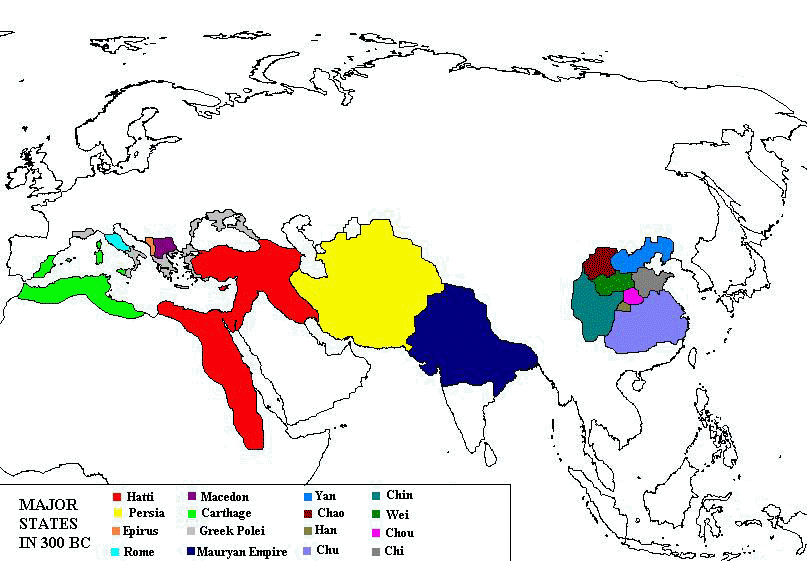
c. 300 BC--Celtic tribes settle in Ireland. Also at about this time, the
city of Axum is
founded on the coast of Ethiopia, partly by Sabaean settlers from Arabia.
Axum will
grow rich by serving as a trade conduit between Hittite-controlled Kush
and Egypt and
the Sabaean cities on the southern Arabian coast. Also at this time, the Kingdom of Hadramaut in southern Arabia also breaks free from Sabaean control.
300-280 BC--Campaigns of King Demetrius I “The Besieger” of Macedon.
Demetrius
moves north and east, conquering Illyria, Thrace, Thessaly, and generally
expanding the
Macedonian frontier northward to the line of the Ister (Danube) and Savus
(Save) Rivers.
He also absorbs the Greek city states on the western shores of the Black
Sea (which are
not allied to Hatti). Mindful of the fate of Phillip II, he avoids direct
confrontation with
the Greek states allied to Hatti. He does intrigue with dissident elements
in those cities,
trying to engineer coups aimed at bringing to power groups which will
voluntarily forego
the alliance with Hatti in favor of an alliance with Macedon. He does not
meet any great
success in this, but his efforts do cause a great deal of instability in
the Greek polei to the
south of Macedon.
299 BC--Death of King Tudhaliyas VI of Hatti. He is succeeded by Zidanta
III. Zidanta
is fortunate to have a relatively peaceful reign. Zidanta promotes trade
with India and
points eastward from the recently gained Hittite ports on the Persian
Gulf, and the Hittite
Empire prospers mightily during his reign.
298-290 BC--Third Samnite War. The Samnites abrogate their treaty with
Rome and
once again declare war. They are joined by the Etruscans, Gauls, and
Umbrians. The
allies are decisively defeated at the Battle of Sentinum in 295 BC, and
never recover. By
290 BC, the Romans have forced all of the allies to make alliances with
Rome.
296 BC--Zhongshan falls to the Chao state.
290 BC--the Mauryan king Bindusara, son of Chandragupta, extends the
empire to the
Deccan.
289 BC--Agathocles of Syracuse dies. Pre-war division of Sicily resumes.
3rd Sicilian
War ends.
288 BC--King Chao-hsiang Wang of Chin and King Min of Chi are recognized
as the
Western and Eastern Kings respectively. Also in this year, King Kurush
(Cyrus) III of
Persia dies, and is succeeded by Xshayarsha (Xerxes) III.
287 BC: Last secession of the plebeians in Rome. As a result, the Lex
Hortensia makes
plebiscites binding in Rome.
287-286 BC--King Xshayarsha III of Persia has pretensions to greatness,
and decides to
attempt an invasion of India. But unfortunately for Persia, he is not as
good a general as
he thinks he is, and his army is defeated by the forces of the Mauryan
Emperor Bindusara.
Bindusara replies with an invasion of Persia, and captures portions of the
Persian
provinces of Gedrosia, Arachosia, and Gandhara before Xshayarsha sues for
peace.
Bindusara, who is faced with rebellions in some of his Indian provinces,
agrees to a
treaty, and the war ends, with Mauryan annexation of the conquered
provinces
recognized.
284 BC : Failed revolt of the Etruscan city of Arrezio against Rome.
280 BC : Fall of the Etruscan city of Vulci to the Romans. Roma issues
coins for the first
time. And also in this year, King Zidanta III of Hatti dies. He is
succeeded by Hantili III.
281-272 BC: Tarentine Wars. Rome has been pressuring the Greek city of
Tarentum in
Southern Italy, and in 281, Tarentum pleas for assistance from King
Pyrrhus of Epirus.
Epirus has been able to maintain it’s independence from Macedon by
virtue of an alliance
with Hatti (it being one of the States who signed treaties with Hatti in
the aftermath of
Chaeronea in 338 BC), and Pyrrhus has gained a reputation for military
ability in various
campaigns. He agrees to the Tarentine offer, and in 280 arrives in south
Italy with 35,000
men and 20 elephants. The Romans promptly lead an army against him and are
heavily
defeated at Heraclea. Though victorious Pyrrhus loses 4,000 men, and when
congratulated for his victory, he comments bitterly that "another
such victory will ruin
me" (hence the expression "Pyrrhic victory"). After this
victory, the south Italian Greeks
(Italiotes), Lucanians and Samnites go over to Pyrrhus. He marches on
Rome, perhaps
expecting to cow them into submission. He finds, however, that even if
some of the
outlying Italian peoples are willing to desert the Romans, they can rely
on the hardcore
support of the Latins and various other communities. In the absence of
large-scale
defections, Pyrrhus can achieve nothing and withdraws to the south. In 279
he again wins
a costly victory against the Romans, losing another 3500 men. At this
point he offers to
make peace if the Romans agreed to guarantee the independence of the
Italiotes and the
Samnites. Rome rejects the offer. In the meanwhile the Carthaginians are
close to
conquering the Greek communities of Sicily, and Pyrrhus crosses over to
Sicily in 278 to
aid the Greeks there. Pyrrhus defeats the Carthaginians and forces them
off the island,
leaving Lilybaeum as their only remaining stronghold. After throwing back
the
Carthaginians, he returnes to Italy in late 276. In 275 two Roman armies
guard against his
attack to the north. His surprise attack on one army fails and he
withdraws to Tarentum to
avoid being encircled. At this point he goes back to Greece with most of
his army, leaving
the Italiotes to their fate. The Greek cities, without military support
from Pyrrhus, are
subdued by Rome and forced to sign treaties of alliance. Rome is now in
effective
control of all of Italy.
279 BC--Celtic tribes from north of the Ister (Danube) invade Greece
through Macedonia,
making it all the way south to the temple of Delphi, which is plundered.
King Demetrius I
Poliorcetes of Macedon dies in battle with the Celts, and is succeeded by
his son,
Antigonus II Gonatas. At the time of his death he was preparing an
invasion of the
Hittite provinces in Anatolia, a project which his successor will continue
with. Also in
this year, Chi defeats Han in the Battle of Jimo.
278 BC--Chin armies occupy the Chu capital at Ying, forcing the Chu
Kingdom to move
its capital to Chen.
277 BC--Chin expansion into Hubei at the expense of the Chu state. Also in
this year,
Antigonus II Gonatas of Macedon defeats the Gauls and drives them out of
Greece. He is
now ready to resume his father’s plans for an invasion of Anatolia...
276-273 BC: War between Macedon and Hatti. In 276 BC, King Antigonus II
Gonatas
launches the long-planned invasion of the Hittite provinces in Anatolia.
King Hantili III
of Hatti leads an army to meet him, but unlike many of his illustrious
forebears, is not a
very competent general, and Antigonus defeats him at the River Granicus.
Hantili’s army
is routed, but the King escapes, and retreats from Anatolia into Syria to
regroup and rally
his forces. Meanwhile, unopposed by any substantial Hittite force,
Antigonus lays siege
to and captures the cities of Sardis and Gordium before the end of 274 BC,
and advances
as far as Hattusas, where he lays siege to the city in early 275 BC. But
he is still
besieging Hattusas when word arrives that Pyrrhus of Epirus (an ally of
Hatti, but acting
for his own purposes rather than to succor his ally) has invaded Macedon.
Antigonus is
forced to lift the siege and return to Macedon to oppose Pyrrhus,
abandoning his gains in
Anatolia. Hantili, at the head of a new Hittite army, follows in the wake
of the
Macedonian retreat, and by the end of 274 BC all the captured territories
are reclaimed.
Hantili then (273 BC) launches a minor invasion of Macedon in support of
Pyrrhus, but is
defeated by a Macedonian army under Crown Prince Demetrius near the city
of
Byzantium, and retires to Anatolia without taking further part in the war.
Hantili and
Antigonus agree on a peace treaty based on status quo antebellum shortly
afterward,
ending the war between the two kingdoms.
274-272 BC--Antigonus II Gonatas, having returned to Macedon from
Anatolia, defends
Macedon from the onslaught of Pyrrhus of Epirus. Several inconclusive
battles are
fought before Pyrrhus is finally killed in 272 BC. Antigonus has
successfully defended
his kingdom, but his forces are severely weakened. He will be in no
condition to commit
foreign aggression for a while.
273 BC--Foundation of the first Roman colony in Etruscan territory.
273 BC onward--Hantili III of Hatti sponsors building projects in many of
the cities of the
empire. Temples and government buildings in cities as disparate as
Hattusas, Sardis, and
Gordium (which required repair due to the recent war), as well as Babylon,
Memphis,
Thebes, Damascus, Jerusalem, and Napata (which did not see damage from the
war) are
renovated and expanded. As a result of these efforts, Hantili will go down
in history as
“Hantili the Builder”...a name he would no doubt far prefer to the
sobriquet of “Hantili
the Feckless,” which he endured through most of his reign as a result of
his defeats in the
war against Macedon.
270 BC--Death of King Xshayarsha (Xerxes) III of Persia. He is succeeded
by
Artaxshassa (Artaxerxes) IV. Artaxerxes is a relatively weak ruler, and
the empire begins
to break down during his reign, as local satraps exert more and more power
and
independence from the throne.
269 BC--Death of the Mauryan Emperor Bindusara. He is succeeded by his
son, Ashoka.
Ashoka will conquer almost all of south India, bringing almost the entire
subcontinent
under Mauryan rule.
270-266 BC: Rome at war with Umbrians and Etruscans. Rome is victorious.
269-263 BC--King Alexander II of Epirus, son of Pyrrhus, once again
invades Macedon.
Taking advantage of the weakened condition of the Macedonian army, he
succeeds in
conquering most of the country and holding it for almost twelve years, but
is finally
defeated by a Macedonian army under Demetrius, son of King Antigonus
Gonatas, in 264
BC, and forced to retreat back to Epirus. Antigonus and Demetrius quickly
re-establish
control over the whole of the Macedonian Empire.
265–264 BC--Fall and destruction, by the Romans, of Volsinii, the last
independent
Etruscan city.
264-241 BC--First Punic War. Rome and Carthage support opposite sides in a
war
between the Greek cities of Sicily, leading Rome to invade the island.
Carthage declares
war on Rome, and a vicious struggle lasting over 20 years is the result.
Rome is
victorious, largely because of it's invention of the corvus...which allows
Roman marines
to board enemy ships and capture them. Carthage's naval power is broken,
and it's armies
are forced to surrender through lack of re-supply. In a humiliating
treaty, Carthage is
forced to surrender all of it's territories in Sicily and Sardinia to
Rome.
261 BC--Death of King Hantili III of Hatti. He is succeeded by Suhis Tesub
IV. Also in
this year, King Antigonus II Gonatas of Macedon attempts to force Athens
into
submission, but Athens appeals to King Suhis Tesub IV of Hatti for aid.
King Suhis
Tesub sends an army to stand with the Athenians, and Antigonus is defeated
near Plataea.
He retreats to Macedon, and agrees to guarantee the independence of Athens
(and other
Greek cities allied to Hatti).
260 BC--Battle of Changping in which Chin defeats Chao.
259 BC--Chin starts its siege of Handan, the Chao capital. Also in this
year, Mauryan
king Ashoka, grandson of Chandragupta, converts to Buddhism and sends out
Buddhist
missionaries to nearby states. He does not attempt to make Buddhism the
state religion,
however...Hindu zealotry is still alive and well in India, and he knows he
would face
major rebellions if he tried anything like that.
258 BC--Birth of Ying Cheng, future First Emperor of China.
257 BC--The Chin army is forced to raise the seige of Handan, capital of
the Chao state.
256 BC--To avert immediate annexation, the Chou state offers lands to the
Chin state.
The Dujiang Ditch and the Cheng ditch are built. Also at this time, Doung
Voung (Thuc
Phan) unifies the tribes of Vietnam and creates the kingdom of Auc Lac
with his capital
at Phuc An.
255 BC--Death of King Suhis Tesub IV of Hatti. He is succeeded by Mursili
IV. King
Mursili IV is more focused on internal Hittite politics than on foreign
affairs, and not as
much of a Graecophile as many of his forebears.
253-240 BC--Civil War in Persia. King Artaxshassa (Artaxerxes) IV of
Persia dies in
253 BC without heirs, and upon his death a seven-year civil war breaks out
as various
claimants vie for the throne. Finally, one of the rival claimants, a
prince named
Darayavahush (Darius), pays Tiridates, king of the Parni (who had recently
arrived in the
Satrapy of Parthia, where they had declared their independence), to
intervene on his side.
The Parni intervention proves decisive, and Darayavahush defeats the other
claimants
within a year and assumes the throne of Persia as king Darayavahush IV.
But
Darayavahush doesn’t like being beholden to the chieftain of a rough
tribe of nomads,
and so he tries to have Tiridates poisoned shortly after taking the throne
in 240 BC. He
fails, and Tiridates overthrows him and takes the crown for himself.
Tiridates marries a
princess of the Achaemenid line, then ruthlessly seeks out and murders all
the remaining
Achaemenid claimants for the throne, ending the Achaemenid Dynasty.
251 BC--Ashoka's son Mahinda introduces Buddhism to Ceylon (Sri Lanka).
250 BC--Prince Zichu ascends the throne of Chin as King Chuang-hsing Wang.
Also at
about this time, Buddhists carve the first cave temples (Lomas Rishi), and
the Greek
scientist Archimedes is active at Syracuse, and China repels an invasion
by the
turkic-speaking Hsiung-nu (Huns).
c. 250 BC--The Parni (a nomadic Indo-Iranian tribe which originally lived
north of the
Aral Sea), lead by their aged chieftain, Arsaces (founder of the Arsacid
Dynasty), invade
the Persian satrapy of Parthia (in northern Iran) and settle there, taking
advantage of the
chaos caused by the ongoing Persian Civil War to enter without resistance. Also at this time, the southern Arabian Kingdom of Sheba conquers the Minaean Empire and most of Qataban. Sheba is once
again the most powerful kingdom in southern Arabia.
249 BC--The realm of the Eastern Chou is annexed by the Chin, marking the
end of the
Chou Dynasty.
248 BC--Antigonus II Gonatas of Macedon invades and conquers Epirus,
despite the
alliance of that country with Hatti. King Mursili IV of Hatti protests,
but does nothing
else. Antigonus is emboldened by this lack of action on the part of the
Hittites.
246 BC--Death of King Chuang-hsing Wang. Ying Cheng ascends the throne of
Chin at
13 years of age. Commencement of work on Ying Cheng's tomb at Mount Li.
245 BC--In Parthia, the new king of the Parni, Tiridates, revolts against
the rule of the
Achaemenid Persian Empire. Parthia is established as an independent
kingdom.
245-244 BC--Emboldened by the lack of Hittite response to his annexation
of Epirus,
Antigonus II Gonatas of Macedon once again attempts to force the states of
southern
Greece into submission, and declares war on Athens. But this repeated
aggression by
King Antigonus finally awakens King Mursili IV of Hatti to the danger
posed by
Macedon, and he sends a large army (under the command of his younger
brother, who is a
much better general than Mursili ever dreamt of being) to the succor of
Athens.
Antigonus is initially successful, defeating the combined Athenian and
Hittite army south
of Thermopylae, in restricted terrain where the superior Hittite cavalry
cannot be usefully
employed. But when he pursues the defeated allies south, he finds them
drawn up on the
plain near Plataea, where he met defeat before (in 261 BC). Despite his
own misgivings,
he accepts battle at this site. With enough open space to operate
effectively, the Hittite
cavalry routs the Macedonian cavalry and then takes the Macedonian
infantry phalanx in
the flank and rear. The Macedonian Phalanx is broken, and Antigonus
himself is killed.
The allies pursue the Macedonians back to the pass of Thermopylae, and
then halt their
pursuit. Demetrius, the son of Antigonus and new king of Macedon,
immediately sues
for peace, and once again guarantees the independence of Athens and the
other Greek
states allied to Hatti. He also agrees to pay an indemnity to Athens and
Hatti. These
terms are accepted in 244 BC, and the war ends.
240-200 BC--The new Parthian dynasty in Persia is consolidating it’s
rule, putting down
revolts among the Medes, Persians, Bactrians, and other native peoples of
the Empire. By
the end of the century the Parthian dynasty is firmly established.
241-237 BC--Civil War in Carthage. Hamilcar Barca, a brilliant general and
statesman,
emerges as virtual dictator in Carthage.
241 BC--Roman destruction of the Etruscan city of Falerii.
239 BC--King Demetrius II of Macedon, mindful of the fates of Phillip II
and his own
father, Antigonus II Gonatas, resumes his grandfather’s policy of
avoiding direct
confrontation and weakening Hittite influence by intriguing with dissident
elements in the
Greek polei to the south. His efforts will eventually bear fruit, when he
gains the support
of King Cleomenes III of Sparta..
236 BC onward--Carthage invades and conquers most of the Iberian
Peninsula. Hamilcar
Barca does this to provide Carthage with an empire to compensate it for
the one lost in
the first Punic War, as well as to gain a base from which to eventually
launch a war of
revenge against Rome.
235 BC--Cleomenes III comes to the throne of Sparta. Cleomenes, like the
rulers of
Sparta before him, opposes the influence of Hatti in Greece, and begins
intriguing with
King Demetrius II of Macedon. He aims to restore Sparta’s pre-eminence
in Greece at
any price...
232 BC--The Indian Emperor Ashoka dies.
232-187 BC--At the
death of Emperor Ashoka of the Mauryan Empire in 232 BC, disputes break
out among his sons over the succession, and the empire begins to break
down. The final collapse does not occur until 187 BC, when the last
Mauryan Emperor is assassinated.
230 BC--Chin conquest of the Han state.
229 BC--229 BC--Death of King Mursili IV of Hatti. He is succeeded by
Kushtashpi II.
Kushtashpi will emulate the achievements of his great grandfather, Hantili
“the Builder,”
and will sponsor construction projects throughout the empire. He is also a
great patron of
learning, and will establish the Royal Library at Hattusas, which will
eventually collect
over 200,000 volumes containing the science, philosophy, and religious
thought of much
of the world. Also in this year, King Demetrius II of Macedon dies. He is
succeeded by
Antigonus III. Antigonus continues his father’s policies and stipends to
King Cleomenes
III of Sparta.
228 BC--Chin annexation of the Chao state. Also in this year, Hamilcar
Barca dies in
battle in Hispania, and is succeeded by his brother, Hasdrubal Barca.
Hasdrubal
continues his brother's policies in Hispania and vis-a-vis Rome.
227 BC--Cleomenes III of Sparta engineers a coup. Four of the five Ephors
are killed,
and Cleomenes deposes his colleague king, Archidamus V. Cleomenes then
institutes a
social revolution in Sparta...dividing the land into 4000 lots, and
redistributing it not only
to Spartan citizens, but also to perioikoi and hypomeinones. He thus
effectually expands
the military base of the Spartan state, which is open only to landowners.
He is also
secretly receiving a stipend from King Antigonus III of Macedon, which he
uses to
re-organize the Spartan army on the Macedonian model. Sparta is once again
ready to
march...
226-215 BC--Wars of Cleomenes III of Sparta. In a series of campaigns
lasting over a
decade, King Cleomenes III of Sparta conquers all of the Peloponnesus,
including the
cities of Argos and Corinth. Although most of the cities involved are
allies of Hatti, the
treaty of alliance with Hatti is specifically against Macedonian
aggression, and the Great
King of Hatti does not intervene in what he views as an “internal Greek
affair.”
225 BC--Chin conquest of the Wei state.
c. 225 BC--The Celts in the west and the Sarmatians in the east overwhelm
the Scythian
tribes (who live in the Danube basin and the area north or the Black Sea).
The Scythians
disappear from history as a separate people.
223 BC--Chin annexation of the Chu state.
222 BC--Chin conquest of the Yan state.
221 BC--The last feudal state in China, Chi, is conquered by Chin. King
Ying Cheng is
now ruler of all China. He assumes the title of Shihuangdi, “The First
Emperor.”
Shihuangdi initiates several important reforms, including abolition of
feudalism and the
centralization of power in the form of a non-hereditary bureaucracy loyal
to himself;
division of the empire into 36 commanderies, which are sub-divided into
prefectures and
counties; the standardization throughout China of written language,
currency, weights
and measures, and the legal code. To deter rebellion against his regime,
he orders the
confiscation of weapons, which are to be melted down to form bells and
giant statues.
Also at his order, the joining of the various defensive walls built by the
former Warring
States begins, under General Meng Tian....this will become, eventually,
the first version
of the Great Wall of China. Also in this year General Meng Tian defeats
the Hsiung-Nu
(later to be known to history as the Huns) and drives them northward. Also
in this year,
King Antigonus III of Macedon dies, he is succeeded by Phillip IV.
221-210 BC--Meng Tian of China initiates campaigns against Rong & Di
barbarians.
220 BC--The Maurya dynasty under Ashoka's son Bindusara expands to almost
all of
India. Also in this year, the Hsiung-nu defeat the Yuezhi, who are forced
to move south
towards Iran and India.
219 BC--Hasdrubal Barca dies, and is succeeded by Hannibal, son of
Hamilcar Barca.
218 BC-202 BC--The Second Punic War. In 218 BC, Hannibal Barca
precipitates the
Second Punic War when he attacks the Roman client city of Saguntum. As in
OTL,
Hannibal leads his army across the Alps and invades Italy, inflicting
numerous defeats on
the Romans over a period of fifteen years, but never able to capture Rome
itself and put
an end to the war. And, although Phillip IV of Macedon signs a treaty of
alliance with
Hannibal in 216 BC, the Macedonians do not intervene effectively,
preferring to let the
Carthaginians do most of the dying and then, hopefully, pick up the pieces
afterward. In
the meantime, Roman armies defeat those of Carthage in Spain, and then
Scipio
Africanus invades Carthaginian territory in Africa itself, where, aided by
the defection of
King Masinissa of Numidia (who brought over to the Roman side the best
cavalry in the
Carthaginian army), he is finally able to defeat Hannibal himself at the
Battle of Zama in
202 BC. Carthage is given harsh peace terms...1) The immediate territory
of Carthage in
Africa would remain free, but the rest was to be ceded to Masinissa of
Numidia; 2)
Carthage would totally withdraw from Spain and Gaul; 3)All elephants were
to be ceded
to the Romans; 4) Carthage could keep only ten warships; 5) Carthage could
not make
war without Roman consent; and 6) Carthage would pay 10,000 talents in 50
annual
installments. Carthage is a broken power.
217 BC--Death of King Kushtashpi II of Hatti. He is succeeded by
Suppiluliuma V.
Suppliluliuma continues his father’s projects, and for the most part,
does not seek to
expand the Hittite Empire. But the Hittites prosper during the period of
peace which
characterizes most of his rule.
216 BC--Philip IV of Macedonia allies with Hannibal of Carthage. This
action causes a
break with King Cleomenes III of Sparta, who opposes Macedonian
involvement in the
struggle with Rome and fears Sparta may be drawn into the war. But by this
time,
Cleomenes is firmly established as ruler of the Peloponnesus, and the loss
of Macedonian
support does not unduly impact his plans.
215 BC onward--Cleomenes III of Sparta extends the Spartan social
revolution to the
other cities of the Peloponnesus, redistributing land, breaking the power
of wealthy
landowners and elevating many lower class elements to power. He also
grants the new
landowners in the recently annexed areas a form of citizenship in the
Spartan state,
allowing their cities a good deal of local autonomy and a seat on the new
Council of
Ephors which he creates in 210 BC, in return for military service. And,
unlike previous
Spartan leaders, he does not actively oppose democracy in the various
cities under his
rule, at least so far as local government is concerned, which increases
his popularity in the
conquered regions yet further. In the process he binds the people of the
conquered
territories ever more closely to Sparta, and succeeds where his ancestors
had always
failed...in creating a unified state out of the disparate polei of the
Peloponnesus.
213 BC--Chinese Emperor Shihuangdi outlaws all schools of thought except
the legalist
one and buries alive 346 scholars.
212-210 BC--In the one instance where King Suppiluliuma acts to expand the
Hittite
Empire, Hittite armies move east from Kush to annex the new state of Axum,
which is
accomplished by 210 BC. Thus is eliminated what Suppliluliuma considers to
be an
unnecessary middle-man in the trade between his empire and the cities of
the Arabian
coast.
211 BC--Death of King Tiridates of the Parthia. He is succeeded by
Artabanus I.
210 BC--Shihuangdi, the First Emperor of China, dies of mercury poisoning
and is buried
in a colossal tomb near Xian, surrounded by thousands of terracotta
soldiers. He is
succeeded by Ershihuangdi (“Second Emperor”).
209-202 BC--Civil war in China. In 209 BC, the Chinese Empire falls apart
as peasant
revolts break out in the former state of Chu, and the heirs of the former
feudal lords of the
states of Chi, Yan, Han, Wei and Chao also rise in rebellion. The Chin
emperor,
Ershihuangdi, is unable to put down the uprisings, and is finally captured
and forced to
commit suicide by the Duke of Chao in 207 BC. In 206 BC, Duke Chang Yu of
the state
of Chu captures and executes the rest of the imperial family, ending the
Chin dynasty.
But it is Duke Liu Pang of the state of Han who in 202 BC finally defeats
his rivals,
including Chang Yu, and reunifies China. Liu Pang takes the throne as the
Emperor Kao
Tsu of China, beginning the Han Dynasty.
207 BC--King Trieu
Da reigns over the Nam Viet kingdom (northern Vietnam) with his capital at
Fan-yu. In this year he subdues the Au Lac kingdom (southern Vietnam). The
Trieu dynasty will reign over Nam Viet from 207 to 111 BC.
206 BC--The kingdom of the Nam Viet dynasty extends from Vietnam to
Canton.
205 BC--Death of King Cleomenes III of Sparta. He is succeeded by
Agesipolis III.
Agesipolis continues his predecessor’s policies, furthering the
unification of the
Peloponnesus into a single state.
200 BC--Mao-tun unites the Huns (Hsiung-nu) in Central Asia around Lake
Baikal and
southeastern Mongolia. The Hsiung-nu conquer northern and western China.
Also at
about this time, the Mahabarata is composed in India, and the Andhras
occupy the Indian
east coast.
Copyright 2004 by Robert Perkins. All rights reserved. Last updated 15 September 2004.