THE THIRD HITTITE EMPIRE
An Alternate History Timeline
by Robert Perkins
PART SIX: 400-300 BC
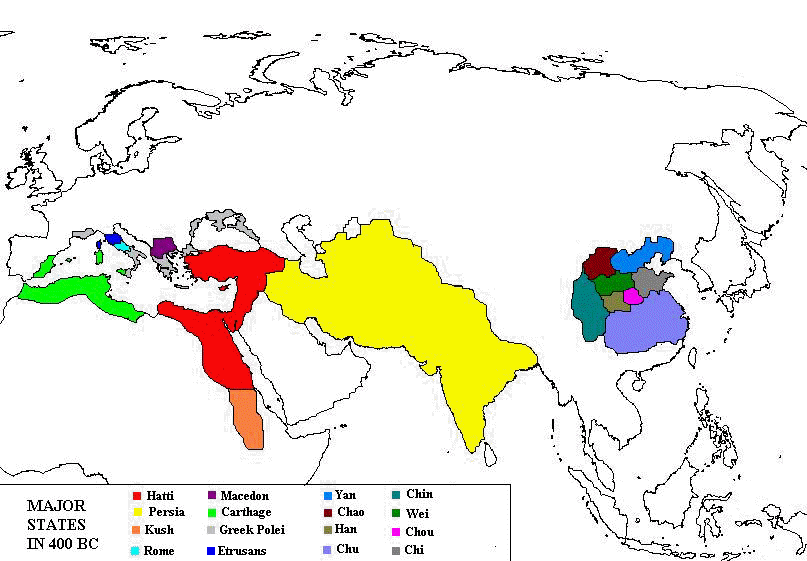
c. 400 BC--The regions of Main and Qataban break free from the Kingdom of Sheba and
found their own kingdoms. The Minaean Empire (founded by the people of Main) is
founded and becomes a serious rival to Sheba for the control of the caravan routes
carrying frankincense and myrrh from southern Arabia to the major states northward.
399 BC--Trial of Socrates, who is sentenced
to death by taking poison. Also in this year,
the catapault is invented in Syracuse by Dionysius I.
398 BC--King Arnuwanda V of Hatti is an admirer of the Greeks, and is
pursuing a
policy aimed toward closer relations between his empire and the various
Greek city states.
As a gesture of goodwill, in 398 BC he grants full independence to the Greek
cities on the
coast of Anatolia. After that, his embassies to various Greek cities are
warmly received,
and thus begins a new era of Graeco-Hittite cooperation.
398 BC--Dionysius I of Syracuse sacks Motya (Carthaginian town in Sicily),
and the
Carthaginians permanently relocate their main Sicilian base to the fortified
town of
Lilybaeum.
397 BC--Himilco drives Dionysius back to Syracuse and resumes siege. In
naval action,
the Carthaginians sink or board 100 Syracusan naval vessels and take 20,000
prisoners.
395-390 BC--Crown Prince Necho of Egypt, who now lives under the protection
of King
Harsiotef of Kush, returns to Egypt at the head of a Kushite army. King
Harsiotef hopes
to restore Necho to the throne of Egypt, and through him, to control Egypt.
The Kushite
army lays siege to Thebes, which falls before the end of 395 BC. Necho dons
the White
Crown of Upper Egypt as Pharaoh Necho IV, and many of the people of Upper
Egypt
rally to his standard. With a greatly bolstered army, Pharaoh Necho and King
Harsiotef
march on Sais, intending to restore Necho’s rule to all of Egypt. But the
Hittite garrison
of Lower Egypt defeats the combined Egyptian/Kushite force outside Sais, and
Necho is
forced to return to Thebes. For the next five years, there will be sporadic
fighting
between Necho’s forces and the Hittites along the border between Upper
Egypt and
Lower Egypt. Finally, in 390 BC, a Hittite army lead by King Arnuwanda’s
best general
decisively defeats the Egyptians and Kushites outside Thebes and takes the
city. Pharaoh
Necho IV, and his son Wahibre, both die in the battle, extinguishing the
26th Dynasty.
King Harsiotef of Kush retreats with his army to their homeland. He is not
pursued by
the Hittites, who are, for the time being, content to re-establish control
over Egypt.
396 BC--Yet another epidemic lays Punic forces low for a third time in
Sicily. Dionysius
capitalizes on this and defeats Himilco in pitched battle. Himilco survives,
but upon
returning to Carthage, starves himself to death. Fighting continues.
395-389 BC--Corinthian War. Angered by Sparta's tyrannical overlordship in
Greece
after the Peloponnesian War, several Greek states challenge Spartan
supremacy. The war
is very costly for both sides, but in the end, Sparta triumphs (unlike OTL,
Sparta is not
also fighting a war against Persia during this time, and Hatti is playing
the role of a strict
neutral, so Sparta is able to defeat the combination which is challenging
it’s supremacy a
bit sooner than in OTL).
393 BC--Carthaginian force under Mago, nephew of Himilco, defeated trying to
re-take
Messana.
392 BC--Mago of Carthage is defeated a second time. Truce signed with
Syracuse.
390 BC--The Gauls (Celtic tribes) under Brennus defeat a Roman army at the
Battle of
the Allia River and then sack Rome itself.
389 BC--Death of King Arnuwanda V of Hatti. He is succeeded by his son, who
reigns
as Kushtashpi I. Kushtashpi continues his father’s pro-Greek policies.
388 BC--Plato, a pupil of Socrates, founds his philosophical Academy, the
first university
in the world. Also in this year, Dionysius of Syracuse, during a war with
the Etruscans,
pillages the Pyrgi sanctuary.
385-371 BC--Hittite conquest of Kush. Since the failed Kushite invasion of
Egypt a few
years earlier, the Kushite King, Harsiotef, has continued to funnel arms and
money into
Egypt in support of rebels against Hittite rule. Furthermore, he has
re-asserted his
family’s claim to the throne of Egypt as the scions of the 25th Dynasty.
Old King
Arnuwanda V of Hatti had allowed this to go on without much response, but
the young
and vigorous King Kushtashpi I is determined to end Kushite meddling in his
Egyptian
provinces once and for all. Beginning in 385 BC, Hittite armies march south
from Egypt,
and in a campaign lasting fourteen years, conquer the Kingdom of Kush. King
Harsiotef
and his sons are all captured or killed, extinguishing the Kushite royal
house. Hittite
garrisons take up residence at Napata and Meroe, the two largest Kushite
cities, and Kush
becomes a province of the Hittite Empire.
384 BC--Carthage renews it's war with Syracuse.
375 BC--Carthage is defeated at Cabala—Mago and 10,000 soldiers killed.
Mago's son
Himilco defeats Dionysius near Himera—truce favorable to Carthage
concluded. Also in
this year, Plato writes the "Republic."
373 BC--The Temple of Apollo at Delphi is destroyed by an earthquake. It
will be
rebuilt.
371 BC--Athens, Thebes, Chios, Mytilene, Byzantium, Rhodes and others revolt
against
Sparta which loses its supremacy. Especially critical is the defeat of the
Spartan army at
Leuctra by Epaminondas of Thebes.
371-362 BC--Period of Theban hegemony in Greece.
370 BC--Death of King Kushtashpi I of Hatti. He is succeeded by his son, who
reigns as
King Tuwanuwa IV.
368-352 BC--The Great Indian Rebellion. The Persians and the Aryan peoples
of India
all came from the same Indo-Iranian stock, and their religion was, at one
time, probably
identical. But over time, a great reversal has crept in, which has had
immense impacts in
the relations between the Persian Kings and their Hindu subjects. In the
Persian
Zoroastrian religion, the Devas (root of our word, “devil”) are demons
who cause plagues
and diseases and who fight every form of religion. They are the male
servants of
Ahriman, and together with female demons called Drugs, they fight the
Persian supreme
god Ahuru Mazda and his servants. When the Persians enter India, they find
that many of
the Persian Devas are known there...Indra, for example, is common to both
Zoroastrianism and Hinduism. But to the utter shock and dismay of the
Persians, the
local Hindus worship the Devas as gods, and consider the Asuras (which the
Persians
worship as gods) to be demons. Therefore, the pious Zoroastrian kings of
Persia have
considered it their mission to stamp out the cults of these “devil
worshipers.” For a
century and a half, the Persians have been attempting to do so, but they
have not been
successful, and of course their efforts have bred a huge amount of
resentment and
zealotry among the Hindus. In 368 BC, this resentment boils over and a huge
rebellion
breaks out as the native Hindus attempt to throw off the Persian yoke. The
Satrap of the
province of Magadha, a native prince named Ajatashatru, takes the leading
role in the
rebellion, and under his leadership, native forces inflict many defeats on
the Persians.
Ajatashatru dies in 361 BC, but his son and successor, Darshaka, continues
the rebellion
and proves as capable a leader as his father. The Indian rebels are helped
by the fact that
Persia and Hatti are at war during most of this period, and by 352 BC, the
last Persian
troops have been driven from India.
367 BC--Dionysius of Syracuse attacks the Carthaginian base at Lilybaeum but
is stopped
when his fleet defeated by Carthaginian warships under Hanno the Great. Also
in this
year, Aristotle enters the Academia of Plato.
366 BC--Dionysius I of Syracuse dies, still at war with Carthage.
362 BC--Thebes is defeated by the Athenians and Spartans at the Battle of
Mantinea.
Epaminondas is killed, Theban hegemony ends.
360 BC--Hanno the Great tries to usurp power in Carthage. He is captured and
crucified.
360-354 BC--War between Hatti and Persia. Hittite spies have reported to
King
Tuwanuwa IV of Hatti the troubles the Persian king is having in India. He
decides to take
advantage of the situation, and invades Mesopotamia. Hittite armies march
all the way to
the Persian Gulf and push the Persians east of the Zagros Mountains by 357
BC. The
Persians mount counter-invasions, but are unable (due to the constant drain
of manpower
caused by the Indian revolt) to make any headway. Finally, desperate to
devote his full
attention to the Indian problem, King Artaxshassa (Artaxerxes) III agrees to
a treaty
ceding the lands east of the Zagros Mountains to the Hittites in 354 BC.
Unfortunately,
as noted elsewhere, it doesn’t help him in India. King Tuwanuwa IV will be
known to
history as “Tuwanuwa the Great” as a result of these conquests.
359 BC--Death of Artaxshassa (Artaxerxes) II. He is succeeded by Artaxshassa
III.
Also in this year, Phillip II comes to the throne of Macedon. Phillip had
spent much of
his youth as a hostage in Thebes, where he studied under the great general,
Epaminondas.
With what he learned there, he will reform the Macedonian army. He replaces
the old
Greek-style hoplite phalanx with a new formation, the Macedonian Phalanx.ªªPhillip's
Macedonian Phalangites are professional soldiers, and are among the first
troops ever to
be drilled, thereby allowing them to execute complex maneuvers well beyond
the reach of
most other armies. They fight packed in a close rectangular formation,
typically eight
men deep, with a leader at the head of each column and a secondary leader in
the middle,
so that the back rows can move off to the sides if more frontage is needed.
Unlike earlier
hoplites, phalangites are mostly unarmored except possibly those of the
first row, and
carried only small shields. No enemies are expected to get close enough for
them to need
any armor, however, since each phalangite carries as his primary weapon a
sarissa, a
double-pointed pike over four metres in length. At close range such large
weapons are
useless, but an intact phalanx can easily keep its enemies at a distance;
the weapons of the
first five rows of men all project beyond the front of the formation, so
that there are more
spearpoints than available targets at any given time. Phillip doesn't use
the Phalanx as
his primary striking force. Instead, the Phalanx is used to hold the enemy
in place for a
decisive charge by the cavalry.
357–354 BC--Rome attacks the Etruscans and the Faliscans. Siege of the
Etruscan city of
Sutri.
356 BC--The temple of Artemis at Ephesus is rebuilt. The new temple will be
considered
one of the seven wonders of the world. The Great King of Hatti, Tuwanuwa IV,
contributes a large sum for the construction project, further increasing the
goodwill
between Hatti and the various Greek city states.
355 BC--Death of King Tuwanuwa IV of Hatti. He is succeeded by his son, who
reigns
as King Warpalawa II. Warpalawa continues the pro-Greek policies of his
father and
grandfather.
352-322 BC--In the aftermath of the successful rebellion which ended Persian
rule, India
once again fragments into several kingdoms, of which Magadha (ruled by the
descendants
of Darshaka) is the most powerful.
352 BC onward--In the newly independent Indian states, Hinduism has taken on
a very
intolerant, puritanical world-view, and followers of beliefs considered
“heretical” are
persecuted. Especially hard hit is greatly is Jainism, which had begun about
600 BC as a
dissident sect of Hinduism. Indeed, persecutions of this faith will be so
severe that by the
end of the century, it will be totally eradicated. Another faith which
suffers greatly is the
relatively new faith of Buddhism, which is nearly wiped out in bloody
persecutions
carried out over the next century, but manages to survive by the barest of
margins.
351 BC--Beginning of the forty years truce between Rome and the Etruscan
city of
Tarquinia.
c. 350 BC--By this date, Carthage has established itself as the leading
power in the West.
Also at around this time in China, the Period of the Warring States has
spawned many
innovations in Chinese society, including coinage, widespread replacement of
bronze
weapons by iron weapons, and public works projects (canals, walls). The
relative lack of
central control during the Warring States Period has also spawned the
Hundred Schools
of Thought, considered to be the Golden Age of Chinese Philosophy. Prominent
schools
are Confucianism, Taoism, Legalism, and Mohism.
350 BC--Duke Xiao Gong of Chin moves his capital from Yung to Xianyang. Xiao
Gong
will be the first great ruler of Chin, and Chin’s rise toward supreme
power in China
begins with his reign.
348 BC--Second treaty between Carthage and Rome.
344 BC--Philip II of Macedon conquers Thessaly, Illyria, and Epirus.
343 BC--Mago sails to Syracuse to drive out the usurper, but fails and
commits suicide in
order to avoid court martial upon his return. Hasdrubal and Hamilcar make a
second
attempt, losing a battle at Segesta. Hasdrubal executed. Gisco, son of Hanno
the Great, is
authorized to make peace. Sicily is divided along the Halycus River. 2nd
Sicilian War
ends.
343-341 BC--First Samnite War between Rome and the Samnites, a hill tribe
from the
central Apennines. War inconclusive.
342 BC--Aristotle tutors Alexander, son of Phillip II of Macedon.
341-338 BC--Revolt of the Latin League against Rome. Rome is victorious. The
Latin
League is dissolved. Some communities closest to Rome are fully absorbed
into the
Roman state. Some Latin communities continue as technically independent
states with
Latin rights, but they sign treaties that subordinate their foreign policy
to that of Rome.
These states provide contingents for the Roman army. The least Romanized
communities
receive a special form of second-rate citizenship. Citizens of these
communities have the
obligations of Roman citizens (in particular military service) but are not
allowed to vote
at Rome.
341 BC--The Kingdom of Chin (Qin) defeats the Kingdom of Wei (Wu) at the
Battle of
Maling. Also in this year, King Warpalawa II of Hatti, having observed the
success of the
reforms instituted in the Macedonian army by Phillip II, decides to
institute similar
reforms in the Hittite army, replacing the Hittite hoplite phalanx with a
Macedonian-style
phalanx. He retains the existing Hittite cavalry and foot archers to
supplement his phalanx
(Hittite cavalry, composed as it is of armored cavalry armed with lance and
bow, and light
cavalry archers, is already better than that of any other nation, and the
foot archers
provide a good base of fire for his army which the Macedonian army lacks).
Warpalawa’s
army is very formidable.
340 BC--A power struggle in Syracuse ends with Timoleon of Corinth
victorious.
339 BC--King Warpalawa II of Hatti receives an entreaty from a coalition of
Greek cities
headed by Athens, requesting help against the expansion of Phillip of
Macedon.
Warpalawa signs a mutual defense treaty with these cities.
338 BC--Death of King Artaxshassa (Artaxerxes) III of Persia. He is
succeeded by Arsha
(Greek--Arses). Also in this year, King Warpalawa II of Hatti dies, and is
succeeded by
his son, who reigns as King Hattusili Tesub IV. In the Spring of this year,
Philip II of
Macedonia declares war on Athens and Thebes (chief cities of the Greek
coalition which
is allied to Hatti) and invades. King Warpalawa having recently died, the
new King
Hattusili Tesub IV takes an army by sea to Athens, arriving there in
mid-July, where it
unites with the combined Athenian and Theban force. At the battle of
Chaeronea on
August 2, the Hittite forces turn the tide against Phillip of Macedon.
Phillip and his son
Alexander are killed in the battle, and the Macedonian army is almost
annihilated.
338 BC onward--Period of increasing cooperation and trade between Hatti and
Greece.
Most of the mainland Greek cities (Sparta being the chief exception) form a
league which
is allied to Hatti militarily. The Great King of Hatti becomes a patron of
Greek arts and
science, and with this encouragement a new Golden Age of Greek Art and
Philosophy
dawns.
338-320 BC--Chaos and Civil War in Macedon. Phillip III Arrhidaeus, the
feeble-minded
son of Phillip II by a Thessalian wife named Phillina of Larissa, has come
to the throne of
Macedon, and Macedon is in chaos. The satellite territories conquered by
Phillip (Illyria,
Thessaly, Thrace, Eprius) soon revolt and re-establish their independence
during this time
period. Phillip III is finally murdered by order of Phillip II’s first
wife, Olympias, in 330
BC, who then tries to give the throne to her brother, Alexander of Epirus.
This however,
leads to civil war, as the Macedonian nobility (lead primarily by Antipater,
Antigonus,
and Ptolemy) revolts against the imposition of a foreign Epirote king.
Olympias is
captured and executed by 325 BC, after which the Macedonian noblemen fight
among
themselves for the throne. Antigonus “One-Eye” emerges as the final
victor in 320 BC,
and establishes a new dynasty for Macedon. However, Macedon is severely
weakened
by the civil war, and there will be intermittent outbreaks of rebellion by
the heirs of
Antipater and Ptolemy over the next few decades (the most serious of which
is that of
Cassander, son of Antipater, in 308 BC). So Antigonus is in no position to
cause trouble
beyond his borders for the rest of his reign.
336 BC--Death of King Arsha (Arses) of Persia. He is succeeded by
Darayavahush
(Darius) III. Darayavahush is a weak king who will be faced by rebellions in
different
parts of the empire during his reign.
334 BC--The feudal Dukes (Gongs) of the Chinese states of Wu and Chin assume
the title
of “King” (Wang). Other rulers will soon follow suit.
326-304 BC--The Great Samnite War. The Romans suffer a major and humiliating
defeat
at the Battle of the Caudine Forks in 321 BC, and another at Lautulae in 315
BC, but they
persevere and finally emerge victorious. The Samnites and many other tribes
allied to
them are subdued and forced into alliance with Rome.
330 BC--Death of King Hattusili Tesub IV of Hatti. He dies childless, and is
succeeded
by his nephew, who reigns as King Tudhaliyas VI. Also in this year King
Darayavahush
(Darius) III of Persia is killed while fighting against rebels in Bactria.
He is succeeded by
a cousin, who reigns as Kambujiya (Cambyses) III. Kambujiya successfully
puts down
the rebellions and establishes firm control over the empire, but the empire
is severely
weakened as a result of the rebellions.
322 BC--Chandragupta Maurya overthrows the king of the Indian kingdom of
Magadha
and establishes the Maurya Dynasty. Chandragupta and his successors will
forge an
empire which will unite most of the Indian subcontinent under their rule.
320-318 BC--War between Persia and the Maurya Kingdom. In 320 BC, King
Kambujiya (Cambyses) III of Persia sends an army to invade India. The forces
of King
Chandragupta Maurya meet the Persians at the River Hydaspes, and the
Persians are
defeated with heavy losses. The next year Chandragupta crosses the Indus and
invades
the Persian provinces of Bactria and Sogdiana, laying siege to the cities of
Bactra and
Maracanda. King Kambujiya of Persia leads an army eastward which lifts the
siege of
both cities, and drives the Indian army back across the Indus in 318 BC.
Shortly
afterward, the two kings agree upon a treaty which sets the boundary of the
two empires.
The Persians agree to cede everything east of the Indus River and south of
the Oxus River
to Chandragupta.
318 BC onward--With the conclusion of a treaty with Persia ending the war
between the
two kingdoms, King Chandragupta Maurya begins invading and conquering the
other
kingdoms of northern India. Chandragupta’s army is huge...estimated at
30,000 cavalry,
9000 elephants, and 600,000 infantry...and at the head of this host he will,
by the end of
his reign, bring all of northern India under his control. When Chandragupta
dies in 296
BC, he reigns over a vast area extending from the Arabian Sea to the Bay of
Bengal. His
successors will expand on this, of course.
315 BC--Agathocles of Syracuse takes Messana from Carthage.
314 BC--The King of Chin inflicts a heavy defeat on the nomads of the
northern steppes.
These nomads will not trouble China for quite some time.
312 BC--Battle of Danyang, in which Chin defeats Chu. Later that same year,
the upper
valley of the Han state is occupied by Chin; Hanchung, the Han capital, is
captured. But
a rump of the Han state survives.
311 BC--Agathocles of Syracuse lays siege to Acragas and crosses the Halcyus,
violating
the peace treaty with Carthage.
311-302 BC--Roman wars against the Etruscans, who had joined Samnites in
their war on
Rome. After the final Etruscan defeat at Roselle in 302 BC, all Etruscan
cities and towns
are forced into alliance with Rome.
310 BC--Carthaginian force under Hamilcar, grandson of Hanno the Great,
defeats a
Greek force at Himera. Siege of Syracuse begins.
309 BC--Agathocles sails with a force of 14,000 to Africa. Carthage meets
him in battle
with 40,000 foot, 1000 cavalry and 2000 chariots under Bomilcar and Hanno.
The Greeks
are victorious, Carthage losing 3000 on the battlefield, but the city itself
is impregnable.
The Siege of Syracuse continues.
308 BC--Bomilcar tries to make himself dictator in Carthage, but is defeated
and tortured
to death. Continued fighting between Greek and Carthaginian forces in
Tunisia.
308-301 BC--Civil War in Macedon. In 308 BC, Cassander, son of the nobleman
Antipater (one of those defeated by Antigonus “One-Eye” during the civil
war following
the death of Phillip II) tries to usurp the throne of Macedon, leading to a
seven-year civil
war. Cassander is defeated and captured in 301 BC, taken to the capital at
Pella, and
executed. However, in the final battle, King Antigonus was seriously
wounded, and later
dies of his wounds. He is succeeded by his son, who reigns as King Demetrius
I.
307 BC--Greek victory outside Syracuse. Hamilcar is captured and killed.
While
Agathocles oversees events in Syracuse, however, Carthage defeats the Greek
and allied
forces in Africa. Despite Syracusan reinforcement, the Greek cause in Africa
is doomed.
Greeks desert to Carthaginian commanders Hanno and Himilco in vast numbers.
A treaty
favorable to Carthage is concluded.
306 BC--Third treaty between Carthage and Rome.
305 BC--Death of King Kambujiya (Cambyses) III of Persia. He is succeeded by
his son,
who reigns as King Kurush (Cyrus) III.
301 BC--Beginning of the reign of King Demetrius I of Macedon. Demetrius
will once
again put Macedon on an aggressive path, with many consequences for the
upcoming
century. Indeed, his aggressive attitude will earn him the nickname
Poliorcetes
(“Besieger”), and it will be a well deserved nickname. Also
in this year, the Emperor Chandragupta Maurya of India
dies. He is succeeded by his son, Bindusara.
300 BC--The Olgunian Law in Rome ends the monopoly of the patrician class on
constructing law and procedure, greatly increasing the rights of the
plebeian class.
300 BC onward--Religious developments in the Hittite Empire. The conquest of
Palestine by the Hittites will have significant effects on the future
development of world
religion. The Great Kings of Hatti are, of course, believers in the old gods
of Hatti.
However, the Hittites have always been very flexible with regard to
religion, adopting the
pantheons of conquered peoples into their own. Thus, Yahweh is recognized as
a real
god by the Hittites, along with the gods of the Aramaeans, Canaanites,
Ammonites,
Moabites, Edomites, Philistines, Phoenicians, Phrygians, Lydians, Greeks,
Egyptians, and
other subject peoples of the Empire. The Great King of Hatti (or his viceroy
in the
region, if the Great King cannot come) goes to Jerusalem once a year to
offer sacrifice to
Yahweh in the Temple. Needless to say, the Hittites are very lenient with
the peoples in
the lands they rule, they are sensitive to the religious feelings of their
subject peoples, and
they do not attempt to impose any sort of religious conformity. The lenient
Hittite
administration allows the Hebrews complete freedom of worship, and the
Hebrews are
loyal subjects of their Hittite overlords. Thus, there is no Maccabean
revolt in this
timeline and no independent Hebrew state. However, as in OTL, the main
religious life in
the province is dominated by the Sadducees (the Temple Priests) and
Pharisees (the
Rabbis). The Sadducees, as in OTL, are involved in politics, and are
allowing commercial
business to take place in the Temple (i.e. the moneychangers), which offends
many of the
more pious people. The Pharisees, who might have served as an alternative,
however, are
obsessed with petty dietary laws and other minutia, and are seen as
hypocrites, observing
the form, but not the spirit, of the Law. As a result, by the end of the 1st
Century BC,
many Hebrews will have become dissatisfied with their religion and are
starting to follow
various cults which look to the arrival of a promised "Messiah"
who will restore the
Hebrew faith to purity.
Copyright 2004 by Robert Perkins. All rights reserved. Last updated 15 September 2004.