THE THIRD HITTITE EMPIRE
An Alternate History Timeline
by Robert Perkins
PART FIVE: 500-400 BC
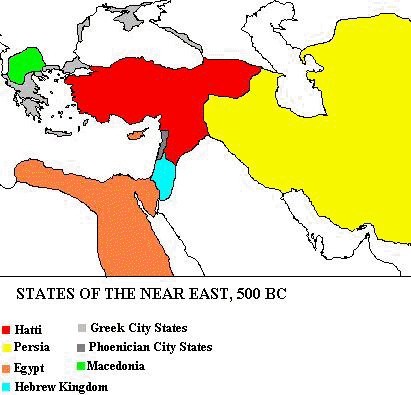
c. 500 BC--The Sabaeans are founding colonies on the coast of Ethiopia. These will
become the nucleus of the later kingdom of Axum.
498
B.C.--Athens at war with Aegina. Also in this year, Hippocrates and Theron
seize
control in Syracuse and attempt to throw the Phoenicians off the western part
of the
island. They are unsuccessful, once again.
494 B.C.--The First Secession of the Plebeians in Rome takes place. Creation
of the
tribunes of the plebs, two of whom are elected annually. Creation of the
office of aedile
for the plebeians of Rome, held by two men.
489 B.C.--Death of King Cleomenes of Sparta.
487 BC--Death of King Abiud of the Hebrews. He is succeeded by his son, who
reigns as
King Eliakim II.
485 BC--Death of King Darayavahush (Darius) I of Persia. He is succeeded by
his son,
Xshayarsha (Greek--Xerxes) I. Xshayarsha, who wants to concentrate on
continuing the
conquest of the Indian subcontinent, shortly afterward concludes a treaty with
King
Suppiluliuma IV of Hatti, ending the decades-long war between the two empires.
481 BC--Athens, Sparta, and other Greek cities form the Hellenic League
against Hatti.
480 BC--A Carthaginian force under Hamilcar the Magonid is defeated by
Sicilian
Greeks at Himera cutting off Carthaginian access to the East. Hamilcar commits
suicide
on the battlefield. In the wake of this defeat a revolution overthrows the
Magonid
dynasty and establishes the Court of 104 Magistrates. Beginning of the
Carthaginian
Republic. Also in this year, King Suppiluliuma IV of Hatti dies, and is
succeeded by
Telepinu III.
480 BC onward--King Xshayarsha (Xerxes) I of Persia and his successor,
Artaxshassa
(Greek--Artazerxes) I, wage war on the Tamil states in southern India. The
Persians
encounter great difficulties in the mountainous, jungle-choked terrain. But by
the end of
the century, the entire Indian subcontinent will be under Persian control.
Persian trading
ships begin traveling to the city states of the Indonesian archipelago and,
eventually, to
the coastal cities of China, bringing back spices, silk, fine Chinese pottery
and bronze
work, and Persia is greatly enriched by these contacts.
480-477 BC--Hittite campaign against Greece. With the ending of the war with
Persia in
485 BC, the Great King of Hatti can now turn his attention to the troublesome
Greeks to
the west of his realm. Ever since the Ionian revolt of two decades ago, Hatti
has been
engaged in low-intensity warfare with the Greek city-states of the Greek
mainland,
especially Athens. Most of this conflict has been in the form of naval
encounters in the
Aegean, with neither side gaining much advantage. In 480 BC, the new King of
Hatti,
Telepinu III, decides to take a more active stance against “Greek Piracy”
in the Aegean,
and begins making preparations for an invasion. Telepinu sends envoys to the
various
Greek city states, as well as to the kings of the Thracian tribes and of
Macedon,
demanding submission. The Thracians chieftains and King Alexander I of
Macedon, as
well as many Greek cities, submit, but the most powerful (cities such as
Athens, Sparta,
and Corinth) do not. These cities, along with many others, form the Hellenic
League to
resist Hatti. In 478 BC, the Hittites land a large force in Thrace, and march
through
Thrace and Macedon into northern Greece. The Greek allies attempt a defense at
the
Pass of Thermopylae, where the Hittite advantage in cavalry will be
neutralized.
However, the Hittite heavy infantry is as good as anything the Greeks have,
there are a
LOT more of them, and they are supported by a large force of archers, which
the Greeks
lack. The Greeks are forced to abandon the pass. The Hittites pursue, and
manage to
bring the Greeks to battle again on an open plain near the city of Plataea.
The Hittites
rout the Greek forces, killing King Leonidas of Sparta (who was in command of
the
Greek forces) and the Athenian general Miltiades (who was second in command of
the
combined force). The Hittites then advance into Attica and lay siege to
Athens.
However, the Hittites then suffer two major disasters. First, the Greek fleet
defeats that
of the Hittites near the island of Salamis, making resupply of the Hittite
army very
problematic while opening up the supply route for the defenders of Athens. And
then in
early 477 BC, a plague breaks out which decimates the Hittite force. One of
the
casualties of this plague is none other than King Telepinu III of Hatti. His
successor,
King Muwatalli IV, decides to abandon the siege and withdraw his army from
Greece.
This he manages to do, although his army is harassed by the Greeks during
it’s retreat
north through Macedon and Thrace, before the end of 477 BC.
479-450 BC--Re-buffed in Sicily, Carthage focuses on Africa, conquering most
of what is
now Tunisia. Colonies in North Africa founded or strengthened. Mago's
expedition
crosses the Sahara.
477 BC--Representatives from the Greek city-states of Asia Minor and the
islands
scattered throughout the Aegean Sea, meet on the island of Delos—a sacred
island
associated with the cult of Apollo—to discuss an alliance with the
Athenians. They swear
oaths of alliance to each other and to Athens; thus is born the Delian League.
This new
league has several purposes besides defense; one of these is to wage a
military campaign
against the Hittites to free those Greek cities that are still under the
control of Hatti.
Although Athens is the leader of the League, each city-state has one
vote—the League is
essentially a democratic alliance between equals. Also in this year, King
Telepinu III of
Hatti dies, and is succeeded by his son, who reigns as Muwatalli IV.
477-450 BC--Wars of the Delian League against Hatti. Although the Kings of
Hatti will
not attempt another invasion of Greece itself, they are successfully able to
defend their
possessions in Asia Minor against the forces of the Delian League. But the war
is
damaging and costly for both sides. Finally, in 450 BC, the Great King of
Hatti offers to
grant limited self-government to the Greek cities of the Anatolian coast, in
exchange for
an end to the war. Pericles of Athens, leader of the Delian League, sees that
the Greeks
won’t get a better deal without unacceptable costs, and agrees. A treaty is
signed which
ends the war between the Hittites and the Greeks.
475 BC--Death of King Eliakim II of the Hebrews. He is succeeded by his son,
who
reigns as King Azor.
c. 475 BC--Beginning of the Period of the Warring States in China. Since 1122
BC, the
Emperors of the Chou (Zhou) Dynasty have maintained a loose hegemony over the
various city-states which comprise China. But this has been weakening for some
time,
and several large and powerful states have arisen, including Chin (Qin), Chi (Qi),
Chu,
Yan, Han, Chao (Zhao), and Wei (Wu). All of these have recognized the legal
hegemony
of the Chou Emperor, while doing pretty much as they please. By 475 BC,
however, the
last pretense is thrown off, and the authority of the Chou Emperor is confined
to his own
small and insignificant kingdom in central China. Over the next couple of
centuries, the
new states will war against each other, and the more powerful will gradually
absorb the
weak. In the end, there can be only one...
472 BC--Carystus, a town on the island of Euboea, is forced into the Delian
League. This
is the first time a Greek state has been forced into the League against it's
will, establishing
a dangerous precedent.
469 BC--The island of Naxos tries to secede from the Delian League. It is
invaded and
captured by League forces, who force it back into the alliance. Thus another
dangerous
precedent is established which will lead, eventually, to the transformation of
the League
into the Athenian Empire.
465 BC--Death of King Xshayarsha (Xerxes) I of Persia. He is succeeded by
Artaxshassa
(Greek--Artaxerxes) I. Artaxshassa continues his father’s policies, focusing
his military
efforts on southern India, while maintaining peace with the states to the
west.
461-451 BC--First Peloponnesian War between Athens and Sparta. Sparta is
jealous of
the power Athens has amassed as leader of the Delian League, and declares war.
The war
lasts a decade, is indecisive, and a peace is agreed to in 451 BC.
461 BC--Pericles comes to power in Athens. His rule will become known as
Athens'
Golden Age. Also in this year, King Azor of the Hebrews dies, and is succeeded
by his
son, who reigns as King Zadok. King Zadok will prove to be a disastrous ruler
for the
Hebrews, as he has pretensions of restoring the complete independence of the
Hebrews
and re-establishing the Hebrews as a great power. In furtherance of these
goals, he begins
intriguing with the Pharaoh of Egypt against his overlord, the Great King of
Hatti.
458 BC--King Muwatalli IV dies, and is succeeded by his son Ini Tesub. Ini
Tesub dies
later that same year in an outbreak of plague which is ravaging the Hittite
capital, and is
succeeded by his son, who reigns as Talmi Tesub II. Within weeks after
ascending the
throne, however, Talmi Tesub himself falls victim to the plague, and is
succeeded by his
young son, who reigns as King Ura Tarhundas III. However, since the new King
is still a
minor, his uncle actually rules as regent for the first years of his reign.
458-450 BC--Period of relative instability and weakness in the Hittite Empire.
The
regent, one Labarnash, is a poor ruler, and revolts break out in several
regions of the
empire which take several years to put down.
458 BC--Death of Pharaoh Necho III. He is succeeded by Psamtik IV. However,
Psamtik IV also dies later this year, and is succeeded by Ahmosi III.
457-455 BC--In 457 BC, King Zadok of the Hebrews makes an alliance with
Pharaoh
Ahmosi III of Egypt, and declares the treaty between his kingdom and the Great
King of
Hatti (who has been, for some time, more of an overlord than an ally, exacting
annual
tribute from the Hebrews) to be null and void. The Hittites, being caught up
in problems
of their own, do not respond. But Zadok soon finds that he has made a poor
choice of
allies. In 456 BC, Pharaoh Ahmosi betrays his newfound ally, and the Egyptian
army
invades the Hebrew Kingdom. The Hebrew army is defeated near Gaza, and King
Zadok
is killed in the fighting. The Egyptians lay siege to Jerusalem, which falls
the next year.
The Egyptians burn and loot the Temple of Solomon, and carry off much of the
Hebrew
upper class population, including the royal family, to exile in Egypt. The
Hebrew
Kingdom ceases to exist, and the territory is absorbed by Egypt.
454 BC--The Treasury of the Delian League, which had, up to this time, been
kept on the
holy island of Delos, is moved to Athens, signifying the transition of the
League from a
voluntary association of Greek States lead by Athens, to an empire ruled by
Athens.
450 BC--The Law of the Twelve Tables is established in Rome. Also in this
year, King
Ura Tarhundas III of Hatti comes of age, and takes over the reigns of
government.
Fortunately for Hatti, Ura Tarhundas is everything his uncle, regent Labarnash,
was not...a
strong and charismatic leader, and a gifted military commander. He quickly
sets the
Hittite house in order, quelling the simmering revolts which have been
festering
throughout the empire for the past five years.
c. 450 BC--At around this time, Herodotus writes the first-ever
non-theological history,
and Hippocrates establishes the foundations of modern medicine. Also at about
this time,
Celtic tribes reach Spain.
448-442 BC--War between Hatti and Egypt. Pharaoh Ahmosi III of Egypt follows
up his
conquest of the Hebrews with an invasion of Syria, determined to restore Egypt
to the full
limits of its ancient empire. However, King Ura Tarhundas III of Hatti defeats
the
Egyptians near Damascus, and follows up with an invasion of Egypt itself the
following
year. By 442 BC, the Hittites have established control over Lower Egypt (the
Delta
region). Pharaoh Ahmosi III is captured and executed, but his son, Crown
Prince
Psamtik, escapes to Thebes, where he wears the White Crown of Upper Egypt as
Pharaoh
Psamtik V, and continues the war against Hatti. King Ura Tarhundas of Hatti
allows the
exiled Hebrews to return to their homeland and to rebuild their temple...but
does not
restore the land to its former independent status. The land of Israel becomes
a province
of the Hittite Empire. King Ura Tarhundas also formally annexes the Phoenician
city
states at this time.
c. 440 BC onward--The Hebrews are rebuilding their Temple, but major changes
have
taken place in the Hebrew religion during the fifteen years of the “Egyptian
Captivity.”
The loss of the Temple, and the centralized worship it represented, has lead
to an early
form of rabbinic synagogue worship becoming the norm among the Hebrews (both
among the Exiles and those who remained in the Land of Israel). The
restoration of the
Temple will not change this. The two will operate, side by side and in
competition with
each other, for centuries to come. Gradually, a split will develop among the
Hebrews
between those who favor the Temple Priests and those who favor the Rabbis.
This will
have profound effects later on.
441 BC--Death of King Ura Tarhundas III of Hatti in battle against the forces
of Pharaoh
Psamtik V of Upper Egypt. He is succeeded by his son, who reigns as King Urhi
Tesub I.
Urhi Tesub, unlike his father, is not a great leader, and the empire suffers
during his
reign. But fortunately for Hatti, he will reign for only six years.
440-432 BC--Pharaoh Psamtik V of Upper Egypt, taking advantage of the weakness
of
the new Hittite King, manages to expel the Hittite garrisons from Lower Egypt.
He will
reign, unmolested, as Pharaoh of a united Egypt for several years. But the
situation will
not last.
438 BC--With funds taken from the treasury of the Delian League, Pericles
begins
construction of the Parthenon in Athens.
437-426 BC--The Fidenaean War between Rome and the city of Fidenae. Rome is
victorious. This marks the beginning of Roman expansion in Italy.
435 BC--Death of King Urhi Tesub I of Hatti. He dies childless, and is
succeeded by his
brother, who reigns as King Warpalawa I. Warpalawa is a virtual carbon copy of
his
great father, King Ura Tarhundas III, and Hatti is blessed by another strong
King.
Warpalawa will have a very long and successful reign.
432 BC--Death of Pharaoh Psamtik V of Egypt. He is succeeded by his son, who
reigns
as Pharaoh Psamtik VI.
431-404 BC--Second Peloponnesian War between the Peloponnesian League (Sparta
and
allies) and the Delian League (Athens and subject states). Sparta is heavily
financed by
Hatti, whose kings have maintained their enmity for Athens, even though the
war
between them ended two decades ago.
430-415 BC--Hittite conquest of Egypt. In 430 BC, King Warpalawa I of Hatti
invades
Egypt, intending to re-establish Hittite control there and end, once and for
all, the
Egyptian threat to his southern border. In a campaign lasting fifteen years,
Hittite forces
establish control over the land of Egypt. Pharaoh Psamtik VI is captured and
executed in
415 BC, and his son, Crown Prince Necho, flees to the court of King
Amanineteyerike of
Kush. With the death of the Pharaoh, the last vestiges of Egyptian resistance
collapse, and
Egypt is incorporated as a province of the Hittite Empire.
429 BC--Pericles dies in an outbreak of plague in Athens. No leader of his
caliber will
arise to replace him, and this is a major factor in the final defeat of Athens
in the war with
Sparta.
424 BC--Death of King Artaxshassa (Artaxerxes) I. He is succeeded by
Xshayarsha
(Xerxes) II. Xshayarsha will be a somewhat weak ruler, and will focus on
internal matters
rather than foreign expansion during his reign.
415 BC--Athens attempts to capture Syracuse in Sicily, but fails. This is the
beginning of
the long road to final defeat in the Peloponnesian Wars.
410 BC--Phoenicians in Hispania join with Celtiberians to secede from
Carthage, denying
the state important silver and copper revenues. Overland tin trade is cut off.
Also at this
time, Himilco's expeditions in the Atlantic and Hanno's expeditions to Morocco
and
Senegal take place.
409 BC--Carthage initiates attempts to conquer Sicily. Hannibal, grandson of
Hamilcar,
takes the fortified towns of Selinus and Himera by use of siege towers.
406-396 BC--Rome conquers the Etruscan city of Veii.
405 BC--Hannibal Mago and hundreds of troops die in epidemic outside the
fortified
town of Acragas. Himilco, his relative, takes over command, but is defeated by
a force
out of Syracuse, and has his route of supply disrupted in naval action.
Syracusan forces
strengthen the garrison. A Carthaginian squadron breaks through Greek
blockade—the
besieged escape under cover of night, Punic forces collect spoils. Later that
year, Himilco
takes town of Gela, defeating a Syracusan force, and then takes town of
Camarina.
Finally, Himilco marches on Syracuse itself, but his army is laid low by
epidemic, and
Himilco seeks peace. By the terms of the treaty, Syracuse grants control of
most of Sicily
and must pay tribute to Carthage. The treaty confirms Dionysius I as dictator
(tyrannos) of
Syracuse. First Sicilian War concluded.
404 BC--Death of King Xshayarsha (Xerxes) II of Persia. He is succeeded by his
son,
Darayavahush (Darius) II. His brother, Artaxshassa (Artaxerxes), revolts
against him,
however, and Darayavahush is overthrown later that same year. His brother
takes the
throne as Artaxshassa II. Also in this year, Sparta and it’s allies force
the surrender of
Athens, ending the Second Peloponnesian War. After the Athenian defeat, the
Athenian
democracy is replaced by an Oligarchy called The Thirty Tyrants.
403 BC--The Thirty Tyrants are overthrown in Athens. Restoration of the
democracy. Also in this year, King Warpalawa I “Egypt Smiter” of Hatti
dies, and is
succeeded by his son, who reigns as King Arnuwanda V.
401 BC--Kurush (Cyrus), younger brother of King Artaxshassa II of Persia,
revolts and
attempts to usurp the throne, but is defeated. However, in contrast to OTL,
Xenophon
and the 10,000 predominently Athenian Greek mercenaries are not with him. They
have,
instead, found employment in the armies of Hatti.
c. 400 BC--Aristophanes is writing the world's first comedic plays. Also at
about this
time, Celtic tribes cross the Alps and settle in northern Italy. They displace
the Etruscans
from the Po River valley, which hereafter is known as Gallia Cisalpina.
Copyright 2004 by Robert Perkins. All rights reserved. Last updated 15 September 2004.