THE THIRD HITTITE EMPIRE
An Alternate History Timeline
by Robert Perkins
PART FOUR: 600-500 BC
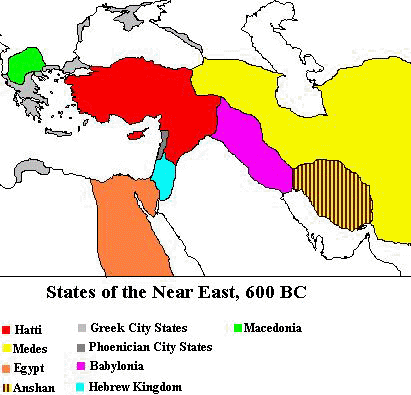
600-575
BC--Intermittent warfare between Babylonia and Hatti. Shortly after assuming
the throne, King Nebuchadnezzar II of Babylon wages war on Hatti in an attempt
to wrest
control of the trade routes through Syria and Palestine from the Hittite King.
Nebuchadnezzar makes nearly annual invasions of Syria, but his armies are
unable to
defeat those of the Hittite king, and he gains nothing. The struggle is very
exhausting for
both empires, and serious fighting peters out by about 588 BC. But a formal
peace treaty
is not finally agreed upon, based on status quo ante bellum, until 570 BC.
c. 600 BC--Confucious teaches in China.
597 BC--Death of King Arnuwanda IV of Hatti. He is succeeded by his son, who
reigns
as Tuwanuwa III.
594 BC--Solon founds the Athenian democracy. He is heavily influenced by his
observations of Egyptian society and law during a visit to Egypt a few years
before.ª
593 BC--Death of Pharaoh Necho II of Egypt. He is succeeded by Psamtik II.
590 BC--Death of King Tuwanuwa III of Hatti in battle against the Babylonians.
Tuwanuwa had no heirs at the time of his death, and he is succeeded by his
brother,
Sharkhurunuwa.
589-575 BC--Pharaoh Psamtik II of Egypt decides to take advantage of the
warfare
between Hatti and Babylon to sieze the Hebrew Kingdom. Egyptian armies invade
the
kingdom, and although the Hebrews fight valiantly, they are over-run. Psamtik
carries
King Eliakim of the Hebrews away in chains, and installs an Egyptian governor
in
Jerusalem. The Egyptians also land an invasion force on Cyprus, and sieze most
of the
island. However, Eliakim’s son, Jehoiachin, and his mother manage to escape
from the
Egyptians along with much of the Hebrew army, and take refuge with the Great
King of
Hatti. Finally, in 580 BC, as the war between Hatti and Babylon winds down,
King
Sharkhurunuwa of Hatti and Prince Jehoiachin of the Hebrews leads their armies
southward. They meet the forces of Egypt, now commanded by Pharaoh Wahibre, in
battle near Jerusalem, and the Egyptians are severely defeated. The allies
spend the next
five years reducing the fortified cities in the region still held by the
Egyptians, and in the
process learn that King Eliakim has died while in Egyptian custody. Jehoiachin
is
declared King of the Hebrews, and is restored to his kingdom in 575 BC. He
reaffirms
the long-standing alliance between his kingdom and the Great King of Hatti.
588 BC--Death of Pharaoh Psamtik II of Egypt. He is succeeded by his son,
Wahibre.
585 BC--King Cyaxares of the Medes dies, and is succeeded by Astyages.
585-583 BC--A final Scythian invasion causes great damage to the Median
kingdom
before they Scythians are finally defeated and forced to retreat back north of
the Caucasus
Mountains by King Astyages.
582 BC: The Pythian games are established in Delphi and the Isthmian games are
established in Corinth.
580 BC--First attempt by the Greeks to drive the Phoenicians out of Sicily.
The attempt
is unsuccessful.ª
c. 580 BC--Nebuchadnezzar II of Babylon, in addition to being a warrior king,
is a great
builder. In Babylon he builds eight monumental gates, the Esagila complex, a
seven-storey ziggurat, and the Hanging Gardens. The last of these will be
accounted one
of the seven wonders of the world.
579 BC--Death of King Eliakim of the Hebrew Kingdom while in the custody of
the
Egyptians. He is succeeded by his son, Jehoiachin.
576-570 BC--War between Babylonia and the Medes. King Nebuchadnezzar attempts
to
conquer the region of Anshan (the former Elamite homeland), which is ruled by
the
Persian Achaemenid Dynasty (who are, in turn, vassals of the Median kings).
King
Kambujiya (Cambyses) I of Anshan calls on his overlord, King Astyages of the
Medes,
for aid, and a six year war between Babylonia and the Medes is the result. The
Medes
make inroads into Babylonia’s northern territories, and King Nebuchadnezzar
concludes
peace with Hatti in order to devote his full attention to the Medes. He is
able to drive the
Medes out of his northern provinces, and a stalemate results. A peace treaty
is finally
signed in 570 BC.
576 BC Death of King Sharkhurunuwa of Hatti. He is succeeded by Tudhaliyas V.
574 BC--King Tudhaliyas V of Hatti signs a peace treaty with Pharaoh Wahibre
of Egypt.
Egypt renounces it’s claim to the Hebrew Kingdom in exchange for recognition
of
Egypt’s claim to Cyprus. Tudhaliyas agress to this in order to gain peace on
his southern
border, and finds the exchange well worth his while. The Great Kings of Hatti
will not be
troubled by further Egyptian incursions for a long time.
570 BC--Pharaoh Wahibre of Egypt receives an appeal for aid from the King of
Libya
against the Greek colony at Cyrene, which has, since it's founding in 630 BC,
had strained
relations with the native Libyans of the region. Wahibre leads an Egyptian
army
westward, but it is severely defeated by the Greeks of Cyrene. A revolt breaks
out
among the native Egyptian contingent of the army, where rumour has it that the
Pharaoh
intentionally lead them to defeat. As Herodotus would later write..."The
Egyptians
blamed him for this and rebelled against him; for they thought that the
Pharaoh had
knowingly sent his men to their doom, so that after their death his rule over
the rest of the
Egyptians would be strengthened. Bitterly angered by this, those who returned
home and
the friends of the slain rose against him.ӻAlso in this year, the first
coins are minted by
Athens.
569-566 BC--Civil War in Egypt. In response to the rebellion in the native
Egyptian
contingents of the army, Wahibre sends Ahmosi, his son and one of his most
trusted
generals, to negotiate with the rebels. But when Ahmosi arrives at the rebel
camp, the
rebels "put a helmet on his head from behind, saying it was the token of
royalty," and
declare him the new king. Ahmosi decides "it’s good to be the
king," goes over to the
rebels, and leads the rebel army against Wahibre. Wahibre rallies the
mercenary
contingent of the army and attempts to put down the insurrection with these
forces, but is
defeated and forced to flee from Sais. Ahmosi is crowned Pharaoh, and takes
the throne
as Ahmosi II. However, Wahibre I continues to claim the kingship, and gathers
another
mercenary army while in exile in Upper Egypt. Finally, in 566 BC, Wahibre I,
at the head
of his mercenary army, attempts to retake the throne of Egypt from Ahmosi II.
He is
defeated and killed.
569-525 BC--Reign of Pharaoh Ahmosi II in Egypt. Ahmosi drastically reduces
the
proportion of mercenaries in the Egyptian army and reduces the term of service
for native
troops, ending a continual problem with army revolts. Ahmosi also establishes
the
world's first income tax. According the Herodotus, he established a law that
"every year
each one of the Egyptians should declare to the ruler of his district, from
what source he
got his livelihood, and if any man did not do this or did not make declaration
of an honest
way of living, he should be punished with death." The new tax puts the
royal treasury on
a more stable footing than it has been in many centuries. Ahmosi also disposes
of the
goods of the temples as he sees fit. Just as the military nobles had been
neutralized by
absorbing many of them into the royal administration, the priests are turned
into officials
of the monarchy too, and their upkeep and that of their temples becomes the
responsibility of the royal treasury. The threat to the monarchy posed by the
power of the
priestly class is broken. Thus by the end of Ahmose II’s reign the
foundations have been
laid for a very stable, prosperous, and secure society.
565 BC--Death of King Tudhaliyas V of Hatti. He is succeeded by Mursili III.
562 BC--Death of King Nebuchadnezzar II of Babylon. He is succeeded by Amel
Marduk.
560 BC--King Amel Marduk of Babylon is assassinated by his brother-in-law,
Nergalsharusur, who usurps the throne. Also in this year, the temple of
Artemis at
Ephesus is built. This temple will eventually become one of the seven wonders
of the
world.ª Also in this year, King Jehoiachin of the Hebrews dies, and is
succeeded by his
son, Shealtiel.
559 BC--Death of King Kambujiya (Cambyses) I of Anshan. Kurush (Cyrus) II
comes to
the throne. Like his father, Kurush is a vassal of the Median king, Astyages.
556 BC--Death of King Nergalsharusur of Babylon. He is succeeded by his young
son,
Labashi Marduk. Labashi Marduk will enjoy a long and successful reign (in OTL,
he was
murdered within a year and the throne usurped by Nabonidus, who came from the
city of
Haran in the north and who seems to have been a commoner with no relation to
the royal
family. Since Haran is a Hittite city in this timeline and not a part of the
Babylonian
Empire, Nabonidus is not in Babylon to usurp the throne).
555 BC--Pharaoh Ahmosi II of Egypt invades and conquers the city of Cyrene in
Libya.ª
The region will be a permanent part of the Egyptian Empire for many years.
550 BC--Kurush (Cyrus) II of Anshan revolts against King Astyages of Media.
Astyages
is defeated and killed. Kurush takes control of the Median Empire, which will
henceforth
be known as the Persian Empire. Also in this year, Carthage allies with the
Etruscans
against the Greeks. A Carthaginian force led by Malchus defeats the Greeks in
Sicily, but
is vanquished in Sardinia. Malchus is banished, and in response marches on
Carthage, but
is caught and executed.
550-500 BC--La Tene culture develops; Celtic culture reaches its peak. Celtic
tribes
expand from their homeland in central Europe and begin moving east, south, and
west.
c. 550 BC--The Sabaeans of southern Arabia build a huge, earth-filled dam near their capital city of Marib,
which enables the irrigation of 250,000 acres of land. The population increase this allows
enables the Kingdom of Sheba to dramatically expand it's power in southwestern Arabia.
Also at about this time, the Nabataean Arabs of northern Arabia begin moving into the
land of Edom, causing many Edomites to emigrate northward. The Edomites are
gradually absorbed into the Hebrew population. However, the Hebrew Kings (and later
the Hittite Kings) prevent the Nabataeans from forming an independent state. Instead,
they form a trading class within the larger society of the region, serving as middlemen in
the frankincense and myrrh trade between the Sabaeans to the south and the Hittites and
other kingdoms to the north.
c. 550 BC onward--Carthaginian presence in the islands of Sicily and Sardinia.
Carthaginian colonies formed along coast of Africa, Algeria, Hadrumetum,
Leptis.
549 BC--Death of King Shealtiel of the Hebrews. He is succeeded by his son,
Josiah II
(in OTL named Zerubabbel...”Child of Babylon”...but since there was no
Babylonian
Captivity in this ATL, the child gets a different name).
547-544 BC--War between Hatti and Persia. In 547 BC, King Kurush (Cyrus) II of
Persia
attempts an invasion of Hatti. But the flexible and hard-hitting Hittite army,
under the
capable leadership of King Mursili III, severely defeats the Persians. Kurush
is severely
wounded, but manages to escape, and will survive his wounds. The following
year, and
each year thereafter, King Mursili III will invade the Persian Empire. The
Persians are
gradually pushed back out of the former lands of Urartu, and King Kurush
finally sues for
peace in 544 BC. A treaty is signed in which Persia cedes the former lands of
Urartu to
Hatti.
546 BC--The Tyrant Peisistratus overthrows democracy in Athens, and Sparta
forms the
Peloponnesean League.
543 BC--King Labashi Marduk of Babylon makes a treaty of alliance with King
Mursili
III of Hatti. The alliance is aimed at Persia.
540-539 BC--King Kurush (Cyrus) II of Persia invades Babylonia. His army
defeats that
of Babylon at the city of Opis, on the Tigris River (near the site of
present-day Baghdad),
and he lays siege to the city of Babylon itself. King Labashi Marduk calls on
his ally,
King Mursili III of Hatti, for aid. Mursili arrives outside Babylon with the
main Hittite
army in the spring of 539 BC, and a battle is fought in which King Kurush of
Persia falls,
struck down by a Hittite arrow. The Persian army is scattered, and the siege
of Babylon is
lifted. However, the Hittite/Babylonian forces also take heavy losses, and are
too
exhausted to follow up with an invasion of Persia. Although no formal treaty
is signed,
the war effectively ends.
539-532 BC--Civil War in Persia. The death of King Kurush II in battle outside
Babylon
has thrown the Persian Empire into turmoil. The Medes, under a prince who
claims
descent from King Cyaxares, revolt against the Persians. In addition, various
factions
within the Achaemenid royal house vie for power. Finally, however, one of the
sons of
King Kurush emerges victorious, and takes the throne as King Kambujiya
(Cambyses) II.
Kambujiya will suppress the Medes, reorganize the Persian empire and armed
forces, and
also re-orient the focus of Persian military efforts from the west to the
east. In
furtherance of the latter of these, he concludes a treaty with Hatti and
Babylon, officially
ending the war begun by his father in 540 BC.
535 BC--Carthage, with the Etruscans, destroys the Phocaean colony in Corsica
and
closes Sardinia-Corsica off to the Greeks.
530 BC--Pythagoras founds Mathematics. Also in this year, King Kambujiya
(Cambyses)
II of Persia launches the first of several invasions of India.
530-500 BC--Persian conquest of northern India. In yearly campaigns, King
Kambujiya
(Cambyses) II of Persia and his successor, King Darayavahush (Darius) I,
conquer most
of northern India, defeating the various native kings and incorporating their
kingdoms
into the Persian Empire.
529 BC--Death of King Labashi Marduk of Babylon. He is succeeded by his son,
who
reigns as King Nebuchadnezzar III.
c. 527 BC--Prince Siddhartha Gautama is enlightened and becomes the Buddha,
founding
a new religion.
525 BC--Death of Pharaoh Ahmosi II of Egypt. He is succeeded by his son,
Psamtik III.
c. 525 BC--The first Greek Tragedies are written. Among the writers are
Aeschylus,
Sophocles, and Euripides.
523-522 BC--Civil War in the Persian Empire. In 523 BC, King Kambujiya
(Cambyses)
II is killed in battle in India. Upon his demise, there is a struggle for the
succession to the
Persian throne. Gaumata, a pretender who claims to be a son of King Kurush
(Cyrus) II
named Smerdis who had actually been killed by Kambujiya some years earlier,
assumes
the throne, but is disputed by another prince of the Achaemenid House, who
finally
defeats Gautama in 522 BC and assumes the throne as King Darayavahush
(Greek--Darius) I.
521 BC--Death of King Mursili III of Hatti. He is succeeded by his son,
Hattusili Tesub
III. Hattusili Tesub III, who was a somewhat elderly man when he assumed the
Kingship,
dies later that same year, and is succeeded by his grandson, Suhis Tesub III.
Suhis Tesub
III’s father had been killed in a hunting accident shortly after Suhis Tesub
was born, and
therefore the new King is a minor child at the time of his succession. A civil
war breaks
out as one of the King’s cousins, Prince Talmi Tesub, contests his right to
the throne.
521-519 BC--King Nebuchadnezzar III of Babylon takes adantage of the chaos
caused by
the civil war in Hatti to sieze the lands between the Harbur and Euphrates
rivers. He lays
siege to the Hittite fortress city of Carchemish, but is unable to take the
city. The new
Hittite King Talmi Tesub, upon ascending the throne, signs a treaty
recognizing the
Babylonian title to the dispute region. Relations between Babylon and Hatti
are never
again to be good.
519 BC--End of the civil war in Hatti. King Suhis Tesub III of Hatti is
captured and put
to death (At the orders of Talmi Tesub, the unfortunate young king is
castrated and
allowed to bleed out, symbolizing the end of the old dynasty), and Prince
Talmi Tesub
usurps the throne, founding a new dynasty. The new king will reign as King
Talmi Tesub
I.
512-510 BC--King Darayavahush (Darius) I of Persia declares war on King
Nebuchadnezzar III of Babylon. Babylon’s army is defeated in battle by the
Persians near
the city of Nippur, and the Persians take Babylon itself in 510 BC.
Nebuchadnezzar III is
captured and put to death, and the Babylonian kingdom comes to an end,
absorbed into
the Persian Empire.
510 BC--Athens joins the Peloponesean League, and the temple of Ceres at
Paestum (in
Italy) is built. Also in this year, King Josiah II of the Hebrews dies, and is
succeeded by
his son, Abiud.
509-485 BC--Period of sporadic warfare between Hatti and Persia. King
Darayavahush
(Darius) I follows up his conquest of Babylon with an invasion of Hatti, but
is defeated
near Carchemish in 509 BC. The Persian King, who is a devout Zoroastrian and
considers it his mission to conquer for the glory of Ahura Mazda, will not
sign a treaty
with the Hittites, and a state of low-intensity warfare continues between the
two
empires...with periodic Persian invasions of Hatti and Hittite
counter-invasions of
Persia...for almost a quarter of a century, until Darayavahush finally dies in
485 BC.
Neither side gains much from these conflicts, which prove exhausting for both
empires.
509 BC--Revolution in Rome. The last Etruscan King, Tarquinius Superbus, is
expelled.
Founding of the Roman Republic.
508 BC--Attack on Rome by the Etruscan general Lars Porsena. Rome is able to
withstand the attack. Several Roman noblewomen, including Cloelia, swim the
Tiber
River to escape from Lars Porsenna and his men.ªAlso in this year, the last
of the Tyrants
is overthrown in Athens, and democracy is restored. Cleisthenes grants full
rights to all
free men of Athens.
507 BC--First treaty between Carthage and Rome.
506 BC--A planned invasion of Rome by ousted King Tarquinius Superbus and an
army
of Etruscans is defeated by the Latin League and Greeks lead by Aristodemos of
Cumae
in a battle at Aricia. Also in this year, a Roman noble named Horatius Cocles
stops an
invasion, when he bars the bridge into Rome. While he is defending the bridge,
the
consuls Sp. Lartius and T. Herminius chop it down to prevent the enemy
crossing.
Horatius swims, fully armored across the Tiber to safety.
505 BC--Death of King Talmi Tesub I of Hatti. He is succeeded by his son, who
reigns
as Suppliluliuma IV. Also in this year, a temple to Apollo is built at Delphi.
501-498 BC--Revolt of the Greek cities in Ionia (coastal Asia Minor). The
Greeks of
these cities call on their brethren in mainland Greece for aid. Only the city
of Athens
responds. But even with Athenian aid, the Greek forces are no match for the
military
power of the Great King of Hatti, and the revolt is crushed within three
years.
Beginning of a period of conflict between Hatti and the Greek city states of
mainland
Greece.
c. 500 BC--Celtic tribes begin moving into Britain.
Copyright 2004 by Robert Perkins. All rights reserved. Last updated 15 September 2004.