THE THIRD HITTITE EMPIRE
An Alternate History Timeline
by Robert Perkins
PART NINE: 1-100 AD
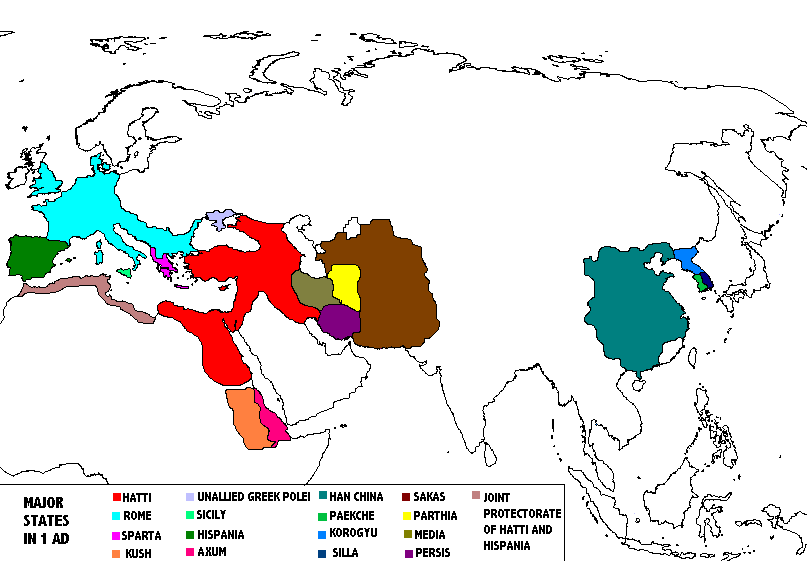
1-100 AD--Era of Relative Peace in the
Mediterranean Basin. Continued peaceful
relations between the two great regional powers...Rome and Hatti...lead to a
century of
near-peace in the region. That is not to say that there is no warfare in the
region at
all...just that the major powers are not involved in warfare against each
other. Both
empires use this time profitably to promote trade, conduct major building
projects and
expand infrastructure. The Era will be variously known by historians as the
Pax Romana
or the Pax Hattica
1-223 AD--During this time period, Rome will gradually move toward the
abolition of
slavery, as successive Dictators continue the reforms begun by Julius Caesar
and Mark
Antony and bring passage of laws increasing the proportion of free labor
required to be
employed by owners of large estates, mine owners, and other large users of
slave labor.
By the end of the First Century, seventy-five percent of the workers on
large estates and
in mining operations are required to be free laborers. This has the salutary
effect of
absorbing the large masses of unemployed who congregate in Roman cities,
living on the
public dole and occasionally rioting and causing other public disorder. By
the end of the
Second Century, this proportion will have increased to over 90%, and the
Roman Senate
will formally abolish slavery in 223 AD.
1 AD onward--Bantu migrations in Africa. The Bantu, iron-working
cattle-herders who
originated in the forests of west Africa, begin migrating south and east in
about 1 AD. In
a process that will consume the next 1,400 years, they will spread out over
most of
sub-saharan Africa, becoming the dominant population in most areas. The
first waves of
Bantu immigration will reach Natal (OTL South Africa) by 200 AD, and the
east coast of
Africa about the same time.
1 AD--Han Chinese Emperor Ai Ti dies and is succeeded by Ping Ti.
c. 1-98 AD--Gothic tribes migrate out of Scandinavia and into the regions of
OTL Poland
and Romania. In the region north of the Danube, they ally themselves with
the Dacians
and Sarmatians, and as a result by 50 AD raids across the Oder and the
Danube begin
which occupy much of Rome’s military resources for much of the latter
half of the
century.
2 AD--The Han Chinese Empire takes a census, revealing it is the most
populous nation
in the world at 57,671,400 souls.
3 AD--The term of the current Roman Dictator, Nero Claudius Drusus
Germanicus, is
coming to an end, and he is not standing for re-election. The Senate selects
Publius
Cornelius Scipio as his successor. Scipio will continue the reforms of Mark
Antony with
regard to the army. Laws passed during his term of office will remove all
military roles
from the various magistrates of the Republic (Consul, Praetor, Tribune,
etc.). Instead, a
military academy is established, where a professional officer corps will be
trained, and it
will be from this professional cadre that army commanders will be selected.
No more
will politicians be able to use the army as a springboard to political
power, and the quality
of generalship displayed by Roman commanders in the field will also improve
greatly.
5 AD--In recognition that his kingdom is no longer an expanded city state,
but a united
Greek nation, King Archidamus VI of Sparta declares that his kingdom will no
longer be
known as Sparta, but will instead be called Hellas...land of the Hellenes.
This
announcement is met with much enthusiasm throughout his realm.
6 AD--Death of King Warpalawa III of Hatti. He is succeeded by his son, who
reigns as
King Labarnash III. Also in this year, Han Chinese Emperor Ping Ti dies, and
is
succeeded by Ju-Tzu. Ju-Tzu is a minor child, and a Confucian Scholar named
Wang
Mang is named as Regent.
8-20 AD--Campaigns of King Labarnash III of Hatti against Kush and Axum.
Eager to
eliminate competition for the lucrative trade with India, and freed of
immediate threats
from Rome, King Labarnash III of Hatti invades the Kingdoms of Kush and Axum
in 8
AD. A series of campaigns spanning the next eighteen years will be required,
but both
kingdoms will be annexed by Hatti by 20 AD.
9-23 AD--The Han Chinese throne is usurped by Wang Mang, who declares the
foundation of a new dynasty, the Hsin Dynasty. Wang Mang hopes to win
support from
common people by reforms, and he issues decrees for the redistribution of
land, reduction
of the tax burden on poor peasants, reduced interest rates on loans,
formation of a state
granary to stabilize the price of grain, and the creation of a body of
officials to regulate
the economy and fix prices. Furthermore, he decrees that critics of his plan
will be
drafted into the military. He justifies all these reforms by claiming that
they are supported
by ‘The Lost Scriptures of Confucianism,” which Wang Mang claims
to have found.
However, gentry-bureaucrats and other owners of good-sized lands fail to
cooperate in
implementing Wang's reforms, and without newspapers or television, local
people remain
unaware of the reforms.
9 AD--The term of Roman Dictator Publius Cornelius Scipio is ending, and
once again,
the current Dictator is not standing for re-election. The Senate selects
Lucius Aemilius
Paulus as the new Dictator.
10 AD--Death of King Phillip I of Sicilia. He is succeeded by Cassander.
Cassander
abandons the relatively benign trade policies followed by his predecessors
and imposes
high tolls on ships passing through Silician waters, especially those of
Hellas and Rome.
Also at about this time, Buddhism makes it’s first significant
inroads in China.
11 AD--TheYellow River overflows it’s banks, leaving millions
homeless and creating a
widespread famine in the Chinese Empire which is made even worse by the
five-year
drought which follows. Emperor Wang Mang is unable to cope with the crisis,
and
rebellions break out all over China. The most dangerous of these is that of
the Red
Eyebrows (so called because it’s members paint their eyebrows red for
easy
identification).
12-23 AD--War between Hellas and Sicilia. In 12 AD, King Archidamus VI of
Hellas
declares war on Sicilia in retaliation against “Sicilian Piracy”
(actually, the imposition of
exhorbitant tolls on Spartan trade ships passing through Sicilian waters).
The nature of
the two antagonists being what they are, the war is primarily naval in
nature, and for the
most part is inconclusive. Rome secretly supports the Hellene war effort
against Sicilia,
however (although it does not declare war itself, not wanting to jeopardize
the profitable
relationship it has with Hatti), and the Sicilian fleet is finally defeated
in 23 AD. King
Cassander immediately sues for peace, realizing that if a Hellenic army
lands on his soil,
his kingdom is probably doomed. Cassander agrees to restore the low pre-war
tolls on
ships passing through Sicilian waters, and also agrees to pay Hellas
reparations of 10,000
talents of silver over ten years. King Leon II (who succeeded Archidamus VI
in 21AD) of
Hellas agrees to these terms, and the war ends.
15 AD--Roman Dictator Lucius Aemilius Paulus wins re-election to a second
term.
21 AD--Death of King Archidamus VI of Hellas. He is succeeded by Leon II.
Also in
this year, the term of Roman Dictator Lucius Aemilius Paulus comes to an
end, and the
Senate selects Tiberius Claudius Nero as his successor.
22 AD--The Red Eyebrows defeat the main Chinese imperial army at Liang.
23 AD--In the aftermath of the defeat by the Red Eyebrows, Wang Mang is
executed by
his own troops. Central authority collapses in China, and civil war breaks
out.
24 AD--Rebellion in Sicilia overthrows King Cassander. He is succeeded by
his nephew,
who reigns as King Dionysius I.
25 AD--General Liu Hsiu, who is distantly related to the royal family of the
old Han
Dynasty seizes the imperial throne as the Emperor Kuang Wu Ti, founding the
Later (or
Eastern) Han Dynasty. However, the country is still disunified, with
warlords holding
sway in various regions, a situation which will prevail for another decade.
26 AD--Death of King Labarnash III of Hatti. He is succeeded by his son, who
reigns as
King Hattusili Tesub V. The new king will not be military minded, but will
rather
concentrate on massive building projects throughout the empire, as well as
on expansion
of the Royal Library at Hattusas.
27 AD--The term of Roman Dictator Tiberius Claudius Nero is coming to an
end, and the
Dictator is standing for re-election. However, he has been somewhat
unpopular, and is
defeated. Instead, Lucius Cornelius Sulla Felix is selected.
29 AD--Death of King Dionysius I of Sicilia. He is succeeded by Spartacus
III.
c.30 AD--Kajula Kadphises unites all the tribes of the Yueh-Chih and become
the first of
the Kushan emperors.
c. 30 AD onward--The Yueh Chih, who had in the preceding century driven the
Sakas
southward from their homeland, themselves begin to move southward into the
Saka
Empire. They will defeat the Sakas and force them further southeast into
India.
Meanwhile, they will found their own empire, which will be named after their
ruler, who
is known as The Kushan. By the end of the century, it will include Bactria,
Gandhara,
and much of northern India.
30-33 AD--Yeshua called to ministry. 12 Disciples join him. Yeshua performs
various
miracles (healing the sick, blind, and lame, walking on water, converting
water into wine,
feeding a large multitude with a small number of loaves and fishes, and
raising the dead,
among others) and preaches a doctrine of peace, brotherly love, and
redemption through
the grace of God. He gains many followers, and comes to be seen as a threat
by the
Hebrew authorities in the Hittite province of Israel. Although Yeshua
himself does not
claim it directly, his Disciples begin spreading the word that Yeshua is the
long-awaited
Messiah.
31 AD--Frictions have been building between Hatti and Hispania over their
joint
administration of the former Roman north African provinces. In 31 AD the
Hispanian
Senate declares the treaty between Hatti and Hispania to be null and void,
and Hispania
declares that it is annexing the north African provinces. King Hattusili
Tesub V of Hatti
does not respond to this provocation, and Hittite troops are withdrawn
peacefully.
32 AD--A Parthian chieftain named Vologeses who is distantly related to the
old Arsacid
royal house seizes power in Parthia, throwing out the puppet regime imposed
by the
Hittites and Saka in the last century. Because Hatti is ruled by a
non-warlike king and the
Saka have their hands full fending off the Kushans, he is able to get away
with it.
Vologeses founds the Neo-Arsacid Dynasty. Vologeses will maintain friendly
relations
with Hatti.
33 AD--Roman Dictator Lucius Cornelius Sulla Felix is elected to a second
term. Also in
this year, Yeshua attacks vendors in Temple at Jerusalem during the Passover
celebration.
He is accused of Blasphemy by the Sanhedrin, tried, convicted and executed.
When His
body disappears from his tomb 3 days later, His Disciples claim to have seen
Yeshua,
risen from the dead, and begin making converts.
34-42 AD--War between Rome and Hispania. Roman Dictator Lucius Cornelius
Sulla
Felix has watched the recent events leading to the breakdown of the alliance
between
Hatti and Hispania with interest, and in 34 AD, he declares war on Hispania.
Roman
armies march south from Gaul, and in a grueling series of campaigns, they
defeat the
Hispanic armies and conquer Hispania. Not wanting Roman power to be
re-established
in Africa, King Hattusili Tesub V of Hatti sends troops to occupy the north
African
provinces which were just recently annexed by Hispania, and makes it known
that any
Roman invasion of these provinces will end the peaceful relationship between
Rome and
Hatti which has prevailed since the time of Mark Antony. Dictator Sulla
agrees, and no
Roman troops enter Africa. Hatti establishes the north African provinces as
an
independent buffer state under the rule of the Punic city of Utica.
34-40 AD--Vologeses of Parthia campaigns in Media and Persis, bringing both
of these
kingdoms under Parthian control.
36 AD--Emperor Kuang Wu Ti of China defeats the last of the warlords and
reunites the
country.
39 AD--Roman Dictator Lucius Cornelius Sulla Felix is elected to a third
term. Sulla
will, during this term, get some important laws passed, including a law
which extends the
franchise to the provinces. No more will voters in Roman elections be
required to be
physically present in Rome in order to vote...now citizens in the provinces
can vote at
their own provincial capital. This still limits the franchise to those who
can be physically
present in the provincial capital on election day, but it is a definite step
forward in truly
integrating the provinces into the Roman State.
40 AD--Most of the followers of Yeshua are driven out of Israel by the
Hebrew
authorities. Communities are formed in Syria, Mesopotamia, Asia Minor,
Egypt, Athens,
Arabia and Rome over the next few years. Converts in Greek-speaking areas
will give
Yeshua a new name...Jesus Christ...and His followers will be known as
"Christians."
The new religion begins to spread.
41 AD--Death of King Hattusili Tesub V of Hatti. He is succeeded by his son,
who
reigns as King Kushtashpi III. Kushtashpi will also be remembered primarily
as a
builder, but will conduct campaigns against the Sarmatian tribes to the
north of his realm
(in reply to Sarmatian raids into Hittite territory).
42-55 AD--Vologeses of Parthia campaigns against the Saka and the Kushans.
He is
generally successful, and retakes much of the territory lost to these
peoples in previous
times.
43 AD--Chinese armies conquer Annam (northern Vietnam).
45 AD--Death of King Kushtashpi III of Hatti in battle against the
Sarmatians. He is
succeeded by his son, who reigns as King Tudhaliyas VII. Tudhaliyas will
also
campaign against the Sarmatians, but most of his long reign will be spent at
peace. Also
in this year, the third term of Roman Dictator Lucius Cornelius Sulla Felix
comes to an
end, and he does not run for re-election. The Senate selects Paulus Fabius
Persicus as his
successor.
48 AD--Chinese armies drive the Hsiung Nu back to their homeland in
Mongolia.
49 AD--Death of King Leon II of Hellas. He is succeeded by Nicander II.
50 AD--The Chinese Empire allies itself with the southern Hsiung Nu tribes.
Also in this
year, the Xianbei (mounted archers) invade north China. Also at this
time, the southern Arabian kingdom of Qataban is conquered by the Himyaritic
Kingdom (with Hittite aid).
51 AD--The term of Roman Dictator Paulus Fabius Persicus comes to an end,
and the
Senate selects Titus Aurelius Fuluus as his successor.
52 AD--Death of King Spartacus III of Sicilia. He is succeeded by Dionysius
II.
55 AD--Death of King Nicander II of Hellas. He is succeeded by Pausanias
III. Also in
this year, King Vologeses of Parthia is killed in battle against the Kushans.
He is
succeeded by his son, who reigns as King Mithridates III. Like his father,
Mithridates
will cultivate friendly relations with Hatti while engaging in warfare
against the Saka and
the Kushans.
57 AD--The term of Roman Dictator Titus Aurelius Fuluus ends, and the Senate
selects
Gaius Marcus Antonius (grandson of Mark Antony) as the new Dictator. Gaius
will
follow in the footsteps of his great ancestor and will get many reforms
passed which will
strengthen the stability of the Republic while making it more inclusive.
Prime among
these is a law which allows the individual provinces to elect their own
Governors, rather
than having one appointed for them by the Dictator and Senate at Rome. He
also creates
provincial assemblies...mini-Senates, if you will...which will act as a
check on the
Governor’s power and pass legislation on local matters, so long as
provincial legislation
does not conflict with legislation passed by the Senate at Rome. The passage
of these
laws will encourage citizens of the provinces to begin to enthusiastically
identify with the
Roman State.
58 AD--Death of the Han Chinese Emperor Kuang Wu Ti. He is succeeded by Ming
Ti.
59 AD--Death of King Dionysius II of Sicilia. He is succeeded by Phillip II.
c. 68 AD--Wima Taktu, Kushan Emperor, conquers northern India.
60-100 AD--Christian Gospels composed and set down in writing.
63 AD--Gaius Marcus Antonius is re-elected to a second term as Roman
Dictator.
65 AD--Decebalus unites the Dacian tribes into a single kingdom. The Dacians
begin
raiding across the Danube, causing severe problems for Rome.
69 AD--Death of King Mithridates III of Parthia. He is succeeded by Arsaces
II. Arsaces
will, like his father and grand-father before him, continue to cultivate
friendly relations
with the Hittites while warring with the Saka and Kushans to the east. Trade
between
Hatti (terminus of the Pepper Route) and Parthia (terminus of the Silk Road)
reaches
unprecedented levels and greatly enriches both realms.
70 AD--Death of King Tudhaliyas VII of Hatti. He is succeeded by his son,
who reigns
as King Huzziya IV. Huzziya’s reign will be most taken up with
campaigns against the
Sarmatians to the north of his realm. Also in this year, Gaius Marcus
Antonius is elected
to a third term as Roman Dictator.
70-100 AD--Roman expansion on it’s northern frontiers. In response to
raiding by
Dacian, Gothic and Sarmatian tribesmen, Roman armies move across the Oder
and the
Danube in a series of campaigns that will last for 30 years and will see the
expansion of
Roman control to the Vistula and the Carpathians. Rome thus gains a
comparatively short
and more easily defended line of defense, which it proceeds to heavily
fortify. It also
absorbs the warlike Gothic, Dacian, and Sarmatian tribes which have been
troubling it for
so long. These peoples will be gradually Romanized, and will make fine
recruiting stock
for the Roman armies.
74-94 AD--The Kushans and other peoples of OTL Turkestan submit to Chinese
hegemony, helping caravan trade on the Silk Road.
76 AD--Death of the Han Chinese Emperor Ming Ti. He is succeeded by Chang
Ti. Also
in this year, Gaius Marcus Antonius steps down after his third term as Roman
Dictator.
Gaius Rutilius Gallicus is selected as the new Dictator.
79 AD--Death of King Huzziya IV of Hatti. He is succeeded by his son, who
reigns as
King Suppiluliuma VI. King Suppiluliuma will be a strong ruler, and under
his reign the
armies of the Hittite Empire will be reorganized, with the infantry
component of the army
being reduced in favor of an expanded force of heavy cavalry armed with
lance and bow
(cataphracts). The new army is proportioned as follows...30% Roman-style
heavy infantry
(short sword and pilum), 10% armored foot archers, 40% Cataphract cavalry,
20% light
horse archers. Death of King Pausanias III of Hellas, who is succeeded by
Eudamidas V.
Also in this year, the Five Classics of Confucianism are assembled in China.
c.80 AD--Wima Kadphises, the son of Wima Taktu, ascends the throne of the
Kushan
Empire.
82 AD--Gaius Rutilius Gallicus is re-elected to a second term as Roman
Dictator.
83 AD--Death of King Phillip II of Sicilia. He is succeeded by Cassander II.
84AD--An envoy from the Kushans asking for marriage to a Han Chinese
princess is
refused. This leads to hostility between the Han Chinese and the Kushans,
and by c.90
AD, Kushan emperors begin to encroach on the Han sphere of influence in the
Western
Regions.
88 AD--Gaius Rutilius Gallicus is defeated in his bid for a third term as
Roman Dictator.
The Senate selects instead L. Asinius Pollio Uerrucosus as his successor.
89 AD--Eighty-one Hsiung Nu tribes, totalling around 200 000, submit to
Chinese
suzerainty after a Chinese army kills 13,000. Also in this year the Han
Chinese Emperor
Chang Ti dies, and is succeeded by Ho Ti.
90 AD--Chinese campaign smashes the northern Hsiung Nu (Hun) tribes and
start the
tribes' migration to Europe.
92 AD--Death of King Arsaces II of Parthia. He is succeeded by his son, who
reigns as
Orodes II. Orodes II will abandon the pro-Hittite policies of his
predecessors and war
against Hatti.
93-97 AD--War between Hatti and Parthia. King Orodes II of Parthia invades
Mesopotamia in 93 AD. However, his army is defeated outside Babylon by
Hittite forces
lead by Crown Prince Urhi Tesub, and Orodes barely escapes with his life.
Orodes
invades again the following year, and this time defeats a Hittite army near
the city of
Nippur, after which he seizes control of most of Mesopotamia. But the
Parthian victory
will be short-lived, and in 96 AD, another Hittite army, again lead by Crown
Prince Urhi
Tesub, invades Mesopotamia. The Hittites meet the Parthians in battle near
the town of
Opis, and the Parthians are defeated. Mesopotamia once again falls into
Hittite control.
Urhi Tesub follows up with an invasion of Parthia the next year, and the
Parthians are
once again defeated, this time near Pasargadae. King Orodes II falls in
battle, and his
successor, King Artabanus III, sues for peace, due in large part to the need
to concentrate
his forces against invading armies from Han China. A treaty is signed later
that year,
establishing the border between the two empires.
94 AD--L. Asinius Pollio Uerrucosus does not run for a second term as Roman
Dictator,
and the Senate selects Gavius Silvanus as his successor.
95-98 AD--War between Parthia and the Han Chinese Empire. The armies of the
Han
Emperor Ho Ti are moving west along the Silk Road, and they finally reach
the borders of
the Parthian Empire. Fighting breaks out as the Parthians oppose the Chinese
advance,
but the Chinese are victorious, and by 97 AD have reached the shores of the
Caspian Sea
(although they do not stay). The new Parthian King, Artabanus II, sues for
peace, and in
98 AD a treaty is signed, establishing the border between the two empires.
King
Artabanus also agrees to give special preferences to Chinese traders and to
assist in
keeping down banditry along the Silk Road.
97 AD--Death of King Suppiluliuma VI of Hatti. He is succeeded by his son,
who reigns
as King Urhi Tesub III. Urhi Tesub is a strong king, with military
experience from the
recent war with Parthia, and Hatti will prosper under his reign. Also in
this year, King
Orodes II is killed in battle with the Hittites. He is succeeded by his son,
who reigns as
King Artabanus II.
100 AD--Buddhist texts are translated into Chinese. Also in this year,
Gavius Silvanus is
re-elected to a second term as Roman Dictator.
Copyright 2005 by Robert Perkins. All rights reserved. Last updated 8 February 2005.