THE THIRD HITTITE EMPIRE
An Alternate History Timeline
by Robert Perkins
PART NINE: 100-200 AD
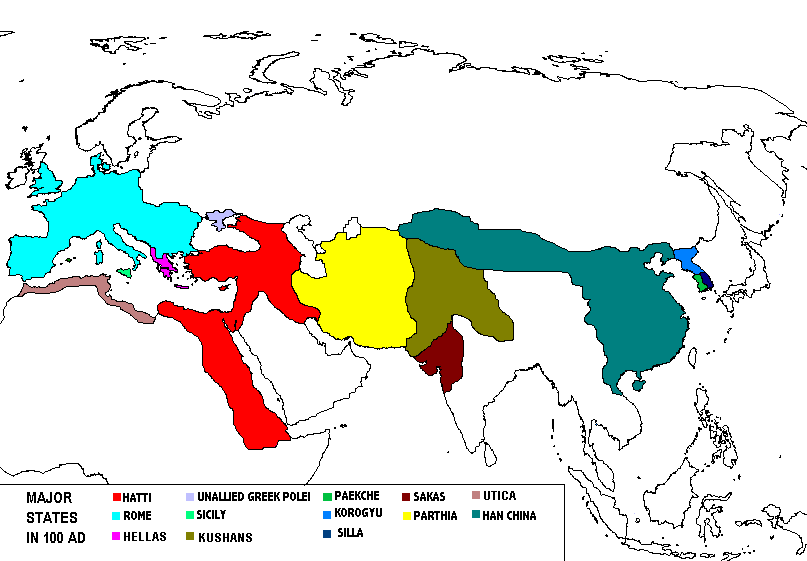
c.
100 AD--Christianity is spreading throughout the Near East. Thriving
communities
exist in the Hittite Empire, Parthia, Rome, and Hellas, and smaller
communities have
been established in the south Arabian kingdoms. In this ATL, adherence to the
State
religion is not a test used for treason (unlike in OTL Rome, where it was
expected that all
citizens make sacrifices to the Emperor as a show of loyalty), and so the
religion is
spreading somewhat faster than in OTL. One place where it is not spreading is
in India,
where a small sect barely maintains itself against persecution by the Hindu
authorities,
who do not willingly allow any competitive religion to thrive there. Another
place where
it is virtually absent is in it's original homeland, the Hittite Province of
Israel, where the
local Hebrew authorities severely persecute Christians.
Christianity's appeal has several sources. For some people the austere
morality of the
Christians is an attraction. Christians can point to the absurdities in many
traditional
religions, especially the worship of gods whose antics make them no guide for
morality.
Christianity also benefits from worship of someone with a human face...Jesus
having
been a common man and a martyr with a message, easier to worship than a god
that was
vague, unseen, unspeaking or a creature other than human. People can see their
own
suffering in the suffering of Jesus. Christianity also has an advantage in
being organized
and unified, and it benefits from its being open to people ignored or excluded
by other
religions: to women, non-citizens and slaves. In particular, Christianity
appeals to the
poor, an appeal aided by the claim that poverty was an advantage in attaining
salvation
after death. And becoming a Christian is less expensive than entering some
other faiths.
To be initiated into Great Mother Worship...a major rival to
Christianity...for example,
one has to bear the great expense of a bull that has to be slaughtered.
Conversion to
Christianity, on the other hand, requires only a free immersion in water. And
last but not
least, when one becomes a Christian, he or she joins a community that looks
after the
welfare of its members. Christians share their meals. They offer health care
(such as it is).
They share their wealth. They take care of the indigent among them, including
widows,
whom they call "Virgins of the Church."
100 AD--The Himyaritic Kingdom conquers the Hadramaut kingdom (with Hittite
aid),
making it the dominant state in Arabia. All of southern Arabia, and much of
the western
coast extending toward the Sinai peninsula, is under Himyaritic control,
giving the
Himyarites complete control of the frankincense and myrrh trade with the
north. They
retain their close alliance and trading relationship with the Hittites, to the
mutual profit of
both. The Hittites thus are able to obtain frankincense and myrrh at “wholesale”
prices,
and profit handsomely by re-selling it to Rome, Parthia, and other regional
kingdoms.
101 AD--Death of King Cassander II of Sicilia. He is succeeded by his son, who
reigns
as King Spartacus IV.
102 AD--Death of King Eudamidas V of Hellas. He is succeeded by Eudamidas VI.
105 AD--Ts'ai Lun invents paper in China.
106 AD--Gavius Silvanus steps down as Roman Dictator, and the Senate selects
Lucius
Licinius Sura as his successor. Also in this year, the Emperor Ho Ti of Han
China dies.
He is succeeded by Shang Ti.
110 AD onward--The Nabataeans, who have never been able to form an independent
state
of their own and who are increasingly deprived of the source of their
livelihood (the
caravan trade in frankincense and myrrh) by the Hittite/Himyarite alliance,
gradually are
forced to seek other employment in the local economies of the regions in which
they live.
By the end of the century, they will lose their identity as a separate group
and disappear
from history.
107 AD--Death of the Emperor Shang Ti of Han China. He is succeeded by An Ti.
112 AD--Lucius Licinius Sura is re-elected to a second term as Roman Dictator.
115 AD--Kushan Emperor Wima Kadphises dies, and is succeeded by Kanishka I.
Also
in this year, King Eudamidas VI of Hellas dies, and is succeeded by Leon III.
118 AD--Lucius Licinius Sura is re-elected to a third term as Roman Dictator.
c. 120 AD--Images of the Buddha begin appearing on Kushan coins for the first
time,
signifying their conversion to Buddhism.
123 AD--Death of King Artabanus II of Parthia. He is succeeded by Artabanus
III.
124 AD--Lucius Licinius Sura steps down from his post as Roman Dictator. The
Senate
selects Gavius Claudius Squilla as his successor.
125-134 AD--War between Hatti and Parthia. The long war is inconclusive, but
exhausting for both sides. It finally peters out without a treaty being signed
in 134 AD.
126 AD--Death of the Emperor An Ti of Han China. He is succeeded by Shun Ti.
128-132 AD--The Sicilian War. In 128 AD, King Spartacus IV of Sicilia dies
without
heirs, and upon his death, civil war breaks out in Sicily as several rival
claimants
(including the heirs of Crixis...the Gallic lieutenant of Spartacus during the
original slave
revolt which lead to the foundation of the kingdom of Sicilia nearly two
centuries ago)
vie for the throne. Rome sees the chaos in Sicilia...which because it was
founded by
escaped Roman slaves, has been viewed as a dangerous example to Rome’s
own
slaves...as an opportunity, and decides to intervene. Gavius Claudius Squilla,
Roman
Dictator, claims (falsely) to have received entreaties for aid from the
Crixines (the faction
supporting the descendants of Crixis), and in short order, a Roman army lands
in Sicily
near Syracuse. Within five years, the Roman army has established control over
the
island, and the Spartacid kingdom comes to an end. King Urhi Tesub III of
Hatti strongly
protests this clear violation of the treaty which ended the Spartacid War,
but, as he is
occupied in a war against Parthia at the time, takes no other action. The
Senate of Utica
and King Eudamidas VI of Hellas also protest, but declare their neutrality.
However, the
war does mark the end of the Pax Romana/Pax Hattica period of relatively
friendly
relations between Rome and Hatti which have existed over the past century.
129 AD--Death of King Urhi Tesub III of Hatti. He is succeeded by Urhi Tesub
IV.
130 AD--Gavius Claudius Squilla steps down from his post as Roman Dictator.
The
Senate selects Quintus Fabius Catullinus as his successor.
131 AD--Death of King Artabanus III of Parthia in battle against the Hittites.
He is
succeeded by Vologeses II.
134 AD--Roman Dictator Quintus Fabius Catullinus declares, in a speech before
the
Roman Senate, that “Rome will reclaim all the lands which, by right,
belong to it.” This
is clearly a reference to the north African state of Utica.
135 AD--A mutual defense treaty is signed between Hatti, Hellas, and Utica.
The treaty
is aimed at Rome, of course, whose recent aggressive actions in Sicily,
coupled with the
bellicose pronouncements of Dictator Catullinus in the Senate, have sent
shockwaves of
fear through all the neighboring powers.
136 AD--Quintus Fabius Catullinus is re-elected, on the strength of the recent
victory of
Roman arms in Sicily, to a second term as Roman Dictator.
139 AD--Kushan Emperor Kanishka I dies, and is succeeded by Vanishka.
140 AD--Death of King Urhi Tesub IV of Hatti. He is succeeded by Mursili V.
142 AD--Quintus Fabius Catullinus declines to run for a third term as Roman
Dictator.
The Senate selects Titus Hoenius Severus, who is a follower of Catullinus, as
his
successor. Rome’s aggressive stance will continue.
143 AD--Kushan Emperor Vanishka dies, and is succeeded by Huvishka.
144-155 AD--The Utican War. In 144 AD, Roman Dictator Titus Hoenius Severus
declares war on Utica, claiming that the Uticans are guilty of sponsoring
piratical acts
against Roman shipping (a charge which is completely false, of course). Roman
armies
cross into Utican territory from Hispania and Sicily, and Utica is quickly
placed under
siege. King Mursili V of Hatti and King Leon III of Hellas immediately declare
war in
the face of this naked Roman aggression. Neither power is able to immediately
intervene,
however.
In 145 AD, the Hittite/Hellene fleet raises the Roman blockade of Utica, which
allows
a seaborne supply line for the city to be opened. Utica thus is able to
withstand the
Roman siege. However, the Romans are able to also maintain a seaborne supply
line for
their own forces, and thus supply and reinforce their armies. Also in this
year, Hittite
armies move westward from Cyrenacia to the support of Utica in North Africa,
while
other Hittite armies join those of Hellas in an invasion of Rome's provinces
in Macedonia
and Illyricum. Fighting between the armies is inconclusive but bloody.
In 146 AD, the Hittites launch an invasion northward from their Caucasus
provinces,
aimed at taking the Greek cities of the Crimean region (which are, once again,
supporting
Rome). The cities are placed under siege. A Roman army moves north from Dacia
in
support of the Crimean Greeks, but is defeated and forced to retreat back to
Roman
territory. Inconclusive but bloody fighting continues in north Africa and the
Balkans, as
well as at sea.
In 147 AD, the Crimean Greek cities fall to the Hittites and are formally
annexed by
Hatti. A stalemate has settled on most of the other fronts.
In 148 AD, the poor progress and steady casualties coming out of the war cause
the
Roman Senate to reject Titus Hoenius Severus when he runs for a second term as
Roman
Dictator. The new Dictator, Slavius Julius Aemilianus, promises to prosecute
the war
more aggressively and to bring it to a victorious conclusion by the end of his
term of
office.
In 149 AD, Rome heavily reinforces it’s army in the Balkans and
inflicts a sharp
defeat on the Hittite/Hellene armies there, driving them out of Macedonia and
Illyricum.
It follows up by invading Hellas itself, penetrating as deep as Athens, which
it places
under siege. The Roman fleet defeats the Hittite/Hellene fleet in the Aegean
and
establishes a blockade of the city.
In 150 AD, Rome concludes a treaty of alliance with King Vologeses II of
Parthia,
who launches an invasion of Mesopotamia. In response, King Mursili of Hatti
concludes
an alliance with Emperor Huvishka of the Kushans, who begins to make inroads
on
Parthia’s Bactrian provinces. So, although the Parthians are initially
successful in their
invasion of Mesopotamia, they are forced to withdraw to meet the Kushan threat
before
the end of the year. However, the need to defend Mesopotamia is stretching
Hittite forces
thin, and the Hittites are unable to reinforce their armies in the Balkans or
in north Africa.
King Leon of Hellas attempts to raise the siege of Athens, but is defeated and
killed in
battle.
In 151 AD, Athens falls to Rome. The new Hellene King, Leonidas V, sues for
peace
shortly afterward. Roman Dictator Aemilianus offers harsh terms...all of
Hellas north of
the Isthmus of Corinth is to be ceded to Rome, with King Leonidas to be left
in control
only of the Peloponnesus. Hellas must abrogate it’s alliance with the
Hittites, and turn
over it’s navy to Rome. With the Hittites still unable to intervene in
the Balkans due to
continued fighting with the Parthians, Leonidas has little choice but to
agree.
In 152 AD, Rome heavily reinforces it’s army in north Africa, and
inflicts a sharp
defeat on the Hittite/Utican forces there. They are still unable to take Utica
itself,
however, which is supplied by sea, but occupy all the rest of the Utican
territories in north
Africa. Meanwhile, the forces of Hittite King Mursili and Kushan Emperor
Huvishka
inflict a devastating defeat on the forces of Parthian king Vologeses II.
Vologeses sues
for peace, and this is granted. The Kushans occupy parts of eastern Iran, and
the Hittites
take Elymais. The Romans attempt an invasion of Anatolia, but their fleet is
defeated in
the Aegean and the transports are forced to turn back.
In 153 AD, Hittite forces freed by the surrender of Parthia are transferred to
north
Africa, where they inflict a serious defeat on the Roman army besieging Utica,
raising the
siege.
In 154 AD, the Hittites and Uticans inflict further defeats on the Romans in
north
Africa, and by the end of the year the Romans have been all but driven out of
North
Africa. Roman Dictator Slavius Julius Aemilianus decides not to seek
re-election as a
result of these defeats. His successor, Tiberius Sextius Lateranus, promises
to end the
war.
In 155 AD, a peace treaty is signed which ends the war, basically recognizing
the
situation existing at the time. Rome is to keep it’s conquests in the
Balkans. The Hittite
annexation of the Crimea is recognized. Utica is to retain it’s
independence.
145 AD--Death of the Emperor Shun Ti of Han China. He is succeeded by Chung
Ti.
146 AD--Death of the Emperor Chung Ti of Han China. He is succeeded by Chih
Ti.
147 AD--Death of the Emperor Chih Ti of Han China. He is succeeded by Huan Ti.
148 AD--Titus Hoenius Severus is defeated in his bid for a second term as
Roman
Dictator. The Senate selects instead Slavius Julius Aemilianus as his
successor.
150 AD--Death of King Leon III of Hellas in battle outside of Athens. He is
succeeded
by Leonidas V.
154 AD--Slavius Julius Aemilianus does not run for re-election as Roman
Dictator. The
Senate selects Tiberius Sextius Lateranus as his successor.
155 AD--Kushan Emperor Huvishka dies, and is succeeded by Kanishka II. During
his
long and successful reign, Kanishka will expand Kushan rule into Uzbekistan,
Kashmir,
Punjab, and the Gangetic Plain. He moves the capital to Peshawar and promotes
Buddhism. In the process he will conquer the final vestiges of the Saka
kingdom, which
disappears from the map forever.
157-166 AD--The First Great Persecution of Christianity. Over the past
century,
Christianity has been quietly growing in numbers and influence, especially in
the Roman
Empire. Rome in OTL had an Emperor Cult, and the Emperors equated refusal to
participate in the State-sponsored worship ceremonies with treason. But in
this ATL, no
such Emperor Cult exists, and Christianity has generally been tolerated. But
in 157 AD,
Roman Dictator Tiberius Sextius Lateranus decides that Rome's recent
lack-luster
performance in the Utican War was due to the anger of the gods, and he issues
a
Proclamation directing all Roman citizens to make sacrifices to the official
Roman gods
(the Olympian Pantheon) by the end of August of that year. When the Christians
refuse
to do so, Lateranus declares them traitors and orders mass arrests. Christians
will be
martyred in large numbers and in many very imaginative ways over the next
several
years, but the bravery they display under these horrendous conditions
impresses many
people, and the religion grows despite the persecutions.
159 AD--Death of King Vologeses II of Parthia. He is succeeded by Tiridates
II.
Tiridates will be a relatively weak ruler, and will spend much of his reign
fighting
off...not completely successfully...incursions by the Kushan Emperor Kanishka
II.
160 AD--Tiberius Sextius Lateranus is re-elected to a second term as Roman
Dictator.
162 AD--Death of King Musili V of Hatti. He is succeeded by Suhis Tesub V.
Suhis
Tesub will spend much of his reign battling raiding Sarmatians...who are
secretly being
financed and supported by Rome. Death of King Leonidas V of Hellas. He is
succeeded
by Archidamus VII.
166 AD--Hittite merchants arrive in Tonkin, China. First direct contact
between the
Hittite and Chinese Empires. Also in this year, Tiberius Sextius Lateranus
does not seek
re-election as Roman Dictator. Licinius Fufidius Pollio is chosen by the
Senate as the
new Roman Dictator. Dictator Pollio orders the persecutions of the Christians
ended.
168 AD--Death of the Emperor Huan Ti of Han China. He is succeeded by Ling Ti.
During his reign, China begins to fall into chaos as a struggle for power
between the
imperial court eunuchs and the Confucianist gentry-bureaucrats begins. Renewed
attacks
by the Hsiung Nu tribes to the north will also take a toll, and China will
lose control of
the Tarim basin and it’s other conquests in the far west during his
reign. Also in this
year, King Tiridates II of Parthia dies, and is succeeded by Mithridates IV.
Like his
father, his reign will be mostly spent in fighting the rising power of the
Kushans to the
east.
170 AD--Death of King Suhis Tesub V of Hatti in battle against the Sarmatians.
He is
succeeded by Arnuwanda VI.
172 AD--Licinius Fufidius Pollio does not seek re-election as Roman Consul. He
is
succeeded by Marcus Aquillis Apollonaris. Apollonaris begins a Roman policy of
providing support to Numidian tribes who revolt against Utica, and for
Kushites/Axumites/Egyptians who revolt against Hatti.
175 AD--Dawn of printing occurs when ink-rubbings are taken of Confucian texts
carved
on stone tablets.
176-190 AD--Numidian revolts against Utica, supported by Rome. They are
ultimately
crushed, but Utica is weakened considerably by the destruction they cause.
177 AD--Kushite revolt against Hatti. Kushite rebels, with Roman financial
support, rise
up in Napata and Meroe. The rebellion is not successful, and is quickly
crushed. But
Hatti is forced to place more garrison troops in Kush.
178 AD--Marcus Aquillis Apollonaris does not seek re-election as Roman
Dictator. The
Senate selects Sergius Cornelius Scipio as his successor. Scipio continues his
predecessor's foreign policy vis-a-vis Hatti.
180 AD--Death of the Kushan Emperor Kanishka II. He is succeeded by Vasudeva.
181 AD--Roman Dictator Sergius Cornelius Scipio dies while in office. The
Senate
selects Lucius Fulvius Brutus as his successor to serve out the rest of his
term. Brutus
continues his predecessor's foreign policy vis-a-vis Hatti.
183 AD--Death of King Archidamus VII of Hellas. He is succeeded by Lycurgus
III.
Lycurgus secretly concludes a new treaty of alliance with Hatti against Rome.
184 AD--Lucius Fulvius Brutus is re-elected to a second term as Roman
Dictator.
184-189 AD--Revolt of the Yellow Turbans in Han China. A Taoist monk named
Chang
Tsu preaches that the Han Emperors have lost the Mandate of Heaven and will
soon be
overthrown. He gathers a large number of followers around him and in 184 AD
leads
them into revolt. Rebellions in sympathy to the Yellow Turbans begin to break
out all
over the Han Chinese Empire. In order to defend itself, the Han Dynasty
conscripts a
huge army, and authorizes local governors to organize their own armies to
combat the
rebels. Wealthy landowners also organize armies to defend themselves. Faced
with the
huge military power of the Han Emperor and his allies (the governors and the
landowners), the Yellow Turbans are essentially defeated within a year,
although there
will be sporadic outbreaks until 189 AD. However, in allowing the local
governors and
wealthy landowners to organize their own armies, the Han Dynasty has sown the
seeds of
it's own destruction. Fighting soon breaks out between rival warlords, in
defiance of the
Emperor's authority. Within forty years, the Han Dynasty will collapse and
China will
fragment once more.
185-199 AD--The Great African Revolt against Hatti. Spurred on by Roman agents
and
financial support, simultaneous rebellions break out in Egypt, Kush and Axum.
The
Hittite garrisons are thrown out, and the three provinces briefly establish
their
independence. But Hittite armies re-invade the area, supported by coastal
invasions by
the Himyarite allies of the Hittites, and in a series of grueling campaigns
lasting for over
ten years, the Hittites re-establish their control over the rebellious
provinces. But the
rebellion is very exhausting for the Hittites.
c. 185 AD--Taking advantage of the chaos in the Chinese Empire, the Kingdom of
Koguryo drives Han Chinese forces from northern Korea, and Vietnamese rebels
drive
the Chinese out of Annam. Death of King Mithridates IV of Parthia. He is
succeeded by
Mithridates V. Like his father, Mithridates V will spend most of his reign
campaigning
against incursions by the Kushans.
188-190 AD--The Great Bread Riots in Rome. Over the preceding decades, many
business owners...farm, factory, and mine owners...have been ignoring
regulations
regarding the proportion of slave labor allowed to be used by their
businesses. As a
result, unemployment has been steadily increasing as freemen have been thrown
out of
their jobs, replaced by slave labor. These unemployed men gravitate toward the
great
cities of the empire, where they can receive free bread from the government.
But in 188
AD, a poor harvest forces the government to temporarily suspend the bread
ration, and
riots break out in many cities around the empire, including Rome itself.
Repeated riots
will occur over the next two years as harvests continue to be poor.
190 AD--The Chinese invent the abacus. Also in this year the Emperor Ling Ti
of Han
China dies, and is succeeded by Hsien Ti. Also in this year, Lucius Fulvius
Brutus is
re-elected to a third term as Roman Dictator. During this term, a
law...strictly
enforced...requiring that slave labor comprise no more than ten percent of the
labor force
at any business (farm, factory or mine) is passed. In addition, a new Slave
Tax is passed,
to apply not only to businesses but also to private owners of slaves. This has
the effect
of drying up most of the large number of unemployed who are living on the
streets of the
empire’s major cities, and ending the rioting which has been plaguing
Roman society for
the past two years.
191 AD--Death of King Arnuwanda VI of Hatti. He is succeeded by Hantili IV.
196-199 AD--Civil War in Rome. In 196 AD, Lucius Fulvius Brutus runs for an
unprecedented fourth term as Roman Dictator, and wins. His opponents in the
Senate,
fearing that he plans to resurrect the post of Dictator for Life or even make
himself
King, have him assassinated. Riots break out in the streets of most major
Roman cities as
a result, and factions in the Senate at Rome appeal to various army generals
for aid. Most
generals remain neutral, as their army academy training teaches them to do,
but a few do
not, and fighting breaks out between the rival factions. It looks for a while
like the
Republic is about to relapse into the chaos which almost destroyed it two
centuries ago,
but a charismatic Roman Senator, Sextus Quintilius Rufinius, persuades the
neutral
generals to act in defense of the Republic and to put down the rebellious
generals...those
supporting both of the factions in the Civil War...in the name of the Roman
State. This is
accomplished by 199 AD, with the rebellious generals being either killed in
battle or
captured and executed, along with those Senators who participated in fomenting
the
rebellion in the army. In the aftermath, Sextus Quintilius Rufinius is
applauded as the
new Saviour of the Republic and is elected as the new Roman Dictator by
acclamation in
the Senate. He immediately introduces a bill to amend the Roman Constitution
to limit
the Dictator to no more than two terms, which is passed unanimously.
198 AD--Death of King Mithridates V of Parthia in battle against the Kushans.
He is
succeeded by Orodes II.
199 AD--Death of King Lycurgus III of Hellas. He is succeeded by Cleomenes V.
Sextus Quintilius Rufinius is elected as Dictator of Rome.
c. 200 AD--First use of the Runic alphabet in Scandinavia. Also at about this
time in
India, the Manu code prescribes the rules of everyday life and divides Hindus
into four
castes (Brahmins, warriors, farmers/traders, non-Aryans).
Copyright 2005 by Robert Perkins. All rights reserved. Last updated 8 February 2005.