THE THIRD HITTITE EMPIRE
An Alternate History Timeline
by Robert Perkins
PART NINE: 200-300 AD
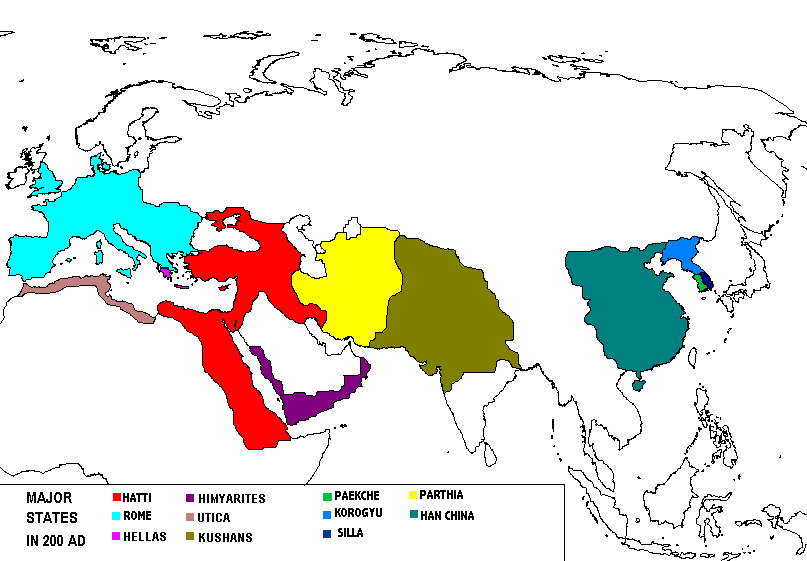
c. 200 AD onward--The various clans (uje)
of Japan are beginning to unite into small
states. Beginning of the process which will lead to a unified Japan.
c. 200 AD onward--Economic crisis in the Roman Empire. In the Third Century
A.D.,
the Roman Empire begins to experience an economic crisis which will have
dramatic
effects on the empire’s future. Although the development of the
governmental system of
the Republic, where civilian Dictators instead of military Emperors hold
sway, has
resulted in somewhat wiser economic policies...such as the gradual reduction
of slavery
as the basis for labor within the empire...the Dictators and Senate have
not, for the most
part, been markedly better at managing the economy of the empire than the
OTL
emperors. Many of the factors which lead, in OTL, to the beginnings of
decline of the
Roman Empire in the Third Century A.D. are still present in this timeline,
and in some
cases, worse than in OTL. Financially, Rome is in a worse position than in
OTL, as they
never acquired the rich provinces of Asia Minor, Egypt, and the Levant
which, in OTL,
provided much of the tax base of the empire. Also, the Hittites are
controlling the trade
in silks, pepper, frankincense, myrrh, and other exotic products from China,
India, and
Arabia, and Rome's trade deficit is thus even greater than in OTL. Heavy
taxation...necessary to fund the large Roman military establishment...has
forced men of
commerce to hoard their money rather than invest it. To pay soldiers, the
Dictators have
debased the money, and government has began paying its debts in money that
it does not
accept from citizens as payment of taxes. Prices skyrocket as a result,
forcing much of the
middle class into bankruptcy and even beggary. Much of the agricultural land
is unused,
as the families which own the land are forced to abandon their farms, and
cities and
towns begin shrinking as the people there begin migrating into the rural
countryside in
search of food. In some cases, these displaced people form into roaming
bands of
brigands, which leads to another important development...the beginnings of
what would
be called feudalism in OTL...as owners of large agricultural estates
threatened by roving
bands of brigands protect themselves by fortification and by raising their
own private
armies, and their neighbors surrender their holdings to them in exchange for
protection.
200-300 AD--Religious Developments. At this point, a brief discussion of
religious
development up to this time is in order.
--Development of Christianity. Christianity is continuing to grow in Rome,
Hatti, and
Parthia (and later Persia). The church is not as well organized as in OTL to
stamp out
heresy, however, and distinct variations of Christianity are thriving in the
various regions
(the Hittite empire itself is home to three...one based in Palestine and
Egypt, one in
Anatolia, and one in Mesopotamia). Disagreements about things such as the
nature of
Christ (was he human, was he divine, or a combination of the two), the
nature of the
Trinity (all manifestations of one entity, or three separate entities?), and
other major
issues divide the various churches from one another. In addition, there are
major
differences in the liturgy of the various churches, the type of baptism
performed, and even
which books of the New Testament are considered to be canonical.
--Zoroastrianism: Has continued much as in OTL, but has been limited in
large part to
Persia itself. The Parthians have been half-supporters of the faith, but
have also been
promoting Mithraism.
--Mithraism: Mithraism has spread from Parthia into the Hittite and Roman
Empires,
where it has gained many followers and is a major competitor of
Christianity.
--Hinduism and Buddhism: Hinduism remains extremely intolerant of other
religions in
this timeline, a legacy of the attempted suppression of Hinduism by the
Zoroastrian
Persians several hundred years ago. When the apostle Thomas went to India in
52 AD,
for example, he was almost immediately murdered by an angry Hindu mob and
Christianity never gained a foothold there as a result. Buddhism, although
promoted by
some kings such as the Mauryan Emperor Ashoka and the various emperors of
the
Kushans, has remained a very small and embattled sect in India. Buddhism
has, however,
gained many converts outside of India, in places like southeast Asia,
Ceylon, China, and
of course, among the Kushans.
--Yahwism: The national faith of the Hebrews continues to be practiced by
the Children
of Israel in Palestine. Small communities of Hebrews also live outside of
Palestine, and
they practice their faith in those distant lands. But Yahwism is very much
looked on as
the Covenant between God and the Hebrews...and not as a faith that can be
inclusive of
foreigners (Gentiles). The local religious authorities in Palestine are much
more powerful
than in OTL, and they quickly stamp out all dissent from the theological
"party line." In
part this is because the Hebrew Temple in Jerusalem, unlike in OTL, has not
been
destroyed. Partly because of the retention of northern Israelite influence
on the religion,
in the ATL Yahwism, unlike it's offshoot, Christianity, does not deny the
existence of
other gods...it simply declares that Hebrews are not to worship any other
gods save
Yahweh.
--Other religions: The Hittite, Egyptian, and Babylonian religions are still
being practiced
in their own homelands. At least one major religion...Manichaeism...has
never gotten
started because it’s founder, Mani, was never born in this timeline.
The Graeco-Roman
pantheon is still worshipped around the Mediterranean, as is the
Phoenician/Canaanite
pantheon (primarily in the lands governed by Utica and in the original
Phoenician
homeland ruled by the Hittite Empire). Celtic and Germanic tribal religions
in lands
under Roman rule are gradually fading into obscurity as these lands are
increasingly
Romanized. However, Germanic religion still survives in Scandinavia and
Celtic religion
survives in northern Britain and Ireland.
203 AD--Death of King Hantili IV of Hatti. He is succeeded by Tuwanuwa VI.
Tuwanuwa is a relatively strong king, and under his rule Hatti will prosper.
He will have
a mainly peaceful reign, and will conduct numerous public works projects
throughout his
realm. Among the most magnificent of these are huge aqueducts to bring
mountain water
to many of the cities of the realm. He also expands on the royal library at
Hattusas,
increasing it’s importance as a center of learning.
205 AD--Sextus Quintilius Rufinius is elected to a second term as Dictator
of Rome.
208 AD--The Battle of Red Cliffs is fought in China. Three powerful
warlords...Cao
Cao, Liu Bei, and Sun Kwan...have pretty much defeated their rivals and are
fighting for
supremacy in the country (while still nominally acknowledging the
overlordship of the
Han Emperor, Hsien Ti). Cao Cao has the largest army and fleet, but is
defeated by the
use of fire ships by the allied fleets of Liu Bei and Sun Kwan. Cao Cao does
not succeed
in uniting the country under his own rule.
211 AD--Having reached his statutory limit of two terms, Sextus Quintilius
Rufinius
steps down as Roman Dictator. The Senate selects Titus Claudius Severus as
his
successor. Severus will be an active Dictator, and will conduct campaigns
against
raiding Germanic and Celtic pirates from Scandinavia and Ireland. No
permanent
conquests will be added to the empire as a result of these campaigns,
however.
213 AD--Death of Kushan Emperor Vasudeva. At his death, the empire is
divided into
eastern and western halves. Emperor Kanishka III rules the eastern empire
from the city
of Mathura in northern India.
217 AD--Titus Claudius Severus does not run for a second term as Roman
Dictator. The
Senate selects Gaius Octavius Suetrius as his successor. Suetrius will
continue his
predecessor’s campaigning in the north.
220 AD--Beginning of the Three Kingdoms Period in China. In the aftermath of
the
Battle of Red Cliffs, three feudal states....Shu Han in the southwest, Wei
in the north, and
Wu in the southeast...have gradually formed within the Han Chinese Empire.
Up until
now, the warlords in control of these states have nominally acknowledged the
authority of
the Han Emperor, but in this year the last Han Emperor, Hsien Ti, abdicates
his throne,
ending the Han Dynasty. Shu, Wei, and Wu assume full independence. Liu Bei,
who is
distantly related to the old Han Dynasty, rules in Shu under the name
Chao-lieh Ti; Cao
Pei, son of Cao Cao who was defeated at the Battle of Red Cliffs and himself
a former
general under the Emperor Hsien Ti, rules in Wei under the name of Wen Ti;
and Sun
Kwan, another former Han general, rules in Wu under the name of Wu Ti. In
terms of
manpower, Wei is by far the strongest, retaining more than 660,000
households and
4,400,000 people within its borders. Shu has a population of 940,000, and Wu
2,300,000.
Thus, Wei has more than 58% of the population and around 40% of territory.
With these
resources, it is estimated that it could raise an army of 400,000 whilst Shu
and Wu could
manage 100,000 and 230,000 respectively: roughly 10% of their registered
populations.
The kingdoms of Wu and Shu will, within a few years, form an alliance
against Wei that
will prove itself to be a militarily stable configuration, and the basic
borders of the Three
Kingdoms will be almost unchanging for more than forty years.
223 AD--Gaius Octavius Suetrius is re-elected to a second term as Roman
Dictator. In
this year, the Roman Senate passes legislation abolishing slavery. It is the
first major
power in the world to do so.
224 AD--Rebellion in Persis. One of the Persian noble houses, the House of
Sassa, rebels
against the rule of the Parthian Neo-Arsacid Dynasty. King Orodes II of
Parthia is killed
in battle with the forces of the Sassanian King Ardashir I. Ardashir claims
the imperial
throne shortly afterward, and the Neo-Arsacid Dynasty comes to an end. He is
a devout
Zoroastrian, and immediately declares Zoroastrianism to be the official
State religion.
Under his sponsorship, the collection of Zoroastrian texts known as the Zend
Avesta will
be assembled.
225 AD--Death of King Tuwanuwa VI of Hatti. He is succeeded by Tuwanuwa VII.
Tuwanuwa VII will prove a weak king, and will rule shakily on his throne for
fifteen
years. Meanwhile, various factions are positioning themselves for the
inevitable power
struggle when he dies...
227-250 AD--Wars of the Sassanian Persian kings Ardashir I and Shapur I
against the
Kushans. The Persians, taking advantage of temporary Hittite weakness,
gradually
conquer most of the Western Kushan Empire. The strongly Zoroastrian Persian
kings
begin suppressing Buddhism in those regions.
229 AD--Since Gaius Octavius Suetrius is not eligible to run for another
turn, the Roman
Senate selects Appius Claudius Julianus as his successor. Appius Claudius
Julianus will
be remembered because he initiates the Second Great Persecution of
Christianity in
Rome.
230-235 AD--The Second Great Persecution of Christianity--Alarmed by the
growing
influence of Christianity within the Roman Empire, which is rapidly gaining
converts as
disaffected people are spurred by the growing economic crisis to seek
comfort in religions
that promise them well-being (as Christianity does), Roman Dictator Appius
Claudius
Julianus pushes through the Roman Senate a law outlawing Christianity and
making
annual sacrifice to the official Roman deities a requirement of citizenship
in the Roman
Empire. Julianus justifies this by claiming (falsely) that the Christians
are engaging in
cannibalism (a perverted interpretation of the rite of communion) and that
they are
responsible for the economic decline of the empire. Once again, Christians
are rounded
up in large numbers and imprisoned, tortured, and killed in many imaginative
ways, but,
as before, the faith emerges stronger and gains more converts despite the
persecution.
c. 230 AD onward--Shift of power in the state of Wei as rivalry between the
royal family
(Cao clan) and the powerful Sima clan erupts. By the end of the 230s, the
Sima family
will displace the Cao family as the de facto rulers of Wei, even though the
Cao family
still technically holds the throne.
232 AD--Emperor Kanishka III of the eastern Kushan Empire dies, and is
succeeded by
Vasishka II.
235 AD--Increasing disgust at the persecution of Christians by Appius
Claudius Julianus
leads to his defeat in his bid for a second term as Roman Dictator. Instead,
the Senate
selects Gnaeus Cornelius Paternus as his successor. Paternus immediately
pushes through
a bill to rescind the anti-Christian act of Julianus, removing the
requirement of sacrifice
to the Olympian gods as a condition of citizenship and ending the
persecutions. End of
the Second Great Persecution of Christianity.
239 AD--First recorded visit by a Japanese envoy to China.
240 AD-249 AD--Death of King Tuwanuwa VII of Hatti. Beginning of a period of
civil
war as Tuwanuwa’s sons, Anitta and Warpalawa, vie for the throne.
Anitta sets himself
up at Hattusas and declares himself to be Anitta IV, Great King of Hatti.
Meanwhile, his
brother sets himself up at Damascus and declares that he is Warpalawa IV,
Great King of
Hatti. The war which rages between them is very destructive, and does not
end when
Anitta is killed in battle in 245 AD. Anitta's faction instead rallies
around Prince
Wasuruma, who is a scion of the old royal family of the city of Kanesh who
is also related
to the current imperial family from Azatiwataya. Wasuruma finally defeats
and kills
Warpalawa IV at the Battle of Aleppo in 249 AD. Warpalawa's faction is
completely
destroyed, and Wasuruma is acclaimed as the new Great King of Hatti,
founding a new
Hittite Dynasty, the first of a family from a city other than Azatiwataya.
241 AD--Gnaeus Cornelius Paternus is re-elected to a second term as Roman
Dictator.
Also in this year, Shah Ardashir I of Persia dies, and is succeeded by
Shapur I.
241-245 AD--Dictator Gnaeus Cornelius Paternus of Rome takes advantage of
opportunity provided by the civil war raging in Hatti to invade Hellas and
Utica. Despite
valiant resistance by both, without Hittite support, Roman armies conquer
Hellas and
Utica by 245 AD, incorporating both into the Roman Empire.
244 AD--The Chinese kingdom of Wei conquers the Kingdom of Koguryo in Korea.
245-255 AD--The Great Plague ravages the Roman Empire. In 245 AD, Roman
soldiers,
returning from the campaign against Utica, bring back with them a mysterious
malady
which rapidly spreads along the excellent Roman road system and leaves
thousands dead
in cities throughout the empire. As much as 1/10 of the entire population of
the Roman
empire perishes in this first outbreak. Repeated outbreaks of the plague
will occur again
over the next ten years, but will be much less severe than the first
outbreak. When all is
said and done, the Roman population has been reduced by 1/6 from where it
stood in 245
AD. Labor shortages caused by the Plague will accelerate the economic crisis
within the
Roman Empire.
Neighboring states and peoples like the Hittite Empire will also be
affected, but to a much
lesser degree, by the Great Plague.
246 AD--Emperor Vasishka II of the Eastern Kushan Empire dies and is
succeeded by
Vasudeva II.
247 AD--Roman Dictator Gnaeus Cornelius Paternus is not eligible for
re-election, so the
Senate selects Marcus Acilius Aviola as his successor.
253 AD--Marcus Acilius Aviola is re-elected to a second term as Roman
Dictator.
255-260 AD--War between Hatti and Persia. In 255 AD, King Shapur I of Persia
invades
Mesopotamia. A series of bloody see-saw campaigns which will consume the
next five
years results. Finally, in 260 AD, Shapur's forces completely defeat the
main Hittite
army outside of the city of Nippur. King Wasuruma I of Hatti barely escapes
capture, and
sues for peace soon afterward. The war has been very exhausting for Shapur
as well, and
he agrees. Hatti cedes all of Mesopotamia and Elymais to Persia.
256 AD--Emperor Vasudeva II of the Eastern Kushan Empire dies and is
succeeded by
Kanishka IV.
259 AD--Marcus Acilius Aviola is not eligible for re-election as Roman
Dictator, so the
Senate selects Licinius Naevius Aquilinus as his successor.
263 AD--In China, the kingdom of Wei conquers the Shu Han kingdom.
264-271 AD--Revolts in Egypt, Kush, and Axum. Sensing the weakness of the
Hittite
regime after the devastating war with Persia, and secretly financed by Rome,
rebellions
break out in Egypt, Kush, and Axum. The Hittite garrisons are thrown out,
and King
Wasuruma I is unable to restore Hittite rule. Indeed, Wasuruma himself will
be killed in
271 AD while campaigning in Egypt.
264 AD--A new native Dynasty establishes itself in Egypt, the 27th Dynasty.
The
Dynasty is based in Thebes, under the rule of Pharaoh Nekhtnebef I.
265 AD--Licinius Naevius Aquilinus does not seek re-election as Roman
Dictator. The
Senate selects Publius Licinius Valerianus as his successor. Valerianus
tries to arrest the
growth of semi-feudal statelets within the empire by passage of laws
forbidding private
individuals from raising their own military forces, but given the continuing
economic
decline in Rome, he does not have the military power to fully enforce these
laws. In
China, Sima Yan, head of the powerful Sima family, deposes the last of the
kings of the
Cao family, the Emperor Yuan Ti of Wei, and usurps the throne of Wei. He
establishes a
new dynasty, the Tsin Dynasty, and reigns under the name of Wu Ti.
c. 270 AD--Hindu resentment at rule by the Buddhist Kushan Emperors has been
growing, and at this time a coalition of native princes under the leadership
of Prince Sri
Gupta of Magadha defeats and kills Emperor Kanishka IV and expels the
Kushans from
the entire region of the Gangetic Plain. Fall of the Eastern Kushan Empire.
However, the
victorious coalition soon falls to fighting among itself, and no new empire
immediately
establishes itself in northern India.
271 AD--Death of King Wasuruma I of Hatti in battle against Egyptian rebels.
He is
succeeded by his son, who reigns as Wasuruma II. Wasuruma II recognizes the
independence of Egypt, Kush, and Hatti. Also in this year, Publius Licinius
Valerianus is
re-elected to a second term as Dictator of Rome. Also in this year, the
magnetic compass
is invented in China.
271-301 AD--Period of dynastic struggle in Persia. In 271 AD, King Shapur I
of Persia
dies. At his death, civil war in Persia begins as his sons, Hormizd and
Bahram, each
declare themselves to be the new Shah of Persia. This will continue for the
next 30 years,
preventing the Sassanids from engaging in military adventurism outside their
own
borders.
272 AD--Roman Dictator Publius Licinius Valerianus orders an invasion of the
Egyptian
province of Cyrenacia. The Romans defeat the Egyptian garrison and capture
the region.
273 AD--Bahram I defeats the forces of Hormizd I to become the sole Shah of
Persia.
Hormizd is captured and executed.
276 AD--Bahram I, Shah of Persia, dies. He is murdered by his son, Bahram
II, who
takes the throne for himself. Bahram will spend most of his reign putting
down revolts
within his own empire, and will be too occupied to engage in military
activity outside his
own borders. Also in this year, Pharaoh Nekhtnebef I of Egypt dies, and is
succeeded by
his son, who reigns as Pharaoh Nefaarud I.
.
277 AD--Since Publius Licinius Valerianus is ineligible to run for another
term as Roman
Dictator, the Senate selects Titus Pomponius Bassus as his successor. Bassus
will try to
restore Rome’s economic fortunes by an old method...military
conquest. Roman armies
will advance northward in Britain and will also land in Ireland, bringing
those regions
under Roman rule. But unfortunately, these are relatively poor regions, and
their
conquest does little to improve the economic standing of Rome.
280 AD--Emperor Wu Ti of Wei conquers the Kingdom of Wu. All of China is
once
again united under the Tsin Dynasty. It will be only a temporary situation,
however. Also
in this year, attacks by the Sarmatians force King Wasuruma II of Hatti to
abandon the
Greek cities of the Crimea.
283 AD--Tiberius Pomponius Bassus is defeated in his bid for a second term
as Roman
Dictator. The Senate selects Junius Verius Lupus as his successor.
285-291 AD--Roman Dictator Junius Verius Lupus sends troops to annex the
Crimean
Greek cities which have been recently abandoned by Hatti. Roman forces also
conquer a
large area of the region known today as the Ukraine, subduing the turbulent
Sarmatian
peoples who live there.
287 AD--Death of King Wasuruma II of Hatti. He is succeeded by Hili I.
Unlike his two
rather undistinguished predecessors, Hili is a strong and militarily gifted
king, who comes
at a critical time in Hittite history.
289 AD--Junius Verius Lupus is re-elected to a second term as Roman
Dictator. He
begins making plans for war with Hatti.
290 AD--Shah Bahram II of Persia persecutes Christians in the Persian
Empire.
291-306 AD--War of the Eight Princes in China. Upon the death of Tsin
Dynasty
Emperor Wu Ti (Sima Yan), civil war breaks out between eight princes of the
imperial
Sima family...some sons of Emperor Wu Ti, others from more distantly related
branches
of the family. The war will be devastating, and will leave China's borders
open to
renewed attacks by the Hsiung Nu and other nomadic, non-Chinese tribes from
the north
(collectively known as the Wu Hu tribes).
292-298 AD--War between Rome and Hatti. In 292 AD, Roman Dictator Junius
Verius
Lupus declares war on the Hittite Empire. However, his expectations of an
easy victory
over the much-weakened Hittite Empire prove to be ill-founded. Rome's own
military
power has been greatly reduced over the course of this century by the
continuing
economic crisis, and the brilliant King Hili I of Hatti proves to be a very
troublesome
opponent. The Hittite fleet virtually annihilates the Roman fleet in the
Aegean, which
allows Hili to take an invading force into the Balkans. Meanwhile, strong
Hittite
defenses in the Caucasus region prevent a Roman invasion from the Ukrainian
regions
which they occupy. Hili is aided by popular revolts in many of the Greek
cities, who look
on Hili as a potential liberator from oppressive Roman rule. Hili skillfully
defeats every
Roman army sent against him, and liberates much of Macedonia, Epirus, and
Hellas from
Roman rule. When Dictator Lupus steps down in 295 AD, his successor will
seek to end
the war. A peace treaty is finally signed in 298 AD in which Rome is forced
to relinquish
control of the Greek cities, which are formed into an alliance of
city-states aligned with
Hatti. Hatti itself occupies Thrace. Macedonia and Epirus remain Roman
provinces.
293 AD--Shah Bahram II of Persia dies, and is succeeded by his son, Bahram
III.
However, Bahram III is soon murdered by a general named Narses...who is also
a
member of the royal family...who usurps the throne. Narses, like his
predecessors, is soon
involved in more dynastic infighting, and so in unable to intervene in the
Romano-Hittite
War.
295 AD--Junius Verius Lupus is ineligible to run for another term as Roman
Dictator, so
the Senate selects Gaius Annius Anullinus as his successor.
298-330--The recent defeat in the war with Hatti has caused much political
turmoil in the
Roman Empire. Rebellions break out in many regions as powerful, semi-feudal
local
lords rise up and attempt to shake off the rule of the Roman central
government. This
period of instability in Rome will last for over 30 years, and Rome will be
much changed
by the chaos which results.
c. 300 AD--The Kidarites, also known as the Red Huns, begin moving southwest
from
their former homes in the region of Mongolia. They will soon come into
contact with the
northern frontiers of the Sassanian and Kushan Empires. The Kushans will not
survive.
Copyright 2005 by Robert Perkins. All rights reserved. Last updated 8 February 2005