THE THIRD HITTITE EMPIRE
An Alternate History Timeline
by Robert Perkins
PART NINE: 400-500 AD
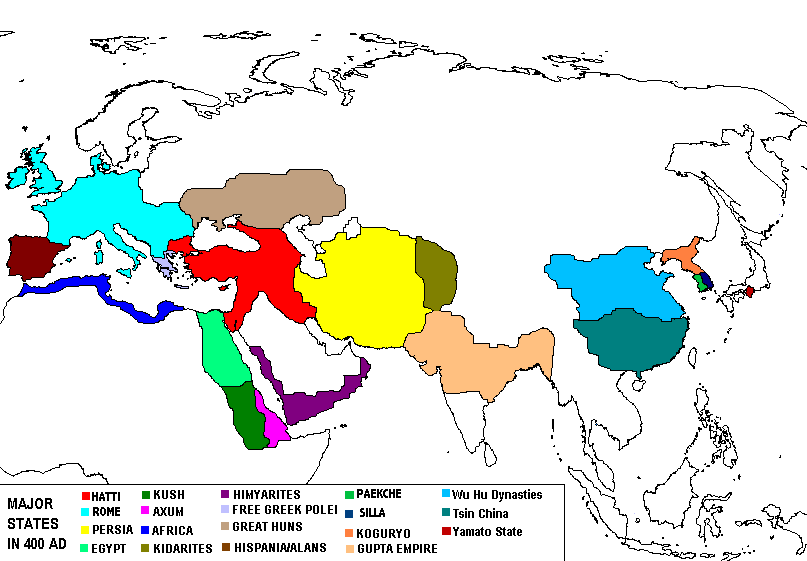
400 AD--King Alatey of the Hispanic Alans
dies, and is succeeded by Beler.
400 AD onward--The introduction of the printing press is having several
unintended
effects within the Hittite Empire. The various Christian sects of Hatti have
taken
advantage of the availability of inexpensive paper to spread their Holy
Books to a wider
audience. Christians set up schools throughout the empire, where prospective
converts
are given Bibles and taught to read. This not only has the effect of greatly
increasing the
growth of Christianity within the Hittite Empire (by the end of the century,
over 50% of
the population will be Christian), but also of greatly increasing literacy
within the Empire
(by the end of the century, literacy rates will be approaching 40% of the
entire population,
and will be growing each year). At the same time, the greater number of
literate people,
along with the availability of inexpensive paper, will lead, by the end of
the century, to
the proliferation of newspapers in the various cities of the Hittite Empire.
Many of these
newspapers will become organs for the voicing of dissent within the Empire,
expressing
the views of the educated bourgeoisie which, influenced by Greek ideas,
favor a more
democratic form of government within the empire. The printing press is also
spreading to
other countries as well. The first presses appear in Egypt, Rome, and Africa
by 450 AD,
and by the end of the century they will have spread to Persia and the Gupta
Empire as
well.
400-430 AD--The White Huns (Hephthalites) begin attacking the Red Hun (Kidarite)
kingdom and the Sassanian Persian Empire. Continuing White Hun attacks
destroy the
Kidarite (Red Hun) kingdom in Afghanistan by 430 AD. The remnants of the Red
Huns
move southward toward India. Persia is more successful in fending them off,
but this
consumes their military resources for the rest of the century, preventing
them from
becoming too adventurous in the west. The Great Kings of Hatti will take
advantage of
this to go on adventures of their own...
405 AD--Flavius Vincentius is elected to a second term as Roman Dictator.
Also in this
year, Flavius Sallustius, Dictator of Africa, dies and is succeeded by
Junius Hanno, a
powerful African noble of mixed Roman and Punic heritage. The constitution
of the
Republic of Africa, unlike the Roman Republic, does not have a term limit
for the
Dictator, which is essentially a “Dictator for Life” position. Hanno
will serve until his
death in 460 AD.
406 AD--Pharaoh Nefenankre II of Egypt and King Ella Wosen of Axum form an
alliance
against the kingdom of Kush. Their ultimate aim is to establish complete
control of the
Red Sea trade routes.
407-416 AD--The Egyptian/Axumite alliance conquers Kush, which is divided
between
Egypt and Axum.
407-410 AD--War between Persia and the Gupta Empire. Emperor Chandra Gupta
II of
India once again takes up the flame of holy war against the Zoroastrian
oppressors of
Hinduism and leads his armies across the border of Persia. A short,
three-year war
results, in which Chandra Gupta extends the frontier of his empire westward
into
Arachosia, but is not able to penetrate very far before being stopped by the
Persians. In
410 AD, Shah Yazdagird I of Persia sues for peace, as he needs to
concentrate his forces
against the incursions of the White Huns, and Chandra Gupta agrees, ending
the war.
408 AD--The Huns, under Khan Uldin, breach the Roman Vistula/Carpathian
line. They
ravage Rome’s provinces north and east of the Oder and Danube, but are
halted by the
second line of Roman defenses on those Rivers. The Huns settle down in the
plains of the
Carpathian basin. Roman control of all lands east of the Oder and north of
the Danube
effectively collapses at this time.
408 AD--King Beler of the Hispanic Alans dies, and is succeeded by
Respendial.
410 AD--Missionaries from the Republic of Africa convert King Respendial of
the
Hispanic Alans to Christianity. The realm of the Hispanic Alans becomes a
Christian
nation.
411 AD--Flavius Vincentius is ineligible to run for another term as Roman
Dictator. The
Senate selects Junius Quartus Palladius as his successor. Palladius will,
unsuccessfully,
attempt to reverse the tide toward feudalism which is gradually breaking up
the cohesion
of the Roman Republic. Also in this year, Khan Uldin of the Huns dies. The
Huns split
into two hordes, the Eastern Huns (ruled by Charaton, centered in the region
north of the
Black Sea) and the Western Huns (ruled by Mundzhuk Aybat, centered in the
Carpathian
Basin).
415 AD--Death of King Wasuruma III of Hatti. He is succeeded by Tuwatis II.
Tuwatis
will enjoy a long and successful reign, and will go down in history as
Tuwatis “the
Great,” in recognition of his brilliant military record and his wise
diplomacy. Also in this
year, Emperor Chandra Gupta II of India dies, and is succeeded by Kumara
Gupta I.
Kumara Gupta have a long reign, and will focus his energy on a campaign to
conquer
southern India, where various Buddhist dynasties rule. By the end of his
reign, these
dynasties will be destroyed, and Kumara will persecute the Buddhist
minorities in those
areas, virtually eradicating them. Thus, by the end of his reign, India’s
population will be
virtually 100% Hindu and all of India will be united under the rule of the
Gupta Empire.
417 AD--Junius Quartus Palladius is defeated in his bid for a second term as
Roman
Dictator. The Senate selects instead Lucius Heraclianus as his successor.
Heraclianus is a
feudal grandee, and reverses all the reformist legislation introduced by his
predecessor.
417-425 AD--The Red Sea War. In the aftermath of their successful conquest
of the
Kushites, Pharaoh Nefanankre of Egypt and King Ella Wosen of Axum agree that
their
next target will be the Himyarite kingdom. Conquest of the Himyarites will
give the
Egyptian/Axumite alliance complete control over the exits from the Red Sea,
and
effectively, over the Red Sea trade routes. In 417 AD, the Egyptians and
Axumites land
an invasion force near Aden, the major Himyarite port in the southwest
corner of Arabia.
The city is captured. The Himyarite King, Warau-amar Ayman, calls on his
long-time
ally, the Great King of Hatti, for aid, and not wishing to lose the vital
Red Sea trade, King
Tuwatis II of Hatti declares war on Egypt and Axum. Hittite armies move into
Egypt,
and the Hittite navy engages the Egyptian and Axumite fleets in the Red Sea.
In a
campaign lasting eight years, the Hittites and their Himyarite allies defeat
and conquer
Egypt and Axum. Hatti claims all of Egypt and most of the former Kush as
it’s
provinces, while the Himyarites lay claim to Axum (which is culturally and
ethnically
very similar to the Himyarite realm itself).
c. 420 AD--Khan Charaton of the Eastern Huns and Mundzhuk Aybat of the
Western
Huns both die at about this time. They are succeeded by Octar (Eastern Huns)
and Ruga
(Western Huns).
420 AD--The rule of the decrepit Tsin Dynasty ends in southern China when
the last Tsin
Emperor, Kung Ti, abdicates in favor of Liu Yu. Liu Yu founds the Anterior
Sung
Dynasty, taking the throne as the Emperor Wu Ti. Also in this year, Shah
Yazdagird I of
Persia dies and is succeeded by Bahram V.
420-589 AD--The end of the Tsin Dynasty in southern China, combined with the
unification of northern China a few years later, ushers in an age of
political weakness and
struggle for dominance in all of China. During this period the process of
sinicization
accelerates among the non-Chinese arrivals in the north and among the
aboriginal
tribesmen in the south. This process is also accompanied by the increasing
popularity of
Buddhism in both north and south China. One thing that weakened government
made
possible was basic cultural innovation. Buddhism had been introduced into
China during
the Han Dynasty, but took a while to catch on in China. Confucians would
really never
accept a teaching that advised people to abandon their families and become
dependents
on society, as Buddhist monks and nuns did. Basic Confucian hostility was
only
overcome by weakening of central authority with the now fragmented nature of
the
country, especially under the barbarian Northern dynasties, where
undiscriminating
"barbarian" tastes perhaps didn't know any better. Despite the
political disunity of the
times, there were notable technological advances. The invention of gunpowder
(at that
time for use only in fireworks) and the wheelbarrow is believed to date from
this period.
Advances in medicine, astronomy, and cartography are also noted by
historians.
423 AD--Lucius Heraclianus is elected to a second term as Roman Dictator.
429 AD--Lucius Heraclianus is ineligible for a second term as Roman
Dictator. The
Senate selects Gaius Flavius Agricola as his successor. Agricola, like
Heraclianus, is a
powerful feudal grandee who does nothing to stop the slow disintegration of
the Roman
state.
c. 430-440 AD--The Red Huns, retreating after their defeat by the White
Huns, begin
attacking the Gupta Empire, making incursions into the Punjab and Kashmir.
The Gupta
Emperors are able to contain these invasions, however, and by 440 AD, the
Red Huns
have been effectively obliterated.
432 AD--Khan Octar of the Eastern Huns is killed in battle with the forces
of Khan Ruga
of the Western Huns. Khan Ruga briefly unites all of the Huns under his
rule.
434 AD--Khan Ruga of the Huns dies. He leaves his realm to his two sons,
Bleda and
Attila, who jointly rule the Hunnic Empire.
435 AD--Gaius Flavius Agricola does not run for a second term as Roman
Dictator. The
Senate selects Julius Licinius Monoxius as his successor. Monoxius is an
opponent of
the grandees and tries to curb their power, but with little success.
439 AD--End of the Period of the Sixteen Kingdoms in China. In northern
China, the last
remaining survivors of the Wu Hu “Sixteen Kingdoms” are fighting for
total dominance
of northern China. The Northern Wei Dynasty defeats and conquers it’s last
remaining
contender, the Northern Liang Dynasty, unifying northern China under one
rule and
ending the Period of the Sixteen Kingdoms. The Northern Wei will be the
first of six
Northern Dynasties which will rule in north China over the next 150 years.
Also in this
year, King Respendial of the Hispanic Alans dies, and is succeeded by
Sangiban. Also in
this year, Shah Bahram V of Persia dies and is succeeded by Yazdagird II.
Yazdagird
will be primarily notable for his persecutions of Christians and other
religious minorities.
440 AD--For some years, Christian Missionaries have been visiting the Huns,
making
conversions and trying to woo the Huns as an ally against Rome, which is
controlled by
an irredentist pagan faction which is severely persecuting Christianity in
territories held
by Rome. In 440 AD, Khan Attila of the Western Huns converts to
Christianity...not so
much because he has genuinely accepted Christian belief, but because he sees
this as a
means to an end...the conquest of Rome.
441 AD--Julius Licinius Monoxius is defeated in his bid for a second term as
Roman
Dictator. The Senate selects Petronius Maximus as his successor. Maximus is
a genial
non-entity supported by the grandees, and during his tenure, Rome slips
further toward
the abyss. He will be the last Dictator of Rome.
444 AD--Khan Attila arranges to have his brother, Bleda, die in a “hunting
accident.”
Attila takes over as sole ruler of the Huns. He shortly afterward begins
negotiating with
the Republic of Africa, the Hispanic Alans, and the Hittites for alliances
against Rome.
446-450 AD--In 446 AD, Khan Attila of the Huns begins to attack the
tottering Roman
Republic. The Dictator, Petronius Maximus, tries to rally the people in
defense of the
Republic, but the process of disintegration has gone too far and very few
respond.
Christians throughout the Republic, including many powerful feudal warlords,
rise up in
support of the Huns. The result is a bloody civil war among the Romans which
severely impairs their ability to defend themselves against the Huns.
Rome’s fate is
sealed when the Christian Republic of Africa, King Tuwatis II of Hatti, the
Greek Polei
allied to Hatti, and King Sangiban of the Hispanic Alans also declare war on
Rome. The
city of Rome itself falls to the invaders in 450 AD, and is sacked and
burned. With the
destruction of Rome, the Roman Republic effectively comes to an end. In some
places...Britannia, Hibernia, and northern Gaul...local Roman warlords
establish Roman
successor states. But most of the Republic’s territory is taken as the
spoils of war by the
conquerors. Hatti takes most of the Balkan provinces, the Huns take Pannonia,
Germania, and Northern Italy, the Alans take southern Gaul, and Africa takes
Southern
Italy, Sicily, Sardinia, and Corsica.
447 AD--A terrified Senate re-elects Petronius Maximus to a second term as
Roman
Dictator, largely because nobody else cares to take responsibility for what
looks to be the
final collapse of the Republic.
450 AD: The Juan-juan (Avars) attack northern China, where they are defeated
by the
Northern Wei Dynasty. Also in this year, the Huns capture and sack Rome, and
the city is
razed to the ground. Petronius Maximus, the last Dictator of Rome, is
captured and
brought before Attila. He pleads for mercy, but Attila has none to give.
Maximus is
flayed alive, and, after the skin is tanned, Attila uses it as a saddle
blanket for his war
horse. This display of raw barbarity shocks many of Attila’s allies as
well as his enemies.
c. 450 AD--The Alchon Huns, a branch of the White Huns, begin to move
southward into
India, where they clash with the armies of the Gupta Empire in the Punjab
and Kashmir.
They are defeated and retreat northward, rejoining the main body of the
White Huns in
Afghanistan. At about this time, the White Huns convert to Zoroastrianism.
451 AD--Khan Attila of the Huns, flush with his victory over the Roman
Republic,
begins eyeing the Hittite lands south of the Danube as the next stop on his
road of
conquest. Hunnic raiders begin crossing the Danube, where they clash with
Hittite forces.
452 AD--With the Huns making threatening moves on his northern border in
Europe,
King Tuwatis II of Hatti offers one of his nieces, a very beautiful princess
named
Puduhepa, as a bride to Khan Attila of the Huns, along with a large payment
in gold, in
exchange for a treaty of peace. Attila accepts.
453 AD--Khan Attila of the Huns and Princess Puduhepa of Hatti are married
at the
Hunnic capital in Pannonia. Attila suffers a nosebleed on his wedding night
and drowns
in his own blood...or at least that is the official story. Actually, he was
assassinated by
order of King Tuwatis II of Hatti, by Princess Puduhepa, who administered a
rare Hittite
herb to Attila in a goblet of wine which rendered him unconscious, and then
smothered
him with a pillow. Puduhepa, appropriately distraught, was found with the
body the next
morning, and suspicion never fell on her. She was later allowed to return to
the Hittite
Empire, where, curiously...or maybe not so curiously...she was never able to
find a man
willing to marry her.
453 onward--Upon the death of Attila, the Hunnic Empire falls apart as civil
war breaks
out among the various sons of Attila. The subject tribes, such as the Goths
and Northern
Alans, go into revolt, as do many of the former Roman feudal warlords in
various
regions. By the end of the century, a patchwork of successor states will
have arisen in the
former Hunnic domains. The Goths will establish two states...the North Goths
in what is
OTL Poland, and the South Goths in northern Italy. The Northern Alans will
found a
state to the east of the North Goths. A sub-Roman state will take control of
the province
of Germania, ruled by a set of powerful Roman feudal grandees. The Huns
themselves
will fragment into five separate hordes...the Western Huns, the Altyn Oba
Huns, the
Kutriger Huns, the Utriger Huns, and the Kremeri Huns. None of these
successor states
will be very powerful, and all of them will be pretty much constantly at war
with each
other.
455 AD--In the aftermath of the war which ended the Roman Republic, King
Tuwatis II
of Hatti decides to take steps to withdraw from his new vulnerable provinces
in Europe,
while leaving them in the hands of a friendly power which will cooperate
with Hatti, as
necessary, in the future. The logical candidate is the Greek Polei, and at
the urging of
Tuwatis, representatives of the Greek Polei meet on the island of Rhodes to
discuss the
formation of a new Hellenic State. Representatives of cities and provinces
from
Macedon, Thrace, Epirus, and Illyria are also invited to this meeting, and
under the
guiding hand of Tuwatis, a new government is formed. The Greek state will be
a
republic. Laws for the republic will be made by a Legislature, called the
Hellenic
Assembly, with equal representation for each city and province of the new
country. As in
the old Delian League, a chief magistrate called an Archon will be elected
to serve a four
year term. The Archon will be the chief executive and head of state, and
have command
of the army. Each administrative unit of the Republic (city or province)
will be bound to
raise a certain number of troops for the standing army and navy of the
Republic, based on
it’s population. All of these troops will be equipped to the same
standard, as specified by
the Hellenic Assembly. King Tuwatis approves of this new government, and the
Republic of Hellas is officially recognized by Hatti in the following year.
Also in this
year, Emperor Kumara Gupta I of India dies, and is succeeded by Skanda
Gupta. Skanda
Gupta continues his father’s policies vis-a-vis the Buddhist minorities of
Southern India.
456-458 AD--Following the official recognition of the Republic of Hellas by
King
Tuwatis II of Hatti, the Hittites withdraw their troops from Europe over the
next two
years. The Republic of Hellas signs a mutual defense treaty with Hatti.
457 AD--Death of Shah Yazdagird II of Persia. He is succeeded by Hormizd
III.
Hormizd’s short reign will be consumed with civil war between himself and
his brothers,
and with fighting the incursions of the White Huns.
459 AD--Death of King Tuwatis II “the Great” of Hatti. He is succeeded
by Anitta V.
Anitta will not be a powerful ruler compared to his father, but fortunately
for him and
Hatti, the surrounding powers will be too busy with their own squabbles to
interfere too
much in Hittite affairs during his reign. Also, in this year Shah Hormizd
III of Persia is
killed in battle with forces lead by his brother, Peroz, who is in league
with the White
Huns. Peroz takes the throne and reigns as Shah Peroz I. Peroz will spend
most of his
reign under the domination of the White Huns, making several unsuccessful
attempts to
regain full independence from them.
459-465 AD--War between the Hispanic Alans and Gallia. King Sangiban of the
Hispanic Alans invades the sub-Roman state of Gallia in 459 AD, sparking a
six-year
war. The war finally ends when Sangiban himself is killed in battle with
Gallic forces on
the River Seine. His successor, Respendial II, takes an offer of tribute
from the Gallic
Confederation (the coalition of Roman feudal grandees which rules the
sub-Roman state
of Gallia) and agrees to end the war. A treaty is signed which establishes
the border
between the two states.
460 AD--Death of Dictator Junius Hanno of the Republic of Africa. He is
succeeded by
Maximian Licinius Sallustius, grandson of former Dictator Flavius Sallustius.
467 AD--Emperor Skanda Gupta of India dies, and is succeeded by Kumara Gupta
II.
470-490 AD--The White Huns launch a massive invasion of India. They
devastate much
of the Ganges basin, including the Gupta capital at Palatiputra. But the
Gupta Emperors
continue to fight against them, and using the fact that the White Huns have
converted to a
form of Zoroastrianism as a rallying cry to the Hindu population of India,
they manage to
expel the invaders after twenty years of hard fighting.
477 AD--Emperor Kumara Gupta II of India dies in battle against the White
Huns, and is
succeeded by Budha Gupta.
479 AD--The Anterior Sung Dynasty ends in southern China, replaced by the
Southern
Ch’i Dynasty. Also in this year, King Respendial II of the Hispanic Alans
dies, and is
succeeded by Beler II.
481 AD--Death of King Anitta V of Hatti. He is succeeded by Mursili VI.
Mursili is
more in the mold of his great grandfather, and Hatti will prosper mightily
under his rule.
Mursili is also important in another regard...he is a Christian, the first
such to become
Great King of Hatti. Mursili belongs to a Christian sect which espouses
ideas close to
those which in OTL would be called Nestorianism. This church argues that
Jesus had
two natures...human and divine. According to this creed, God the Father
incarnated a
portion of Himself as Jesus, becoming human in the process. When Jesus
returned to His
Father’s side after his death as a human being, He resumed His divine
nature. Thus, while
on earth, Jesus was human, but once returned to Heaven, he became divine.
And nearly
as importantly, Mary was the mother of the human man, Jesus, but not the
mother of God.
This is in contrast to various monophysite creeds in the Hittite Empire
which argue that
Jesus had only one nature...Divine...and that Mary was therefore the mother
of God. It
contrasts as well as with the Roman Orthodox creed, which forms the basis of
several
sects within the Hittite Empire, which argues that Christ had two
natures...human and
divine...but also argues that Mary was the mother of God, not merely of the
human man,
Jesus. While Mursili does not try to impose his belief on the empire as a
whole, he does
begin to work toward the consolidation of the various Christian faiths in
the Hittite
Empire into one unified Hittite Church, holding several ecumenical councils
during his
reign which attempt to hammer out the differences between the various sects.
He will not
succeed during his reign, and indeed, the effort he begins will never be
entirely
successful, but great strides toward a single orthodoxy will be made.
483 AD--Death of Dictator Maximian Licinius Sallustius of the Republic of
Africa. He is
succeeded by Theophanes of Hippo, a Greek citizen of Africa. Theophanes
steps up the
persecution of the few remaining pagans in the Republic, mostly in the newly
conquered
provinces of Sicily, Sardinia, Corsica, and southern Italy.
484 AD--Since taking the throne, Shah Peroz I has found himself dominated by
the White
Huns, and has fought several wars against them, all unsuccessfully. In 484
he raises a
large army and advances against them, but his luck holds true to form, and
his guides lead
his army into a barren desert, where Peroz and his entire army perishes. He
is succeeded
by his brother, Balash.
484-486 AD--The White Huns plunder and sack at will throughout the Persian
Empire
until a respected Persian noble, Zahrmir of the House of Karen, drives the
White Huns
out and raises the brother of the unfortunate Shah Peroz I to the throne in
486 AD. The
brother rules as Shah Balash.
488 AD--Shah Balash of Persia, who has proven to be a mild and generous
monarch at a
time when a ruthless one is required, is deposed and blinded. The throne is
usurped by
his nephew, who reigns as Shah Kavadh I. Kavadh, in an attempt to break the
power of
the great nobles of Persia, gives support to a communistic Zoroastrian sect
called the
Mazdakites, which preaches that the rich should divide their wives and
wealth with the
poor. Needless to say, this causes much dissension among the nobility.
490 AD onward--Defeated in their attempt to conquer India, the White Huns
once again
focus their attentions on Persia. They also begin expanding eastward, into
the Tarim
Basin region. Theophanes of Hippo, Dictator of Africa, is assassinated by
unknown
persons as he is returning home from religious services. He is succeeded by
Julius Lucius
Barca, another citizen of mixed Roman and Punic heritage. Barca declares the
pagans
responsible for the assassination of Dictator Theophanes, and during his
reign, the last
remaining pagans in the Republic will be either exterminated or forced to
flee. Africa
will become the world’s first 100% Christian state.
491 AD--King Mursili VI of Hatti issues an Imperial Edict formally
abolishing slavery
throughout the Hittite Empire. This was not as dramatic a step as it might
seem, as
slavery, as an institution, has been slowly dying out in the Hittite Empire
for centuries
due to some quirks in Hittite law. Under Hittite law, slaves may amass
private wealth,
the possession of which has gradually eroded the barriers between slaves and
free men in
Hittite society and allowed increasing numbers of slaves to purchase their
own freedom.
Furthermore, a Hittite slave may marry a free person legally without
depriving his spouse
of the rights of his/her free birth. The children of such unions are all
granted freedom
upon reaching adulthood. The combined effects of these two idiocyncracies of
Hittite
Law has been to gradually reduce the number of slaves over the centuries to
the point
where very few slaves remain in the Hittite Empire anymore. Mursili, in
issuing his
Imperial Edict, simply recognizes what has become a virtual fait accompli
within his
empire.
496 AD--Emperor Budha Gupta of India dies, and is succeeded by Chandra Gupta
III.
Chandra Gupta will spend his reign rebuilding his Empire, repairing the
damage caused
by the White Hun invasion. Also in this year, Shah Kavadh I of Persia is
deposed and
imprisoned in the Castle of Oblivion in Susiana. The nobles raise his
brother, Jamasp, to
the throne.
497 AD--Kavadh, the deposed Shah of Persia, escapes from the Castle of
Oblivion and
finds refuge with Khan Akhshunwar of the White Huns. He marries the daughter
of the
White Hun Khan, and the White Huns begin aiding him as he attempts to return
to power
in Persia.
499 AD--With the assistance of the White Huns, deposed Shah Kavadh of Persia
defeats
and kills his brother, Jamasp, and retakes the throne. But although he is
king in name, the
real power in Persia is now Khan Akhshunwar of the White Huns, to whom
Kavadh
shortly finds himself paying tribute. He secretly begins intriguing with
King Mursili VI
of Hatti, seeking to free himself from White Hun domination. Mursili, who
has no wish
to see Persia restored to an independent status, basically strings Kavadh
along, making
promises and providing small amounts of money, but not enough to allow
Kavadh to
overthrow his White Hun overlords.
500 AD--The Juan-juan (Avars) convert to Buddhism, and the Himyarites
convert to
Christianity.
Copyright 2005 by Robert Perkins. All rights reserved. Last updated 8 February 2005.