THE THIRD HITTITE EMPIRE
An Alternate History Timeline
by Robert Perkins
PART NINE: 500-600 AD
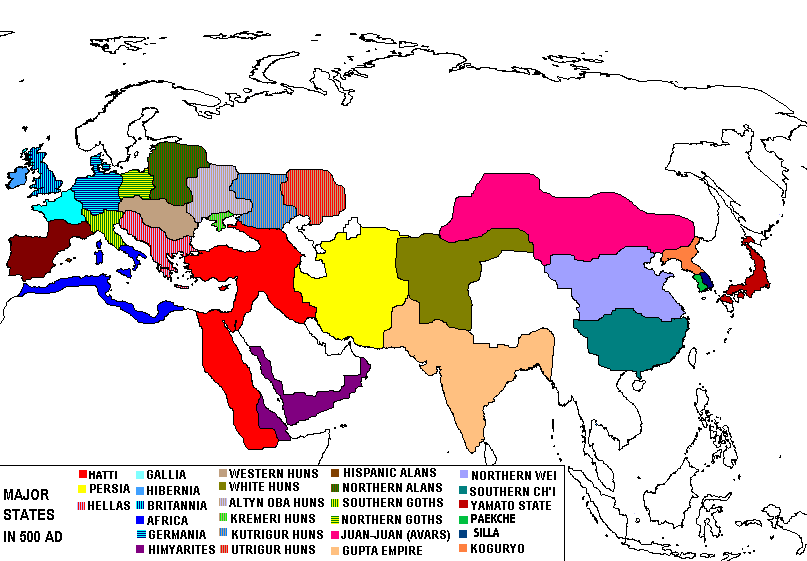
c. 500 AD--The Srivijaya kingdom is founded in southern
Sumatra (Indonesia) with
capital in Palembang. Also at about this time, Polynesian people begin
arriving on
Madagascar. Also at this time, the Chinese alphabet is adapted to the
Japanese language.
500 AD--Emperor Chandra Gupta III of India dies, and is succeeded by Vainya
Gupta.
The years of his predecessor’s reign have been spent rebuilding the
country, and Vainya
Gupta inherits a very strong empire, with the people firmly united behind
their emperors.
500 AD onward--The printing press continues to exert increasing influence
over the
course of events in Hatti and elsewhere.
502 AD--The Southern Liang Dynasty replaces the Southern Ch’i Dynasty as
rulers of
South China.
505 AD--Death of King Mursili VI of Hatti. He is succeeded by Uassurme II.
Uassurme,
unlike his father, is not a Christian, and takes no interest in furthering
his father’s goal of
creating a unified Hittite Church.
507-535 AD--War between Hatti and the White Huns. In 507 AD, the White Huns
discover that Shah Kavadh I of Persia has been intriguing against them with
the Great
King of Hatti. The White Huns invade Persia, meet Kavadh in battle near
Ecbatana, and
rout his army. Kavadh himself escapes and flees to the court of King
Uassurme II of
Hatti. When the White Huns, in pursuit, cross the Hittite border later that
year,
Uassurme declares war. The Hittite main army meets the White Huns near the
city of
Opis in Mesopotamia, inflicts a severe defeat on them, and the White Huns
retreat back
across the Zagros Mountains. The following year, King Uassurme leads the
Hittite army,
along with the pitiful remnants of the Persian army lead by Shah Kavadh, in
an invasion
of Persia itself. This leads to a series of campaigns lasting 28 years in
which the Hittites
gradually...ostensibly in the name of the Persian Shah...conquer most of
Iran. However,
when Shah Kavadh dies in 531 AD, King Uassurme has his son, Prince Khosrau,
deposed
and executed, ending the Sassanid Dynasty. Uassurme instead incorporates the
former
Persian lands into the Hittite Empire, creating four new provinces from
them...Persis,
Media, Parthia, and Elymais. Shortly afterward, in 535 AD, the Khan of the
White Huns,
Lakhana, sues for peace with Hatti, and a treaty is signed establishing the
borders
between the two kingdoms. The White Huns are forced to pay tribute to Hatti
as well.
Their power sharply declines from this point on.
510-518 AD--Conquest of northern Italy by the Republic of Africa. The
Republic of
Africa holds that it is the only true successor to the old Roman Republic,
but up to now,
due to a variety of circumstances, has been unable to press it’s claims to
former Roman
territories in Europe. In 510 AD this changes, however, when Dictator Junius
Lucius
Barca declares war on King Theodoric of the Southern Goths. A brutal eight
year war
results in which African forces conquer and essentially destroy the Southern
Goths as a
people. Southern Gothic territory is absorbed into the Republic of Africa.
The remnants
of the Southern Goths take refuge with the Hispanic Alans or the Western
Huns, where
they are absorbed by these larger groups and lose their identity.
512 AD--Emperor Vainya Gupta declares holy war against the Persians and the
White
Huns, the great Zoroastrian powers to the north and west. He becomes a
defacto ally of
the Hittites, who are also engaged in a war with the White Huns at this
time.
515 AD--Emperor Vainya Gupta of India is killed in battle with the White
Huns, and is
succeeded by Narasihma Gupta. Narasihma Gupta continues his father’s holy
war.
530 AD--Emperor Narasimha Gupta of India dies, and is succeeded by Kumara
Gupta III.
Like his father and grandfather, Kumara Gupta continues the holy war against
the
Zoroastrians to the north and west.
531 AD--Death of Junius Lucius Barca, Dictator of Africa. He is succeeded by
Gaius
Maximus Strabo. Strabo is an army general who, recognizing that the office
of Dictator
has become a monarchy in all but name, decides to formalize the situation.
However,
remembering the long-standing Roman tradition which forbids anyone from
claiming the
title of “Rex” (King), Strabo instead claims the title of
“Imperator” (Emperor). He
furthermore will see to it that the office is passed down to his heirs. He
reigns as
Emperor Gaius I. The Republic of Africa becomes the African Empire. Also in
this year,
Shah Kavadh I of Persia dies, and is succeeded by his son, Khosrau. Khosrau
is,
however, quickly deposed and executed at the order of King Uassurme II of
Hatti
534 AD--The Northern Wei Dynasty ruling northern China fragments. Two
successor
dynasties arise...the Eastern Wei and the Western Wei.
538 AD--A delegation from the Korean kingdom of Paekche introduces Buddhism
to the
Japanese Emperor at Osaka. Buddhism had previously been introduced into
Japan, but
had not made much headway there. Once accepted by the Emperor, it rapidly
spreads.
540 AD--Emperor Kumara Gupta III of India dies in battle against the White
Huns, and is
succeeded by Vishnu Gupta. Vishnu Gupta decides to end the holy war, and
makes peace
with the White Huns later that same year. The effect of the holy war has
been to
significantly expand the Gupta empire to the north and west. Persecutions of
the newly
conquered Zoroastrian populations quickly begin in the conquered
territories. Vishnu
Gupta and his successors will look with suspicion at the Hittites to the
west, who they see
as sheltering the Zoroastrian “devil worshipers.” They will tend to
maintain chilly but
cordial relations with Hatti. Also at this time, the Magyars migrate from
the Ural
Mountains in Russia to the Don. They come under the overlordship of the
Avars
540-558 AD--African Conquest of the Hispanic Alans: Emperor Gaius I of
Africa,
pursuing his predecessor’s quest to reunite former Roman territory under
the “rightful”
heir of Rome...the African Empire...declares war on King Alatey II of the
Hispanic Alans
in 540 AD. Emperor Gaius leads African armies in a two pronged assault on
Alanic
territory, with one army crossing into Hispania at the Pillars of Hercules,
and another
pushing into southern Gaul from northern Italy. The Alans prove to be
staunch
opponents, and a bloody 18 year war results in which Emperor Gaius himself
is killed.
But in the end, the forces of his successor, Emperor Marcus I, are
victorious, and the
territory of the Hispanic Alans is absorbed into the African Empire.
549 AD--Death of Gaius Maximus Strabo, Emperor of Africa, in battle with the
Hispanic
Alans. He is succeeded by his son, Marcus Livius Strabo. He reigns as
Emperor Marcus
I.
550 AD--Death of King Uassurme II of Hatti. He is succeeded by his son,
Uassurme III.
Uassurme III is a Christian, like his grandfather, and a very zealous one.
Upon his
accession to the throne, he declares Christianity...and in particular, the
form of
Christianity favored by himself and his grandfather (called Kuruntite
Christianity, after
it’s founder, Bishop Kurunta of Hattusas)...to be the official religion of
the Hittite
Empire. His heavy-handed attempts to enforce these edicts lead to widespread
resentment in the empire, and within two years, civil war will have broken
out. Also at
this time, the Northern Ch’i Dynasty takes over rule of the territories
held by the Eastern
Wei in northern China.
c. 550 AD--The Sun (Soga) dynasty takes effective control of the Yamato
state and the
capital of Japan is moved from Osaka to their homeland, the Asuka valley in
the central
Yamato plain. At this time, the term "Shinto" is introduced to
differentiate the native
religion from the philosophies and religions imported from China...Buddhism
and
Confucianism. Also at about this time, the fragile structure of the
sub-Roman state of
Hibernia comes crashing down as local Celtic chieftains revolt against the
“Romanized”
class which rules Ireland. Ireland splits into various competing petty
states, and will
remain disunited for some time to come.
552-555 AD--The First War of Religion: In 552 AD, attempts by Hittite
officials in the
service of King Uassurme III to close down the Hebrew Temple in Jerusalem
and forbid
all non-Christian worship in the province of Israel leads to a bloody
revolt. Other
disaffected factions scattered over the empire, both pagan and Christian,
soon follow suit,
and it is not long before the various anti-Uassurme factions are
coordinating their efforts.
Civil war threatens to tear apart the empire.
552 onward--Hebrew refugees from the brutal oppression of their religion by
King
Uassurme III of Hatti flee to the Himyarite kingdom. Lead by a set of rabbis
who reject
the orthodox, henotheistic interpretation of Yahwism in favor of a
monotheistic
interpretation, these Hebrews set up thriving communities in many of the
cities of the
Himyarite kingdom and make many converts.
552 AD--The Juan-juan (Avars) are defeated and expelled by their
Turkic-speaking
vassals. They begin to move west. The Turks found their own empire, the Gok
Turk
Khaganate, which will in the succeeding years conquer a huge area from the
shores of the
Sea of Japan in the east to the Caspian Sea in the west.
555 AD--King Uassurme III of Hatti is killed in battle with rebels opposed
to his edicts
establishing Kuruntite Christianity as the official religion of the empire.
The leader of the
rebel faction is his cousin, who takes the throne as King Hattusili Tesub
VI. The new
king is a pagan will go down in history as “The Apostate.” During his
fifteen year reign,
Hattusili Tesub will attempt to promote a return to paganism and will
eventually even
attempt to outlaw Christianity. Needless to say, this only serves to deepen
the religious
divisions within the empire.
556 AD--The Northern Chou Dynasty overthrows the Western Wei Dynasty and
takes
over rulership in northwestern China.
557 AD--The Southern Liang Dynasty is deposed by the Chen Dynasty in most of
southern China with their capital at Nanking. A branch of the Liang, called
the Nan
Liang, will continue to rule a small kingdom from the city of Xining, in
southwestern
China.
558 AD--The Avars (remnants of the Juan-juan), under their Khagan Kandik,
invade the
Russian steppes and push the Slavs to the west. The Slavs split into three
main
groups...the Eastern, Western, and Southern Slavs. They also crush the
Hunnic Altyn
Oba, Utrigur and Kutrigur hordes. The remnants of these hordes flee to the
west, where
they take refuge with their kinsmen, the Western Huns.
559 AD--The Avars destroy the kingdom of the Northern Alans. The Western
Huns are
assailed by Slavic invaders from the east. Both the Huns and the Slavs begin
crossing the
Danube into the territory of the Republic of Hellas. Also in this year,
Emperor Marcus I
of Africa moves his capital to Rome. He declares that henceforward his state
will be
known not as the African Empire, but as the Roman Empire.
560 AD--The Avars destroy the kingdom of the Northern Goths. The remnants of
the
Goths flee westward into Germania. The Republic of Hellas hires Avar
mercenaries to
fight invading Slavs and Huns, and calls for assistance from King Hattusili
Tesub VI of
Hatti. A Hittite army lands at Byzantium, and in cooperation with the Greeks
and their
Avar mercenaries, forces the invading hordes of Huns and Slavs back north of
the
Danube.
562 AD--The Gok Turks invade the Khanate of the White Huns and destroy it.
The
survivors flee for safety into the Hittite Empire, where they are settled in
Parthia and are
gradually absorbed into the population.
565 AD--Kandik, Khagan of the Avars, is killed in battle with the Republic
of Hellas. He
is succeeded by Bayan.
565-567 AD--The Avars invade the sub-Roman state of Germania. The feudal
grandees
which rule the area in a loose confederation are unable to put up a united
front to resist
the Avar onslaught, and Germania falls to the Avars.
567 AD--The Gok Turks invade the Gupta Empire, but are defeated by the
forces of
Emperor Vishnu Gupta. This begins a period of nearly constant warfare
between the two
empires which will continue for several decades.
568 AD--The Avars, under Khagan Bayan, invade Pannonia, expelling the
Western Huns
who move towards Italy. They then settle down for a while to digest their
conquests, and
the rest of Europe knows a brief interlude of relative peace. Also at this
time, the
Emperor of the Northern Chou Dynasty in China gives his daughter to the
Khagan of the
Gok Turks in marriage. This is an attempt to cement relations between the
two empires
and prevent the Gok Turks from depredating in northern China.
568-580 AD--The Western Huns, driven west by the Avars, invade northern
Italy. There
they come into conflict with the forces of Roman Emperors Marcus I and
Gnaeus I. A
bitter struggle lasting twelve years ensues, but in the end, the Huns are
finally and
decisively defeated outside Milan in 580 AD. The defeat is so decisive that
the Western
Huns effectively cease to exist as a people after this date...caught between
the victorious
Romans to the south and the Avars to the north, they have nowhere to go and
are pretty
much exterminated over the next few years.
570 AD--King Hattusili Tesub VI is overthrown in a palace coup lead by Hili,
the
younger brother of King Uassurme III. King Hili III will repeal the
anti-Christian laws
and will once again declare Kuruntite Christianity to be the official
religion of the empire.
However, he issues edicts of tolerance for pagans, Yahwists, and
“heretic” Christians,
which will serve to preserve the peace in his empire during his long and
successful reign.
However, the peace is fragile, and will not outlast his reign. Also in this
year, Marcus
Livius Strabo, Emperor of Rome, dies. He is succeeded by Gnaeus Flavius
Strabo. He
reigns as Emperor Gnaeus I. Also in this year, Emperor Vishnu Gupta of India
dies, and
is succeeded by Chandra Gupta IV. Chandra Gupta will spend most of his reign
fighting
with the Gok Turks on his northern frontier. He will maintain chilly, but
cordial,
relations with Hatti. Also in this year, in the Himyarite city of Mecca, a
boy named
Muhammad is born.
570-580 AD--The Southern Slavs, fleeing from the Avars, manage to cross the
Danube
and settle in the Balkan peninsula, despite resistance by the forces of the
Republic of
Hellas. Among these groups are two which are the descendants of a merger
between
primitive Slavic tribes and the Northern Alans...the Serbs (from the Alan
tribe, the
Serboi) and the Croats (from the Alan tribe, the Choroatos). The Greeks
decide that “if
you can’t beat them, join them,” and begin to make efforts to integrate
the new arrivals
into their political and social structure.
571 AD: The Hittite Empire and the Republic of Hellas sign a peace treaty
with the
Avars. The sub-Roman state of Gallia, ruled by a confederation of feudal
grandees which
is completely terrified of the Avars who are now just across the Rhine
River, appeals to
Emperor Gnaeus I for admission into the Roman Empire. Gnaeus accepts, and
Roman
troops move into Gallia and begin building fortifications along the Rhine.
c. 575 AD--By this time, the East Slavs inhabit western Russia and the West
Slavs inhabit
what will become in OTL Poland, Czechoslovakia and Prussia. These two groups
are
under the overlordship of the Avar Khagan.
577 AD--The Northern Chou Dynasty conquers the Northern Ch’i, re-uniting
northern
China.
580 AD--The confederation of Romanized grandees which rules in Britannia,
seeing the
new Roman Christian power rising across the Oceanus Britannicus, decides to
declare
that the Roman creed of Christianity will be henceforward be the official
state religion of
Britannia. They also begin negotiating with Emperor Gnaeus I for a treaty of
alliance...more to keep the Roman Empire from coming after them than because
they feel
any real outside threats at the moment. Gnaeus, who looks at the treaty as a
first step in
the eventual re-claiming of Britannia as a province of the Roman Empire,
accepts the
offer, and a treaty of alliance is signed at Rome later that same year.
581 AD--General Yang Chien overthrows the Northern Chou Dynasty in north
China. He
founds the Sui Dynasty, taking the throne as the Emperor Wen Ti.
582 AD--The ruler of the Himyarite kingdom converts to Yahwism and begins to
persecute Christians.
583 AD--Muhammad travels with a caravan to the Hittite Empire. This is the
first of
several such trips, where he is exposed to several versions of Christianity.
584 AD--Khan Kubrat unifies the Bulgars, a collection of Turkic peoples who
had taken
part in the Hunnic migrations and now are under the overlordship of the
Avars. Under
Kubrat’s leadership, the Bulgars throw off the Avar yoke and establish
their own
independent state, Great Bulgaria.
586 AD--Death of Gnaeus Flavius Strabo, Emperor of Rome. He is succeeded by
his
son, Decimus Flavius Strabo. He reigns as Emperor Decimus I.
587 AD--Emperor Wen Ti of the Sui Dynasty conquers the Nan Liang Dynasty in
southwestern China. Also at this time, spurred on by Chinese agents, civil
war breaks out
in the Gok Turk Empire, which splits into eastern and western halves.
588 AD--Emperor Chandra Gupta IV of India dies, and is succeeded by Rama
Gupta II.
Rama Gupta will maintain cordial relations with Hatti, while warring with
the Gok Turks
on his northern frontier. He will also send Hindu missionaries to the
Indonesian
archipelago and southeast Asia, where they will vie with the Buddhists for
supremacy in
those regions.
589 AD--Emperor Wen Ti of the Sui Dynasty conquers the Chen Dynasty and
re-unifies
all of China for the first time in almost three centuries. Under Wen Ti and
his
successors, the Sui Dynasty will accomplish great things...such as the
construction of the
Grand Canal and reconstruction of the Great Wall...but only by using
extremely
tyrannical methods and imposing great hardship on the people. The Grand
Canal alone
was accomplished by the forced impressment of no less than 3,000,000
laborers, with
those caught while evading service being executed. The Sui will not hold
power for long.
590 AD--The empire of the Avars extends from the Rhine to the Volga and from
the
Danube to the Baltic Sea. Also in this year, Muhammad enters a seminary in
the Hittite
city of Damascus, where he begins training to be a Christian priest. Over
the next couple
of decades he will make a name for himself, preaching against the
persecution of
Christians by the Yahwist Himyarite kings. He subscribes to the Kuruntite
version of
Christianity.
593 AD--Prince Shotoku of the Soga clan
rules Japan and promotes Buddhism.
599 AD--The Avars, abrogating their treaty of 571 AD, cross the Danube,
inflicting a
heavy defeat on the forces of the Republic of Hellas near Pella. The Avars,
in a display
of barbarity, capture 12,000 Greek prisoners of war and execute them all.
They then
proceed to rape and pillage through most of the Balkan peninsula, before
retiring north of
the Danube, heavily weighed down with plunder. The Republic of Hellas is
devastated.
600 AD--Prince Shotoku sends the first official Japanese mission to China.
Copyright 2005 by Robert Perkins. All rights reserved. Last updated 12 February 2005.