THE THIRD HITTITE EMPIRE
An Alternate History Timeline
by Robert Perkins
PART NINE: 700-800 AD
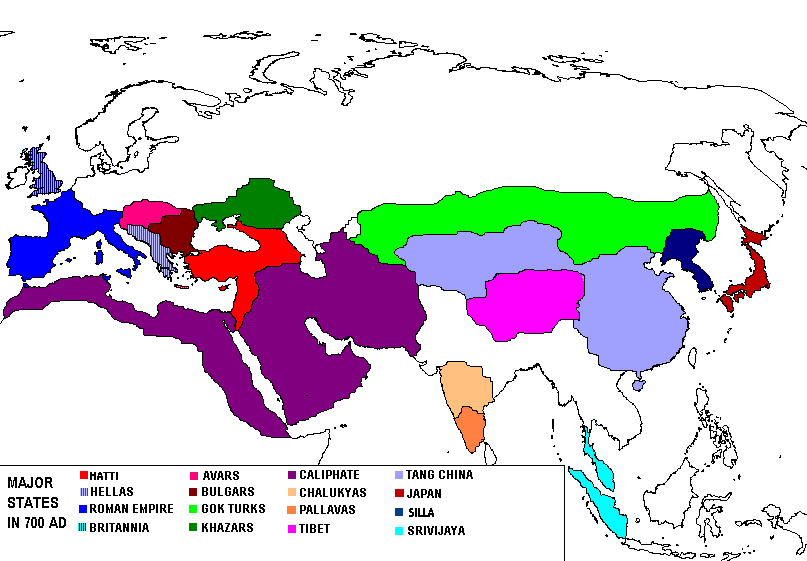
700 AD onward--In India, with the collapse
of the Gupta Empire, India has fragmented
into numerous small states, which are ruled by competing Hindu dynasties
which vie for
control over India. Dynasties such as the Chalukyas, Pratiharas, Vengis,
Gangas, Cholas,
Palas and Rashtrakutas all achieve brief periods of dominance over different
parts of the
subcontinent, but none is able to establish a lasting empire. India is thus
ill prepared for
the Muslim onslaught that will come in this century.
c. 700 AD onward--The Industrial Revolution continues in the Hittite
Empire. Over the
course of this century, machines to automate the spinning of thread and the
weaving of
cloth make their appearance, and the first true factories arise as a result.
The reduction in
the labor necessary for agriculture, which has been allowed by the invention
of reaping,
threshing, and seeding machines, has created a ready work force which can be
used to
work in the new factories, as well as allowing the Hittite
armies to be rebuilt despite the
great loss of territory in the past century. The steam engine will be
dramatically improved,
and will begin to see utilization outside the mining industry for the first
time before the
end of the century.
Additionally, this century will see the continued development of that
mysterious chemical
formula brought back from China...gunpowder. By the end of the century, the
first
military applications of the powder will begin to be made.
Finally, over the course of this century, the Industrial Revolution begins
to spread to some
of the states surrounding the Hittite Empire.
Hellas, and more importantly Rome, begin
to utilize the new farming technology and steam engines, and Greek and Roman
inventors
begin to make their own contributions to the Industrial Revolution.
c. 700 AD--The peoples of Scandinavia have been somewhat influenced by their
close
proximity to the Roman Empire, but have retained their essential culture.
The Romans
never felt they were worth conquering, and so the only true Germanic culture
left in the
world still survives, worshipping their warlike gods, trading and raiding
their neighbors,
and squabbling among themselves. Over the previous millennium, the Norse
peoples of
Scandinavia have been slowly developing sleek, double-ended boats. These are
oar
powered, and carry only small crews, and are capable of only short coastal
voyages in
sight of land. Even in these limited craft, the Norse have made themselves a
nuisance
with raids on Rome’s northern frontiers. However, about 700 AD, two
innovations (the
T-shaped keel, which strengthens the vessel against heavy seas as well as
allowing a mast
and sail to be mounted, and the sideboard rudder) are made by Norse
shipbuilders in
Norway which will enable the Norse to leave their home waters and become not
merely a
nuisance, but a plague. However, it will be a few decades still before these
designs are
perfected, and the fearsome Viking longship makes it’s appearance on the
world scene.
700 AD onward--The Islamic Church has not been nearly as successful in
integrating
conquered peoples into itself as it’s OTL counterpart. Being a Christian
sect, rather than
a separate religion, the Islamic Church tends to treat Christians in the
conquered
territories as heretics to be persecuted rather than as potential converts
to be brought to
the true faith. Non-Christians have fared somewhat better, usually getting
the option of
converting or paying a poll tax. But even they have found themselves on the
receiving
end of Muslim persecution as mobs of fanatical Muslims riot periodically in
various
places. As a result, Muslims remain a minority population outside of Arabia,
and the
Caliphate is basically composed of a lot of resentful conquered peoples held
down by a
thin smattering of Arab soldiers. The Caliphate is also in political
disarray as the new
century dawns. Since the death of Caliph Yazid, the new Caliph, Mu’awiya
II, has been
faced with rebellions by various pretenders to the throne, including his
cousin, Marwan
and Marwan’s son, Abd al Malik, and Abdul ibn Zubayr, a nephew of
Muhammad’s
confidant, Kadijah, all of whom claim to be the true Caliph and have gained
large
followings. This will provide an opportunity for enemies of the new faith to
rally against
it in the upcoming century.
701 AD--Emperor Flavius I of Rome dies, and is succeeded by his son, Flavius
Gaius
Strabo, who reigns as Emperor Flavius II. In this year, Caliph Mu’awiya II
is defeated
and captured by the forces of Abd al Malik. He is executed shortly
afterward, and Abd al
Malik declares himself the new Caliph.
705 AD--Empress Wu Chou of China is deposed by her son, who restores the
T’ang
Dynasty to the throne of China. The son assumes the imperial name of Chung
Tsung.
Abd al Malik dies, and is succeeded as Caliph by his son, Al Walid I.
707 AD--The forces of Caliph Al Walid I defeat the army of Abdul ibn Zubayr.
Abdul
ibn Zubayr is captured and executed. The last of the major pretenders to the
Caliphate is
thus eliminated, and the Marwanate branch of the Ummayad House is firmly
established
on the throne. But the flames of rebellion continue to burn in various
places throughout
the Islamic realm, and Al Walid will spend most of his reign putting down
these
rebellions. This will not preclude some expansion of the Muslim Empire,
however, as
later entries will show.
710 AD--Japan's capital is moved from Asuka to Nara, modeled after China's
capital
Xian. The Emperor Chung Tsung of China dies, and is succeeded by his
brother, who
reigns as the Emperor Jui Tsung.
711 AD--King Hattusili IV of Hatti dies, and is succeeded by his son, who
reigns as King
Hantili VI. Hantili, who will go down in history as “Hantili the
Redeemer,” and to a
greater extent his son and grandson, will all be strong and resourceful
rulers, and the
Hittite Empire will prosper mightily during
their reigns. Also at this time, the Arabs
conquer Sindh and Multan (Pakistan).
712 AD--The collection of tales "Kojiki" (record of ancient times)
is written in Japan.
The Emperor Jui Tsung of China dies, and is succeeded by his son, who reigns
as the
Emperor Hsuan Tsung. Hsuan Tsung will be the last great Emperor of the
T’ang
Dynasty, and the T’ang Empire will reach it’s greatest extent under his
rule. The Arabs
conquer Transoxiana and convert the Turks to Islam.
715 AD--Caliph Al Walid I dies, and is succeeded by his younger brother,
Suleiman.
Suleiman is indebted to political opponents of many of his brother’s most
successful
generals, and he attempts to have those generals murdered. However, word of
his
nefarious scheme reaches the generals and when he calls them to his capital,
they refuse
his summons and instead raise the banner of rebellion. The Caliphate is soon
being torn
apart by civil war.
716-730 AD--The War of Redemption: King Hantili VI of Hatti, seeing the
chaos which
is reigning within the Caliphate, decides to take advantage of the
situation. In the interim
since the death of Caliph Yazid outside the walls of Azatiwataya, the Great
Kings of Hatti
have thoroughly reorganized their armed forces, and King Hattusili IV had
made an
alliance with the Roman Empire which Hantili has renewed. Thus, in 716 AD,
Hantili
and Emperor Flavius II of Rome jointly declare war on the Caliphate. Hittite
armies
sweep into Mesopotamia, while Roman armies burst out of Carthage and Tingis
in North
Africa. The advance of the Hittite and Roman
armies is met with great rejoicing by the
persecuted Christian populations of the Caliphate, and recruits flock to the
Hittite and
Roman banners after the Arab armies defending those regions are defeated and
destroyed.
In the succeeding years, Hittite armies
reclaim Egypt, Kush, and Axum as well, and also
advance into Persia, where they are likewise met with much enthusiasm by a
grateful
population. Caliph Suleiman and, after Suleiman is killed in battle, his
successors, lead
yearly counterinvasions from the Arabian peninsula, but these are beaten
back.
Attempted Hittite invasions of Arabia
likewise are repelled by fanatical Arab resistance.
Finally, in 730 AD, a treaty is agreed upon which recognizes the status quo
as it exists at
that time. Hatti has restored it’s empire to it’s old limits, and Rome
has recovered it’s
north African provinces. Only Arabia remains under the rule of the Caliphs.
718 AD--Caliph Suleiman is killed in battle with the Hittites near Damascus.
He is
succeeded by his cousin, Umar ibn Abd al Aziz, who was personally selected
by
Suleiman to be his successor, bypassing his own brothers and son. Caliph
Umar continues
his predecessor’s efforts to regain the lost lands of the Caliphate.
720 AD--The "Nihon shoki" (history of Japan) is composed. Caliph
Umar II dies, and is
succeeded by his cousin, Yazid ibn Abd al Malik, who reigns as Caliph Yazid
II. Also in
this year, the Republic of Hellas inflicts a major defeat on the Bulgars,
who are forced to
acknowledge the hegemony of Hellas. The Bulgars will be greatly weakened and
will
remain relatively quiescent for the remainder of the century.
723 AD--King Hantili VI of Hatti dies, and is succeeded by his son, who
reigns as King
Suppiluliuma VII. Suppliluliuma will go down in history as Suppliluliuma
“The
Conqueror” after his successful campaigns to recover Egypt, Kush, Axum,
and Persia.
Also at this time, Kathmandu is founded in Nepal.
724 AD--Caliph Yazid II dies of tuberculosis. He is succeeded by his
brother, Hisham
ibn Abd al Malik, who reigns as Caliph Hisham.
730 AD--Emperor Flavius II of Rome dies, and is succeeded by his son, Marcus
Livius
Strabo, who reigns as the Emperor Marcus III. Also in this year, the Khazars
raid the
Hittite provinces in the Caucasus. They are
repelled, but cause much damage.
730 AD onward--In the aftermath of the War of Redemption, a long period of
relative
peace settles over the near east, especially in those lands ruled by the
Great Kings of
Hatti. In the lands recently retaken from the Caliphate, Hittite
and Roman administrators
begin rebuilding the provinces and integrating them into their respective
empires. The
Hittites are helped by their tolerant religious policies, which guarantee
everyone,
including those who have converted to Islam, complete freedom of worship.
Thus the
local populations are bonded in loyalty to the Hittite
King and his benevolent
government. Roman policies, however, are not as tolerant, and Muslims in
Roman lands
find themselves the objects of persecution. Fortunately for Rome, the number
of Muslims
in their territories is small, so they do not form a major threat to
imperial rule in those
regions. Unlike the Hittites, who spend most of the rest of the century
consolidating their
gains, the Romans will conduct several military campaigns which will greatly
expand the
limits of their empire.
Meanwhile, in Arabia, the power of the Ummayad Caliphs is severely eroded as
the faith
of the masses in the divine inspiration of the Caliphs is greatly shaken by
the recent
defeats by the “heretic” Hittites and Romans. It will not be long before
rivals arise to
challenge them. The resulting internecine fighting will prevent the Arabs
from
threatening their neighbors for quite some time. At the same time, in
Transoxiana and
the recently conquered regions of Sindh and Multan in India (which were not
reached by
the Hittites before the end of the War of Redemption), the Muslim generals
who
command in those regions throw off the authority of the Caliph and set
themselves up as
independent Kings.
731 AD--Roman mine owners begin to use steam engines to pump water out of
their
mines, purchasing them from Hittite sources.
Within a short time, Roman firms are
making copies of the machines inside the Roman Empire itself.
732 AD--Sanjaya founds the Sanjaya dynasty in central Java (Indonesia) with
capital in
Mataram.
740 AD--The loose confederation of Romano-Celtic warlords and grandees which
rules
in Britannia breaks down, and civil war erupts. Emperor Marcus III of Rome
sends an
army across the Oceanus Britannicus to “restore order.” Roman troops put
down the
rebels, and peace is restored. But the Romans do not leave, and Roman
governors and
administrators follow them to the island. Britannia is re-incorporated into
the Roman
Empire.
742 AD--Emperor Marcus III of Rome dies, and is succeeded by his son, Julius
Licinius
Strabo, who reigns as Emperor Julius I. Emperor Julius will be variously
known in
history as “Germanicus” following his conquest of that region and “The
Avar Slayer” for
his devastating campaigns against that people.
742-750 AD--Emperor Julius I sends Roman armies into Germania, where they
defeat the
disunited local feudal warlords and force their submission to Rome. Germania
is
re-incorporated into the Roman Empire.
743 AD--Japan's emperor Shomu founds the temple Todaiji in Nara (largest
wooden
building in the world) with a colossal Buddha inside. Caliph Hisham dies,
and is
succeeded by his nephew, Walid ibn Yazid, who reigns as Caliph Al Walid II.
744-745 AD--The Chinese Tang dismantle the Gok Turk empire. The
Turkic-speaking
Uigurs, thanks to their alliance with the Tang, conquer the Eastern Gok Turk
Khanate and
expand from Lake Balkash to Lake Baykal, with capital in Kara-Balgasun. The
first
Turkic alphabet appears about this time.
746 AD--Demosthenes of Argos, a Greek inventor living in the Republic of
Hellas, builds
on the anonymous innovations of several other inventors and produces the
first fully
automated weaving machine. His invention is soon put to use in factories in
the Hittite
Empire and Rome.
748-758 AD--Roman campaigns against the Avars. Over a ten year period, Rome
completely crushes these troublesome nomads and annexes their territory.
Emperor
Julius I is killed during the campaign, but the conquest is completed by his
son, Emperor
Gaius III. Gaius orders the rebuilding of the old Roman defenses on the Oder
and
Danube Rivers.
750 AD--The Khazars transfer their capital to Itil (Atil) on the Volga
River. Also at
about this time, the Bulgars adopt a Slavic language. Also at this time, the
Palas rule
eastern India, the Gurjara-Pratiharas rule the north of India, and the
temples of
Bhubaneshwar and Puri are begun in India. Also in this year, Caliph Al Walid
II is killed by rebels. No new Caliph is named, as the tribes of Arabia
cannot agree on a successor. Arabia fragments into numerous small, tribal
states.
751 AD--Battle of Talas River between the forces of the Muslim ruler of
Transoxiana and
the T’ang Chinese. The Chinese are victorious, but are soon forced to
abandon their
gains by the outbreak of rebellions at home. Also in this year, Korean prime
Minister
Kim Tae-song orders the construction of the Buddhist cave temple Sokkuram at
Mount
Toham.
753 AD--The Rashtrakutas, a Chalukya dynasty, expand from the Deccan into
south and
central India.
755 AD--Emperor Julius I is killed in battle with the Avars. He is succeeded
by his son,
Gaius Lucius Strabo, who reigns as the Emperor Gaius III. Also in this year,
An Lushan's
rebellion begins in China. The rebellion will span the reigns of three
emperors, and cause
as many as 36 million deaths.
756 AD--Emperor Hsuan Tsung of China is forced to flee his capital by rebels
commanded by An Lushan. He is shortly afterward deposed by the army and his
son
elevated to the throne, where he reigns as the Emperor Su Tsung. Su
Tsung’s reign will
see the beginning of the growth of the power of the court eunuchs and the
army generals,
at the expense of the imperial throne, which will eventually lead to the
final collapse of
the T’ang Dynasty.
757 AD--The capital of the Chalukyan kingdom in India is moved from Badami
to
Pattadakal. Also in this year, the Kailasa temple at Ellora is begun.
Quintus Decimus
Lupus, a Roman inventor, invents a mechanical seed sower, which, along with
the
threshing and reaping machines already invented, greatly reduces the labor
needed for
agriculture.
759 AD--The poetic anthology "Man'yoshu" ("Collection of
Myriad Leaves") is written in
Japan.
760 AD--King Suppliluliuma VII of Hatti dies, and is succeeded by his son,
who reigns
as King Suppliluliuma VIII. The new king will be noted for his peaceful
reign, and many
major building projects will be accomplished. Suppliluliuma will also be a
great patron
of learning and invention within the Empire. Also in this year, Indian
mystics such as
Santarakshita and Padmasambhava visit Tibet, where they are instrumental in
the spread
of Buddhism in that region.
762 AD--The Khazars invade the Transcaucasus, but are defeated by the armies
of Hatti.
Emperor Su Tsung of China dies of a heart attack. He is succeeded by his
son, who
reigns as the Emperor Tai Tsung.
763 AD--The An Lushan rebellion is finally crushed by armies loyal to
Emperor Tai
Tsung. But the T’ang Empire has been left in such a weakened state that
the Tibetans
invade and succeed in sacking the Chinese capital of Chang’an (Xian). The
Tibetans also
drive the Chinese out of the Tarim Basin, and they will not return during
the remainder of
the T’ang Dynasty. This marks the beginning of a long period when China
will be beset
by the Tibetans and will suffer several major military defeats at their
hands.
768 AD--Hiram of Tyre, a Phoenician inventor living in the Hittite
Empire, introduces a
greatly improved version of the steam engine invented by Aristobulos of
Ephesus nearly
seventy years before. Steam engines begin to be used outside of the mining
industry as a
result.
775 AD--The Rashtrakutas of India are defeated by the Chalukyas, who move
the capital
at Kalyani (Mysore). Krishna I of the Rashtrakuta dynasty builds the
rock-cut Kailasha
Temple at Ellora. Steam engines are first used to power automated looms in
the Hittite
Empire.
777 AD--King Suppiluliuma VIII of Hatti dies, and is succeeded by his son,
who reigns
as King Mursili VII. Mursili, like his father, will be a great patron of
learning and of
inventors.
778 AD--Sailendra king Dharmatunga begins construction of the Buddhist
temple at
Borobudur in Java (Indonesia)
779 AD-- The first Buddhist monastery in Tibet is founded in Samye by Guru
Rinpoche/
Padmasambhava. Emperor Tai Tsung of China dies, and is succeeded by his son,
who
reigns as the Emperor Te Tsung.
780-781 AD--Arab raids into the Hittite
Empire are repulsed by Hittite forces.
781 AD--Tibetans occupy Dunhuang in China.
784 AD--The Japanese Emperor moves the capital to Nagaoka. In India, the
Pratihara
king Nagabhata II conquers the sacred capital of the north, Kanyakubja.
788 AD--The Buddhist monk Saicho founds the monastery of Mt. Hiei, near
Kyoto,
which will become a vast ensemble of temples.
790 AD--Death of the Emperor Gaius III of Rome. He is succeeded by his son
Lucius
Gnaeus Strabo, who reigns as the Emperor Lucius I.
791 AD--The Tibetans capture Kansu, in China. Archidamos of Miletus, a Greek
inventor in the Hittite Empire, develops the
first practical artillery rockets using
gunpowder. They are not very accurate, but are destructive and very
frightening when
used against troops who have never seen them. The Hittites secretly
incorporate them
into their armies forthwith.
794 AD--Emperor Kammu of Japan moves the capital to Heian-kyo (Kyoto).
795 AD--Warpalupis, a Hittite inventor,
demonstrates a steam locomotive before King
Mursili VII of Hatti, who is greatly impressed. Mursili recognizes the
potential military
value of the invention, which would enable rapid movement of troops and
supplies to
areas of the Hittite Empire which are
threatened by attack. With his support, construction
begins on a network of rail lines which will link the various cities of the Hittite
Empire.
798 AD--King Mursili VII of Hatti dies childless. He is succeeded by nephew,
who
reigns as King Tuwatis IV.
800 AD--Licinius Gaius Marcian, a Roman inventor, demonstrates the first
steam-powered boat. It is a small vessel, hardly practical for anything
much, but will be
the precursor to much more impressive vessels in the future.
Copyright 2005 by Robert Perkins. All rights reserved. Last updated 11 September 2005.