One frosty morning on the 8th of December
1949 three brothers – Pavel, Petko and Michail Deikovi worked together at the
region of “Merul” tile factory near Panagyurishte. It’s
about ten o’clock in the morning, when processing a new layer of clay they
came across unusual glossy objects. With all of its magnificence a fabulous set
of vessel glittered in front of the workers.
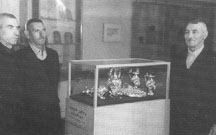 At once, the three brothers, without
hesitation decided to report this discovery to the city authorities.
At once, the three brothers, without
hesitation decided to report this discovery to the city authorities.
This
is the rebirth of an unique masterpiece of an ancient art. A triumphal tour
includes more that 40 worlds capitals and cities – Rome, Paris, New York,
Moscow, Berlin, Prague, Budapest, Tokyo, Mexico city, New Delhi, Montreal,
Madrid, Boston, Detroit, Helsinki. Wherever shown in the world, it arouses administration
of academics and admirers of antiquity.
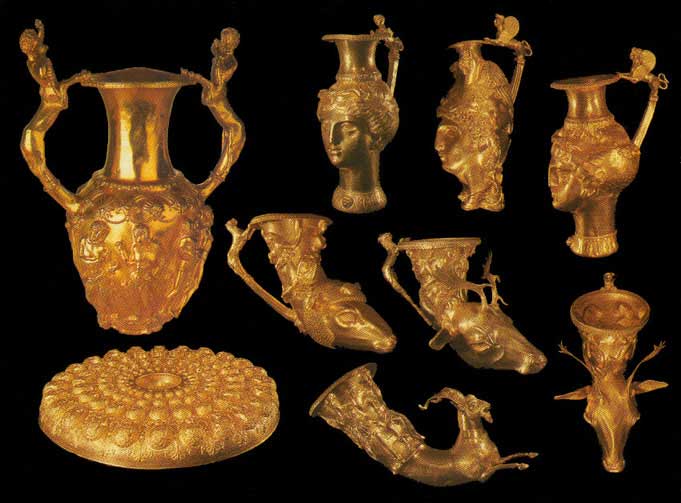
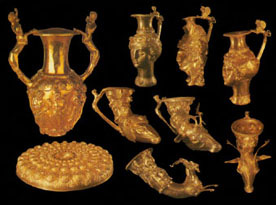 The Panagyurishte treasure consists of nine utensils
with rich decoration. It is made of solid gold and weights 6.164 kg.
The Panagyurishte treasure consists of nine utensils
with rich decoration. It is made of solid gold and weights 6.164 kg.
The
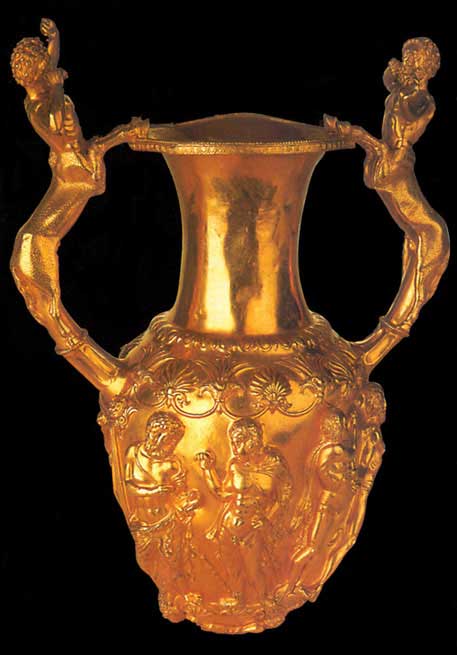
biggest utensil is an Amphora rhyton.
Seven utensils are rhyta (horn-shaped), three are in the shape of animal heads,
one is like front part of he-goat’s body, three are like women’s heads, and
one is phiale. It’s most likely that the
set was used for drinking wine in religious context or in everyday life. There
is opinion, that it was designated for ritual purifying of a liquid, probably
wine, by decanting from one utensil into another.
The biggest, most
interesting and most important utensil is the amphora-rhyton, which is
interpreted as being used for swearing brotherhood (two men drink at the same
time from it or they fill two other utensils, placed under the amphora) because
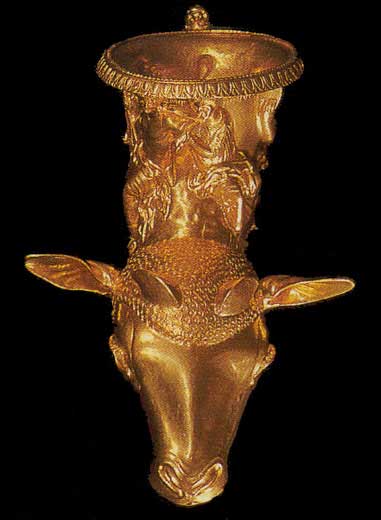
of its two apertures at the bottom. The two other rhyta are in the shape of
heads of a stag of a fallow deer. The “Judgment of Paris”, the cause of the
Trojan War, well known from mythology, is portrayed on one of the necks. On the
neck of the other one are portrayed two heroic scenes – Herakles overcomes the
foe and the Thesus fights the Marathonian Bull.The he-goat rhyton is embossed
too. Zeus’s wife – Hera, is sitting in the middle of the image and beside
her – Artemis and Apollo. On the backside is shaped the goddess of the victory
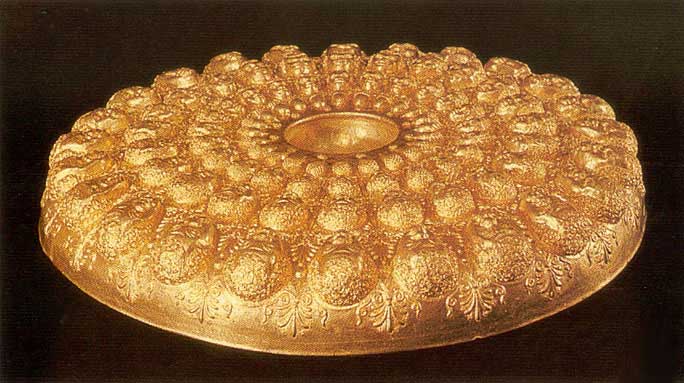
– Nike. Three of the Rhytons probably present Amazons. The phiale from
Panagyurishte treasure, with its size and weight, is biggest and the heaviest
phiale so far from the antiquity know. Its decoration, which is placed in four
concentric circles, is unique too. The circle closest to the center consists of
acorns and the rest three circles represents Negro heads.
The treasure is
dated to the last 3-4 decades of the 4th century b.c. There
are reasons to presume the existence of a Thracian art workshop around
Panagyurishte.
Masters
with different skills made decorations at this workshop. Some were perfunctory
shaped like those on the golden pectoral from Strelcha, the Mramor collection
near Panagyurishte, and possibly like those on the bottom of the amphora rhyton.
Others were imposing exquisite images like skyphos from Strelcha, the rhyton
from Poroyna – Romania, and why not, the whole Panagyurishte treasure.
This
treasure represents Thracian the creative and technical traditions. Their
traditions contributed to the development of Balkan nations culture.
More photos of
Panagyurishte Gold Treasure
 City
Guide of PANAGYURISHTE
City
Guide of PANAGYURISHTE