 City
Guide of PANAGYURISHTE
City
Guide of PANAGYURISHTE
|
|
The townfolk of Panagyurishte imortalized the name of their humble town. Their Oborishte and their town should stay at the top of the
pages of Bulgaria's modern history. ZAHARI STOYANOV
The town and the surrounding area did
play a part in ancient history, too, despite being off the main roads of
antiquity and the Middle Ages.
The ruins of the once-mighty Bulgarian fortresses of Krassen and Doushkovchenin indicate that in the Middle Ages, too, people were attracted by the town’s comfortable location, bountiful nature and the fine climate.
Economically, the town reached its heyday in the early nineteenth century, when animal husbandry gave rise to crafts and occupations like trading, homespun cloth manufacturing, tanning and fur clothing, shoe-making and goldsmithery. Master craftsmen alone numbered in excess of 550; together with the journeymen and apprentices, their number was well above 2,500. Merchants from Panagyurishte peddled their goods to the markets of Asia, Serbia and Greece, and as far as Vienna, Dubrovnik and Cairo… It
was this economic boom that led to an intellectual upsurge which reached a
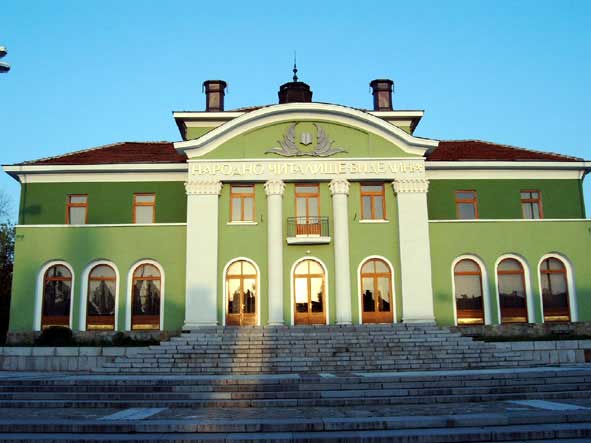
high point on the eve of the April 1876 Uprising. Alongside the two schools, there was yet another cultural institution in town stirring up the freedom-loving spirits of Panagyurishte’s inhabitants: the “Videlina” (Enlightenment) community center, the core of various cultural and educational undertakings, newspaper and book readings, lectures and discussions on politics and on the affairs of the Ottoman Empire. Just
prior to the April Uprising, Panagyurishte welcomed back home Pavel Bobekov, a
graduate of Constantinople’s Military Medical School. As head teacher at the
boys’ school and chairman of the community center’s board of trustees.
Bobekov was at the heart of a patriotic fervor, creating, according to
contemporary accounts, “an entire movement among the young people”.
The
atmosphere of economic and intellectual prosperity was largely responsible for
Panagyurishte’s ardently embracing the idea of national liberation as early
as the time at which that great fighter for Bulgaria’s liberation, Vassil
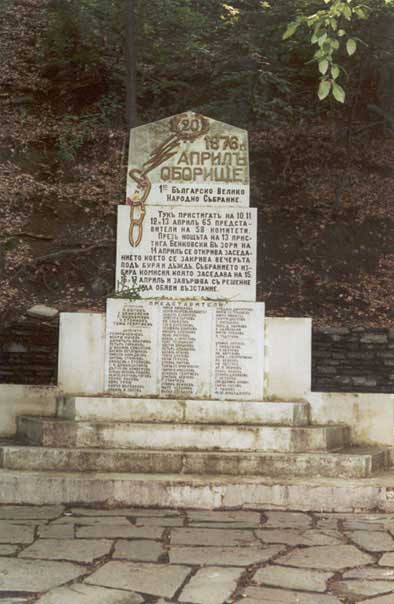
Levski, was setting up his revolutionary committees across the country. These preparations culminated in the history-making assembly at the Oborishte, “Liberty or Death!” Little remains today from the town of that time. In the uprising’s
suppression, there burnt many of the two-storied merchants’ houses, erected
by the best builders and decorated by famous painters. Yet, a few have
remained, as if to tell us about the memorable days of April. One of these is
the Toutevs’ house, in which the uprising was proclaimed on April 20, 1876.
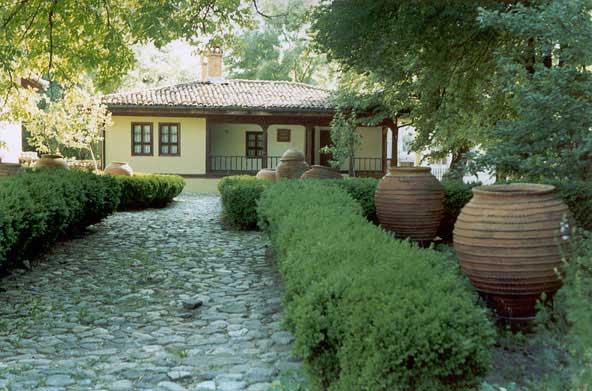
Another treasured monument is the house in which national heroine Raina Popgeorgieva was born. Today the house-museum tells the story of the maiden who embroidered and carried across town the banner of freedom; of the maiden whom the nation has lovingly named Princess Raina (Raina Kniaginia). At the mere age of twenty at the time, Raina was already head mistress at the girls’ school. On a memorable evening, in the midst of the feverish preparations for the uprising, the leader Benkovski asked her to make the main battle flag for the insurgents, the legendary ensign with the lion rampant and the winged motto: “Liberty or Death”. Not far from Raina’s home are the walls that fenced in what was Hadji Louka’s house, the office of the Interim Revolutionary Government of 1876, headed by Pavel Bobekov. The townsfolk of Panagyurishte basked in freedom but for ten days, then they had to defend it with the bullet and the sword, and to prove they were worthy of it. Many were the feats of the heroes who defended Panagyurishte. The victims were even more numerous. The Doudekovs’ house, one of the last strongholds in the town’s heroic defense, is another silent witness to the common self-sacrifice. Peter Shturbanov, a member of the Interim Revolutionary Government, chose suicide here rather than surrender to the overwhelming adversary. Together with the other towns and villages in which the April Uprising broke out, Panagyurishte entered Bulgaria’s history as the author of one of its most glorious pages. Men like Victor Hugo, Feodor Dostoevski, Ivan Turgenev, Leo Tolstoy, Guiseppe Garibaldi and US journalist Generarius MacGahan spoke out in defense of the Bulgarians. The following year, Russia declared war on Turkey, during which, in the course of two years, 1877 and 1878, 200,000 Russian soldiers gave their lives at the altar of Bulgarian’s liberation. |
|
Copyright 2002, Nadejda
Karaboycheva. Photos: Dimitar Karaboychev |