Little remains today from the
town of that time. In the uprising’s suppression in 1876, there burnt many of
the two-storied merchants’ houses, erected by the best builders and decorated
by famous painters. There were burned the east and central part of the town,
along with the market place, churches, schools and new houses. Yet, a few old
houses have remained, as if to tell us about the memorable days of April.
More of the preserved houses have been promulgated as monuments of culture
– Raina Kniaginia’s house (Futekovs’ house), Toutevs’, Dudekovs’,
Drinos’, Smolskata (former Center of Bulgarian-Russian friendship), Lekovs’,
Dedevs’, Djudjevs’, Landjevs’, Kaloyanovs’, Kamenskata etc.
The
Historical museum, founded in 1951,
unfurls in a museum ensemble with National Revival Architecture, exhibition
halls and the characteristic Panagyurishte flower gardens. There are over16 000
museum exhibits in the museum's stock - precious relics of the town's
interesting past.
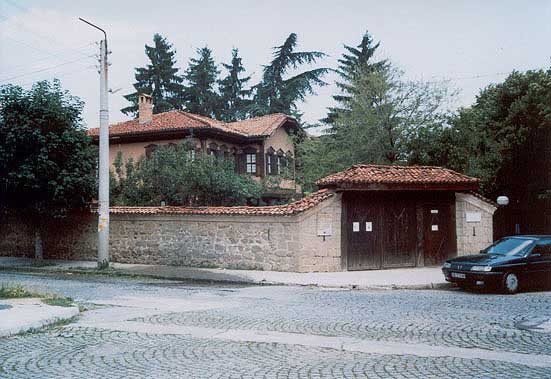
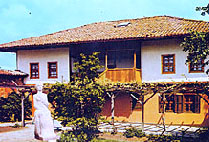
 House-Museum of Raina Kniaginia
is the native house of the
national heroine Raina Popgeorgieva. The house's exhibition shows the feat of
the girl who embroidered and bore the flag of the April Uprising in 1876. At the
mere age of twenty at the time, Raina was already head mistress at the girls’
school. On a memorable evening, in the midst of the feverish preparations for
the uprising, the leader Benkovski asked her to make the main battle flag for
the insurgents, the legendary ensign with the lion rampant and the winged motto:
“Liberty or Death”. The house is supposed to have been built in 1673. It is
a typical asymmetrical Sredna Gora house, overlooking the spacious yard. The
house was proclaimed a museum and a cultural monument of national importance in
1950. It underwent a capital restoration in 1979-1981, and a documental and
material exhibition containing Raina Kniaginia's flag was open the former
workshop on the ground floor. The heroine's bones were buried in the house's
yard.
House-Museum of Raina Kniaginia
is the native house of the
national heroine Raina Popgeorgieva. The house's exhibition shows the feat of
the girl who embroidered and bore the flag of the April Uprising in 1876. At the
mere age of twenty at the time, Raina was already head mistress at the girls’
school. On a memorable evening, in the midst of the feverish preparations for
the uprising, the leader Benkovski asked her to make the main battle flag for
the insurgents, the legendary ensign with the lion rampant and the winged motto:
“Liberty or Death”. The house is supposed to have been built in 1673. It is
a typical asymmetrical Sredna Gora house, overlooking the spacious yard. The
house was proclaimed a museum and a cultural monument of national importance in
1950. It underwent a capital restoration in 1979-1981, and a documental and
material exhibition containing Raina Kniaginia's flag was open the former
workshop on the ground floor. The heroine's bones were buried in the house's
yard.
Not far from Raina’s home
are the walls that fenced in what was Hadji Louka’s house, the office of the
Interim Revolutionary Government of 1876, headed by Pavel Bobekov.
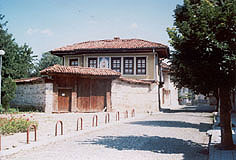 The
Toutevs’ House, in which the uprising was proclaimed on April 20,
1876. Ivan Tutev was a wealthy citizen of Panagyurishte and participated in the
revolutionary activity. His house was Benkovski’s last accommodation in
Panagyurishte. When the courier from Koprivshtitsa brought the news, that
Koprivshtitsa revolted, the leaders ahead with Benkovski and Volov decided to
rise in revolt. The enthusiastic Volov shooted twice with his gun. The four
apostles Benkovski, Volov, Zahari Stoyanov and Ikonomov went out of this house,
dressed in rebellion uniforms and armed with exclamations for uprising against
Turkish tyranny. The house survived the stormy events and yet to date, it stays
untouched, such it was during the Uprising in April 1876. Nowadays the house is
preserved as a museum.
The
Toutevs’ House, in which the uprising was proclaimed on April 20,
1876. Ivan Tutev was a wealthy citizen of Panagyurishte and participated in the
revolutionary activity. His house was Benkovski’s last accommodation in
Panagyurishte. When the courier from Koprivshtitsa brought the news, that
Koprivshtitsa revolted, the leaders ahead with Benkovski and Volov decided to
rise in revolt. The enthusiastic Volov shooted twice with his gun. The four
apostles Benkovski, Volov, Zahari Stoyanov and Ikonomov went out of this house,
dressed in rebellion uniforms and armed with exclamations for uprising against
Turkish tyranny. The house survived the stormy events and yet to date, it stays
untouched, such it was during the Uprising in April 1876. Nowadays the house is
preserved as a museum.
Another silent witness of the general heroism and self-sacrifice was Dudekovs’ House - one of the last strongholds in the town’s heroic defense, is another
silent witness to the common self-sacrifice. Peter Shturbanov, a member of the
Interim Revolutionary Government, chose suicide here rather than surrender to
the overwhelming adversary. Dudekovs’ House was built in 1853-1856 keeping the
symmetrical design of Plovdiv’s houses. The facade with a trapezium fronton above the colonnaded entrance imparts to the house an
imposing presence. The house was renovated in 1990-1996. It’s exposition
represents the style of living of a wealthy merchant on the eve of April’s
Uprising in 1876. In the cellar, there have been arranged a memorial place,
privy to the people who died in the house on 30 April 1876.
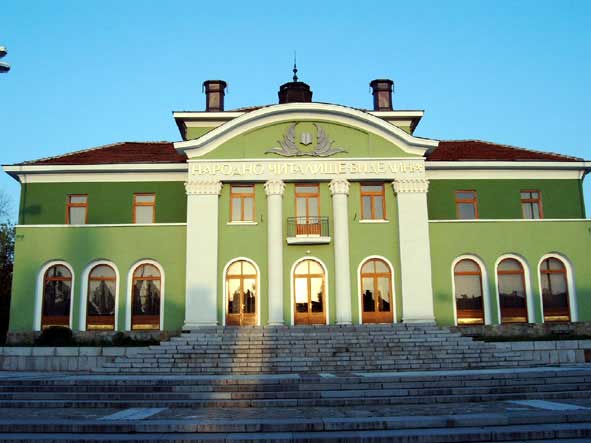
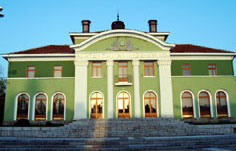 Alongside the two schools, there was yet another cultural institution in
town stirring up the freedom-loving spirits of Panagyurishte’s inhabitants: the “Videlina”
(Enlightenment) community center, founded in 1865, it was the core of various cultural and educational
undertakings, newspaper and book readings, lectures and discussions on politics
and on the affairs of the Ottoman Empire.
Alongside the two schools, there was yet another cultural institution in
town stirring up the freedom-loving spirits of Panagyurishte’s inhabitants: the “Videlina”
(Enlightenment) community center, founded in 1865, it was the core of various cultural and educational
undertakings, newspaper and book readings, lectures and discussions on politics
and on the affairs of the Ottoman Empire.
More
photos of museums and old buildings in Panagyurishte
 City
Guide of PANAGYURISHTE
City
Guide of PANAGYURISHTE