|
|
THE EBOLA VIRUS The Ebola
owes its name to the fact that it was discovered in Classification The Ebola virus belongs to the family filoviridae,
which is a group of negatively stranded RNA viruses. This group of viruses is
thread like in structure, or string shaped and hence they are called filoviruses. The Ebola virus has a single RNA strand for
its genetic code. This type of genetic coding is widely believed to be the
most primitive coding mechanism for life. Thus it would be safe to suppose,
given its genetic coding and structure, the Ebola virus is probably an
extremely old life form probably dating back to the beginning of life on
earth. However, this is conjecture. I received
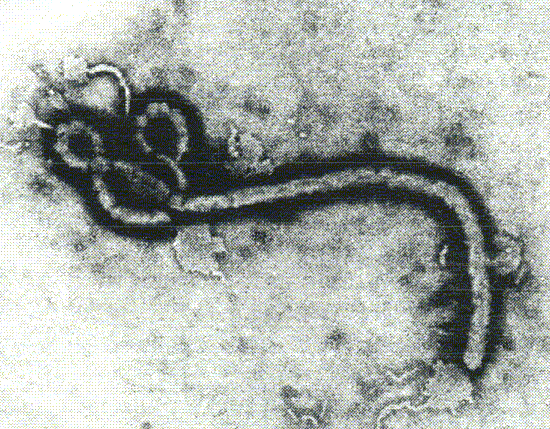
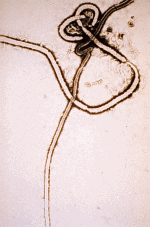
a mail from Ed Rybicki of the dept of molecular biology of the Form The Ebola virus when viewed through an electron microscope has
been described in many ways - a worm, a thread, pigtails, bends like the
letter U and even snakes. One of the descriptions that was made and was
adopted was the similarity to a “shepherds crook”. The virus is pleomorphic, appearing as long filamentous (and sometimes
branched) forms in a variety of shapes including U, 6-shaped, and circular.
The virions have a uniform diameter of 80 nm,
composed of a helical nucleocapsid and are
enveloped with surface projections Replication The exact mechanism that the Ebola virus uses to make its entry into the host cell is still unknown. It is assumed that they use the same mechanism as rhabdoviruses which have similar genetic characteristics. The actual process of replication has been described in a later part of this report. Image of the Virus Fig. 1 is one of the first images taken of the Ebola virus
taken in October 1976, right after the Reservoir Species A reservoir species is a species that carries a virus with
experiencing little or no side effects from carrying the virus. One of the
major drawbacks so far in the isolation of the Ebola virus and the search for
a cure, has been the inability to identify the
reservoir species. During the outbreaks of Ebola, frantic attempts were made
to isolate the reservoir species. The cotton factory where the virus was
first recorded was scoured and every living thing within the factory was
captured, including spiders, cockroaches and other insects and they were all
tested. Even bat droppings were collected and analysed
but the virus remained elusive. It was earlier thought that the virus was
carried by primates but recent studies and evidence show that primates are as
much a victim of the virus as human beings. Laboratory
observation has shown that bats experimentally infected with Ebola do not die
and this has raised speculation that these mammals may play a role in
maintaining the virus in the tropical forest. It is evident that this reservoir species has its home
somewhere within the rainforest and has only in recent times come into
contact with man. This also indicates the possibility that the species is not
yet a recorded one.
VARIATIONS OF THE VIRUS Ebola Ebola Ebola The Ebola Sudan outbreak occurred roughly the same time that
the Ebola Zaire outbreak took place. The Ebola Reston This strain was identified and named after a batch of monkeys
shipped to an experimental lab in Ebola Tai This is the most recently identified of Ebola viruses (1995),
though the discovery of the Tai strain has now sparked a debate as to what
actually constitutes an Ebola strain. Several Chimpanzees were killed by this
virus but the only known human infection was the non-fatal infection of a
Swiss researcher in the The Other Haemorrhagic fevers Other
well-known haemorrhagic fevers are: ·
·
|
Fig 1 Electron microscope image of the virus M = 112,000 X
Variants of the
Ebola Virus Picture of the Ebola
Marburg Virus Pictures courtesy Dr. F A Murphy |
|
Feedback? Bouquets?
Brickbats? |
||
|
Copyrights and all
that stuff |
||
|
LINKS Need more information? |
||
|
Why this page was
published |
||
|
The violent world
of Biosafety level 4 viruses |
||
|
The shepherd’s crook |
||
|
The nature of the beast - Pathology- |
||
|
Comparison of Ebola with the deadly AIDS virus |
||
|
Where does the virus hide? |
||
|
Comprehensive list of outbreaks till date |
||
|
Current stage of
research |
||
|
Overlay of
deforestation and Ebola outbreak areas |
||
|
Is the human race
headed for destruction? |
||