|
|
TROPICAL RAINFOREST AND
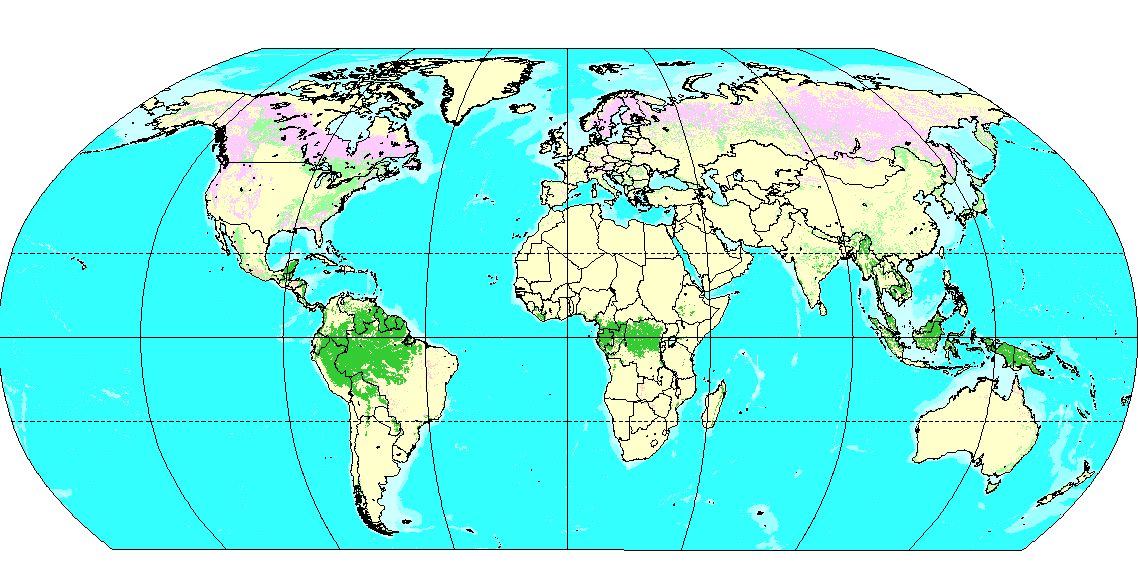
ITS DESTRUCTION Extent of the Tropical Rainforest The Tropical rainforest is a unique
biosphere – 2 % of the earth’s surface, concentrated in a narrow equatorial
belt is believed to contain 50 % of the world’s species. A map with the
extent of tropical rainforests has been shown below. Characteristics of the Tropical Rainforest The tropical rainforest derives its name
from the fact that it represents vegetation, which has resulted due to
tropical rains. The rainforest is a complex community whose framework is
provided by trees of many sizes. The tropical rainforest is characterised by dense vegetation,
in a succession of layers. The microclimate under the canopy differs from
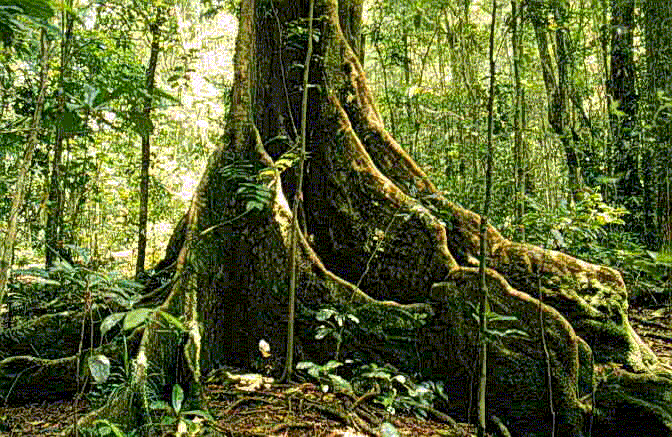
that outside – there is less light, higher humidity and lower temperatures. Trees have large buttress roots to support
their immense size and roots run close to the surface in an attempt to
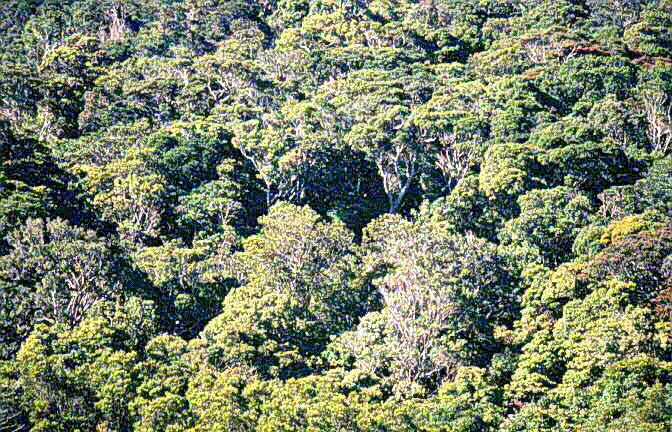
intercept nutrients. The Canopy The canopy, as the name implies is the
uppermost layer of the rainforest formed as continuous foliage formed by the
crowns of the trees. It is assumed that 70 % of species within the rainforest
reside within the canopy. Within the forest canopy, especially in
lowland forests, there are a large number of both vertebrates and
invertebrates. These species either subsist on plant or animals, giving rise
to complex inter-relationships: for example, in relation to the pollination
of flowers and dispersal of seeds. The whole organic community and its immediate
physical and chemical environment together make up the ecosystem of the
rainforest. Over a sufficiently large area, the climax forest itself is in a
state of dynamic equilibrium. This means that while the forest is
constantly growing and changing, there is no net increase in the overall
number of living plants and animals; deaths are more or less balanced by
replacements. Many areas of montane forests are important
but lack any protection at this time. This is especially critical in view of
the increasing human population pressure in eastern Destruction of Rainforest ‘The direct pressures of mounting human
numbers, and the less direct but equally profound changes in the biosphere
that result from human perturbation of biogeochemical processes, are altering
the course and character of biological evolution’ 3 . ‘Tropical rainforests are being destroyed at
tremendous rates. The estimates vary but the earth is losing tropical
rainforest at the rate of around 60,000 m2 per minute or approximately 1,000
m2 per second. Clear felling is being practised in order to clear areas for
human activities and agriculture. This is resulting in the loss of species
diversity and the loss of primary forest.
2 ‘Bio diversity in Sub
Saharan 3
Holdgate, Martin in ‘Tropical Deforestation and Species
Extinction’ eds. Whitmore T.C, Sayer J.A, IUCN, Chapman and Hall,
4 Reid,
W.V., in ‘Tropical Deforestation and Species Extinction’ eds. Whitmore
T.C, Sayer J.A, IUCN, Chapman and Hall, |
Fig 7 : Equatorial tropical rainforests
shown as green patches
Fig 8 : Buttress roots typical of a
rainforest
Fig 9 : Rainforest Canopy
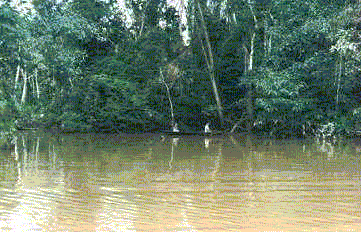
Fig 10 : River through
rainforest with a view of the thick undergrowth
|
|
Feedback? Bouquets?
Brickbats? |
||
|
Copyrights and all
that stuff |
||
|
LINKS Need more information? |
||
|
Why this page was
published |
||
|
The violent world
of Biosafety level 4 viruses |
||
|
The shepherd’s crook |
||
|
The nature of the beast - Pathology- |
||
|
Comparison of Ebola with the deadly AIDS virus |
||
|
Where does the virus hide? |
||
|
Comprehensive list of outbreaks till date |
||
|
Current stage of
research |
||
|
Overlay of
deforestation and Ebola outbreak areas |
||
|
Is the human race
headed for destruction? |
||
|
|

|
Estimate |
% Global loss |
Method of |
Reference |
|
|
|
|
|
|
|
8 – 11 |
|
Lovejoy 1980 |
|
|
9 |
Estimated species area curve, forest loss based on Global 2000
projections. |
Raven 1988 a,b |
|
|
7 |
|
Myers 1979 |
|
|
2 -3 |
|
|