|
|
THE HIV VIRUS AIDS is arguably the worst environmental disaster
of the 20th century While discussing the Ebola virus, comparisons must be
inevitably made to AIDS, caused by the HIV (Human Immunodeficiency)
particles. The HIV virus is also believed to have its origins from within the
Rainforest. Mode of
Action The main difference between HIV and Ebola is the mode of
action. AIDS is an acronym for Acquired Immune Deficiency Syndrome. HIV is
transmitted like Ebola, but is much less contagious than Ebola. AIDS moves
silently and one of the reasons why it has been so successful in penetrating
the human species is its long incubation period. It is not easy to identify a
carrier of HIV and he or she may freely transmit the virus over a long period
of time, unknowingly. The virus attaches itself to T-Lymphocytes, or the cells that
are responsible for the human immune system and which fight disease and
infections. The virus when it begins to replicate, disables and destroys the
T-Lymphocytes, thus making even common infections like colds lethal, in the
absence of an immune system. · Thus the HIV does
not kill directly – it disables the immune system, allowing for the invasion
of other diseases. · On the other hand
Ebola, as described earlier, physically destroys
every cell it comes into contact with. The incubation period is extremely
short, thus limiting the number of additional people that can be infected. Given
that the virus is extremely contagious, this is one factor that has been
crucial for limiting the spread of the virus. Mutation
ability ·
The HIV virus mutates rapidly and a patient who finally
dies from AIDS may have multiple strains of the same virus. Ebola does not
mutate so rapidly. ·
In fact, the strains of virus isolated in the 1976 Bumba outbreaks and the 1995 Kikwit
outbreaks, though separated by 19 years and 1,800 kilometres
are very similar in structure. Transmission
·
The HIV virus can be stopped from transmission through
preventive measures, with an almost 100 % efficiency. That means
that the virus can finally isolated and prevented
from spreading, theoretically. ·
The Ebola virus knows no such limits. The virus is a biosafety level 4 agent – It is to be handled under
extremely tight security, with all possible safety measures. Access to a
level 4 laboratory is by means of electronic identification cards and sensors. Biosafety level 4 Scientists who work with Ebola must undergo decon (decontamination showers) before and after they
enter the Level 4 laboratory. They must work with space suits, which are
internally pressurised to provide a positive air
pressure within the suit. They must wear two pairs of airtight gloves. As a
final precaution, the lab is always maintained at a negative pressure,
relative to the outside, so as to prevent leaks to the outside atmosphere.
The air drawn from the level 4 lab is passed through disinfecting agents and
is scrubbed before being released back to open air. If there is any evidence of a suit leak and possible
contamination with Ebola virus particles, the involved person is kept in an
airtight chamber (called the submarine) for a quarantine period of two weeks.
Possible
killers HIV or Ebola, both are killers – their human hosts are ideal
for their replication, with little or no immunity against these microscopic
killers. If Ebola were to be as successful as AIDS in penetrating the human
species, there seems little hope for man. With an 80 % population wipe out,
development as we know it, would be put back by
hundreds of years. |
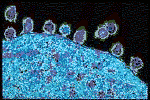
Pseudocolored
transmission electron micrograph of human immunodeficiency virus (HIV) on infected
human lymphocyte Source : Custom Medical
Stock Photo
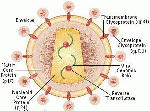
Graphical
representation of the HIV virus Source : exHIV |
|
Feedback? Bouquets?
Brickbats? |
||
|
Copyrights and all
that stuff |
||
|
LINKS Need more information? |
||
|
Why this page was
published |
||
|
The violent world
of Biosafety level 4 viruses |
||
|
The shepherd’s crook |
||
|
The nature of the beast - Pathology- |
||
|
Comparison of Ebola with the deadly AIDS virus |
||
|
Where does the virus hide? |
||
|
Comprehensive list of outbreaks till date |
||
|
Current stage of
research |
||
|
Overlay of
deforestation and Ebola outbreak areas |
||
|
Is the human race headed
for destruction? |
||
|
|