
INTRODUCTION
Focus of Study
The study will focus on the Ebola Virus and the possible link between destruction of rainforest and the emergence of the Ebola virus in Western and Central Africa.
Humanisation and destruction of environment
The processes of development as currently understood involve the extensive use of natural resources for the growth of economies, construction of infrastructure and other activities, which are encompassed in the term development. These processes in most cases involve the conflict of man with nature, or the ‘humanisation’ of the planet. Development, population growths, depletion of natural resources, global warming and pressure on water and land resources have led to an unwanted destruction of the environment.
It is with this background that we see an
increasing number of natural disasters, many of them having anthropogenic
origin. The depletion of the ozone layer, global warming, increasing floods
and landslides are some of the effects, which seem to be recent phenomena.
In the past two hundred years, man has destroyed
large parts of the biosphere, large pools of genetic diversity, which have
taken billions of years to build. The ‘humanisation’ of the planet has
paid a heavy price.
Destruction of Rainforests
Tropical rainforests in particular have undergone
tremendous destruction and continue to be destroyed at the rate of almost
one-hectare per second, world wide. Rainforests covering only 2 % of the
world’s surface are thought to contain more than 50 % of the world’s biodiversity.
It is from the tattered edges of the rainforest
that Ebola has emerged. Human pressure has bought people into uncomfortably
close contact with areas, which were once virgin forest. People have cut
down and burned forests, and areas that have been undisturbed for millions
of years have suddenly been exposed to the activities of man.
Contact with Ebola
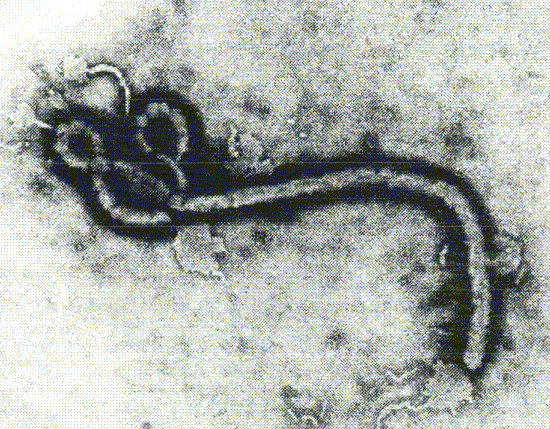
Somewhere, from these regions, man has come into contact with the Ebola virus that has probably lain undisturbed ever since the beginning of life on this earth. The virus has gladly accepted the human host as a refuge for replication, for its continued survival and propagation. Virologists today are voicing the concern that the emergence of the Ebola virus is essentially due to the destruction of the rainforest and the contact of man with the reservoir species.
The Ebola virus is a threat to mankind, hiding deep within the rainforest, a threat that cannot be wished away.
Feedback? Bouquets? Brickbats?
Copyrights
and all that stuff
LINKS
Need more information?
Why this page was published
The violent world of Biosafety level 4 viruses
The shepherd’s crook
The
nature of the beast
- Pathology-
Comparison of Ebola with the deadly AIDS virus
Where does the virus hide?
Comprehensive list of outbreaks till date
Current stage of research
Overlay of deforestation and Ebola outbreak areas
Is the human race headed for destruction
-
Mode of Action
Ebola is extremely destructive to the host, which could probably explain the fact why it has not yet been as successful in penetrating the human species as AIDS. The extreme speed at which it spreads through the body and destroys it, prevents it from transmitting itself from host to host with a high rate of success. While AIDS is a silent stalker, Ebola is a violent, bloody predator.
-
Affinity for Connective tissue
Most strains of Ebola attack every part of the human body with the exception of skeletal muscle and bone. Every other part of the body is susceptible to the attack of the Ebola virus. The virus is extremely successful which is evident in the fact that it attacks every part of the body and converts it into a digested mass of virus particles. At the beginning, blood clots are formed in the bloodstream and the blood thickens and begins to slow down. The clots attach themselves to walls of the blood vessels in a process known as pavementing.
As the number of clots increases, some clots find their way to smaller capillaries where they get stuck and thus form “dead” spots within the brain, liver, and kidneys and all through the skin. The skin develops haemorrhages under itself. Ebola has a particular affinity for connective tissue, which is the tissue that holds the internal organs together. By its action, the virus actually acts on the collagen (the protein which is a component of connective tissue) and converts it into a soft mush and under layers of the skin die. The virus attacks the intestines, the eyeballs, the lungs and the liver with equal ferocity.
-
Destruction of the host
The virus kills a huge amount of tissue and converts it into a digested slime before it finally kills its host. Internal organs slough tissue and even the heart itself begins to bleed inside itself. At the end of the process the host is totally destroyed in a process called ‘crashing out’ where the host dies and begins to bleed from every possible orifice, including the skin pores. This could be viewed as a mechanism for the virus to ‘seek’ a new host.
