
LIFECYCLE OF THE VIRUS
Hot Virus
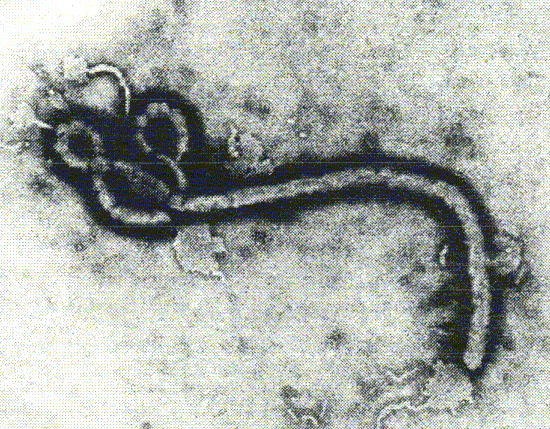
The Ebola virus is termed as a ‘hot’ virus. This means that it is a lethally infective agent. The Ebola virus has a prime directive to replicate, like any other known virus on this planet.
The Ebola virus has however a major difference in terms that the reservoir species of the virus is yet unknown. The reservoir species is the carrier of the virus, which itself is not affected by the virus. Thus, a major mystery of that part of the life cycle of the virus is unknown. What are known are the effects and the mode of functioning of the virus once inside a host.
Replication using proteins
The Ebola virus, once inside a host, begins to replicate. The seven proteins that make up the body of the virus begin to consume the host cell as the virus starts making copies of itself. These seven proteins attack the body of the cell and somehow attack the structural proteins of the body of the host.
Virus bricks
Ebola and Marburg multiply extremely rapidly and powerfully that within no time the infected cell becomes packed with crystal like blocks of virus particles (Ref fig 2). These virus particles are themselves getting ready to replicate.
The crystal like blocks, or bricks, form at the centre of the cell and begin to grow outwards, migrating to the cell wall. On reaching the cell wall, the brick dissolves into hundreds of individual virus particles (Ref. fig 1)
The Ebola virus particles then infiltrate the bloodstream of the host and keep attaching themselves to cells everywhere. Here the procedure of replication is repeated until the tissue becomes saturated with virus crystal bricks.
Amplification of the virus
This amplification continues till even a droplet of blood of the host can contain up to 100 million virus particles. The Ebola virus thus destroys its host and “seeks” a new one. Like any other virus, the Ebola cannot survive by itself and needs either a reservoir or host for its continued existence.
Transmission
It is believed that the virus is mainly transmitted through contact with the blood of an infected person or primate, either directly or indirectly, for example through the use of an infected syringe.
It is known that the Ebola virus is spread from person to person through direct contact with body fluids (e.g., blood, semen, vaginal fluid, organs) of an infected person. Transmission may occur through sexual activity and during pregnancy. Studies show that transmission through semen may occur up to 7 weeks after an individual has recovered from the virus. The risk of transmission is high for health-care providers, family members of an infected individual and others in a health-care setting where contact with body fluids is frequent and sterilization of equipment may not be guaranteed.
Risk is also high for family members and others having direct contact with a deceased infected individual in preparation for burial.
Since the virus is extremely lethal, clinical tests have not been easy to conduct and hence no concrete data is available as to the exact mode of transmission. However, the strain of Ebola that was isolated in Reston, Virginia, is believed to be transmitted by aerosol contact.
Symptoms
The incubation period of the Ebola virus ranges from 2 to 21 days. EHF symptoms often begin within a few days of becoming infected, with the sudden onset of high fever, weakness, muscle pain, headache and sore throat. This is quickly followed by more severe symptoms including vomiting, diarrhea, rash, decreased kidney and liver functioning, and internal and external bleeding. Specific laboratory blood tests can confirm diagnosis.
Pathology
-
Hosts
The life cycle of the virus has been explained. The Ebola virus has so far two known hosts – primates and Homo sapiens. As explained, the virus is termed as a level 4 agent, which means that it is extremely infective and lethal.
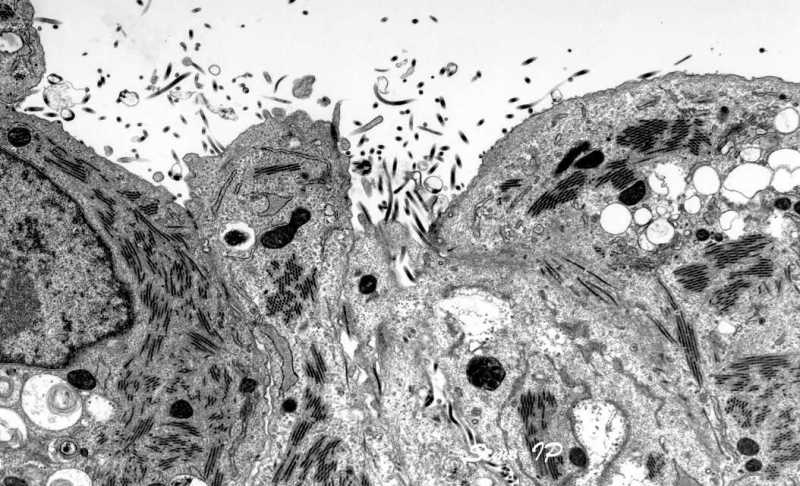
Figure 1
Particles bursting the cell wall
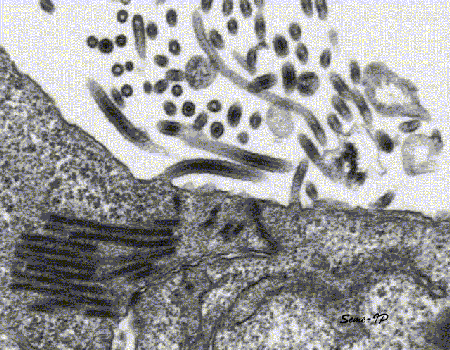
Figure 2
Ebola Brick particle in the cell wall
Variants of the virus
Ebola Marburg

Feedback? Bouquets? Brickbats?
Copyrights
and all that stuff
LINKS
Need more information?
Why this page was published
The violent world of Biosafety level 4 viruses
The shepherd’s crook
The
nature of the beast
- Pathology-
Comparison of Ebola with the deadly AIDS virus
Where does the virus hide?
Comprehensive list of outbreaks till date
Current stage of research
Overlay of deforestation and Ebola outbreak areas
Is the human race headed for destruction
-
Mode of Action
Ebola is extremely destructive to the host, which could probably explain the fact why it has not yet been as successful in penetrating the human species as AIDS. The extreme speed at which it spreads through the body and destroys it, prevents it from transmitting itself from host to host with a high rate of success. While AIDS is a silent stalker, Ebola is a violent, bloody predator.
-
Affinity for Connective tissue
Most strains of Ebola attack every part of the human body with the exception of skeletal muscle and bone. Every other part of the body is susceptible to the attack of the Ebola virus. The virus is extremely successful which is evident in the fact that it attacks every part of the body and converts it into a digested mass of virus particles. At the beginning, blood clots are formed in the bloodstream and the blood thickens and begins to slow down. The clots attach themselves to walls of the blood vessels in a process known as pavementing.
As the number of clots increases, some clots find their way to smaller capillaries where they get stuck and thus form “dead” spots within the brain, liver, and kidneys and all through the skin. The skin develops haemorrhages under itself. Ebola has a particular affinity for connective tissue, which is the tissue that holds the internal organs together. By its action, the virus actually acts on the collagen (the protein which is a component of connective tissue) and converts it into a soft mush and under layers of the skin die. The virus attacks the intestines, the eyeballs, the lungs and the liver with equal ferocity.
-
Destruction of the host
The virus kills a huge amount of tissue and converts it into a digested slime before it finally kills its host. Internal organs slough tissue and even the heart itself begins to bleed inside itself. At the end of the process the host is totally destroyed in a process called ‘crashing out’ where the host dies and begins to bleed from every possible orifice, including the skin pores. This could be viewed as a mechanism for the virus to ‘seek’ a new host.
