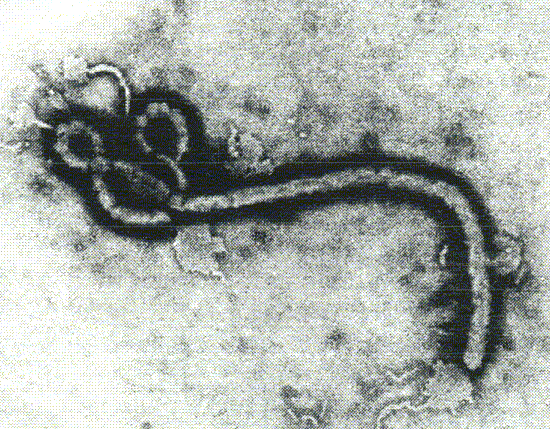
|
|
HISTORY
OF OUTBREAKS Index case The
Ebola virus is what can be termed as a newcomer. The first recorded
case, or
index case of a virulent disease,
which later would be
called Ebola, was in the town of
Spread to N'Zara and Maridi The
virus spread with devastating
speed and effect. It burned through the population of N’zara and hit the nearby town of Ebola in the Bumba Region But that was not the end.
A
few months after the
outbreak of Ebola The virus burns through the Bumba region The virus erupted
simultaneously in fifty-five
villages surrounding the hospital. The virus swept through the local
population,
especially the women who prepare the dead for burial. It hit the
hospital staff
and then it hit the nuns. The virus even at this stage was still an
unknown agent. One
of the nuns who fell sick was transported
to a hospital in By the time the WHO
delegation reached the Bumba area,
there was a total blackout of information. The virus had burned
the Bumba region. Meanwhile, Nurse Mayinga crashed out and died. The WHO team set
up biocontainment pavilions to isolate
people
who had any contact with Mayinga or who
showed any signs of having contracted the disease. Then, against the fears
of an epidemic breaking out
on a wild scale in In Ebola announces its presence to the world The virus was then
identified as a filovirus
and was named Ebola after the
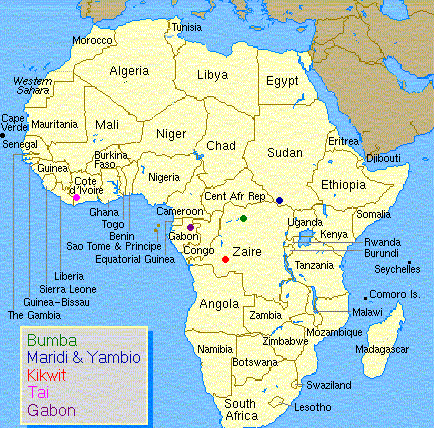
river where it had first emerged. The virus from From the table, it is
clear that the Ebola
virus is a phenomenon of Central and part of |
Fig 4 Map
of Ebola Outbreaks (Central and
Fig
5
Fig
6 Land
Sat image of deforested areas near the river Ebola in |
|
Feedback?
Bouquets? Brickbats? |
||
|
Copyrights
and all that stuff |
||
|
Need
more information? |
||
|
Why
this page was published |
||
|
The
violent world of Biosafety level 4 viruses |
||
|
The
shepherd’s crook |
||
|
The
nature of the beast -
Pathology- |
||
|
Comparison
of Ebola with the deadly AIDS virus |
||
|
Where
does the virus hide? |
||
|
Comprehensive
list of outbreaks till date |
||
|
Current
stage of research |
||
|
Overlay
of deforestation and Ebola outbreak areas |
||
|
Is
the human race headed for destruction? |
||



|
YEAR |
STRAIN |
CASES
/FATALITIES |
COMMENTS |
LINKS FOR MORE INFORMATION |
| May 2005 | Margburg | 275 (255) | Uige Province , Angola |
|
| June 2004 | No Data | 28 (7) | Yambio, Western Equatoria, Southern Sudan | |
|
Nov
2003 |
No
Data |
35
(29) |
Districts
of Mbomo and Kéllé
in Cuvette, Republic of |
|
|
Feb
2003 - |
No
data |
143
(128) |
Districts
of Mbomo and Kéllé in Cuvette, Republic of Congo |
|
|
October
- May 2002 |
No
data |
60
(50) |
Libreville,
Gabon (Ivindo district), last death on March 19 |
|
|
2001 |
No
data (suspected might be Crimean - Congo Haemorrhagic fever |
75
(8) |
Afghanistan
- Pakistan border |
|
|
2000
- 2001 |
No
data |
428
(174) |
Uganda
(Gulu District) |
|
|
1999 |
No
data |
63 |
Watsa (Congo - Sudan Border) |
|
|
July
96 - |
Subtype
Ebola Zaire |
60
|
Libreville,
Gabon |
|
|
1996 |
|
2
(1) |
South
Africa initial case imported from Gabon |
|
|
1996* |
No
data |
60
(45) |
Cases
recorded near Libreville, Gabon between July 1996 and March 1997. |
|
|
1996* |
No
data |
37
(21) |
Cases
recorded in Mayibout, Gabon between January and March. The virus was
apparently transmitted from a chimpanzee that was prepared for a feast
by villagers of the village Mayibout. The village is about 150 km away
from the provincial capital of Makokou on the Ivindo river. |
|
|
1996* |
No
data |
1
(0) |
Case
recorded in Plibo, Liberia. |
|
|
1996* |
Ebola
Zaire |
316
(245) |
Cases
recorded in Kikwit, Zaire between Jan- June 1995. |
|
|
1994* |
Ebola Tai (Cote d'Ivorie) |
1
(0) |
- |
|
|
1989 |
Ebola Reston |
4
(0) |
Reston
Virginia; infected cynomolgus macaques imported from the Philippines.
Subsequent studies established Asian origin of virus. All four cases
were subclinical. Ebola Reston is thought to be harmless to humans but
lethal for primates. |
|
|
1979 |
Ebola Sudan |
34
(22) |
Recurrent
episode in Nzara. The index case in this outbreak worked in the same
cotton factory which was the centre of the first outbreak. |
|
|
1977 |
Ebola
Zaire |
1
(0) |
Child
in Tandala, Zaire died of hemorrhagic fever. |
|
|
1976 |
Ebola
Zaire |
318
(280) |
Index
case introduced into hospital run by Belgian nuns at Yambuku in the
Bumba region. Secondary transmission occurred by injection and
unsterilized equipment as well as contact with infected people. |
|
|
1976 |
Ebola
Sudan |
284
(141) |
Epidemic
had its origins in Nzara, Sudan. Index case was traced to a cotton
factory. Spread to adjacent towns including the hospital at Maridi. |