|
|
TREATMENT AND CURRENT
STAGE OF RESEARCH No known cure The Ebola virus has no know cure. Till recent times not much
attention was paid to the virus until it was isolated in A virus cannot be treated by antibiotics, unlike in the case
of diseases like typhoid and malaria. The usual method of treating a viral infection
is to inject a milder form of the virus, which has been cultivated in a
vaccine, into the patient. This causes the body to respond with an immune
reaction and produce specific antibodies against the invasion of this virus.
These antibodies which are now activated, prevent
further infection and help destroy virus particles already present. Usually
these antibodies and this immune reaction last for a lifetime. Current Stage of Research There have been many instances of news or articles about a
vaccine which has shown promising results, but no further news about any one
of them has been available. As of March 2003, there has been no concrete news
of a vaccine successful enough to begin human trials with. No immune reactions have been observed in any human cases of
the Ebola virus. There are several experimental vaccines being tested. The
Journal of Virology reports in its April 2002 issue from a paper by Mangala Rao et al, a test using
L(EV) (liposome-encapsulated virus) did not immunize or prevent death of
monkeys, but did retard the onset of the virus (more…) and another research by Manish Gupta et al,
using a polyclonal immune serum did not lead to immunity. (more…..) A vaccine has been tested on Guinea Pigs in a laboratory in
the Michigan Medical Centre that has shown favourable
results with the test animals. However researches say that the vaccine is
nowhere near ready for trial on human beings, and it is just the first known
weakness of the Ebola virus. National
Institutes of Health: Virus Research Centre A
team of researchers led by scientists from the National Institutes of Health (NIH)
has developed a novel vaccine that prevents Ebola virus infection in monkeys.
All four vaccinated monkeys were completely protected from a lethal dose of
the virus. This study describes the first primate model of immune protection
against Ebola virus, a model that may allow scientists to rationally design a
vaccine that prevents this dreaded disease in humans. This was discovered in
Nov of 2000, but no further news has been made available. CDC Research Research on the Ebola virus has been taken up seriously. The
virus, although having been most virulent in ·
No specific treatment or vaccine exists for Ebola haemorrhagic fever. ·
Severe cases require intensive supportive care, as
patients are frequently dehydrated and in need of intravenous fluids. ·
Experimental studies involving the use of hyper-immune
sera on animals demonstrated no long-term protection against the disease
after interruption of therapy. |
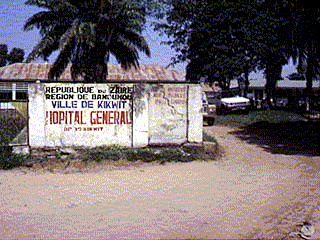
Fig 5 Kikwit Hospital in Zaire, epicentre of the 1995 epidemic
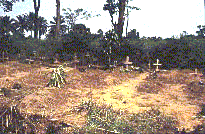
Fig 6 Graveyard in Kikwit for Ebola victims
|
|
Feedback? Bouquets?
Brickbats? |
||
|
Copyrights and all
that stuff |
||
|
LINKS Need more information? |
||
|
Why this page was
published |
||
|
The violent world
of Biosafety level 4 viruses |
||
|
The shepherd’s crook |
||
|
The nature of the beast - Pathology- |
||
|
Comparison of Ebola with the deadly AIDS virus |
||
|
Where does the virus hide? |
||
|
Comprehensive list of outbreaks till date |
||
|
Current stage of
research |
||
|
Overlay of
deforestation and Ebola outbreak areas |
||
|
Is the human race
headed for destruction? |
||
|
|