3)
The Mitsubishi installed this heat exchanger in the
motor for USA in the order to fulfil their Pollution
norms, particularly the one item about emission of
hydro carbides.
This
is not a performance component.
It
is an modification made in order to get the vehicle
homologated by Californian pollution laws. CARB
The
function of this exchange is to heat the oil during
the motor heating phase, warm-up, Since the water
collecting point for the exchanger is placed at the
point of highest water Circuit temperature, at the
outlet of the head, before entering the radiator.
4)
The desastrous effects, consequences, produced by
this exchanger in Brazil Are attributed to following
aggregated facts:
A) With the tropical climate conditions in Brazil,
it is really necessary to maintain the oil Temperature
below 130 degrees Celsius thru. An true exchanger
, which is not the case of this one, since it works
with water at 100 Degrees Celsius, small delta, for
a very small exchanger and with by-pass.
B) At this time Castrol stopped to produce the oil
RS 10W60 indicated in the owner manual, MITSUBISHI
BRAZIL made a bad mistake in the choice of the new
oil to be used.
The SLX 0W30 oil has a too low viscosity for tropical
climate. This mistake was only fix in 2003, after
the slaughter of many motors.
C) With the installation of a turbocharger in 4G63
motor, the available space was reduced.
It was necessary to relocate the oil filter to enable
the installation of a true water/ oil Heat exchanger,
but this was not done, instead, the one installed
only fulfilled the space Limitations.
The small exchanger has charge loss and flow reduction
on the line that lubricates The whole motor, not as
foreseen in the original project.
In a new motor, the oil flow reduction is not significative
but, with the enlargement of internal gap produced
by wear , the motor needs a stronger oil flow in order
to maintain the Same pressure.
What makes things worse is that the small ducts of
the exchanger are obstructed with the Wastes of motor
carbonization, reducing the flow even more.
D) The excessive carbonization due to a wrong TROPICALIZATION,
witch reduced the Spark Advanced and enriched the
air/fuel ratio, brought along higher working temperatures,
valves And spark plug melting and a quicker oil degradation.
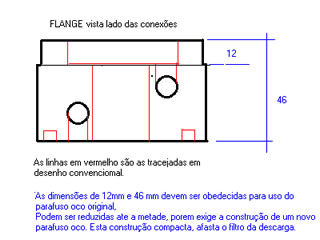
The
final diagnostic of the inadequacy of the exchanger
installed by MITSUBISHI MOTORS
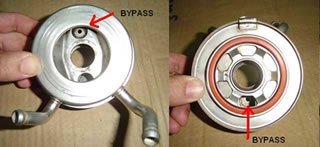
Is indicated on the photo, by the passage BY-PASS
hole in the oil gallery of the heat exchanger, showing
its failure in allowing the necessary oil for the
motor flow.
This way the direct passed oil did not exchange heat.
5)
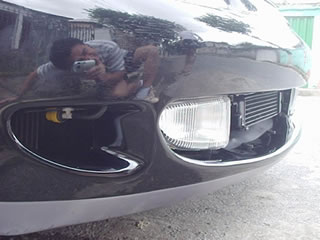
The solution is to take this exchanger out and to
put a true air/oil exchanger in, as shown in the photo,
like an older MITSUBISHI models .
6)
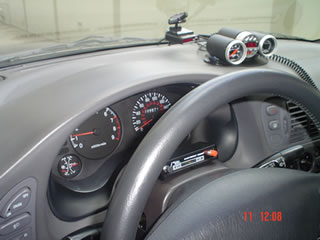
Effects, outcome, after this installation .
As seen in the instrument panel photo, at idle , the
oil manometer indicates more than Half scale, that
would be impossible with the original heat exchanger.
With the motor running at 3000 rpm, the oil manometer
now indicates more than 3/4 of the scale. The motor
also grateful, running smooth and robust.
There will also more be more horse-power because this
motor has JET COOLER.
Now . with more oil and lower temperature , there
will be less detonation and more volumetric efficiency.
The motor will be trustful and have longer life, because,
as the gap grow, the higher available oil volume will
maintain the necessary pressure to fill them, So avoiding
the direct metal with metal contact that destroys
the motor.
It
can no be said with certainty that this exchanger
is the cause of the CRANKWALK, But surely increase
its effects.
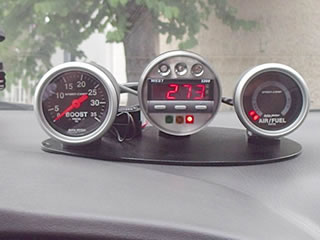
Look
at the EGT display, digital at the center
The temperatures lowered in all the range 100 degrees
Celsius
Before, in idle we had 450 degrees
Now we have 350 degrees
That means we can increase the boost or
Lean the air/fuel ratio or
Even keep both and improve reliability.
This EGT temperature reduction is due mainly to two
reasons, lower oil temps,
More advanced ignition timing, due the new set-up
eprom ECU
Roberto Zschaber
|