New Year's Eve by Su Tung Po 1037-1101 New Year's Eve-- you'd think I could go home early but official business keeps me. I hold the brush and face them with tears: pitiful convicts in chains, little men who tried to fill their bellies, fell into the law's net, don't understand disgrace. And I? In love with a meagre stipend I hold on to my job and miss the chance to retire. Don't ask who is foolish or wise; all of us alike scheme for a meal. The ancients would have freed them a while at New Year -- would I do otherwise? I am silent with shame. Note: this poem was written in 1071, when Su was vice-governor of Hangchow. By custom, criminal cases involving the death penalty had to be settled before New Year's Day. |
My Comment The poet feels humiliated at his inability to be as compassionate as his legendary predecessors. He looks sympathetically at the criminals and cynically at himself. He recognises that he is just like the criminals in the way that he protects his own livelihood, irrationally at times. The brush he holds is a writing implement. With it he will form the Chinese characters that will make their executions official. He is a man trapped by his dependence on a modest salary. There is a modern equivalent in a civil servant who will do nothing that will endanger his superannuation payout. It is a bleak and painfully honest poem with the ring of truth. Merv Daw |
Window on Chinese Poetry |
Collection Five |
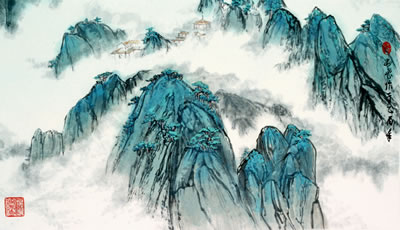
Climbing up Cold Mountain by Han Shan Clambering up Cold Mountain, the Cold Mountain Trail goes on and on; the long gorge choked with scree and boulders, the wide creek, the mist-blurred grass. The moss is slippery though there's been no rain. The pine sings, but there's no wind. Who can leap the world's ties and sit with me among the white clouds? Adapted from a translation by Gary Snyder |
My Comment There is unexplained moisture near the top of the mountain, but that is not the only inexplicable thing. What is making the pine sing? This poem has wonderful, tough imagery of the mountain, even in English translation. Although it has been a long and laborious climb, he feels inspired by the setting and invites anyone to join him, meditating on the peak among the clouds. Merv Daw |
"the long gorge choked with scree and boulders, the wide creek, the mist-blurred grass." |
Early Autumn by Xu Hun A harp in the night is playing clear; the west wind rustles a green vine. A low cloud touches the jade-white dew; an early wildgoose flies in the River of Stars. Night in the tall trees clings to dawn; light makes folds in the distant hills. Here on the Huai, by one falling leaf, I can feel a storm on Lake Dongting. |
My Comment Amazing imagery, isn't it? There is an oblique reference here to the idea that everything in nature affects everything else. It is part of the yin yang theory of things being complementary and necessary to each other. On the river, a single falling leaf tells him of the storm on the distant lake. The images are fresh and alive, with each one affecting your reading of the other. There is faint music, the rustling of the wind, the whiteness of clouds and dew, the single bird flying across the starry sky, dim light in the trees, she shape of hills revealed in the soft morning light, then the single leaf falling. It's a beautiful, dynamic picture, with movement, sound and change. Merv Daw |
"Night in the tall trees clings to dawn; light makes folds in the distant hills." |
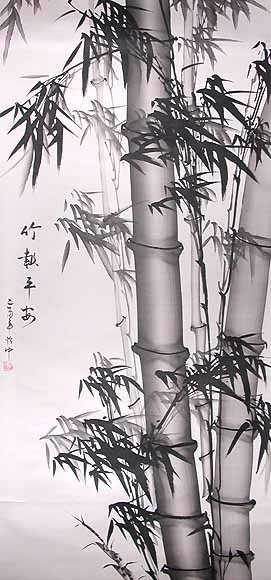
"A Sketch of Mount Chung" by Wang An-shih Noiselessly, the mountain stream circles the bamboo grove. West of the bamboo, flowers and grasses sport with the tenderness of spring. I sit under thatched eaves facing this all day. Not a single bird sings; the silence of the hills deepens. |
My Comment Meditation poem. Take it easy and let your mind heal itself from the stresses of daily living. Time. Silence. Peace. Merv Daw |
 |
 |
 |