Window on Chinese Poetry |
Collection Two |
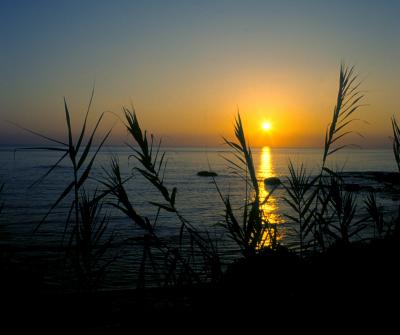
"Mooring at twilight in Yuyi District" by Wei Yingwu Furling my sail near the town of Huai, I find for harbour a little cove where a sudden breeze whips up the waves. The sun is growing dim now and sinks into the dusk. People are coming home. The bright mountain-peak darkens. Wildgeese fly down to an island of white weeds. ...At midnight I think of a northern city-gate, and I hear a bell tolling between me and sleep. |
"I travel day and night" by Su Tung Po I travel day and night toward the Yangtze and the sea. Maple leaves, reed flowers: fall has endless sights. On the broad Huai I can't tell if the sky is near or far; green hills keep rising and falling with the boat. Shou Chou: already I have seen the white stone pagoda, though short oars haven't brought us around Yellow grass Hill. Waves calm, wind mild; I look for the landing. My friends have stood a long time in twilight mist. |
My Comments I like this poem and the way it presents eager anticipation. He can "see" his destination before it really comes into view. The image of his friends quietly waiting for his arrival is particularly moving. They are gathered on the landing in the twilight mist. That image, together with the calmness of the wind and water, give a feeling of tranquil satisfaction and contentment. Merv Daw |
"On seeing the snow-peak of Zhongnan" by Zu Young See how Zhongnan Mountain soars with its white top over floating clouds and a warm sky opening at the snow-line while the town in the valley grows colder and colder. Adapted from a translation by Witter Bynner |
My Comments With such spare description, the imagination is unleashed. Sometimes less is really much better. People who read the poem can construct the picture in their mind, and feel the cold in their own way. No picture with this poem! Merv Daw |
"A song of the palace" by Zhu Qingyu Now that the palace gate has slowly closed on its flowers, ladies file out to their pavilion of jade, abrim to the lips with imperial gossip but not daring to breathe it with a parrot among them. Adapted from a translation by Witter Bynner |
My Comments Who had the brilliant idea of the parrot-spy? Imagine the frustration of the women with so much to talk about and so little confidence to speak! I enjoy the humour of this poem and also its evocative suggestion of the sheltered, inbred sort of court life that women at the palace experienced. Merv Daw |
 |
 |