| Window on Chinese Poetry |
Background to this site |
How did it start? I began this site in February 2002, with the thought of putting a few Chinese poems in English translations on a website as a hobby. I had been living in Hong Kong for eighteen months or so and had in my spare time been reading quite a lot of Tang Dynasty poems in translation, becoming a real fan. Commentaries Most websites and books that I culled my selections from had no commentaries on the poems, and I wanted to share my reactions and feelings about them. I still haven't seen much in the way of commentary on the net. Design I have looked at other websites and taken ideas about presentation from them. My site was designed to be easy to read, colourful, unified and illustrated. I didn't want anything too gaudy, and have tried and rejected various moving "tricks" that only distract a reader. More Recently Later additions were the biographies of the poets, and I expanded the number of poets that had their own pages from three to five. I was an Australian teacher of English to Chinese students from 2000 to 2004, and from time to time have used the poems in my teaching. I encouraged my students to read the poems and write comments about them. Their comments were very good and I have published them on the site with their permission. Sources Most of the poems on this site have been collected from the websites listed on the Links page, but some have come from books. Where possible I have acknowledged the translator, even if I have adapted their translation quite a bit. As I have developed this site I have become more knowledgeable about the poems and the poets, so I have made more and more alterations to translations, trying to reflect what I feel are the original intentions of the poets and the original patterns of the poems. I have found that the translations of poems vary a good deal because in many cases, the original poems were deliberately ambiguous, and/or allusive in many ways. I think there is room for many versions, all of them valid interpretations; after all, we aren't guessing at what the writer meant, but making a meaning for ourselves out of the poem. Relevance The thing that amazes me is that so many of these ancient poems are wonderfully relevant even to readers in these times, which are so different to the times of the Tang Dynasty. My trip to the North West of China In April 2002 I joined a small tour group and visited remote Chinese localities on the North West frontier. The trip was mind-bending and provided a real boost to my interest in the Tang period. It was during this era that the Silk Road was a busy conduit between Europe and Asia. We saw Dunhuang, the last real town before the travellers split up to go round the Taklamakan Desert. Near Dunhuang there is a group of grottoes carved into a cliff, housing incredible statues and frescoes from the first advent of Buddhism into China from India. These Mogao Grottoes were one of the great archaelogical finds of the 19th Century, with a huge number of manuscripts, some in then unknown languages. Our trip also took us to some ruins of cities destroyed by Genghis Khan, near Turfan. All of this made the frontier war poems of the Tang Dynasty come alive. We saw some real mountain country near Urumqi and the Terracotta Warriors that had been unearthed near Xian (known in the Tang era as Chang 'an). Merv Daw |
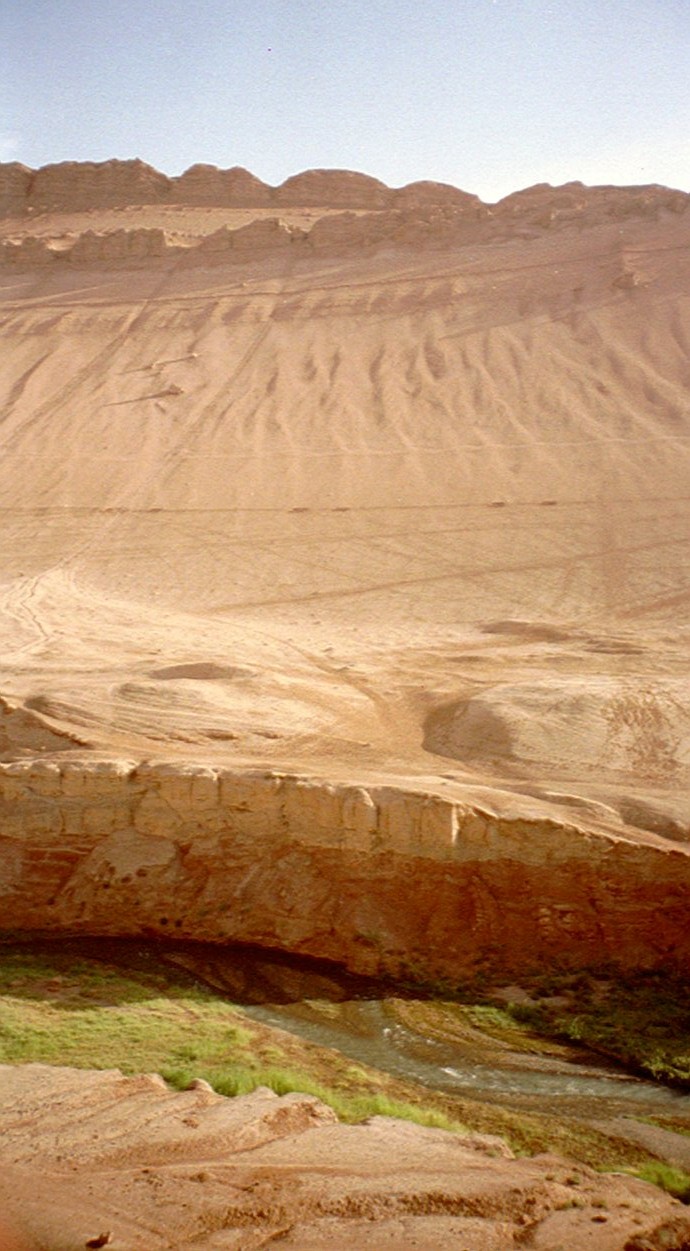 |
Bezaklik: scene of decorated grottoes and a river that flows into the desert from the mountains. |