Window on Chinese Poetry |
"Moonlit Night" by Du Fu Tonight my wife must watch alone the full moon over Fu-Shou; I think sadly of my sons and daughters far away, too young to understand this separation or remember our life in Chang'an. In fragrant mist her flowing hair is damp; in clear moonlight her jade-white arms are cold. When will we lean at the open casement together while the moonlight dries our shining tears? Adapted from a translation by David Lunde To read my comments on this poem and the comments of other readers click HERE |
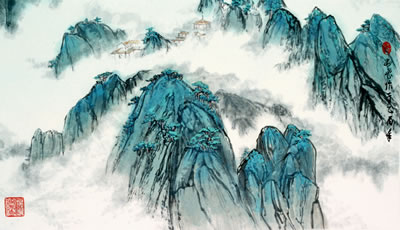
"Gazing at Mount Tai" by Du Fu How to describe Tai Mountain? Its green towers over all of Chi and Lu! Here the creator concentrated divine beauty; its north and south sides split dark from dawn. Chest pounding, you reach the birthplace of the clouds; bursting eyes fill with birds returning to nest. Someday I must climb to the very top, looking down at all the little mountains at once. Adapted from a translation by David Lunde To read my comments on this poem click HERE |
 |
 |
"Returning Late" by Du Fu After midnight, eluding tigers on the road, I return home below dark mountains, my family asleep inside. The Northern dipper drifts nearby, sinking low over the river. Venus blazes -- huge in empty space. Holding a candle in the courtyard, I call for two torches. A gibbon in the gorge, startled, shrieks once. Old and tired, my hair white, I dance and sing out, goosefoot cane, no sleep,...."Catch me if you can!" Adapted from a translation by David Hinton |
 |
 |
 |
|
 |
| Du Fu poems To read a short biography of Du Fu, click HERE |
|
 |
from "Ballad of the old Cypress" by Du Fu In front of the K'ung-ming Shrine stands an old cypress, with branches like green bronze and roots like granite. Its hoary bark, far round, glistens with raindrops, and blueblack hues, high up, blend in with heaven's. Long ago, statesmen and kings kept time's appointment; but still this standing tree has men's devotion. It is united with the mists of ghostly gorges, through which the moon brings cold from snowy mountains... ...Wide, wide, though writhing roots maintain its station; Far, far, in lonely heights; many's the tempest when its hold is the strength of divine wisdom and its straightness the work of the creator. Yet if a crumbling hall needed a rooftree, yoked herds would, turning heads, baulk at this mountain. By art still unexposed, all have admired it but if the axe were not refused, who could transport it?... ...Oh ambitious unknowns, sigh no more sadly. Using timber this big was never easy. Adapted from a translation by David Hawks |
 |
"Full Moon" by Du Fu Above the tower -- a lone, twice-sized moon. On the cold river passing night-filled homes, it scatters restless gold across waves. On mats it shines richer than silken gauze. Empty peaks, silence; among sparse stars, not yet flawed, it drifts. Pine and cinnamon spreading in my old garden...all light, all ten thousand miles at once in its light! |
Asking of Wu Lang again by Du Fu Couldn't we let her filch dates from your garden? She's a neighbour. Childless and without food, alone - only desperation could bring her to this. We must be gentle, if only to ease her shame. People from far away frighten her. She knows us now - A fence would be too harsh. Tax collectors hound her, she told me, keeping her bone poor... how quickly thoughts of war become falling tears. |
My Comment It is huge and old, solid as rock or bronze. The ancient tree has a strength and resilience that seem supernatural. The poet admires everything about it: its location, size, character and power. It has outlived generations of important people and still demands respect as they used to. It has remained standing through countless storms that threatened it. Its roots hold it firm, even though the branches spread far and wide. It is so old, tough and knotty that it defies the axe. Men who look at it prosaically as so much wood are frustrated by the impossibility of dealing with it. To me, this tree represents nature. It is not just timber, or a resource. The poem could well be an anthem for the preservation of old-growth forests. It makes me recall seeing film of aboriginal people in the Amazon Basin apologising to the spirit of the tree before they fell it. Merv Daw |
"By the River" by Du Fu A literal, word-for-word translation: River blue bird exceed white Hill green flower about to ignite This spring see again have What day be return year. A well-known translation: The river's blue, the bird a perfect white, The mountain's green with flowers about to blaze. I've watched the spring pass away again, When will I be able to return? My version: River, blue; bird, incredibly white; mountain, green; flower, about to ignite; This spring I have seen again. On what day will spring return? |
My Comment My version tries to suggest in English the concentrated meaning of the Chinese version, and to follow the meaning as closely as possible, adding as few new ideas as possible. Sometimes it is impossible to say what the original meaning was. There is an ambiguity that was possibly intended by the poet. In my third line, for example, it could mean, "I have seen spring again," or it could mean, "this spring has made me see (afresh) again." The last line seems to say to me, "On what day will spring return?" rather than, "When will I return?" which seems to me a pointless question. The whole theme of the poem seems to be about the staggering, colourful beauty of this spring, and how he can't wait for next spring to arrive. He wants to be there, waiting for it. Merv Daw |
My Comment It is surprising that so many Chinese poems are about the moon. Maybe, in the times before electric light, the stars and the moon were noticed far more by people and the nights were quiet and dark, so that sitting outside and contemplating the moon was a common pastime. The third and fourth lines capture how moonlight can add magical touches to the surface of moving water, and even to something as humble as a floor mat. The last lines are very expressive indeed. You can feel the observer's pleasure, pride and feeling of awe. Merv Daw |
Kuei-Chou by Du Fu Above Kuei-chou's wall, a cloud-form village; below: wind-tossed sheets of falling rain, a swollen river thrashing in the gorge. Thunder and lightning battle. Kingfisher-grey trees and ashen ivy shroud sun and moon. War horses can't compare to those back in quiet pastures. But of a thousand homes, a bare hundred remain. Ai - Ai - the widow beaten by life's toll, grief-torn, sobbing; in what village, where, on the autumn plain? |
A servant boy arrives by Du Fu Fresh greens grace haw and pear. Tinged apricot and plum have turned half yellow. The courtyard silent � a boy comes, bringing ripe, fragrant fruit in delicate baskets. Replete with mountain wind, iced with wild dew, the flavours shine. Propped on pillows, a guest of rivers and lakes, I linger over days and months themselves forever in each taste. |
 |
 |