Window on Chinese Poetry |
Collection Four |
"The Past" by Li Yu The beauty of the scenery cannot sweeten my bitter memories. In the courtyard, moss spreads over the steps despite the autumn wind. My bed curtains hang down for days, since no one comes. The golden sword has long been buried and my ambitions have withered like weeds. In the cool and still sky the moon opens like a flower. The shadows of my old palaces must now be aimlessly falling across the moats. |
My Comment When I first read this poem I thought that the poet had adopted the persona of a deposed emperor and imagined the rest. It wasn't until much later that I read that Li Yu actually was a deposed emperor, and many of his poems are about the shock and horror of that traumatic time. In this poem, the solid objects all take on special significance: the moss on the steps, the bed curtains, the golden sword, the moon, the shadows and the moats. These things are presented and described simply, then work together to make the total effect of sadness, impotent bewilderment and nostalgia. I have played around with the lines to emphasise the original pattern in Chinese, subject: statement, subject:statement... Merv Daw |
"...my ambitions have withered like weeds" |
"A Farewell to my Friend" by Li Ch'i In the fourth month the south wind blows plains of yellow barley, date flowers have not faded yet and lakka leaves are long. The green peak that we left at dawn we can still see in the evening, while our horses whinny on the road, eager to turn homeward. Ch'en, my friend, you have always been a great and good man, with your dragon's moustache, tiger's eyebrows and your massive forehead. In your bosom you have shelved away ten thousand volumes. You have held your head high, never bowed it in the dust. After buying us wine and pledging us, here at the eastern gate, and taking things as lightly as a wildgoose feather, you lie flat, tipsy, forgetting the white sun; but now and then you open your eyes and gaze at a high lone cloud. The tide-head of the long river joins the darkening sky. The ferryman beaches his boat. It has grown too late to sail. And people on their way from Cheng cannot go home, and people from Louyang sigh with disappointment. I have heard about the many friends around your woodland dwelling. Yesterday you were dismissed. Are they your friends today? Adapted from a translation by Witter Bynner |
My Comment The poem is long and complex, providing quite a challenge to the reader. The symbolism of some actions and objects is not clear at first, and there must be many Chinese cultural significances that are lost on an outsider. However, if you work backwards from the idea that the man has been sacked and may lose friends as a consequence, some things make sense. The lone cloud in the vastness of the sky may represent his feeling of abandonment. The horses, uneasily whinnying, want to return home, to familiar and comforting surroundings. The people unable to take the ferry home are also disappointed and anxious. So the pattern emerges, and you can work your own way through this expressive tribute to a close friend who has fallen on hard times. There is a clearly sympathetic, dismayed feeling about it. I find it very powerful and evocative. Merv Daw |
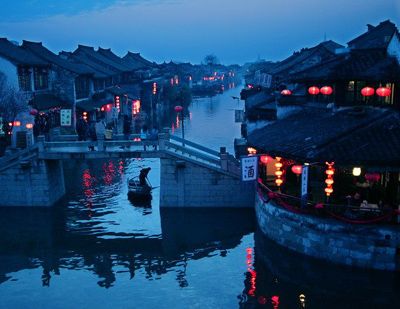
The Lantern Festival by Xin Qiji (1140-1207) Lanterns look like thousands of flowers aglow; later like stars, from the skies, fallen below. On main streets, horses and carriages ply. There, ladies shed perfume as they pass by. Orchestral music and song greet our ears, as the moon, slow and steady, eastward veers. Of the Spring Festival, this night marks the end. The whole night, capering, carps and dragons spend. Adorned with ribbons or paper flowers on their head, clad in their best raiment, something bright or red, Women squeeze their way among the festive crowd, As they talk and laugh; even giggle aloud. Rouged and powdered; perfumed to their heart's content, They cannot but leave behind a subtle scent. Up and down the main streets, I must have run -- A thousand times or more in quest of one, Who I have concluded, cannot be found; For, everywhere, no trace of her can be seen, When, all of a sudden, I turn about... That's her, where lanterns are few and far between. |
My Comment I associate this poem with September, because this is when Chinese people observe the Mid-autumn Festival, eating mooncakes and lighting lanterns in the parks. It is a cheerful, family-oriented festival. The translator of the poem has used rhyming couplets, which sometimes sound a bit forced, but are similar in effect to the regular rhyming effect of the original Chinese verse. The couplets definitely suit the happy mood of this poem. The poem describes what happens and what he can see on the night, and it sounds as if he has thoroughly enjoyed the evening. However, he wants to see a particular woman, and only finds her after a desperate search. She is on the fringe of the crowds, perhaps waiting patiently for him to find her. Merv Daw |
"An old Fisherman" by Liu Zongyuan An old fisherman spent the night here, under the western cliff; he dipped up water from the pure Hsiang and made a bamboo fire; and then, at sunrise, he went his way through the cloven mist, with only the creak of his paddle left, in the greenness of mountain and river. I turn and see the waves moving as from heaven, and clouds above the cliffs coming idly, one by one. |
My Comment Another river poem! there are many that I like about this subject. There are some subtle touches here that appeal to me. Imagine being able to boat on a river of pure drinking water! The old man is living a quiet, frugal lifestyle, leaving no trace of where he has been. You can hear the oars creak, but you can't see him in the mist. Relentlessly the waves and clouds advance, marking the passing of time. Merv Daw |
 |
 |