Window on Chinese Poetry |
Archives for 2003 |
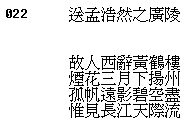 |
"A farewell to Meng Haoran on his way to Yangzhou" by Li Bai You have left me behind, old friend, at the Yellow Crane Terrace, on your way to visit Yangzhou in the misty month of flowers; your sail, a single shadow, becomes one with the blue sky, till now I see only the river, on its way to heaven. Adapted from a translation by Witter Bynner |
| Poem of the month for January |
My Comment This poem is a real favourite among Chinese people and has also been translated into English many times. All the translations are interesting. They demonstrate just what a range of possible meanings can be suggested by a small poem in the Chinese language. They also suggest just how beautiful and creative the poem is. The lines have a suggestion of death and the soul's passage to heaven; sad partings can seem to have that association. It could also be a bit of a play on the idea of the poet as "an immortal by the river", which was a role that the poets of the time adopted for themselves, sometimes tongue-in-cheek. The poem also reminds me of a wonderful day in Augusta, a small town in the south west of Western Australia, when the sea calmed off and the estuary and the river merged seamlessly together. Meng Haoran was a skilful poet of the era. It is interesting that so many of the Tang Dynasty poets knew one another and wrote about and to eachother. Merv Daw |
"Song of the Arrowhead at Changping" By Li Ho (790-816) Black spots like coal, white ones like bone ash, red like desert sand; a coppery pattern of ancient blood stains stands out. The weather of the years has destroyed the golden shaft and white feather, so there remains only the three-edged arrowhead like a wolf�s tooth. Over the plain our two horses plod east of the remount station, on through the stony buckwheat fields against an unceasing wind. The winter day is short, and the stars come out. Strips of cloud, like black flags, stream through the wide night sky. The spirits of the dead seem all around us, so we stop, make offerings of milk and soup. The insects have become silent, but wild geese are crying amongst the gleaming red reeds. A wind springs up again and blows the gloaming fire, a sign to bid me farewell, and I reflect on looking for relics over so wide a space, finding only this arrowhead, then think how horribly it must have sped, swiftly cutting and piercing living flesh. On his horse comes a boy from the city, lightly advising me to buy a shaft to make it a complete arrow again. Adapted from the translation by Rewi Alley |
| Poem of the month for February |
My Comment This extraordinary poem was written many centuries ago yet has a breadth of knowledge and wisdom that makes it seem so modern. In a sense it is about archaeology: finding traces of historic events and speculating about what happened. It adds the poet's perspective, with that wonderfully expressed insight into the actual suffering of the "target" of the arrow. Finally, the boy's flippant and cheerful ignorance puts another layer over the top. It makes you think that the lessons of history will only be learnt by a few special people and the rest of us will be doomed to repeat historical tragedies. Merv Daw |
"A palace poem" by Gu Kuang High above, from a jade chamber, songs float half-way to heaven. The palace-girls' happy voices are mingled with the wind � But now they are still, and you hear a water-clock drip in the Court of the Moon.... They have opened the curtain wide, and are facing the River of Stars. Note: the River of Stars is the Chinese expression for what is known in English as the Milky Way. Adapted from a translation by Witter Bynner |
My Comment What can keep these happy, sociable court women quiet? It is the sight that has stilled most people in a sort of reverence at certain times: the sight of the stars blazing away brilliantly in a black sky. I like the part about the water clock dripping in the moonlight. It is the sort of quiet background sound that is finally heard and appreciated when human voices are quietened. Another fine touch is the idea of the songs mingling with the wind and carrying a long way in the night, "half-way to heaven." Merv Daw |
| Poem of the month for March |
"Full Moon" by Du Fu Above the tower -- a lone, twice-sized moon. On the cold river passing night-filled homes, it scatters restless gold across waves. On mats it shines richer than silken gauze. Empty peaks, silence; among sparse stars, not yet flawed, it drifts. Pine and cinnamon spreading in my old garden...all light, all ten thousand miles at once in its light! |
My Comment It is surprising that so many Chinese poems are about the moon. Maybe, in the times before electric light, the stars and the moon were noticed far more by people and the nights were quiet and dark, so that sitting outside and contemplating the moon was a common pastime. The third and fourth lines capture how moonlight can add magical touches to the surface of moving water, and even to something as humble as a floor mat. The last lines are very expressive indeed. You can feel the observer's pleasure, pride and feeling of awe. Merv Daw |
| Poem of the month for April |
"A Buddhist retreat behind Broken Mountain Temple" by Chang Jian In the pure morning, near the old temple, where early sunlight points the tree-tops, my path has wound, through a sheltered hollow of boughs and flowers, to a Buddhist retreat. Here birds are alive with mountain-light, the mind of man touches peace in a pool, and a thousand sounds are quieted by the breathing of a temple-bell. Adapted from a translation by Witter Bynner |
| Poem of the month for May |
My Comment Don't you love this walk through the trees on a fresh morning? The morning is "pure", new and untouched. The early sun highlights the tips of the trees. The new light on the mountain brings the birds "alive". The soft, winding path and the "sheltered hollow of boughs and flowers" are very easy to imagine. All of these things make you think of the writer's delight in the beauty of the morning. I think it is a very restful, peaceful poem. The clear, still surface of the pool allows people to "touch" peace, no matter how briefly. The last image of the "breathing" of the temple-bell is really clever at suggesting the soft, delicate, brushing sound the bell makes. It is not ringing or chiming, just gently "breathing". After reading the poem, I just feel like saying, "Thanks, Chang Jian, for sharing the beauty and peace of the moment with me." Merv Daw |
 |
 |
 |
 |
 |
from "Entertaining literary men in my official residence on a rainy day" by Wei Yingwu "When the mind is exalted, the body is lightened and feels as if it could float in the wind." Adapted from a translation by Witter Bynner |
| Poem of the month for June |
My Comment Beautifully put! And so true. Merv Daw |
"Strips of cloud, like black flags, stream through the wide night sky." |
| "...a thousand sounds are quieted by the breathing of a temple-bell." |
"The Past" by Li Yu The beauty of the scenery cannot sweeten my bitter memories. In the courtyard, moss spreads over the steps despite the autumn wind. My bed curtains hang down for days, since no one comes. The golden sword has long been buried and my ambitions have withered like weeds. In the cool and still sky the moon opens like a flower. The shadows of my old palaces must now be aimlessly falling across the moats. |
My Comment When I first read this poem I thought that the poet had adopted the persona of a deposed emperor and imagined the rest. It wasn't until much later that I read that Li Yu actually was a deposed emperor, and many of his poems are about the shock and horror of that traumatic time. In this poem, the solid objects all take on special significance: the moss on the steps, the bed curtains, the golden sword, the moon, the shadows and the moats. These things are presented and described simply, then work together to make the total effect of sadness, impotent bewilderment and nostalgia. I have played around with the lines to emphasise the original pattern in Chinese, subject:statement, subject:statement... Merv Daw |
|
"...my ambitions have withered like weeds" |
| Poem of the month for July |
"A Farewell to my Friend" by Li Ch'i In the fourth month the south wind blows plains of yellow barley, date flowers have not faded yet and lakka leaves are long. The green peak that we left at dawn we can still see in the evening, while our horses whinny on the road, eager to turn homeward. Ch'en, my friend, you have always been a great and good man, with your dragon's moustache, tiger's eyebrows and your massive forehead. In your bosom you have shelved away ten thousand volumes. You have held your head high, never bowed it in the dust. After buying us wine and pledging us, here at the eastern gate, and taking things as lightly as a wildgoose feather, you lie flat, tipsy, forgetting the white sun; but now and then you open your eyes and gaze at a high lone cloud. The tide-head of the long river joins the darkening sky. The ferryman beaches his boat. It has grown too late to sail. And people on their way from Cheng cannot go home, and people from Louyang sigh with disappointment. I have heard about the many friends around your woodland dwelling. Yesterday you were dismissed. Are they your friends today? Adapted from a translation by Witter Bynner |
| Poem of the month for August |
My Comment The poem is long and complex, providing quite a challenge to the reader. The symbolism of some actions and objects is not clear at first, and there must be many Chinese cultural significances that are lost on an outsider. However, if you work backwards from the idea that the man has been sacked and may lose friends as a consequence, some things make sense. The lone cloud in the vastness of the sky may represent his feeling of abandonment. The horses, uneasily whinnying, want to return home, to familiar and comforting surroundings. The people unable to take the ferry home are also disappointed and anxious. So the pattern emerges, and you can work your own way through this expressive tribute to a close friend who has fallen on hard times. There is a clearly sympathetic, dismayed feeling about it. I find it very powerful and evocative. Merv Daw |
The Lantern Festival by Xin Qiji (1140-1207) Lanterns look like thousands of flowers aglow; later like stars, from the skies, fallen below. On main streets, horses and carriages ply. There, ladies shed perfume as they pass by. Orchestral music and song greet our ears, as the moon, slow and steady, eastward veers. Of the Spring Festival, this night marks the end. The whole night, capering, carps and dragons spend. Adorned with ribbons or paper flowers on their head, clad in their best raiment, something bright or red, Women squeeze their way among the festive crowd, As they talk and laugh; even giggle aloud. Rouged and powdered; perfumed to their heart's content, They cannot but leave behind a subtle scent. Up and down the main streets, I must have run� A thousand times or more in quest of one, Who I have concluded, cannot be found; For, everywhere, no trace of her can be seen, When, all of a sudden, I turn about... That's her, where lanterns are few and far between. |
My Comment This poem is included as poem of the month for September, because this is when Chinese people observe the Mid-autumn Festival, eating mooncakes and lighting lanterns in the parks. It is a cheerful, family-oriented festival. The translator of the poem has used rhyming couplets, which sometimes sound a bit forced, but are similar in effect to the regular rhyming effect of the original Chinese verse. The couplets definitely suit the happy mood of this poem. The poem describes what happens and what he can see on the night, and it sounds as if he has thoroughly enjoyed the evening. However, he wants to see a particular woman, and only finds her after a desperate search. She is on the fringe of the crowds, perhaps waiting patiently for him to find her. Merv Daw |
| Poem of the month for September |
"By the River" by Du Fu A literal, word-for-word translation: River blue bird exceed white Hill green flower about to ignite This spring see again have What day be return year. A well-known translation: The river's blue, the bird a perfect white, The mountain's green with flowers about to blaze. I've watched the spring pass away again, When will I be able to return? My version: River, blue; bird, incredibly white; mountain, green; flower, about to ignite; This spring I have seen again. On what day will spring return? |
| Poem of the month for October |
My Comment My version tries to suggest in English the concentrated meaning of the Chinese version, and to follow the meaning as closely as possible, adding as few new ideas as possible. Sometimes it is impossible to say what the original meaning was. There is an ambiguity that was possibly intended by the poet. In my third line, for example, it could mean, "I have seen spring again," or it could mean, "this spring has made me see (afresh) again." The last line seems to say to me, "On what day will spring return?" rather than, "When will I return?" which seems to me a pointless question. The whole theme of the poem seems to be about the staggering, colourful beauty of this spring, and how he can't wait for next spring to arrive. He wants to be there, waiting for it. Merv Daw |
"An old Fisherman" by Liu Zongyuan An old fisherman spent the night here, under the western cliff; he dipped up water from the pure Hsiang and made a bamboo fire; and then, at sunrise, he went his way through the cloven mist, with only the creak of his paddle left, in the greenness of mountain and river. I turn and see the waves moving as from heaven, and clouds above the cliffs coming idly, one by one. |
My Comment Another river poem! there are many that I like about this subject. There are some subtle touches here that appeal to me. Imagine being able to boat on a river of pure drinking water! The old man is living a quiet, frugal lifestyle, and he is leaving no trace of where he has been. You can hear the oars creak, but you can't see him in the mist. Relentlessly the waves and clouds advance, marking the passing of time. Merv Daw |
 |
from Ballad of the Old Cyprus by Du Fu In front of the K'ung-ming Shrine stands an old cypress, with branches like green bronze and roots like granite. Its hoary bark, far round, glistens with raindrops, and blueblack hues, high up, blend in with heaven's. Long ago, statesmen and kings kept time's appointment; but still this standing tree has men's devotion. It is united with the mists of ghostly gorges, through which the moon brings cold from snowy mountains... ...Wide, wide, though writhing roots maintain its station; Far, far, in lonely heights; many's the tempest when its hold is the strength of divine wisdom and its straightness the work of the creator. Yet if a crumbling hall needed a rooftree, yoked herds would, turning heads, baulk at this mountain. By art still unexposed, all have admired it but if the axe were not refused, who could transport it?... ...Oh ambitious unknowns, sigh no more sadly. Using timber this big was never easy. Adapted from a translation by David Hawks |
| Poem of the month for December |
| Poem of the month for November |
My Comment It is huge and old, solid as rock or bronze. The ancient tree has a strength and resilience that seem supernatural. The poet admires everything about it: its location, size, character and power. It has outlived generations of important people and still demands respect as they used to. It has remained standing through countless storms that threatened it. Its roots hold it firm, even though the branches spread far and wide. It is so old, tough and knotty that it defies the axe. Men who look at it prosaically as so much wood are frustrated by the impossibility of dealing with it. To me, this tree represents nature. It is not just timber, or a resource. The poem could well be an anthem for the preservation of old-growth forests. It makes me recall seeing film of aboriginal people in the Amazon Basin apologising to the spirit of the tree before they fell it. Merv Daw |
 |
 |
 |