|
Country Profile
Malaysia lies in the heart of Southeast Asia. It is situated
close to the equator within longitudes 1 to 7 degrees North and
100 to 119 degrees East. It occupies two distinct regions -
Peninsular Malaysia extending from the Kra Isthmus to the Straits
of Johor, and Sabah and Sarawak on the northwestern coast of Borneo.
These regions are separated by about 750 kilometers of the South
China Sea.
Peninsular Malaysia is divided into the east coast and west coast
by the Main Range known as Banjaran Titiwangsa, which runs from the
Malaysia-Thai border in the north to the southern state of Negeri
Sembilan. The states of Sabah and Sarawak are geographically rugged,
with a series of mountain range encompassing the interior regions of
the states. Mount Knabalu in Sabah, with a height of 4,095.2 meters
is the highest peak in Southeast Asia.
Malaysia covers an area of 330,434 square kilometers (Peninsular -
131,537 square kilometers; Sabah - 124,449 square kilometers; Sarawak -
73,711 square kilometers). The coastline extends for nearly 4,830
kilometers, while the coastline of Sabah and Sarawak is 2,100 kilometers
long.
The states in Peninsular Malaysia are Perlis, Kedah, Pulau Pinang, Perak,
Selangor, Negeri Sembilan, Melaka, Johor, Pahang, Terengganu, Kelantan and
the Federal Territories of Kuala Lumpur and Putra Jaya. The states located
on Borneo are Sabah and Sarawak. Kuala Lumpur, the capital of Selangor, was
turned into a Federal Territory on 1st February 1974. The island of Labuan in
Sabah followed suit on 16th April 1984 and Putrajaya on 1st February, 2001.
Putrajaya is the new Administrative Centre of the Federal Government of
Malaysia. Situated within the Multimedia Super Corridor (MSC), Putrajaya
is set to become a model city with its sophisticated and up-to-date
information network. Putrajaya will use multimedia technologies to become
an electronic administrative centre. All interaction within government and
the public will be conducted via electronic and multimedia channels.
Putrajaya is located along the South Growth Corridor which begins with the
Kuala Lumpur City Centre in the north to the new Kuala Lumpur International
Airport at Sepang. Putrajaya is just 25 kilometers away from Kuala Lumpur and
20 kilometers from the Kuala Lumpur International Airport.
Brief History
Malaysia's history may be said to date from the period of
the Melaka Sultanate founded just before 1400 A.D. Melaka
was founded by Parameswara, a prince from Palembang who
initially discovered Temasik which he called Singapura.
He was then forced to flee from Singapura by the Srivijayan
forces and moved to Melaka which flourished as a port trading
center in the region.
The spread of Islam within the archipelago is attributed to
the Muslim traders, mainly from India who came to trade.
Parameswara also converted to Islam and became the first
Sultan of Melaka.
1511 - Melaka's spice trade led to its
attack by the Portuguese, resulting in the fall of the
Sultanate.
People
Malaysia is a multi-racial country with a population of
23.26 million. This consists of the Malays (58.1%), the
Chinese (24.3%), the Indians (6.9%) and the rest (3.2%),
the indigenouse people of Sarawak and Sabah (the Ibans,
Bidayuhs, Kenyahs, Kadazans, Kelabits, Muruts, Kayans,
Bisarays, Melanaus) and the Eurasians.
Bahasa Malaysia is the national and official language in
the country. However, there are other Asian languages and
dialects widely spoken by the people. The main Chinese
dialects are Hokkien, Cantonese, Hakka, Teochew and Hainanese.
The common Indian languages used are Tamil, Telegu, Malayalam,
Punjabi, Hindi, Gujerati and Urdu. English is widely spoken and
is extensively used in commerce and industry.
Under the Federal Constitution, Islam is the official religion
but there is a freedom of worship. The multi-racial society
practices various religions such as Islam, Christianity, Hinduism,
Buddhism and Taoism.
Holidays and Festivals
National Day
The National Day is celebrated annually on August 31 to commemorate
Malaysia's Independence. Parades and processions, variety shows and
shopping carnivals are held to mark the event.
Birthday of His Majesty the Yang di-Pertuan Agong
His Majesty's official birthday is celebrated on June 1 each eary
which is declared a public holiday. The highlight of the celebration
is the conferment of awards and titles by His Majesty to those who
have distinguished themselves in their services to the country.
Hari Raya Puasa Aidil Fitri
Hari Raya Aidil Fitri concludes a month of fasting from sunrise
to sunset. Muslims usher in the special day with prayers at the
mosque and seek forgiveness from family members. It is custormary for
Muslims to open their homes to well-wishers as well as visit friends
and relatives.
Hari Raya Haji Aidil Adha - Dzulhijjah 10
Hari Raya Haji Aidil Adha is celebrated on Dzulhijjah 10
internationally, when Muslims perform the last phase of haj
in the holy city of Mecca. The act of sacrificing cattle, goats
and camels locally knows as "korban" is performed to feed the poor
and needy.
Chinese New Year
The Chinese New year is celebrated on the first day of the
first moon on the Chinese lunar calendar. It is a joyous occasion
marked by family reunions and giving away of small red packets or
"ang pow" containing money to children and unmarried youngsters.
Moon Cake Festival
This festival is celebrated on the fifteenth day of the eighth month
of the Chinese lunar calendar, with the exchange and eating of
mooncakes with assorted fillings. In the evening, children will
light the paper lanterns while women pray to the Goddess of the Moon.
Deepavali
Deepavali or the Festival of Lights signifies the triumph of good
over evil. The day begins with the traditional oil bath. The celebration
includes visits to temples and prayers at household altars. Hindu homes
are adorned with oil lamps or lights to signify the victory of Lord Krishna
over the demon Narakasuka.
Thaipusam
Hindus celebrate the day to commemorate the birthday of Lord Subramaniam.
The festival begins with a grand procession of the silver chariot bearing
the statue of Lord Subramaniam. Devotees carry davadis or wooden steel
yokes with long spikes and metal hooks pierced into their bodies.
Christmas
Christmas is celebrated by Christians on December 25 each year. They
attend midnight church servicces on Christmas eve. Friends and relatives
go visiting and exchange gifts to celebrate the birth of Jesus Christ.
Wesak Day
Buddhists celebrate Wesak Day to commemorate the birthday of Lord Buddha,
which falls in May. The Buddhists offer prayers, incense and jossticks
at temple. The highlight of the celebration is the colorful procession
of floats held during the night.
Gawai Festival
The Gawai Festival marks the end of the paddy planting season and the
beginning of a new season. It is celebrated by the Dayaks of Sarawak.
Friends and relatives go visiting during the Gawai Dayak season. During
the festival, visitors have the opportunity to see the Dayak in their
finery, complete with accessories and headgear.
Kadazan Festival
The Kadazan festival which is locally known as the Pesta Ka'amatan is
essentially the harvest festival celebrated by the Kadazan, Dusun and
Murut people of Sabah. The highlight of the festival is the performance
of the traditional dance; the Sumazau.
National Symbols
Source: Malaysia in Brief 2004 and http://www.tradepartners.gov.uk |
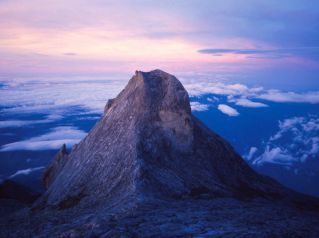 Mount Kinabalu
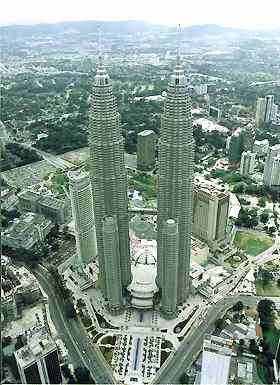 Petronas Twin Towers
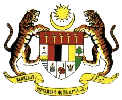 The armorial ensign of Malaysia shows a 14 pointed star
representing the 13 constituent States within the Federation of
Malaysia together with the Federal Government, while the star and
the crescent together symbolizes Islam as the official religion
of Malaysia. The five krises represent the five former Undfederated
Malay States of Johor, Kedah, Perlis, Kelantan and Terengganu.
The armorial ensign of Malaysia shows a 14 pointed star
representing the 13 constituent States within the Federation of
Malaysia together with the Federal Government, while the star and
the crescent together symbolizes Islam as the official religion
of Malaysia. The five krises represent the five former Undfederated
Malay States of Johor, Kedah, Perlis, Kelantan and Terengganu.
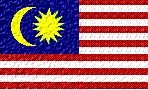 The Jalur Gemilang or Malaysian Flag consists of
14 horizontal red and white stripes of equal width,
representing the equal membership in the Federation
of 13 component states and the Federal Government.
The union or canton of dark blue in the upper quarter
next to the staff and extending down to the top of the
fifth stripe stands for the unity of the people of Malaysia.
The Jalur Gemilang or Malaysian Flag consists of
14 horizontal red and white stripes of equal width,
representing the equal membership in the Federation
of 13 component states and the Federal Government.
The union or canton of dark blue in the upper quarter
next to the staff and extending down to the top of the
fifth stripe stands for the unity of the people of Malaysia.