|
Malaysia practices
parliamentary democracy with a constitutional monarch, His Majesty
the Yang di-Pertuan Agong as the Supreme head of the country.
The Federal Constitution clearly defines the separation of powers between the Legislative, Judicial and Executive Authorities. The separation of power occurs both at federal and state levels as in keeping the concept of federalism, which form the basis of the government administration.
His Majesty Tuanku Syed Sirajuddin Ibni Al-Marhum Tuanku Syed Putra Jamalullail
His Majesty the Yang di-Pertuan Agong is elected by the Conference
of Rulers for a term of five years. He acts upon the advice of the
Prime Minister and the Cabinet. He appoints the Judges of the Supreme
Court and the High Court.
As the Supreme Commander of the Malaysian Armed Forces, he exercises
the prerogative of mercy in respect of court martial offences. His
Majesty is also responsible in safeguarding the special position of
the Malays and Islam as the official religion, and the legitimate
interests of the natives/bumiputras of Sabah and Sarawak.
|
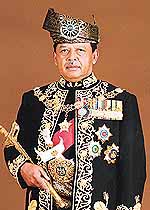 Yang di-Pertuan Agong
|
Consitution
The Federal Constitution of Malaysia is the supreme and over-riding
law of the nation. The Constitution guarantees liberty of the person,
protection against retrospective criminal laws and repeated trials,
equality before the law, freedom of movement, speech and religion and
the right to property.
The Constitution distributes the power of governance in accordance with
the practice of parliamentary democracy. The Constitution may be amended
by a two-thirds majority in Parliament.
Parliament The Parliament of Malaysia comprises of the Yang di-Pertuan Agong and two houses; the Dewan Negara (Senate) and Dewan Rakyat (House of Representatives). Dewan Rakyat Members of Dewan Rakyat or House of Representatives are elected by the people through general elections. It consists of 193 members who hold office for a period of five years. Out of the 193 members, 144 are from Peninsular Malaysia, 28 from Sarawak, 20 from Sabah and 1 from Labuan. Dewan Negara The Dewan Negara consists of 69 members; 43 are appointed by His Majesty the Yang di-Pertuan Agong and 26 are elected by the legislative assemblies of the 13 states of Malaysia. Each state has two representatives in the Dewan negara, two more from the Federal Territory of Kuala Lumpur and another from the Federal Territory of Labuan. A senator holds office for three years for a maximum of two terms. Judicial Authority
The judicial power in Malaysia is vested in the Supreme Court, the High
Court of Borneo and subordinate courts as provided by federal law. The
Head of the Judiciary is the Lord President of the Federal Court.
The Supreme Court has jurisdiction to determine the validity of any
law made by Parliament or by a State legislature and disputes between
States of between the Federation and any state. It also has the
authority to interpret the Federal and State Constitutions.
Executive Authority
Dato� Seri Abdullah Ahmad Badawi The Executive Authority is vested in His Majesty the Yang di-Pertuan Agong and is exercisable by a Cabinet of Ministers headed by the Prime Minister, who in accordance with the principle of a democratic ruling system is the Chief Executive. The Cabinet is responsible to His Majesty the Yang di-Pertuan Agong. Legislative Authority Legislative Authority is the power to make laws and also the power to raise taxes and authorize expenditure. At Federal level, legislative power is vested in a bicameral Parliament, headed by the Yang di-Pertuan Agong and comprises of the Senate and the House of Representatives. Source: Malaysia in Brief 2003 |