|
Country Profile
The Republic of Croatia is a European country situated along
the Adriatic Sea and its hinterland. It stretches from the slopes
of the Alps and deep into the Pannonian Valley to the banks of the
Danube and Drava rivers.
Thus according to its natural characteristics, as well as its cultural
and historical development, Croatia can be divided into three geographically
distinct zones: the Coastal region, the Mountain region, and the Pannonian
region.
The area of Croatia is 21,830 sq. miles (56,538 sq km), approximately the
size of West Virginia. Croatia's population, which totals 4,784,265 according
to the 1991 census, is predominantly Roman Catholic.
Ethnics and Religion
Source: 1991 Census
The official language is Croatian, although English, German and
Italian are widely spoken.
History of the Croatian State
Croatia enjoys a rich political and cultural history, marked by
the following moments:
Emergence of Croatian Statehood
Croats arrived in their present homeland in the 7th century.
679, Croats entered into a treaty with Pope Agatho, and Croats
accepted Christianity during the rule of Prince Viseslav in 800.
Viceroy Trpimir, an ancestor of the Croatian dynasty of Trpimirovic,
ruled Dalmatian Croatia. In a letter dated 852, the name
Hrvat (Croat) was recorded for the first time on the Adriatic coast.
Pope John VII blessed Croatian Prince Branimir, Croatian clergy and
Croatian people in St. Peter Church in Rome on May 21, 879, the first
international recognition of Croatia.
Croatia first emerged as a nation-state in 925 when Ban Tomislav
united Pannonian and Dalmatian Croatia and was crowned the first Croatian King.
In 1094 the Bishopric of Zagreb was founded. Under the archdiocese
of Ostrogon until 1180, and the archdiocese of
Kalocza from 1180 to 1152,
Zagreb was in 1852 elevated to the rank of an independent archdiocese.
The Baska tablet, one of the oldest and most valuable texts in the Croatian
language and Glagolic script, was written in 1100.
It details land King Zvonimir
gave to the abbey of St. Lucia in Draga Bascanska and the construction of the
St. Lucia Church.
Croatia as part of the Austrian-Hungarian Empire
In 1102 Croatia and Hungary entered
into a special arrangement (Pacta conventa),
under which Croatia remained independent but recognized the Hungarian King as
its sovereign.
In 1527, at Cetingrad the greater
part of the Croatian nobility elected
Ferdinand of Habsburg, who promised to respect the rights, laws and customs
of the Croatian kingdom and to defend Croatia against the Ottomans.
In the 19th century, the Croatian national
revival emerged, striving to end
the Germanic and Hungarian grip on Croatia.
In 1848, Croatians led by Ban Josip Jelacic
demanded the reorganization
of the Habsburg Monarchy on federal principles.
In 1868, the Croatian-Hungarian Treaty was
adopted to regulate relations
between the two states. This treaty was the political recognition of the
Croatian people and guaranteed that Croatia had the right to its own
parliament, the Ban as Viceroy, and autonomy in administration, education,
religion and the judiciary. Croatian was also recognized as the official
language in Croatia.
Croatia in Yugoslavia
Croatia became a part of the Kingdom of Serbs, Croats and Slovenes against
the will of its people after the dissolution of the Austrian-Hungarian Empire.
For the first time in its history, Croatia's continuous self-rule was
interrupted, with all activity of the Croatian parliament suspended and the
Croatian state divided within the Kingdom.
In 1928, Croatian representatives
were shot in the Belgrade Assembly, killing
several of them, including the leader of the Croatian Peasant Party, Stjepan Radic.
The following year, Serbian King Alexander Karadjordjevic proclaimed a royalist
dictatorship.
In 1939 the Banovina of Croatia was
established by which Croatian state identity
was restored in the Kingdom of Yugoslavia.
In 1941, after Germany occupied and partitioned the Kingdom of Yugoslavia,
the "Independent State of Croatia" was proclaimed under the auspices of the Axis
powers with large territorial sacrifices in favor of their sponsors, particularly Italy.
Although the idea of Croatian statehood was supported, the majority of Croatians
opposed the Axis occupation of Croatia and founded the anti-fascist movement under
the leadership of Josip Broz Tito and Andrija Hebrang. The communist domination of
Yugoslavia stifled the development of Croatian statehood and democracy after the war.
In 1971, the Croatian democratic movement,
known as the "Croatian Spring," was quashed
by dogmatic centralistic forces that were opposed
to pluralism and democracy in Croatia.
Croatia as a sovereign and independent state
The frst free democratic elections were held in Croatia in
April and May 1990. The Croatian Democratic
Union (HDZ), led by its founder and president Dr. Franjo
Tudjman, won the election on a platform that united all Croats around the idea of
a sovereign, democratic state and national reconciliation. The first democratically
elected Parliament was constituted on May 30, the day that has come to mark Croatian
statehood.
In the referendum held in May 1991, 94 percent of
Croatian voters declared their support for a sovereign and
independent Croatia.
The Croatian Parliament declared Croatian independence
on June 25, 1991.
On October 8, 1991 after the three month "Brijuni moratorium" on the
implementation of the declaration of independence had expired, the Croatian
Parliament broke all ties with former Yugoslavia and proclaimed Croatia a
sovereign and independent state.
Croatia was recognized on January 13 by the Holy See,
and on January 15, 1992 by the European Community
Ministerial Council and other states in Europe and beyond. By the end of
January, Croatia has been recognized by 42 countries.
On May 22, 1992 Croatia was admitted to the
United Nations. Today, over a 120 states have recognized Croatia and
Croatia has established diplomatic relations with more than 100 countries.
Culture and Tourism
In the cultural geography of Europe, Croatia holds a unique position. It is a
border and at the same time a link between four cultural areas: the
north-central European, the southern Mediterranean, the west European,
and the east European, and thus Croatian culture encompasses influences
of all these cultural regions. Attracting tourists and visitors since the
early 14th century, the country has since become one of the
leading central European tourist attractions. Croatia offers the world a
long and scenic coastline, many nature reserves, hot summer weather, and a
rich historical and cultural heritage.
The country has seven national parks, of which the most famous is
Plitvice Lakes, part of the United Nations Educational, Scientific and Cultural
Organization's (UNESCO) World Heritage trust. Other tourist attractions
include Croatia's more than 1,000 islands, and many towns dating from the
Roman or medieval eras. Dubrovnik, named the "pearl of the Adriatic" by English
poet Lord Byron, is one of Croatia's main tourist attractions, and one of
only three European cities ranked as a World Heritage Site of zero category by
UNESCO in 1977.
Some Popular Croatian Tourist Areas
Zagreb -
the capital city of Croatia and the country's political,
intellectual, and cultural center. The city celebrated its
900 anniversary this past year.
Pula - the ancient city
near the southern tip of Istria, known for its 2,000 year old
amphitheater.
Split -
the regional capital of Dalmatia, famous for its palace built
by Roman Emperor Diocletian in the third century.
Dubrovnik -
the best preserved walled city in the Mediterranean. A
medieval aristocratic republic from the 12th-19th centuries, the city
is rated one of the three top cultural monuments in Europe by UNESCO.
Osijek -
the regional capital of Slavonia, featuring the Croatian
National theater, fine baroque buildings, and museums.
Opatija -
a tourist mecca on the northern Adriatic since the time of
the Habsburgs, known for its well-tended parks, small botanical gardens
and cozy restaurants and hotels.
Porec -
famous as the most visited place in Istria, known for its
hotel settlements, the Blue and the Green Lagoons, and the islet of
St. Nikola nearby.
Just as Finland has been called "the country of a thousand lakes",
Croatia is known as "the country of a thousand islands."
Here are just a few:
Brijuni -
an archipelago of 14 islands off the coast of Pula,
boasting Roman and early Byzantine architecture scattered in
the magnificent exotic flora.
Korcula -
island birthplace of Marco Polo, contains museums
showcasing the island's stone masonry and art heritage.
Kornati -
the largest archipelago in the Mediterranean, with
110 scarcely inhabited islands and islets, known as a national
park and a sailing and diving paradise.
Mljet -
island containing pine forest and two salt water
lakes, one with an island of its own.
Rab -
island with Romanesque belfries, lovely beaches, pine
forests and medieval architecture.
Losinj -
a long island with sub-tropical vegetation, forested with
tall pines. Due to its exceptionally mild climate, Losinj
has long been known as a health resort.
Hvar -
because of the mild climate, this island has long been
a winter as well as a summer resort. Traditionally, if winter
temperatures fall below freezing, lodging is free.
Public Holidays
January 1 - New Year's Day
All Holidays are non-working days in the Republic of Croatia.
Orthodox citizens of the Republic of Croatia who celebrate Christmas
on 7th of January, citizens of the Islamic faith on the days of Ramadan
Bairam and Kurban Bairam, and citizens of the Jewish faith on the days
of Rosh Hashanah and Yom Kippur have the right not to work.
Source: http://www.croatiaemb.org |
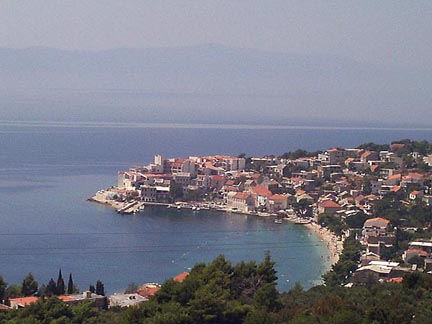 Village of Ingane on Croatian Coast
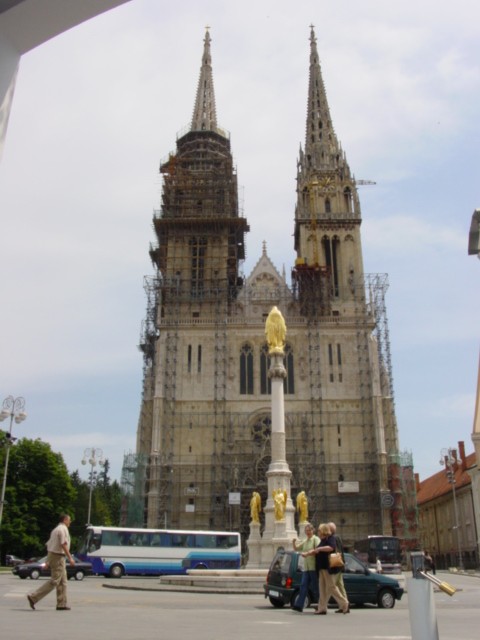 Kaptol, the main Cathedral in Zagreb Centar.