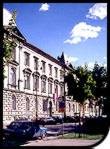
 Higher education in Croatia dates back to 1396
when Dominicans established the General
University � Universitas Jadertina in Zadar. This was the first and the oldest
University in Croatia entitled to confer degrees of Master of Science and Doctor of
Science and was thus equal in status to the other eminent European universities of the
time.
Higher education in Croatia dates back to 1396
when Dominicans established the General
University � Universitas Jadertina in Zadar. This was the first and the oldest
University in Croatia entitled to confer degrees of Master of Science and Doctor of
Science and was thus equal in status to the other eminent European universities of the
time.
Croatia is a country undergoing a transition in various fields, including higher education. Our development in this field has been determined by the heritage of the former system in which natural and technical sciences were more developed than other research fields. The result of this situation is that natural and technical sciences match the European standards. Quality, relevance and international cooperation are among priorities of the Croatian higher education policy. Quality assessment and assurance of the Croatian system are performed by the National Council for Higher Education, an independent body composed of eighteen members nominated by the Rectors� Conference and higher education institutions, and appointed by the Parliament of the Republic of Croatia. The Ministry of Science and Technology creates its policy on the findings of the National Council for Higher Education and the National Scientific Research Council, an independent body responsible for the preparation of the National Scientific Research Program. International cooperation is seen as one of the tools for ensuring quality of teaching and research. The Higher Education Act from 1996 determines the organization of higher education institutions. According to this Act and the principles of the Council of Europe�s Legislative Reform Program, the Ministry of Science and Technology has implemented a separation of university courses of study from professional courses of study. The Ministry of Science and Technology implemented the separation of university and professional courses of study taking into consideration previous scientific approach to the higher education programs, as well as the need for shorter, professional courses of study which could offer practice-oriented professional knowledge. In the current academic year university courses of study are carried out by 4 universities (University of Zagreb, Rijeka, Split and Osijek). They include 55 faculties, 4 academies of arts, 3 university departments and 1 course of study operated by a university. Professional courses of study are carried out by 7 polytechnics, 6 independent schools of professional higher education one teachers' accademy and 8 teachers� schools of professional higher education. Croatian higher education institutions currently employ 1.133 full professors and 801 associate professors. Duration of courses of study is determined on the basis of the curriculum�s complexity and the time necessary for its mastering. Undergraduate university studies last at least four years while undergraduate professional studies last at least two years. The objective of reaching an equivalent number of students at university and professional courses of study has been almost accomplished. The number of students to be enrolled into university and professional courses of study is based on the case studies prepared by independent institutions (e.g. a case study on Elements of Admission Policy of Universities, Schools of Professional Higher Education and Polytechnics, prepared by the Institute for International Relations, Zagreb). A total number of students enrolled into higher education institutions in Croatia is 84.088. 59.230 are enrolled into the university courses of study and they will be awarded a Bachelor degree, while 24.858 students are enrolled into the professional courses of study and they will be awarded an Associate degree. Zagreb area has the largest number of students. There are 33.889 students of the university studies and 14.640 students of the professional studies. A total number of students in this area is 48.529 which equals 58% of the total number of students in Croatia. Zagreb is a university, research and economic center of Croatia. Being aware of the need for decentralization of higher education and research, the Ministry of Science and Technology has done many efforts with these intentions. However it is a lengthy process that cannot be achieved through regulations but through a gradual development of relations between the capital and regional centers. There is no development without an exchange of goods, capital, human resources and ideas. Croatian higher education policy endorses academic mobility of students, according to the principles of European and international conventions on recognition of equivalence of education credentials (e.g. the Lisbon Convention). Preferred mode of mobility of scholars and researchers are short � term visits based on the principle of reciprocity. In addition to the international mobility, there is need for an increased internal mobility within Croatia. This type of mobility is aimed at the improvement of cooperation among institutions located in Zagreb and institutions in other Croatian regions. In this context it is necessary to mention the efforts of the Ministry of Science and Technology in the implementation of the European Credit Transfer System. We expect to see the results of this project in the near future. Higher Education Institutions in the Republic of Croatia Source: Ministry of Science, Education and Sports
|