

The necessity
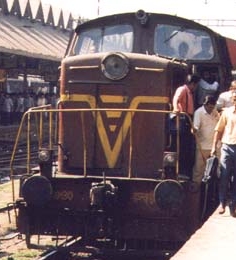
After independence there was a phenomenal Increase in Railway traffic in India. To cope up the demand it was felt necessary to modernise the Indian Railways with faster trains . Steam locomotive had a draw back in their capacity and speed. The ministry of Railways decided to set up manufacture of Diesel Locomotives at Varanasi and Electric Locomotives at Chittaranjan for main line use. The problem for main line having been solved to some extent, there was still difficulties in shunting locomotives and shuttle services . There was also demand for better haulage in Metropolitan towns, Colliery sidings and other large public sector plants and areas like ports, cement factories , Steel, fertiliser etc. which were done old steam locomotives. This work was trusted on Chittaranjan Locomotive Works. A completely new phase of work was started in 1966 and the first Diesel shunter 650 H.P. WDS 4 with 48% indigenous content, was commissioned by Shri C.M.Poonacha , the then Railway Minister on 5th January, 1968.
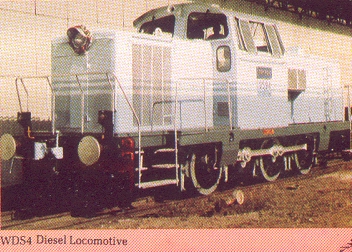
These Locomotives were manufactured in collaboration with MaK of the then West Germany and are fitted with SURI transmission . These locomotives are in service in different Railways in India and a large number of Public Sector Units.
These Diesel shunters are of rugged design having three axles, a rigid frame, Jack-shaft and coupling rod drive, a well proven design in German federal Railways and also in India.
SALIENT FEATURES
Transmission
Suri Hydro-mechanical transmission with
optional change over to mechanical transmission at 40% maximum road speed, and
automatic change over at 70% of max. road speed.
Reversing Gear Box
This provides for forward and reverse directions as also
choice of shunting and main line speed range gears for either direction
Mechanism of Work
The power from engine is transmitted to
wheels through a cardan shaft, then the transmission and finally through a
drive gear box where the final output is connected to the wheels by coupling
rods.
It has six wheels out side the main frame plates. The wheels are
connected with each other and the output shaft of the gear box through coupling
rods. Seems similar to steam locomotive practices.
The Driver's cab , a raised one is placed in middle between front and rear
superstructure. Large windows provided in rear and front and also sides. This
gives the driver to have a clear view of all sides. The controls are placed in a
desk within the reach of the driver. The front Superstructure houses the engine,
compressor, vacuum exhauster , the fuel tank and the control equipments. The
rear part houses the final drive gear box the transmission, its oil tank and the
radiator . The radiators fans are a little different . These are driven by
hydrostatic motors instead of mechanical or electrical drive, being adjusted by
governors to suit different ranges of cooling requirement.
ADVANTAGES
1. Saving in operating expenses as compared to Steam Locomotives.
2. Quick acceleration and improved hauling capacity.
3. More suitable for negotiating sharper curves.
4. Due to efficient and quick working the line capacity is increased for hauling more traffic.
5. Elimination of smoke and coal grit nuisance.
The production of Diesel Hydraulic Locomotives was taken up during 1968. After manufacturing 842 Diesel Hydraulic Locos of 7 types, production of diesel hydraulic locos were discontinued from 1993-94 .
Please visit other pages
STEAM
DIESEL
ELECTRIC
MILESTONES Strategy
INNOVATION
3 Phase
Technology
WAG-5 WAG-7
WAG9h WAP4
WAP5
WAP7