
WAG9H 6000 HP Freight Locomotive
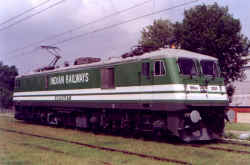 Indian Railways imported 22 high capacity freight Locomotives
from ABB Transportation Systems Ltd. Switzerland under a contract in July
1993 which included Transfer of Technology to permit Indian
Railways to indigenously manufacture two types of locomotives WAG 9 and
WAP 5 . This was a new technology with higher tractive effort regenerative
braking system , microprocessor controls and sophisticated design
requiring less maintenance contributing to more revenue and ease of
operation. These Locomotives have a maximum potential starting
tractive effort is 520 kN and can be controlled by a microprocessor based
stepless control. to haul 58 loaded BOXN wagons with a single
locomotive CLW successfully absorbed this new technology as
usual and produced its first WAG 9h class locomotive christened
" NAVSHAKTI" on 17th. May 2000.
Indian Railways imported 22 high capacity freight Locomotives
from ABB Transportation Systems Ltd. Switzerland under a contract in July
1993 which included Transfer of Technology to permit Indian
Railways to indigenously manufacture two types of locomotives WAG 9 and
WAP 5 . This was a new technology with higher tractive effort regenerative
braking system , microprocessor controls and sophisticated design
requiring less maintenance contributing to more revenue and ease of
operation. These Locomotives have a maximum potential starting
tractive effort is 520 kN and can be controlled by a microprocessor based
stepless control. to haul 58 loaded BOXN wagons with a single
locomotive CLW successfully absorbed this new technology as
usual and produced its first WAG 9h class locomotive christened
" NAVSHAKTI" on 17th. May 2000.
THE NECESSITY
Indian Railways had been using WAG5 and WAG7 locomotives for freight service. These were powered by direct traction motors and are rated 3900 and 5000 HP respectively with a speed of 100 kmph. Due to low power, poor adhesion ,control and old tap changer technology, they needed multiple operation in many section graded above 1 in 200 specially in the freight originating mining/colliery areas. IR needed some locomotive which will overcome these difficulties. WAG-9 class of locomotives were produced with increased power 6000 HP , microprocessor based stepless control which were capable of hauling 58 BOXN rake in a graded section of 1 in 180. But there were sections with a grade of 1 in 150 and again these required a banker or multiple operation.
WHAT WAS DONE AT CLW
The Engineers at CLW found that the main task to improve the WAG-9 version was to increase the starting tractive effort from 460 KN to 520 KN and this was possible by increasing the adhesive weight of the loco from 123 t to 135t . A design was evolved at RDSO and ADtranz approved the design. Adhesion of 12 tonnes was achieved by welding ballast weights at 4 locations inside the machine room and behind the Cabs. But this was not that easy . The addition of weights needed strengthening of suspension arrangements and springs. The changed performance characteristics called for modification of application software. All these were done at CLW with in-house skill.
![wag9h[1].jpg (75396 bytes)](http://www.geocities.com/emkaydas/images/wag9h[1].jpg)
^
Click to enlarge
ADVANTAGE
The 3-phase system provides a lot of advantages.
1. Efficiency : Overall efficiency is increased by 5%
2. Savings in operation : IR is paying the SEBs in terms of "Maximum Demand" only , which speaks of high quantity and its reflection in bills. The new locomotives are regeneration type and and having unity power factor. Approximately 15% to 20% energy is conserved through regeneration while braking. Thus there will be a lot of savings.
3. Less maintenance of traction motors due to absence of commutator and brushgear.
4. Easy maintenance hence better availability. Normally lifting is not required during attention to failures saving a lot of time.
5. The traction motor is maintenance free.
Therefore improved reliability. 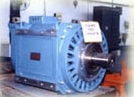
6. Low unsprung masses result in minimum wear on rails.
Traction Motor for WAG9
manufactured at CLW
Special diagnostics
7. Automated fault isolation.
8. Display terminal in Driver's Cab. Drivers get assistance during faults and rectification.
9. Diagnostic Computer to log faults and this can be uploaded to a PC in the shed/workshops for
better fault identification
These Locomotives
require special skill and equipments during maintenance and can be done
only in equipped sheds. Presently all WAG9 locos are homed at GOMOH
VITAL STATISTICS
| Type of service | Freight | Length of Cab | 2434 mm |
| Supply System | 25KV. AC, 50Hz | Overall width of body | 3152 mm |
| Class | WAG-9H | Panto locked down height | 4255 mm |
| Track gauge | 1676 mm | Traction Motor Type | 6FRA6068, 3-phase Squirrel cage Induction Motorsl |
| Axle arrangement | Co-Co | Traction Motor mounting | Axle Hung Nose Suspended |
| Brake system | Air, Regenerative and parking | Gear Ratio | 5.13 (77:15) |
| Total Weight | 135 tonnes | Cont. Power at Wheel Rim | 4500 kW (6000 H.P.) |
| Axle Load | 22.5 t | Starting tractive effort | 520KN |
| Unsprung mass per axle | 3.984 t | Cont. tractive effort | 325 KN |
| Wheel Diameter | 1092mm(New) 1016 mm (fully worn) |
Maximum regenerative braking effort | 260 KN |
| Length over buffers | 20562 mm | Maximum service speed | 100 kmph |
| Length over Head Stocks | 19280 mm | Control system voltage | 110 V DC |
| Bogie CRS | 12000 mm | Drive system | 3 Phase Drive with GTO Thyristor & microprocessor based VVVF control |
| Loco wheel base | 15700 mm | Multiple Unit operation | Max 2 locos |
| Bogie wheel base | 1850 mm+1850mm | Hauling Capacity | 4700 t in 1 in 150 grade |
Please visit other pages
Steam Diesel Electric Milestones WAG-5 WAG-7 WAG9h WAP4 WAP5 WAP7

