|
|
-
- The Evolution of
Cellular Data:
- On the Road to 3G
- Introduction
- Wireless phone use
is taking off around the world. Many of
us would no longer know how to cope
without our cellphones. Always being
connected offers us flexibility in our
lifestyles, makes us more productive in
our jobs, and makes us feel more secure.
So far, voice has been the primary
wireless application. But with the
Internet continuing to influence an
increasing proportion of our daily lives,
and more of our work being away from the
office, it is inevitable that the demand
for wireless data is going to ignite.
Already, in those countries that have
cellular-data services readily available,
the number of cellular subscribers taking
advantage of data has reached significant
proportions. We want wireless Internet,
we want our organizational data from
anywhere, and we want it now.
- But to move forward,
the question is whether current cellular-data
services are sufficient, or whether the
networks need to deliver greater
capabilities. The fact is that with
proper application configuration, use of
middleware, and new wireless-optimized
protocols, today’s cellular-data can
offer tremendous productivity
enhancements. But for those potential
users who have stood on the sidelines,
subsequent generations of cellular data
should overcome all of their objections.
These new services will roll out both as
enhancements to existing second-generation
cellular networks, and an entirely new
third generation of cellular technology.
Our job here is to describe this road to
the third generation (3G), as well as to
show you how these services will allow
new applications never before possible.
-
- The World
Today
- Before we peek into
the future, let’s quickly look at
where we are today. In 1999, the primary
cellular-based data services are Cellular
Digital Packet Data (CDPD), circuit-switched
data services for GSM networks, and
circuit-switched data service for CDMA
networks. Some brave souls connect their
PC Card modems to their analog cellphones,
but this approach is not very popular
because it is tricky to configure. All of
these services offer speeds in the 9.6
Kbps to 14.4 Kbps range. Why such low
speeds? The basic reason is that in today’s
cellular systems, data is allocated to
the same radio bandwidth as a voice call.
Since voice encoders (vocoders) in
current cellular networks digitize voice
in the range of 8 to 13 Kbps, that’s
about the amount available for data.
Remember, too, that today’s digital
and PCS technology designs started over
five years ago. Back then, 9.6 Kbps was
considered more than adequate. Today, it
can seem slow with graphical or
multimedia content, though it is more
than adequate for text-based applications
and carefully configured applications.
- There are two basic
ways that the cellular industry is
currently delivering data services. One
approach is with smart phones, which are
cellular phones that include a
microbrowser. With these, you can view
specially formatted Internet information.
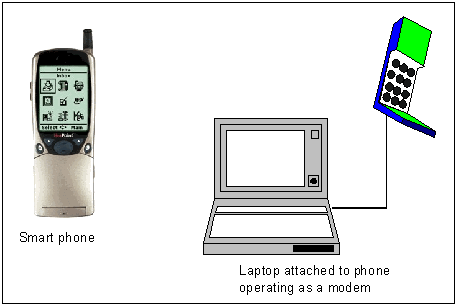
The other approach is through wireless
modems, supplied either in PC Card format
or by using a cellphone with a cable
connection to a computer. See Figure 1.
- Figure
1: Smart phone
versus phone connected to laptop
- Both approaches can
give you access to Internet sites and
corporate systems, including e-mail,
databases, or host-based systems. But
both approaches also require that the
user take throughput and latency of the
network into account. In contrast,
next generation networks promise
throughput, global coverage, and ease-of-use
that will greatly expand your mobile
computing options.
-
- The World
Tomorrow
- Before diving into
details of different network technologies,
we need to realize that from a user
perspective, the offerings from all of
these networks will be largely comparable.
Introduction dates of services may vary
by up to a year, and exact data rates may
differ by 20 or 30%. But just as voice
users today may be hard-pressed to
distinguish between the quality of an IS-136
call using AT&T’s wireless
network, a GSM call using Omnipoint’s
network, or a CDMA call using Sprint PCS
network, data users will notice great
similarity between the new cellular-data
services.
- In thinking about
the rollout of next generation services,
consider what features can be added to
existing networks, and what features will
require vastly new network infrastructure.
Since we refer to the current generation
of cellular as second generation, then
new feature advancements to the current
network are sometimes called 2.5G.
Generally, 2.5G technologies have been
developed for third generation (3G)
networks, but they are applied
incrementally to existing networks. This
approach allows carriers to offer new
high-speed data and increased voice
capacity at much lower cost than
deploying all new 3G networks. Plus, they
can do so using their existing spectrum.
- Let’s consider
data rates in more detail. The global
standards body for communications is the
International Telecommunications Union (ITU).
The 3G standards effort is called
International Mobile Telephone 2000 (IMT-2000).
IMT-2000 mandates data speeds of 144 Kbps
at driving speeds, 384 Kbps for outside
stationary use or walking speeds, and 2
Mbps indoors. Does this mean that we’ll
all be using our cellphones at 2 Mbps? No.
The indoor rate will depend on careful
frequency planning within buildings, and
possibly an organization’s
commitment to work closely with a carrier.
However, since high-speed services such
as wireless LANs already offer speeds of
up to 11Mbps, it’s difficult to
predict the expected market demand for 2Mbps
indoor service when 3G networks roll out.
- What is of much
greater interest is the 384 Kbps data
rate for outdoor use, as this IP protocol-based
packet service will be available over
wide areas. This service is the one that
will let us extend our office to any
location. And the good news? The
technology that will provide 384 Kbps in
3G networks is the same technology that
will be deployed in 2.5G networks, albeit
at slightly lower data rates in the 50 to
150 Kbps range. But this is still some
ten times faster than most options today.
More good news? 2.5G services will be
released in the year 2000, well in
advance of 3G networks that won’t
start rolling out until 2002 at the
earliest. See Table One.
-
- Core
Technology
|
- Service
|
- Data
Capability
|
- Expected
Deployment
|
- GSM
|
- Circuit-switched
data based on the standard GSM 07.07
|
- 9.6 Kbps or
14.4 Kbps
|
- Available
worldwide now
|
-
|
- High-speed
circuit-switched data (HSCSD)
|
- 28.8 to 56
Kbps service likely
|
- Limited
deployment 1999 and 2000 as many
carriers will wait for GPRS
|
-
|
- General
Packet Radio Service (GPRS)
|
- IP and X.25
communications over Kbps
|
- Trial
deployments in 2000, rollout of
service 2001
|
-
|
- Enhanced
Data Rates for GSM Evolution (EDGE)
|
- IP
communications to 384 Kbps.
Roaming with IS-136 networks
possible.
|
- Trial
deployment in 2001, rollout of
service 2002
|
-
|
- Wideband
CDMA (WCDMA)
|
- Similar to
EDGE but adds 2Mbps indoor
capability. Increased capacity
for voice.
|
- Initial
deployment in 2002 or 2003
|
- IS-136
|
- Circuit-switched
data based on the standard IS-135
|
- 9.6 Kbps
|
- Some
carriers may offer service, but
not expected on widespread basis
because key carriers already
offer Cellular Digital Packet
Data (CDPD)
|
-
|
- EDGE
|
- IP
communications to 384 Kbps.
Roaming with GSM networks
possible.
|
- Initial
deployment 2002 or 2003
|
-
|
- WCDMA or
Wideband TDMA (WTDMA)
|
- Similar to
EDGE but adds 2Mbps indoor
capability
|
- No stated
deployment plans
|
- CDMA
|
- Circuit-switched
data based on the standard IS-707
|
- 9.6 Kbps or
14.4 Kbps
|
- Available
by some carriers now
|
-
|
- IS-95B
|
- IP
communications to 64 Kbps
|
- Expected in
Japanese markets by early 2000
|
-
|
- CDMA2000 -
1XRTT
|
- IP
communications to 144 Kbps
|
- Trial
deployment in 2001, rollout of
service 2002
|
-
|
- CDMA2000 -
3XRTT
|
- IP
communications to 384 Kbps
outdoors and 2 Mbps indoors
|
- Initial
deployment in 2002 or 2003.
|
- Table One: Summary
of forthcoming cellular-data services.
Time estimates by Rysavy Research.
- How the three major
cellular technologies will provide these
services varies, but all have a similar
roadmap. In fact, as we detail in
subsequent sections, these technologies
are slowly converging, beginning with a
convergence of IS-136 and GSM data
services, and followed by a harmonization
of the 3G versions of GSM and CDMA. By
harmonization, we mean that while
differences will continue to exist, the
systems will interoperate more readily.
- There are some
other important trends to note. The first
is that standards bodies are working not
just on radio technologies, but also on
the networking infrastructure. One
objective is to allow users to seamlessly
roam from private networks (e.g. Ethernet,
WLAN) to public networks. Such roaming
will require the implementation of
standards such as Mobile IP. Another goal
is to simplify the connection between
mobile computers and wireless devices
through personal-area network (PAN)
technologies such as Bluetooth. Yet
another trend is voice over IP. As
terrestrial networks start using IP for
voice and multimedia, it will be
important for such IP communications to
extend all the way to the wireless device.
- Perhaps the most
important trend of all is for ubiquitous
coverage. This will be achieved not just
by converging wireless standards, but
also by sophisticated new devices that
operate in multiple modes and at multiple
frequencies. This is the world of
tomorrow. To understand how we’ll
get there, we will look first at GSM and
IS-136 networks, and then CDMA networks.
-
- Networks
in Detail
- GSM and IS-136
- GSM dominates the
world today, with over 200 million users
in over a hundred countries. As the most
mature digital-cellular standard, GSM
networks offered circuit-switched data
services well in advance of other
networks. Now in trials is a service
called high-speed circuit-switched data
service (HSCSD), which combines two to
four of the time slots (out of a total of
8 in each frame) to provide service from
28.8 Kbps to 56 Kbps. HSCSD is attractive
to carriers because it requires minimal
new infrastructure. Nevertheless, most
GSM carriers are putting their bets on a
service called General Packet Radio
Service (GPRS), a 2.5G technology. GPRS
can combine up to 8 (out of 8 available)
time slots in each time interval for IP-based
packet data speeds up to a maximum
theoretical rate of 160 Kbps.
However, a typical GPRS device may not
use all 8 time slots. One proposed
configuration is four time slots (80 Kbps
maximum, 56 Kbps typical) for the
downlink and one timeslot (20 Kbps
maximum, 14.4 Kbps typical) for the
uplink. GPRS supports both IP and X.25
networking. Entering field trials in 2000,
GPRS service should start rolling out in
2001.
- GPRS can be added
to GSM infrastructures quite readily. It
takes advantage of existing 200 kHz radio
channels and does not require new radio
spectrum. The principal new
infrastructure elements are called the
Gateway GPRS Support Node (GGSN) and the
Serving GPRS Support Node (SGSN). The
GGSN provides the interconnection to
other networks such as the Internet or
private networks, while the SGSN tracks
the location of mobile devices and routes
packet traffic to them. GPRS capability
will be added to cellphones, and will
also be made available in data-only
devices such as PC Card modems. Pricing
will either be flat rate or based on the
volume of information communicated.
Services such as GPRS are exciting not
only because of their higher data rates,
but also because packet service allows
constant "virtual" connections
without the need to constantly "dial"
into the network.
- The phase after
GPRS is called Enhanced Data Rates for
GSM Evolution (EDGE). EDGE, generally
considered a 3G technology, introduces
new methods at the physical layer,
including a new form of modulation (8 PSK)
and different ways of encoding data to
protect against errors. Meanwhile, higher
layer protocols, such as those used by
the GGSN and SGSN, stay the same. The
result is that EDGE will deliver data
rates up to 500 Kbps using the same GPRS
infrastructure. Keep in mind though that
500 Kbps represents a best case scenario,
with a strong signal, no interference,
and a user device accessing the entire
200 kHz radio channel. In addition, this
radio channel must also be shared by
multiple users in that sector of the cell
site. Consequently, practical throughputs
may be only half the maximum rate. EDGE
data services could start rolling out in
2002, depending on market demand and
actual carrier deployments.
- Though developed
initially for GSM, the Universal Wireless
Communications Consortium (UWCC), an
organization that represents IS-136
carriers and vendors worldwide, has
decided to embrace EDGE for IS-136
networks. The tricky part of adopting
EDGE is that IS-136 networks use 30 kHz
radio channels. Deploying EDGE will
require new radios in base stations to
support the 200 kHz data channels. The
GGSN and SGSN will be virtually the same
for both GSM and IS-136 networks.
EDGE data users will eventually be able
to roam between IS-136 and GSM networks
around the world. EDGE data services for
IS-136 networks will probably roll out
shortly after EDGE for GSM networks,
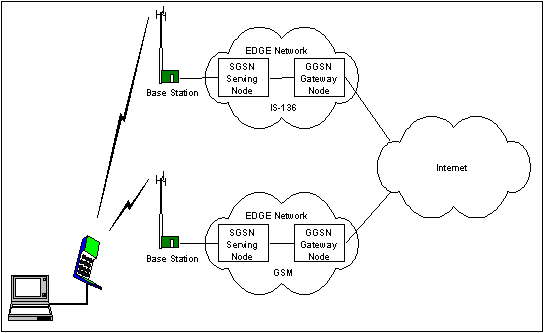
possibly in 2002 or 2003. Figure 2 shows
the common network technology used by
both GSM and IS-136 networks.
- Figure
2: The same EDGE wireless
device will be able to communicate
across both IS-136 and GSM networks.
- IS-136 networks
will also converge with GSM for voice
related functions. For instance, the same
vocoder technology will eventually be
used by both networks. Meanwhile, in
advance of common vocoders, multi-mode
cellphones are planned that will allow
voice operation across IS-136, GSM, and
AMPS networks worldwide.
- The 3G version of
GSM, Wideband CDMA or WCDMA, is based on
CDMA technology. This version of CDMA
deviates from American standards,
although it uses the same spread spectrum
principles. For data, WCDMA adds
the capability for 2Mbps data rates
indoors. The airlink, using either 5MHz,
10MHz, or 20MHz radio channels, will be
completely different from GSM’s
current 200 kHz channels. However, the
data networking for WCDMA will likely be
based on EDGE/GPRS infrastructure
protocols, such as the GPRS Tunneling
Protocol. The earliest WCDMA deployment
is expected in Japan in 2002. IS-136
carriers might eventually use WCDMA
technology, though a wideband TDMA (WTDMA)
approach has also been proposed.
- CDMA
- CDMA network
deployment and subscriber growth have
developed considerable momentum, and data
services are now available from a number
of carriers. Currently, these carriers
use circuit-switched technology operating
at 14.4 Kbps. As with GSM, CDMA requires
a handset that specifically supports data.
Connect the phone to a laptop, and the
phone operates just like a modem,
enabling you to establish dial-up
connections to the Internet, your
corporate remote access server (RAS), and
so on. WAP-based microbrowser
applications are also being made
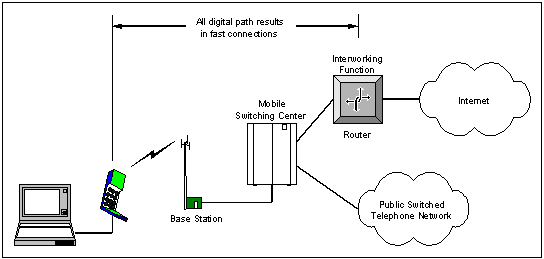
available. Another service for CDMA
networks is called QuickNet Connect. By
eliminating conventional modem
connections, this service allows fast
connections (of approximately five
seconds) to the Internet. See Figure 3.
To the user, the carrier appears like an
ISP offering dial-up Internet service.
- Today’s CDMA
service is based on the IS-95A standard.
A refinement of this standard, IS-95B,
allows up to eight channels to be
combined for packet-data rates as high as
64 Kbps. Japanese CDMA carriers, IDO and
DDI, are planning on deploying this
higher-speed service by early 2000.
- Beyond IS-95B, CDMA
evolves into 3G technology in a standard
called CDMA2000. CDMA2000 comes in two
phases. The first, with a specification
already completed, is 1XRTT, while the
next phase is 3XRTT. The 1X and 3X refer
to the number of 1.25 MHz wide radio
carrier channels used, and RTT refers to
radio-transmission technology. CDMA2000
includes numerous improvements over IS-95A,
including more sophisticated power
control, new modulation on the reverse
channels, and improved data encoding
methods. The result is significantly
higher capacity for the same amount of
spectrum, and indoor data rates up to 2Mbps
that meet the IMT-2000 requirements. The
full-blown 3XRTT implementation of CDMA
requires a 5MHz spectrum commitment for
both forward and reverse links. However,
1XRTT can be used in existing CDMA
channels since it uses the same 1.25 MHz
bandwidth.
- 1XRTT technology is
thus a convenient stepping stone for CDMA
carriers moving to 3G, and it can also be
thought of as a 2.5G technology. 1XRTT
can be deployed in existing spectrum to
double voice capacity, and requires only
a modest investment in infrastructure. It
will provide IP-based packet-data rates
of up to 144 Kbps. Initial deployment of
1XRTT is expected by US CDMA carriers in
2001, with 3XRTT following a year or two
behind, depending on whether new spectrum
becomes available.
- But what about the
differences between CDMA2000 and WCDMA?
If the goal of IMT-2000 is a single
worldwide standard, can these two
versions of CDMA be harmonized into a
single standard? That is the very
question being addressed by the CDMA
Operators Harmonization Group that is
developing the Global 3G CDMA standard (G3G).
Since there are some irreconcilable
differences between CDMA2000 and WCDMA in
the radio portion, the approach is a
modular architecture as shown in Figure 4.
This approach allows any of three airlink
technologies to be used in a network,
including WCDMA, 3XRTT, and a time-division
duplex form of spread spectrum. In
addition to the three types of airlinks,
the architecture recognizes that network
infrastructures may be based on either
GSM-MAP protocols or ANSI-41 protocols. G3G
will give operators flexibility in
choosing the airlink and network
infrastructure that best addresses their
particular needs.
- Figure
4: Modular approach
used in the Global 3G CDMA architecture
- One issue in
harmonizing CDMA data is that WCDMA is
based on GPRS protocols, which use the
GPRS tunneling protocol (GTP) to forward
IP packets to the mobile station.
Mobility management is also handled by
specific GPRS protocols. CDMA2000,
however, is based on the Mobile IP
standard. Any harmonized CDMA standard
should ideally be based on the same set
of tunneling and mobility standards.
For this reason, the European
Telecommunications Standards Institute (ETSI),
responsible for GSM and GPRS, has started
an investigation of how GPRS/EDGE could
integrate Mobile IP.
-
- 3G In
Context
- 3G cellular
technology is a huge technological and
market phenomenon, but it needs to be
understood in the context of other
developments. One development is that
there will be other high-speed wireless-data
solutions available. For instance, don’t
overlook Metricom’s Ricochet network.
Though service is restricted to just
several cities today, significant new
investment from Paul Allen and MCI
WorldCom, combined with a new high-speed
service at 128 Kbps, will propel this
service to much wider availability in
2000.
- Consider also the
Personal Handyphone System (PHS) deployed
widely in Asia, a form of cellular
technology limited to pedestrian use. PHS
will soon offer 64 Kbps data service.
Nextel has also recently unveiled a new
data service for its Integrated Dispatch
Enhanced Network (iDEN) – based
technology. This service uses Mobile IP
to provide both WAP service and IP-based
packet data at about 20 Kbps. Also, some
companies are planning on deploying
wireless LAN technology in public places
such as airports. Will all of these
developments stifle the demand for
cellular-based data? Probably not, but
they will offer options, increase
competition, and help drive down prices.
- Finally, some
market developments will both shape the
nature of wireless-data networks, and
increase the demand for such services.
These include the following:
-
-
- The
control network used in telephone
networks today is called
Signaling System 7 (SS7). This
system will evolve into an IP-based
system, increasing the importance
for IP-based control mechanisms
in wireless networks.
-
- IP will
increasingly be used for voice
communications, so delivery of IP-based
voice to cellphones will be
critical. This will require the
resolution of difficult, quality-of-service
issues in wireless networks.
-
- As E-commerce
becomes common, users will want
to safely conduct transactions
from their mobile terminals. Such
use will make robust security
protocols a must for wireless
networks.
-
- Mobile users will
want to access private
information from anywhere,
driving the demand for secure
communications and related
technologies such as virtual
private networks (VPNs).
-
- As a huge
population of mobile-data users
emerges, content developers will
start producing material
specifically for these users,
including items related to travel,
entertainment, news, weather, and
recreation. Though such
developments are already underway,
they are still in their infancy.
- There is no question that a myriad of
new applications will be possible with
next-generation, wireless-data networks.
But keep in mind that these are massively
complex networks, and it will take both
time and large investments to develop and
deploy the technology. Many of the
advantages that these networks will offer
are already available using existing data
services. Organizations that gain
experience with wireless technologies
today will be the ones best positioned to
take advantage of new networks tomorrow.
|