


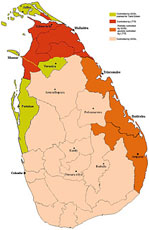
இலங்கையில் தேசிய எல்லைகள் இரண்டு!
"Its only one border in Sri Lanka" President Mahinda Rajapakse BBC Interview

| ENB TAMIL BLOG |
| Text only Page |
| Tamil Page |
| Sri Lanka |
| News Alert |
| Top Stories |
| World Economy |
| Documents |
| Reports |
| People Struggle |
|
ENB Leaflet |
|
Construction 5 |
| Posters |
|
SPACE |
|
Construction 6 |
|
Construction 7 |
|
Construction 8 |
|
Construction 9 |
|
Construction 10 |
|
Construction 11 |
|
Construction 12 |

FAIR USE NOTICE:
This site contains copyrighted material the use of which has not always been specifically authorized by the copyright owner. We are making such material available in our efforts to advance understanding of issues of Political,Economical, Social,Cultural,Environ-mental and humanitarian significance. To debate understand,and fight to progrees our world forward.We believe this constitutes a 'fair use' of any such copyrighted material as provided by Copyright Law. In accordance with, the material on this site is distributed without profit to those who have expressed a prior interest in receiving the included information for research and educational purposes of their National and social problemes. If you wish to use copyrighted material from this site for purposes of your own that go beyond 'fair use', you must obtain permission from the copyright owner. ENB

Last updated 27/10/2007 17:10 +0100
Putin denounces US missile shield
By MIKE ECKEL, Associated Press Writer
Fri Oct 26, 12:52 PM ET
Russian President Vladimir Putin on Friday compared the U.S. proposal to build a missile defense shield in Eastern Europe to the Cuban missile crisis of the 1960s.
"Analogous actions by the Soviet Union, when it deployed missiles in Cuba, prompted the 'Caribbean crisis,'" Putin said at a news conference at the end of a European Union-Russian summit in Portugal, using the Russian term for the Cuban missile crisis.
"Such a threat is being set up on our borders," he said.
At the same time, Putin suggested the tension was much lower that during the 1962 Cuban missile crisis because Russian-U.S. relations have moved on since the Cold War. He also said he believes the United States is listening to Moscow's concerns about its missile plans.
Putin said his relationship with President Bush helps solve problems in relations with the U.S., calling him a friend.
The U.S. plan would install a radar base in the Czech Republic and 10 interceptor missiles in Poland — both former Soviet satellites that are now NATO members. It is part of a wider missile shield involving defenses in California and Alaska which the United States says are to defend against any long-range missile attack from countries such as North Korea or Iran.
Russia strongly opposes the idea, saying Iran is decades away from developing missile technology that could threaten Europe or North America, and it says the U.S. bases will undermine Russia's own missile deterrent force.
Turning to his future, Putin said he would not assume presidential powers if he became prime minister after finishing his term in the spring.
"If someone thinks that I intend to move, let's say, into the government of the Russian Federation and transfer the fundamental powers there, that's not the case," he said at a news conference. "There will be no infringement on the powers of the president of the Russian Federation, at least while it depends on me."
The popular Putin is barred from seeking a third consecutive term in the March 2008 presidential election. But he suggested earlier this month that he could become prime minister after his term ends in May, leading some to speculate that the substantial powers now invested in the presidency might be transferred to the prime minister.
After repeating his insistence that he does not intend to change the constitution in order to run for a third term, Putin said he had not yet decided where and in what capacity he would work as former president. He is expected to remain an influential figure in Russia.
Putin will lead the ticket of the dominant United Russia party in December parliamentary elections. An overwhelming victory for the party could turn the legislature into a new power base for Putin and give him a claim to continued authority based on his popularity.
Putin and EU leaders put a positive spin on Friday's Portugal summit. Many observers had approached the meeting with low expectations, given deepening disputes between Moscow and the 27-nation union over issues such as energy, human rights and the Balkans.
Putin, European Commission President Jose Manuel Barroso and other EU officials repeatedly characterized the talks as "open, frank and productive."
However, the two sides failed to sign a new cooperation agreement to replace an expiring one, and two minor deals — on drug trafficking and steel exports — were the only concrete results announced.
Topping the list of concerns for a growing number of European nations is Russian energy policy — the reliability of supplies and the intentions of state-run oil and gas companies. Russia already provides 30 percent of EU energy imports, including 44 percent of natural gas imports.
The state-controlled gas giant OAO Gazprom has recently moved to acquire assets in Europe and strike bilateral deals with some EU countries.
That has led the EU to consider new restrictions on non-EU companies owning majority stakes in gas pipelines or electricity power grids without additional agreements — much to the Russians' consternation.
Earlier, Putin tried to assure European leaders that Russian investment was not to be feared.
"When we hear in some countries phrases like, 'The Russians are coming with their scary money,' it sounds a bit funny," he said.
He said money flowing into Russian government coffers — largely from oil and gas exports — was being used to resolve domestic problems. And he noted that private foreign investors hold large amounts of shares in Gazprom.
Putin held talks Friday with Barroso and Portuguese Prime Minister Jose Socrates, whose country holds the EU's rotating presidency, at an 18th-century baroque palace in Mafra, a small town about 30 miles north of Lisbon.
___
Associated Press Writer Barry Hatton in Mafra contributed to this report.
US READY FOR WAR AGAINST IRAN!-ENB
17-10-2007
Press Conference by the President
James S. Brady Briefing Room 10:45 A.M. EDT
Text:
THE PRESIDENT: Good morning. We're now more than halfway through October, and the new leaders in Congress have had more than nine months to get things done for the American people. Unfortunately, they haven't managed to pass many important bills. Now the clock is winding down and in some key areas Congress is just getting started.
Congress has work to do on health care. Tomorrow Congress will hold a vote attempting to override my veto of the S-CHIP bill. It's unlikely that that override vote will succeed, which Congress knew when they sent me the bill. Now it's time to put politics aside and seek common ground to reauthorize this important program. I've asked Health and Human Services Secretary Mike Leavitt, National Economic Council Director Al Hubbard, and OMB Director Jim Nussle to lead my administration's discussions with the Congress. I made clear that if putting poor children first requires more than the 20 percent increase in funding I proposed, we'll work with Congress to find the money we need. I'm confident we can work out our differences and reauthorize S-CHIP.
Congress has work to do to keep our people safe. One of the things Congress did manage to get done this year is pass legislation that began modernizing the Foreign Intelligence Surveillance Act. FISA is a law that our intelligence professionals use to monitor the communications of terrorists who want to do harm to our people. The problem is that Congress arranged for the measure they passed to expire this coming February. In addition, the House is now considering another FISA bill that would weaken the reforms they approved just two months ago. When it comes to improving FISA, Congress needs to move forward, not backward, so we can ensure our intelligence professionals have the tools they need to protect us.
Congress has work to do on the budget. One of Congress's basic duties is to fund the day-to-day operations of the federal government. Yet Congress has not sent me a single appropriations bill. Time is running short, so I urge the Speaker and the leader of the Senate to name conferees for six of the annual appropriations bills that have already passed the House and the Senate. The two Houses need to work out their differences on these bills, and get them to my desk as soon as possible. They also need to pass the remaining spending bills, one at a time and in a fiscally responsible way.
Congress has work to do on education. As we saw from the recent Nation's Report Card, the No Child Left Behind Act is getting results for America's children. Test scores are rising. The achievement gap is beginning to close. And Congress should send me a bipartisan bill that reauthorizes and strengthens this effective piece of legislation.
Congress has work to do on housing. Back in August I proposed a series of reforms to help homeowners struggling with their mortgage payments. More than six weeks later, Congress has yet to finish work on any of these measures. These are sensible reforms that would help American families stay in their homes, and Congress needs to act quickly on these proposals.
Congress has work to do on trade. Earlier this year my administration reached out to the Congress, and we forged a bipartisan agreement to advance trade legislation. Now Congress needs to begin moving on trade agreements with Peru, Colombia, Panama, and South Korea. These agreements expand access to overseas markets, they strengthen democratic allies, and they level the playing field for American workers, farmers, and small businesses.
Congress has work to do for our military veterans. Yesterday I sent Congress legislation to implement the Dole-Shalala commission's recommendations that would modernize and improve our system of care for wounded warriors. Congress should consider this legislation promptly so that those injured while defending our freedom can get the quality care they deserve.
Congress also needs to complete the Veterans Affairs appropriations bill that funds veterans' benefits and other ongoing programs. Look, we have our differences on appropriations bills, but the veterans' bill is where we agree. So I ask Congress to send me a clean bill that will fund our veterans, a bill without unnecessary spending in it. And they need to get this work done, and I hope they can get it done by Veteran's Day. It seems like a reasonable request on behalf of our nation's veterans.
Congress has work to do for law enforcement and the judiciary. I want to thank the Senate Judiciary Committee for beginning hearings today on Judge Mukasey's nomination to serve as the Attorney General. I urge the committee to vote on that nomination this week and send it to the full Senate for a vote next week. The Senate also needs to act on the many judicial nominations that are pending, and give those nominees an up or down vote. Confirming federal judges is one of the most important responsibilities of the Senate, and the Senate owes it to the American people to meet that responsibility in a timely way.
With all these pressing responsibilities, one thing Congress should not be doing is sorting out the historical record of the Ottoman Empire. The resolution on the mass killings of Armenians beginning in 1915 is counterproductive. Both Republicans and Democrats, including every living former Secretary of State, have spoken out against this resolution. Congress has more important work to do than antagonizing a democratic ally in the Muslim world, especially one that is providing vital support for our military every day.
It's little time left in the year, and Congress has little to show for all the time that has gone by. Now is the time for them to act. And I look forward to working with members of both parties on important goals that I've outlined this morning.
And I now I look forward to taking some of your questions -- believe it or not. (Laughter.)
Q Mr. President, Turkey's parliament is debating sending military forces into Iraq to pursue Kurdish rebels. Do you think that Turkey has the legitimate right to stage a cross-country -- cross-country offensive -- cross-border offensive?
THE PRESIDENT: I've talked to Ambassador Crocker and General Petraeus about this issue this morning. We are making it very clear to Turkey that we don't think it is in their interests to send troops into Iraq. Actually, they have troops already stationed in Iraq, and they've had troops stationed there for quite a while. We don't think it's in their interests to send more troops in.
I appreciate very much the fact that the Iraqi government understands that this is a sensitive issue with the Turks, and that's why Vice President Hashimi is in Istanbul today, talking with the Turkish leaders to assure them that Iraq shares their concerns about terrorist activities, but that there's a better way to deal with the issue than having the Turks send massive troops into the country -- massive additional troops into the country.
What I'm telling you is, is that there's a lot of dialogue going on, and that's positive. We are actively involved with the Turks and the Iraqis through a tripartite arrangement, and we'll continue to -- dialoguing with the Turks.
Q Thank you, Mr. President.
THE PRESIDENT: Matt.
Q Why are going to attend the Congressional Award Ceremony for the Dalai Lama today --
THE PRESIDENT: Why -- when am I, or why am I?
Q Why are you going to, when China has expressed outrage about it? And what, if any, potential damage do you see to U.S.-China relations, considering that you need their support in dealing with Iran and North Korean nuclear issues?
THE PRESIDENT: One, I admire the Dalai Lama a lot. Two, I support religious freedom; he supports religious freedom. Thirdly, I like going to the Gold Medal ceremonies. I think it's a good thing for the President to do, to recognize those who Congress has honored. And I'm looking forward to going.
I told the Chinese President, President Hu that I was going to go to the ceremony. In other words, I brought it up. And I said I'm going because I want to honor this man. I have consistently told the Chinese that religious freedom is in their nation's interest. I've also told them that I think it's in their interest to meet with the Dalai Lama, and will say so at the ceremony today in Congress. If they were to sit down with the Dalai Lama they would find him to be a man of peace and reconciliation. And I think it's in the country's interest to allow him to come to China and meet with him.
So my visit today is not new to the Chinese leadership. As I told you, I brought it up with him. I wanted to make sure he understood exactly why I was going. And they didn't like it, of course, but I don't think it's going to damage -- severely damage relations. Matter of fact, I don't think it ever damages relations when the American President talks about religious tolerance and religious freedom is good for a nation. I do this every time I meet with him.
David. Welcome back.
Q Mr. President, last time you used that line and we were here -- (laughter) --
THE PRESIDENT: But you know something, the interesting thing about it is it works every time because -- (laughter) --
Q I know.
THE PRESIDENT: -- because there's a grain of truth. (Laughter.) I won't use it again, though. (Laughter.)
Q There's a report today from Israel Army Radio indicating that the Syrians have confirmed that the Israelis struck a nuclear site in their country. You wouldn't comment on that before, and I'm wondering if now, on the general question, you think it's appropriate for Israel to take such action if it feels that there is mortal danger being posed to the state?
THE PRESIDENT: David, my position hadn't changed. You can ask me another question.
Q Can I ask you whether -- did you support Israel's strike in 1981 on the Iraqi reactor outside Baghdad?
THE PRESIDENT: You know, Dave, I don't remember what I was doing in 1980 -- let's see, I was living in Midland, Texas; I don't remember my reaction that far back.
Q Well, but as you look at it as President now --
THE PRESIDENT: -- private citizen back there in 1981 in Midland, Texas, trying to make a living for my family and --
Q But you're a careful -- someone who studies history --
THE PRESIDENT: Student of history? I do, yes. No, I don't remember my reaction, to be frank with you.
Q But I'm asking you now, as you look back at it, do you think it was the right action for Israel to take?
THE PRESIDENT: David, I'm not going to comment on the subject that you're trying to get me to comment on.
Q Why won't you? But isn't it a fair question to say, is it -- given all the talk about Iran and the potential threat, whether it would be appropriate for Israel to act --
THE PRESIDENT: Hey, Dave -- Dave --
Q -- in self-defense --
THE PRESIDENT: I understand --
Q -- if Iran were to --
THE PRESIDENT: -- I understand where you're trying to take --
Q -- develop nuclear weapons?
THE PRESIDENT: I understand where you're trying to take. It's a clever ruse to get me to comment on it, but I'm not going to. Thank you.
Q Well, I'm just wondering why you think it's not appropriate to make that judgment, when it's a -- it is a real-world scenario, as we know, since they apparently took this action against Syria --
THE PRESIDENT: Dave. Welcome back. (Laughter.)
Q Good morning, Mr. President, thank you. I don't know if you saw the picture on the front page of one of the papers this morning of Mahmoud Ahmadinejad and Vladimir Putin.
THE PRESIDENT: I did.
Q It looked like they were getting along pretty well. And they are among --
THE PRESIDENT: Surprised they weren't kind of fighting each other on the front page of the paper? No, man, come on.
Q It looked like they were enjoying each other's company. And I'm wondering, since they were leaders of five Caspian Sea region nations that have now declared each country will not be used as a base to attack the other, A, what do you make of their growing relationship? B, does it complicate what the United States can do in the region? And C, would you characterize that arrangement as some sort of Caspian Sea Truman Doctrine or something like that?
THE PRESIDENT: You know, I -- I think it's hard to judge how their conversations went from a picture. Generally leaders don't like to be photographed scowling at each other or making bad gestures at each other. So I'm not surprised that there was a nice picture of them walking along. I try to make sure that when I'm with foreign leaders, there's a pretty picture of the two of us walking down the colonnades, or something like that, to send a good message.
Q Are you saying it's not so warm?
THE PRESIDENT: Well, I don't know yet. What I'm about to tell you is, is that I'm looking forward to getting President Putin's readout from the meeting. I think one of the -- the thing I'm interested in is whether or not he continues to harbor the same concerns that I do. And I say "continues" because when we were in Australia, he reconfirmed to me that it is -- he recognized it's not in the world's interest for Iran to have the capacity to make a nuclear weapon. And they have been very supportive in the United Nations. And we're working with them on a potential third resolution.
So that's where my concerns -- I don't worry about the pictures. I understand why they meet. I am -- will continue to work with Russia, as well as other nations, to keep a focused effort on sending Iran a message that you will remain isolated if you continue your nuclear weapons ambitions.
Q But this declaration doesn't speak to that, Mr. President. This declaration doesn't suggest isolation for Iran. Just the opposite, that Russia and Iran are going to do business.
THE PRESIDENT: Well, we'll find out, see. You're trying to get me to interpret the meeting based upon a news story or a picture. I'd rather spend some time with Vladimir Putin finding out exactly what went on. Thank you.
Q Let's stay with the nuclear -- here. When North Korea tested a nuclear device, you said that any proliferation would be a grave threat to the U.S., and North Korea would be responsible for the consequences. Are you denying that North Korea has any role in the suspected nuclear --
THE PRESIDENT: See, you're trying to pull a Gregory.
Q Yes, I am.
THE PRESIDENT: Okay, well, I'm not going to fall for it. But I'd like to talk about --
Q Don't Americans have a right to know about who is proliferating, especially when you're negotiating with North Korea?
THE PRESIDENT: No, you have a right to know this, that when it comes to the six-party talks, proliferation -- the issue of proliferation has equal importance with the issue of weaponry, and that North Korea has said that they will stop proliferating, just like they have said they will fully disclose and disable any weapons programs.
Step one of that has been dealing with shuttering Pyongyang. Step two will be full declaration of any plutonium that has been manufactured, and/or the construction of bombs, along with a full declaration of any proliferation activities. And in my judgment, the best way to solve this issue with North Korea peacefully is to put it in -- keep it in the context of six-party talks. And the reason why is that diplomacy only works if there are consequences when diplomacy breaks down, and it makes sense for there to be other people at the table so that if North Korea were to have said to all of us, we're doing to do x, y, or z, and they don't, that we have other -- people other than the United States being consequential.
There's a lot of aid that goes on with -- between North Korea and China, or North Korea and South Korea, and therefore, if they renege on their promises -- and they have said -- they have declared that they will show us weapons and get rid of the weapons programs, as well as stop proliferation -- if they don't fulfill that which they've said, we are now in a position to make sure that they understand that there will be consequences.
And I'm pleased with the progress we're making. Is there still work to be done? You bet there's work to be done. Do I go into this thing saying, well, you know, gosh, the process is more important than results? I don't. What matters most to me are whether or not we can achieve the results that I've said we're hoping to achieve. And if not, there will be consequences to the North Koreans.
Q Was Syria part of those talks? Is Syria part of the talks?
THE PRESIDENT: Proliferation is a part of the talks.
Q Including Syria?
THE PRESIDENT: Elaine.
Look, in all due respect to you and Gregory, this is not my first rodeo. And I know where you're trying to get me to comment. I'm not going to comment on it, one way or the other.
Elaine.
Q But, Mr. President, your administration has talked about --
THE PRESIDENT: Thank you, Martha. Martha, thank you. Elaine.
Q Mr. President, on Iraq, you've talked repeatedly about the threat of al Qaeda in Iraq. And we've also heard a lot about the military progress that's been made against that group. Can you tell Americans how close the United States is to declaring victory against that group? And if you're not able to do so, does that suggest that your critics are correct that this war cannot be won militarily?
THE PRESIDENT: The Iraq situation cannot be won by military means alone. There has to be political reconciliation to go with it. There has to be an emergence of a democracy. That's been my position ever since it started.
Al Qaeda is still dangerous. They're dangerous in Iraq, they're dangerous elsewhere. Al Qaeda is not going to go away anytime soon. That's why it's important for us to be finding out what their intentions are, and what are their plans, so we can respond to them. This is a -- this war against al Qaeda requires actionable intelligence. That's why this FISA bill is important. And they still want to do us harm, Elaine, and they're still active. Yeah, we've hurt them bad in Iraq. We've hurt them bad elsewhere. If you're the number three person in al Qaeda, you've had some rough goes -- you've either been captured or killed. And we're keeping the pressure on them, all the time.
And so, yes, we're making progress. But, no, I fully understand those who say you can't win this thing militarily. That's exactly what the United States military says, that you can't win this military [sic]. That's why it's very important that we continue to work with the Iraqis on economic progress, as well as political progress.
And what's happened is, in Iraq, is there's been a lot of political reconciliation at the grassroots level. In other words, people that hadn't been talking to each other are now talking to each other. They're beginning to realize there's a better future than one of -- that one -- with a country with deep sectarian divide. And what's going to end up happening is, is that the local reconciliation will affect the national government. In the meantime, we're pressing hard to get the national government to complete the strategic partnership with the United States, as well as pass meaningful legislation, like the de-Baath law, or the provincial government law, or the oil revenue-sharing law.
Bret.
Q Sir, given that, what you just laid out, should the American people prepare for a large number of U.S. forces to remain in Iraq after you are finished with your presidency?
THE PRESIDENT: The troop levels in Iraq will be determined by our commanders on the ground and the progress being made. Thank you.
Q Mr. President, I'd like to follow on Mr. -- on President Putin's visit to Tehran. It's not about the image of President Putin and President Ahmadinejad, but about the words that Vladimir Putin said there. He issued a stern warning against potential U.S. military action -- U.S. military action against Tehran --
THE PRESIDENT: Did he say U.S.?
Q Yes.
THE PRESIDENT: Oh, he did?
Q He said -- well, at least the quote said that -- and he also said, "He sees no evidence to suggest Iran wants to build a nuclear bomb." Were you disappointed with that message? And does that indicate possibly that international pressure is not as great as you once thought against Iran abandoning its nuclear program?
THE PRESIDENT: I -- as I said, I look forward to -- if those are, in fact, his comments, I look forward to having him clarify those, because when I visited with him, he understands that it's in the world's interest to make sure that Iran does not have the capacity to make a nuclear weapon. And that's why, on -- in the first round at the U.N., he joined us, and second round, we joined together to send a message. I mean, if he wasn't concerned about it, Bret, then why did we have such good progress at the United Nations in round one and round two?
And so I will visit with him about it. I have not yet been briefed yet by Condi or Bob Gates about, you know, their visit with Vladimir Putin.
Q But you definitively believe Iran wants to build a nuclear weapon?
THE PRESIDENT: I think so long -- until they suspend and/or make it clear that they -- that their statements aren't real, yeah, I believe they want to have the capacity, the knowledge, in order to make a nuclear weapon. And I know it's in the world's interest to prevent them from doing so. I believe that the Iranian -- if Iran had a nuclear weapon, it would be a dangerous threat to world peace.
But this -- we got a leader in Iran who has announced that he wants to destroy Israel. So I've told people that if you're interested in avoiding World War III, it seems like you ought to be interested in preventing them from have the knowledge necessary to make a nuclear weapon. I take the threat of Iran with a nuclear weapon very seriously. And we'll continue to work with all nations about the seriousness of this threat. Plus we'll continue working the financial measures that we're in the process of doing. In other words, I think -- the whole strategy is, is that at some point in time, leaders or responsible folks inside of Iran may get tired of isolation and say, this isn't worth it. And to me, it's worth the effort to keep the pressure on this government.
And secondly, it's important for the Iranian people to know we harbor no resentment to them. We're disappointed in the Iranian government's actions, as should they be. Inflation is way too high; isolation is causing economic pain. This is a country that has got a much better future, people have got a much better -- should have better hope inside Iran than this current government is providing them.
So it's -- look, it's a complex issue, no question about it. But my intent is to continue to rally the world to send a focused signal to the Iranian government that we will continue to work to isolate you, in the hopes that at some point in time, somebody else shows up and says it's not worth the isolation.
Yes, ma'am.
Q Mr. President, you are sponsoring the international peace conference. President Abbas said he is not going to come unless there is a timetable.
THE PRESIDENT: Who said that?
Q President Abbas. Secretary Rice said that failure is not an option. You talked about substantial issues need to be discussed. What is the minimum expectation from you that you would call this conference a success? What you're offering the Arab nations to encourage them to participate?
THE PRESIDENT: Right. Well, that's why Condi is making the trip she's making, is to explain to people in private, as well as in public that, one, we're for comprehensive peace; two, that there is a -- the meeting, the international meeting will be serious and substantive. In other words -- as she said the other day this isn't going to be just a photo opportunity. This is going to be a serious and substantive meeting.
We believe that now is the time to push ahead with a meeting at which the Israelis and Palestinians will lay out a vision of what a state could look like. And the reason why there needs to be a vision of what a state could look like is because the Palestinians, that have been promised all these years, need to see there's a serious, focused effort to step up a state. And that's important so that the people who want to reject extremism have something to be for.
So this is a serious attempt. And I'm pleased with the progress. And the reason I'm pleased is because it appears to me that President Abbas and Prime Minister Olmert are, one, talking -- I know they're talking a lot -- but they're making progress. And in order for there to be lasting peace, the deal has to be good for the Palestinians, as well as the Israelis. Our job is to facilitate the process.
Another reason I have an international meeting is to -- is to get Arab buy-in for a state. In other words, part of the issue in the past has been that the Arab nations stood on the sidelines and when a state was in reach, they weren't a part of the process encouraging the parties to move forward. And so this is -- that's what I mean by comprehensive. It's comprehensive not only for what the state will look like, it's comprehensive in getting people in the region to be a part of the process. And so I'm feeling pretty optimistic about it.
Q -- and Jerusalem and security and other issues --
THE PRESIDENT: They are -- the important issue -- the important thing -- I have discussed those publicly, as you know, early on in my presidency, when I articulated a two-state solution. The important thing is for the Israelis and the Palestinians to be discussing them. That's the important issue. The United States can't impose peace. We can encourage the development of a state. That's precisely what I have been doing since the early stages of my presidency. In order for there to be a Palestinian state, it's going to require the Israelis and the Palestinians coming to an accord. We can facilitate that. But we can't force people to make hard decisions; they're going to have to do that themselves.
I'm encouraged, I'm encouraged from what Condi tells me is going on in the Middle East, that there is -- the attitude is, let's work together to see if we can't lay out that vision for the sake of -- for the sake of peace between Israel and the Palestinians. And it's possible. I believe that we will see a democratic state, and I understand how hard it is. And the reason it is hard, by the way, is because there are extremists who don't want there to be a democracy in the Middle East, whether it be in Iraq or Lebanon or in the Palestinian Territories. That's the struggle, that when you see people trying to blow up the opportunity for a state to exist, you just got to understand it's broader than just the Palestinian Territory. It's a part of this struggle, this ideological struggle in which we're engaged. We've got to ask ourselves, why don't they want there to be a democracy? And the answer is, because it doesn't fit into their ideological vision -- "they" being the extremists.
Another issue with Iran, by the way, that is of great concern to us is their willingness to fund groups that try to either destabilize or prevent the rise of a democracy. Anyway, I'm optimistic this can be achieved, and we'll continue working to that end.
Yes, Ed.
Q Mr. President, could I ask you about a domestic matter?
THE PRESIDENT: Sure.
Q The Commerce Department reported today that the housing starts last month fell to the lowest level since 1993. How concerned are you that this housing recession will spill over into the broader economy, and what more can be done to prevent that from happening?
THE PRESIDENT: Ed, I'm encouraged by the rate of inflation, the job growth. We've had 49 consecutive months of uninterrupted job growth, which is a record here in America. I'm pleased with the fact that our deficit is shrinking. But like our Secretary of the Treasury, I recognize there's softness in the housing market. By the way, we had growth in the GDP because of exports. In other words, there's positive elements of our economy. But no question the housing is soft.
And the fundamental question is, what do we do to help homeowners? I don't think we ought to be providing bailouts for lenders, but I do think we ought to put policy in place that help people stay in their home. And that's why this FHA modernization bill is really important, because it will extend the reach of the FHA, and to -- to help more people be able to refinance their homes.
Part of the issue in the housing market has been that as a result of asset bundling, that it's hard sometimes for people to find somebody to talk to, to help them refinance. In other words, in old days, you go into your saving and loan, your local savings and loan, and sit down and negotiate a house deal, and the person with whom you negotiated would be around if you had financial difficulties, to say, can't you help me restructure? Today the originator of the note no longer owns the note, in many cases.
The securitization of mortgages actually provide a lot of liquidity in the market, and that's a good thing. But it also creates a issue here in America, and that is, how do we get people to understand the nature of the mortgages they bought, and how do you help people refinance to stay in home -- stay in their home? And so that's what Secretary Paulson, Secretary Jackson have been working on, particularly with the private sector, to facilitate the ability to people to refinance.
And finally, we need to change the tax laws. You're disadvantaged if you refinance your home. It creates a tax liability. And if we want people staying in their homes, then it seems like to me we got to change the tax code. That's why I talked to Senator Stabenow the other day and thanked her for her sponsorship of an important piece of tax legislation that will enable people to more likely stay in their homes.
So there's some things we can do, Ed. In the meantime, you just got to understand, it's going to have to work -- when you got more houses than you got buyers, the price tends to go down. And we're just going to have to work through the issue. I'm not a forecaster, but I can tell people that I feel good about many of the economic indicators here in the United States.
Peter.
Q Mr. President, following up on Vladimir Putin for a moment. He said recently that next year when he has to step down, according to the constitution, as President, he may become Prime Minister, in effect keeping power and dashing any hopes for a genuine democratic transition there. Senator McCain --
THE PRESIDENT: I've been planning that myself. (Laughter.)
Q Senator McCain said yesterday, when he looks into Putin's eyes, he sees a K, a G and a B, and he would never have invited --
THE PRESIDENT: Pretty good line.
Q And he would never have invited him to Kennebunkport. And he said it's time we got a little tough with Vladimir Putin. I'm wondering if you think -- is Senator McCain right? And what would it mean for Russian democracy if, when you leave power, assuming you do, in January 2009 -- (laughter) -- if Vladimir Putin is still in power?
THE PRESIDENT: You know, one of the interesting -- well, my leadership style has been to try to be in a position where I actually can influence people. And one way to do that is to have personal relationships that enable me to sit down and tell people what's on my mind without fear of rupturing relations. And that's how I've tried to conduct my business with Vladimir Putin. We don't agree on a lot of issues; we do agree on some. Iran is one; nuclear proliferation is another. Reducing our nuclear warheads was an issue that we agreed on early.
But I believe that diplomacy requires good relations at the leadership level. That's why, in Slovakia, I was in a position to tell him that we didn't understand why he was altering the relationship between the Russian government and a free press -- in other words, why the fress press was becoming less free. And I was able to do -- he didn't like it. Nobody likes to be talked to in a way that may point up different flaws in their strategy. But I was able to do so in a way that didn't rupture relations. He was able to tell me going into Iraq wasn't the right thing. And to me that's good diplomacy. And so I'm -- and I'll continue to practice that diplomacy.
Now, in terms of whether or not it's possible to reprogram the kind of basic Russian DNA, which is a centralized authority, that's hard to do. We've worked hard to make it appear in their interests -- we made it clear to them that it is in their interests to have good relations with the West. And the best way to have good long-term relations with the West is to recognize that checks and balances in government are important, or recognize there are certain freedoms that are inviolate. So Russia a complex relationship, but it's an important relationship to maintain.
Q Will you be disappointed if he stays in power after you're gone?
THE PRESIDENT: I have no idea what he's going to do. He -- I asked him when I saw him in Australia, I tried to get it out of him, who's going to be his successor, what he intends to do, and he was wily. He wouldn't tip his hand. I'll tip mine: I'm going to finish -- I'm going to work hard to the finish. I'm going to sprint to the finish line, and then you'll find me in Crawford.
Sheryl.
Q Mr. President, I'd like to turn your attention back to Capitol Hill. A year ago, after Republicans lost control of Congress, you said you wanted to find common ground. This morning you gave us a pretty scathing report card on Democrats. But I'm wondering how have you assessed yourself in dealing with Democrats this past year? How effective have you been in dealing with them on various issues, and do you think you've done a good job in finding common ground?
THE PRESIDENT: We're finding common ground on Iraq. We're -- I recognize there are people Congress that say we shouldn't have been there in the first place. But it sounds to me as if the debate has shifted, that David Petraeus and Ryan Crocker's testimony made a difference to a lot of members. I hope we continue to find ground by making sure our troops get funded.
We found common ground on FISA. My only question is why change a good law? The way that law was written works for the security of the country. That's what the American people want to know, by the way, are we passing laws that are beneficial to the American people. This law is beneficial because it enables our intelligence experts to -- and professionals to find out the intentions of al Qaeda. Now, the law needs to be changed, enhanced, by providing the phone companies that allegedly helped us with liability protection. So we found common ground there.
Hopefully we can find common ground as the Congress begins to move pieces of legislation. The reason I said what I said today is there's a lot to be done. As you recognize, I'm not a member of the legislative branch, probably wouldn't be a very good legislator. But as the head of the executive branch, it makes sense to call upon Congress to show progress and get results. It's hard to find common ground unless important bills are moving. They're not even moving. And not one appropriations bill has made it to my desk. How can you find common ground when there's no appropriations process?
We found common ground on a trade bill -- trade bills; really important pieces of legislation, as far as I'm concerned. One of the reasons why is exports helped us overcome the weakness in the housing market last quarter. If that's the case, it seems like it makes sense to continue and open up markets to U.S. goods and services. And yet there hadn't been one -- there haven't been any bills moving when it comes to trade.
Veterans Affairs is an area where we can find common ground. I've called in -- I asked Bob Dole and Donna Shalala to lead an important commission, a commission to make sure our veterans get the benefits they deserve. I was concerned about bureaucratic delay and concerned about a system that had been in place for years. But this didn't recognize this different nature -- a different kind of war that we're fighting.
I don't like it when I meet wives who are sitting by -- beside their husband's bed in Walter Reed and not being supported by its government, not being helped to provide care. I'm concerned about PTSD, and I want people to focus on PTSD. And so we sent up a bill and I hope they move on it quickly. There's a place where we can find common ground, Sheryl.
Q Is it all their fault that these bills aren't moving, that you've got these veto threats out?
THE PRESIDENT: I think it is their fault that bills aren't moving, yeah. As I said, I'm not a part of the legislative branch. All I can do is ask them to move bills. It's up to the leaders to move the bills. And you bet I'm going to put veto threats out. Of course, I want to remind you, I put a lot of veto threats out when the Republicans were in control of Congress. I said, now, if you overspend I'm going to veto your bills, and they listened, and we worked together. Whether or not that's the case, we'll find out.
And by the way, on the S-CHIP bill, we weren't dialed in in the beginning. The leaders said, okay, let's see if we can get something moving. And I'm surprised I hadn't been asked about S-CHIP. It's an issue that hadn't been --
Q How far are you planning to go?
THE PRESIDENT: -- surprised I hadn't been asked about S-CHIP yet. It's a -- I made it abundantly clear why I have vetoed the bill. I find it interesting that when Americans begin to hear the facts, they understand the rationale behind the veto. First of all, there are 500,000 children who are eligible for the current program who aren't covered. And so, to answer your question on how far I'm willing to go, I want to provide enough money to make sure those 500,000 do get covered. That ought to be the focus of our efforts.
Six or seven -- in six or seven states they spend more money on adults than children. And finally, the eligibility has been increased up to $83,000. That doesn't sound like it's a program for poor children to me. And I look forward to working with the Congress if my veto is upheld to focus on those who are supposed to be covered. That's what we need to get done.
Mark.
Q Sir --
THE PRESIDENT: Yes.
Q I wonder if you felt blind-sided by the very blistering criticism recently from retired General Ricardo Sanchez, who was one of your top commanders in Iraq. He told a news conference last week that there's been glaring, unfortunate display of incompetent strategic leadership within our national leaders on Iraq.
THE PRESIDENT: Right.
Q Seems like quite a lack of common ground there, sir.
THE PRESIDENT: You know, look, I admire General Sanchez's service to the country. I appreciate his service to the country. The situation on the ground has changed quite dramatically since he left Iraq. The security situation is changing dramatically. The reconciliation that's taking place is changing. The economy is getting better. And so I -- I'm pleased with the progress we're making. And I admire the fact that he served. I appreciate his service.
Q Should the American people feel disturbed that a former top general says that?
THE PRESIDENT: Massimo.
Q Thank you, Mr. President. As Commander-in-Chief, are you in control of and responsible for military contractors in Iraq? And if not, who is?
THE PRESIDENT: Yes, I'm responsible in that the State Department has hired those military contractors.
Q Are you satisfied with their performance? And if not, what are you doing to satisfy yourself that --
THE PRESIDENT: I will be anxious to see the analysis of their performance. There's a lot of studying going on, both inside Iraq and out, as to whether or not people violated rules of engagement. I will tell you, though, that a firm like Blackwater provides a valuable service. They protect people's lives. And I appreciate the sacrifice and the service that the Blackwater employees have made. And they, too, want to make sure that if there's any inconsistencies or behavior that shouldn't -- that ought to be modified, that we do that. And so we're analyzing it fully.
Ann.
Q I wanted to ask you about S-CHIP and why you even let that get to a situation where it had to be a veto? Isn't there a responsibility by both the President and congressional leadership to work on this common ground before it gets to a veto?
THE PRESIDENT: Right, as I said, we weren't dialed in. And I don't know why. But they just ran the bill, and I made it clear we weren't going to accept it. That happens sometimes. In the past, when I -- I said, look, make sure we're a part of the process, and we were. In this case, this bill started heading our way, and I recognize Republicans in the Senate supported it. We made it clear we didn't agree. They passed it anyway. And so now, hopefully, we'll be in the process. That's why the President has a veto. Sometimes the legislative branch wants to go on without the President, pass pieces of legislation, and the President then can use the veto to make sure he's a part of the process. And that's -- as you know, I fully intend to do. I want to make sure -- and that's why, when I tell you I'm going to sprint to the finish, and finish this job strong, that's one way to ensure that I am relevant; that's one way to sure that I am in the process. And I intend to use the veto.
Wolffe.
Q Thank you, sir. A simple question.
THE PRESIDENT: Yes. It may require a simple answer.
Q What's your definition of the word "torture"?
THE PRESIDENT: Of what?
Q The word "torture." What's your definition?
THE PRESIDENT: That's defined in U.S. law, and we don't torture.
Q Can you give me your version of it, sir?
THE PRESIDENT: Whatever the law says.
Q You talked about sprinting to the finish, and then you also, just a moment ago, sounded a bit resigned to the fact that if legislators don't move there's not much you can do. So --
THE PRESIDENT: Well, I'm doing it right now, see -- not to interrupt you -- but it's called the bully pulpit. And I hope to get your -- I was trying to get your attention focused on the fact that major pieces of legislation aren't moving, and those that are, are at a snail's pace. And I hope I did that. I hope I was able to accomplish that.
Q One on veterans, sir?
THE PRESIDENT: Go ahead -- he hasn't asked his question. I rudely interrupted him.
Q Do you feel as if you're -- do you feel as if you're losing leverage, and that you're becoming increasingly irrelevant? And what can you do about that to --
THE PRESIDENT: Quite the contrary. I've never felt more engaged and more capable of helping people recognize -- American people recognize that there's a lot of unfinished business. And I'm really looking forward to the next 15 months. I'm looking forward to getting some things done for the American people. And if it doesn't get done, I'm looking forward to reminding people as to why it's not getting done.
But I'm confident we can get positive things done. I mean, you shouldn't view this as somebody who says, well, this is impossible for Congress and the President to work together; quite the contrary. I just named some areas where we have worked together. And we're going to have to work together. We have to make sure our troops get the money they need. We have to make sure America is protected.
Having said that, I'm not going to accept a lousy bill, and the American people don't want there to be a lousy bill on this issue. The American people want to know that our professionals have the tools necessary to defend them. See, they understand al Qaeda and terrorism is still a threat to the security of this country. In other words, they're still out there, and they're still plotting and planning. And it's in our interest to have the tools necessary to protect the American people. It's our most solemn duty.
So there's a lot of areas where we can work together. This just happens to be a period of time when not much is happening. And my job is to see if I can't get some of that movement in the right direction, and at the same time, make sure that we're part of the process. And one way the executive branch stays a part of the process is to issue veto threats and then follow through with them. And so that's what you're going to see tomorrow, as to whether or not the Congress will sustain my veto on a bill that I said I would veto, and explained why I'm vetoing it.
And again, I want to repeat it so the American people clearly understand: One, there are half a million children who are eligible under this program but aren't being covered today; two, states are spending -- some states are spending more money on adults than children. That doesn't make any sense if you're trying to help poor children.
By the way, in Medicaid, we spend about $35 billion a year on poor children. So if somebody is listening out there saying, well, they don't care about poor children, they ought to look at the size -- the amount of money we're spending under Medicaid for poor children.
And finally, to increase eligibility up to $83,000, in my judgment, is an attempt by some in Congress to expand the reach of the federal government in medicine. And I believe strongly in private medicine. Now, I think the federal government ought to help those who are poor, and it's one of the reasons why I work so hard on Medicare reform, is to make sure that we fulfill our promise to the elderly. But I don't like plans that move people from -- encourage people to move from private medicine to the public. And that's what's happening under this bill. And so I'm looking forward to working with the Congress to make sure the bill does what it's supposed to do.
Listen, thank you all for your time. I enjoyed it.
THE END 11:32 A.M. EDT
US President Addresses Veterans of Foreign Wars on the War on Terror
Omni Shoreham HotelWashington, D.C.
10:17 A.M. EST
THE PRESIDENT: Thanks for the warm welcome. It is an honor to stand with the men and women of the Veterans of Foreign Wars -- again. This is one of America's great organizations. I appreciate the proud and patriotic work you do across America. Thanks for your hard work in our nation's capital to make sure our government listens to the concerns of our veterans. (Applause.)
Your members include veterans who served in World War II. I just happened to spend Christmas with one of your members. (Laughter.) The Korean War, the Vietnam War, the Persian Gulf War, Panama, Bosnia, Kosovo and many other operations. In the past four years, you've welcomed into your ranks new veterans who have defended liberty in places like Afghanistan and Iraq as a part of the global war on terror. No matter where you deployed, or which century you wore the uniform, each of you stepped forward when America needed you most. And in these days, first days of the year 2006, a grateful nation says thank you for your service in the cause of freedom. (Applause.)
I want to thank the Commander-in-Chief of the VFW, Jim Mueller. I had the honor of welcoming him to the Oval Office the other day, where we discussed issues important to our nation's veterans and issues important to our nation's security. He's a clear thinker. He's a patriot. I appreciate the invitation, Jim.
I'm also proud to be joined today by the Secretary of State, Condi Rice. (Applause.) The Secretary of the Department of Veterans Affairs, Jim Nicholson. Mr. Secretary. (Applause.) Two members of the United States Congress, one Republican and one Democrat have joined us. (Laughter). Americans quest for freedom and peace is a bipartisan quest. And I'm honored that Senator Pat Roberts is with us and Congressman Adam Schiff. Thank you both for coming. (Applause.)
Lieutenant General Bob Shea of the Joint Chiefs is with us today. As is my friend, Lieutenant General Danny James, who was the Texas Adjutant General when I had the honor of being the Commander-in-Chief of the Texas Guard. (Laughter.) Good to see you, Danny. (Applause.)
To all those who wear the uniform who are here, I particularly want to pay my respects to those wounded soldiers from Walter Reed. (Applause.) Thanks for serving. (Applause.) I'm proud you're here. And I want to report to our fellow citizens that we've got a fantastic health care system for those who wear the uniform. Any man or woman wounded in combat is removed immediately from the battlefield into the best possible care. I want to thank those at Walter Reed, those healers and helpers -- not only at Walter Reed, but at Bethesda and Brooke, where I recently went -- for the great compassion and great skill that they show in helping those who have been wounded on the battlefield. May God bless you all. (Applause.)
As veterans and soon to be veterans, you have placed the nation's security before your own lives. You took an oath to defend our flag and our freedom, and you kept that oath underseas [sic] and under fire. (Applause.) All of us who live in liberty live in your debt, and we must never forget the sacrifice and the service of our veterans.
A new generation of Americans is carrying on your legacy, defending our nation in another great struggle for freedom -- the global war on terror. This war began with a sudden attack on September the 11th, 2001. That morning, we saw the destruction our enemies intend for us -- and we accepted new responsibilities. Like generations before us, we're taking the fight to those who attacked us, and those who share their murderous vision for future attacks. Like generations before us, we have faced setbacks on the path to victory -- yet we will fight this war with resolve and without wavering. And like generations before us, we will prevail. (Applause.)
Like earlier struggles for freedom, the war on terror is being fought on many battlefronts. Yet the terrorists have made it clear that Iraq is the central front in their war against humanity. And so we must recognize Iraq as the central front in the war against the terrorists.
Our goal in Iraq is victory. (Applause.) And in a series of speeches last December, I described the enemy we face in that country, our strategy to defeat them, and how we have adapted our tactics to meet changing conditions on the ground. Today, I've come before you to discuss what the American people can expect to see in Iraq in the year ahead. We will see more tough fighting and we will see more sacrifice in 2006, because the enemies of freedom in Iraq continue to sow violence and destruction. We'll also see more progress toward victory. Victory will come when the terrorists and Saddamists can no longer threaten Iraq's democracy. Victory will come when the Iraqi security forces can provide for the safety of their own citizens. Victory will come when Iraq is not a safe haven for terrorists to plot new attacks on our nation.
And when victory comes and democracy takes hold in Iraq, it will serve as a model for freedom in the broader Middle East. (Applause.) History has shown that free nations are peaceful nations. And by helping Iraqis build a lasting democracy, we spread the hope of liberty across a troubled region, we will gain new allies in the cause of freedom. By spreading democracy and freedom, we're laying the foundation of peace for generations to come. (Applause.)
Our work in Iraq in 2006 will be focused on three critical areas. On the political side, we will help Iraqis consolidate the democratic gains they made last year, and help them build democratic institutions, a unified government, and a lasting free society. On the security side, we will stay on the offense against the terrorists and Saddamists. We will continue to strengthen the Iraqi security forces -- with an emphasis on improving the capabilities of the Iraqi police, so that over the next 12 months, Iraqi forces can take control of more territory from our coalition and take the lead in the fight.
And on the economic side, we will continue reconstruction efforts, and help Iraq's new government implement difficult reforms that are necessary to build a modern economy and a better life. In all three aspects of our strategy -- democracy and security and reconstruction -- we're learning from our experiences, and we're fixing what hasn't worked. And in the year ahead, we will continue to make every change that will help us complete the mission and achieve the victory we all want.
On the political side, we've witnessed a transformation in Iraq over the past 12 months that is virtually without precedent. Think back to a year ago. At this time last year, the Iraqi people had an appointed government, no elected legislature, no permanent constitution and no recent experience with free national elections. Just one year later, they have completed three successful nationwide elections.
Iraqis voted for a transitional government, drafted the most progressive, democratic constitution in the Arab world, approved that constitution in a national referendum and elected a new government under their new constitution. Each successive election has seen less violence, bigger turnouts, and broader participation than the one before. One Iraqi voter in Tal Afar described the December elections this way: "We want democracy. This is our answer to the decades of slavery we had before."
When the final election results come in, Iraqi leaders will begin working to form a new government. And in the weeks ahead, Americans will likely see a good deal of political turmoil in Iraq as different factions and leaders compete for position and jockey for power. Our top commander in the region, General John Abizaid, has said he expects the coming weeks to produce "some of the hardest bare-knuckle politics ever in the Arab world." We should welcome this for what it is -- freedom in action.
Dictatorships seem orderly -- when one man makes all the decisions, there is no need for negotiation or compromise. Democracies are sometimes messy and seemingly chaotic, as different parties advance competing agendas and seek their share of political power. We've seen this throughout our own history. We've seen this in other democracies around the world. Yet out of the turmoil in Iraq, a free government will emerge that represents the will of the Iraqi people -- instead of the will of one cruel dictator. (Applause.)
Iraqis are undertaking this process with just a year's experience in democratic politics -- and the legacy of three decades under one of the world's most brutal tyrannies still hangs over them. Many of the institutions and traditions we take for granted in America -- from our party structures, to our centuries' experience with peaceful transitions of power -- are new to Iraq. So we shouldn't be surprised if Iraqis make mistakes and face setbacks in their effort to build a government that unites the Iraqi people.
Despite the obstacles they face, Iraqis have shown that they can come together for the sake of national unity. Think about what happened after the January 2005 elections -- Shia and Kurdish leaders who did well at the polls reached out to Sunni Arabs who failed to participate, giving them posts in the government, and a role in fashioning the constitution. Now Iraqis must reach out once again across political and religious and sectarian lines and form a government of national unity that gives a voice to all Iraqis.
Because Sunni Arabs participated in large numbers in the December elections, they will now have a bigger role in the new parliament -- and more influence in Iraq's new government. It's important that Sunnis who abandoned violence to join the political process now see the benefits of peaceful participation. Sunnis need to learn how to use their influence constructively in a democratic system to benefit their community and the country at large. And Shia and Kurds need to understand that successful free societies protect the rights of a minority against the tyranny of the majority.
The promise of democracy begins with free elections and majority rule -- but it is fulfilled by minority rights, and equal justice, and an inclusive society in which every person belongs. A country that divides into factions and dwells on old grievances cannot move forward -- and risks sliding back into tyranny. Compromise and consensus and power-sharing are the only path to national unity and lasting democracy. And, ultimately, the success of Iraqi democracy will come when political divisions in Iraq are driven not by sectarian rivalries, but by ideas, and convictions, and a common vision for the future. (Applause.)
When the new Iraqi government assumes office, Iraq's new leaders will face some tough decisions on issues such as security and reconstruction and economic reform. Iraqi leaders will also have to review and possibly amend the constitution to ensure that this historic document earns the broad support of all Iraqi communities. If the new parliament approves amendments, these changes will be once again taken to the Iraqi people for their approval in a referendum before the end of the year. By taking these steps, Iraqi leaders will bring their nation together behind a strong democracy -- and help to defeat the terrorists and the Saddamists.
America and our coalition partners will stand with the Iraqi people during this period of transition. We will continue helping Iraqis build an impartial system of justice, so they can replace the rule of fear with the rule of law. We'll help Iraqi leaders combat corruption by strengthening Iraq's Commission on Public Integrity -- so Iraqis can build a transparent, accountable government. And we will help Iraq's new leaders earn the confidence of their citizens, by helping them build effective government ministries.
It's especially important in the early months after Iraq's new government takes hold that its leaders demonstrate an ability to deliver measurable progress in the lives of the Iraqi people. So we will continue helping the new government to develop their ministries, to ensure they can lead effectively and produce real results for the Iraqi people.
The foreign terrorists and Saddamists will continue to fight this progress by targeting the citizens and institutions and infrastructure of a free Iraq. An enemy that sends suicide bombers to kill mourners at a funeral procession is an enemy without conscience. (Applause.) These killers will stop at nothing to undermine the new government, divide the Iraqi people, and try to break their will. Yet with the recent elections, the enemies of a free Iraq have suffered a real defeat. The Saddamists and rejectionists are finding themselves increasingly marginalized, as Sunni Arabs who once rejected the political process are now participating in the democratic life of their country.
And as democracy takes hold in Iraq, the terrorists like Zarqawi and his al Qaeda associates are suffering major defeats. Zarqawi tried to stop the elections throughout the year 2005, and he failed. He tried to stop the writing and ratification of a new constitution, and he failed. The advance of freedom is destroying his and al Qaeda's greatest myth: These terrorists are not fighting on behalf of the Iraqi people against a foreign occupation -- they are fighting the will of the Iraqi people expressed in free elections. (Applause.)
In the face of these thugs and terrorists and assassins, the Iraqi people have sent a clear message to the world: Iraqis will not cower before the killers -- and the terrorists and regime loyalists are no match for millions of Iraqis determined to live in liberty. (Applause.)
As we help Iraqis strengthen their new government, we're also helping them to defend their young democracy. We're going to train the security forces of a free Iraq. We have been doing so and we will continue to do so in 2006. Last November, I described many of the changes we made over the past year to improve the training of the Iraqi army and the police. And we saw the fruits of those changes during the December elections. Iraqi forces took the lead in the election security. They were in the lead; we were there to help. They protected over 6,000 polling centers, they disrupted attacks, and they maintained order across the country.
Thanks in large part to their courage and skill, the number of attacks during the elections declined dramatically compared with last January's vote. One Iraqi General put it this way on election day: "All the time and money you have spent in training the Iraqi army -- you harvest it today."
The Iraqi security forces are growing in strength and in size, and they're earning the trust and confidence of the Iraqi people. And as Iraqis see their own countrymen defending them against the terrorists and Saddamists, they're beginning to step forward with needed intelligence. General Casey reports that the number of tips from Iraqis has grown from 400 in the month of March of 2005 to over 4,700 last month -- and that some of the new intelligence is being passed by Iraqi civilians directly to Iraqi soldiers and police. Iraqis are gaining confidence that their security forces can defeat the enemy, and that confidence is producing intelligence that is helping to turn the tide in freedom's way.
There's more work to be done in the year ahead. Our commanders tell me that the Iraqi army and police are increasingly able to take the lead in the fight. Yet the Iraqi police still lag behind the army in training and capabilities --and so one of our major goals in 2006 is to accelerate the training of the Iraqi police. We'll focus our efforts on improving the performance of three categories of the Iraqi police. First, we will work to improve the Special Police under the Ministry of Interior, who are fighting alongside the Iraqi army against the terrorists and Saddamists. Second, we will expand and strengthen the border police charged with securing Iraq's frontiers. And, third, we will increase our focus on training local station police, so they can protect their communities from the criminals and terrorists.
The Interior Ministry's Special Police are the most capable of the Iraqi police forces. There are now about 19,000 Iraqi Special Police trained and equipped -- which is near our goal for a complete force. Many of these Special Police forces are professional, they represent all aspects of society. But recently some have been accused of committing abuses against Iraqi civilians. That's unacceptable. That's unacceptable to the United States government; it's unacceptable to the Iraqi government, as well. And Iraqi leaders are committed to stopping these abuses. We must ensure that the police understand that their mission is to serve the cause of a free Iraq -- not to address old grievances by taking justice into their own hands.
To stop abuses and increase the professionalism of all the Iraqi Special Police units, we're making several adjustments in the way these forces are trained. We're working with the Iraqi government to increase the training Iraqi Special Police receive in human rights and the rule of law. We're establishing a new Police Ethics and Leadership Institute in Baghdad that will help train Iraqi officers in the role of the police in a democratic system -- and establish clear lesson plans in professional ethics for all nine Iraqi police academies. To improve their capability, we will soon begin implementing a program that has been effective with the Iraqi army -- and that is partnering U.S. battalions with Iraqi Special Police battalions. These U.S. forces will work with and train their Iraqi counterparts, helping them become more capable and professional, so they can serve and protect all the Iraqi's without discrimination.
Second, we're working to increase the number of border police that can defend Iraq's frontiers and stop foreign terrorists from crossing into that country. Iraqis now have 18,000 border police on the job, manning land and sea and air ports across the country. Our goal is to have a total of 28,000 Iraqi border police trained and equipped by the end of this year.
To better train Iraqi police, we've established a new customs academy in Basra. We're embedding border police transition teams with Iraqi units, made up of coalition soldiers and assisted by experts from our Department of Homeland Security. The Iraqi border police are growing increasingly capable and are taking on more responsibility. In November, these forces took the lead in protecting Iraq's Syrian border, with coalition forces playing a supporting role. In other words, they're beginning to take the lead and take responsibility for doing their duty to protect the new democracy. And as more skilled border police come on line, we're going to hand over primary responsibility for all of Iraq's borders to Iraqi border police later on this year.
Finally, we're helping Iraqis build the numbers and capabilities of the local station police. These are the Iraqi police forces that need the most work. There are now over 80,000 local police officers across Iraq -- a little more than halfway toward our goal of 135,000. To improve the capabilities of these local police, we're taking a concept that worked well in the Balkans and applying it to Iraq -- partnering local Iraqi police stations with teams of U.S. military police and international police liaison officers, including retired U.S. police officers.
These officers will work with provincial police chiefs across Iraq, and focus on improving local police forces in nine key cities that have seen intense fighting with the terrorists. By strengthening local police in these cities, we can help Iraqis provide security in areas cleared of enemy forces and make it harder for these thugs to return. And by strengthening Iraqi local police in these cities, we'll help them earn the confidence of the local population, which will make it easier for local leaders and residents to accelerate reconstruction and rebuild their lives.
The training of the Iraqi police is an enormous task and, frankly, it hasn't always gone smoothly. Yet we're making progress -- and our soldiers see the transformation up close. Army Staff Sergeant Dan MacDonald is a Philadelphia cop who helped train Iraqi police officers in Baghdad. He says this of his Iraqi comrades: "From where they were when we got here to where they are now, it's like two different groups of peoplea. They're hyped-up, they look sharp, they're a lot better with their weapons . I'd take these guys out with me back home." If he's going to take them back home in Philadelphia, they must be improving. (Laughter and applause.)
As we bring more Iraqi police and soldiers online in the months ahead, we will increasingly shift our focus from generating new Iraqi forces to preparing Iraqis to take primary responsibility for the security of their own country. At this moment, more than 35 Iraqi battalions have assumed control of their own areas of responsibility -- including nearly half of the Baghdad province, and sectors of south-central Iraq, southeast Iraq, western Iraq, and north-central Iraq. And in the year ahead, we will continue handing more territory to Iraqi forces, with the goal of having the Iraqis in control of more territory than the coalition by the end of 2006.
As Iraqi forces take more responsibility, this will free up coalition forces to conduct specialized operations against the most dangerous terrorists, like Zarqawi and his associates, so we can defeat the terrorists in Iraq so we do not have to face them here at home. (Applause.) We will continue to hand over territory to the Iraqis so they can defend their democracy, so they can do the hard work, and our troops will be able to come home with the honor they have earned.
I've said that our strategy in Iraq can be summed up this way: As the Iraqis stand up, we will stand down. And with more Iraqi forces demonstrating the capabilities needed to achieve victory, our commanders on the ground have determined that we can decrease our combat forces in Iraq from 17 to 15 brigades by the spring of 2006. That's what they've decided. And when they decide something, I listen to them. This adjustment will result in a net decrease of several thousand troops below the pre-election baseline of 138,000 U.S. troops in Iraq. This decrease comes in addition to the reduction of about 20,000 troops who were in Iraq largely to assist with the security during the December elections.
Later this year, if Iraqis continue to make progress on the security and political sides, we expect to discuss further possible adjustments with the leaders of Iraq's new government. Having said this, all of my decisions will be based upon conditions on the ground, not artificial timetables set by Washington politicians. (Applause.) Our commanders on the ground will have the forces they need to complete the mission and achieve victory in Iraq.
As we help Iraqis defend their democracy, we will continue to help Iraqis build their infrastructure and economy in the coming year. Iraqis face real challenges from the long-term economic damage caused by Saddam Hussein's regime. They face challenges because of acts of sabotage by the enemies of a free Iraq. Yet despite these challenges, our coalition and Iraqi leaders have made progress in a number of areas. Iraq now has a stable currency, an independent stock exchange, an independent Central Bank. Iraqis have new investment laws to welcome foreign capital, tax and commercial laws to encourage private sector growth, and a low-tariff trade regime that has opened Iraq's economy to the world. Under Saddam, private property was not protected. Today, Iraq's new constitution guarantees private property rights that are the foundation of any free society.
Iraqi leaders are also beginning to make the tough choices necessary to reform their economy -- such as easing gasoline subsidies. Until recently, government subsidies put the price of fuel in Iraq at artificially low prices -- really low prices. And that created incentives for black-market corruption and crime -- and changing these subsidies is a necessary step on the path for economic reform. So Iraqi leaders have begun a series of price increases aimed at dismantling the gas subsidy system. That's hard political work. But gasoline subsidies, along with other subsidies, consume over half of Iraq's annual budget; it diverts critical resources from health care and education and infrastructure and security. Addressing these subsidies will allow Iraqi leaders to better provide for their people and build a modern economy.
One of the biggest challenges facing Iraq is restoring the country's oil and electric power infrastructure. These sectors were devastated by decades of neglect. And since liberation, terrorists have targeted these areas for destruction. As a result, oil and power production are below pre-war levels. To help increase production, we're helping Iraqis better maintain their refineries, build their oil supply and transportation capabilities, improve their capacity to generate power, and better protect their strategic infrastructure.
The struggles with oil production and the shortage of electricity remain sources of frustration for the Iraqi citizens. Yet they're putting these challenges in perspective. Today, seven in 10 Iraqis say their lives are going well; nearly two-thirds expect things to improve even more in the next year. The vast majority of Iraqis prefer freedom with intermittent power to life in the permanent darkness of tyranny and terror. Iraqis are optimistic about the future, and their optimism is justified.
To realize their dreams, the Iraqi people still need help. And in the coming year, the international community must step up and do its part. So far, other nations and international organizations have pledged more than $13 billion in assistance to Iraq. Iraqis are grateful for this promised aid. So is the United States. Yet many nations have been slow to make good on their commitments.
I call on all governments that have pledged assistance to follow through with their promises as quickly as possible, so the Iraqis can rebuild their country and provide a better future for their children. Many nations have still not returned all the Iraqi assets frozen during the regime of Saddam Hussein. I call on all nations to return these assets to their rightful owners: The free people of Iraq own those assets, not the foreign governments. (Applause.)
Many of the world's smallest nations have been among the most generous. Last month, for example, Slovakia announced that it plans to forgive a hundred percent of Iraq's $145 million debt. This makes Slovakia only the third country, along with the United States and Malta, to write off Iraqi debt completely. More nations should do the same so the Iraq people are not held back by the crushing burden of debt accumulated by Saddam Hussein.
International lending institutions are also stepping forward with needed assistance. Last month, the International Monetary Fund approved Iraq's request for a $680 million loan to carry out economic reforms. The World Bank recently approved its first loan to Iraq in over 30 years, lending the Iraqi government $100 million to improve the Iraqi school system, and making up to $400 million available to fund water, electricity, roads and sanitation projects.
The international community must meet its responsibilities in Iraq -- and here in America we have responsibilities, as well. The coming year will test the character of our country, and the will of our citizens. We have a strategy for victory -- but to achieve that victory, we must have the determination to see this strategy through. The enemy in Iraq knows they cannot defeat us on the battlefield -- and so they're trying to shake our will with acts of violence, and force us to retreat. That means that our resolve in 2006 must stay strong. We must have patience as Iraqis struggle to build democracy in a volatile region of the world. We must not allow the images of destruction to discourage us, or obscure the real progress our troops are making in Iraq. And we must continue to provide these troops with all the resources they need to defend our nation and prevail in the global war on terror.
We face an added challenge in the months ahead: The campaign season will soon be upon us -- and that means our nation must carry on this war in an election year. There is a vigorous debate about the war in Iraq today, and we should not fear the debate. It's one of the great strengths of our democracy that we can discuss our differences openly and honestly -- even in times of war. Yet we must remember there is a difference between responsible and irresponsible debate -- and it's even more important to conduct this debate responsibly when American troops are risking their lives overseas.
The American people know the difference between responsible and irresponsible debate when they see it. They know the difference between honest critics who question the way the war is being prosecuted and partisan critics who claim that we acted in Iraq because of oil, or because of Israel, or because we misled the American people. And they know the difference between a loyal opposition that points out what is wrong, and defeatists who refuse to see that anything is right.
When our soldiers hear politicians in Washington question the mission they are risking their lives to accomplish, it hurts their morale. In a time of war, we have a responsibility to show that whatever our political differences at home, our nation is united and determined to prevail. And we have a responsibility to our men and women in uniform -- who deserve to know that once our politicians vote to send them into harm's way, our support will be with them in good days and in bad days -- and we will settle for nothing less than complete victory. (Applause.)
We also have an opportunity this year to show the Iraqi people what responsible debate in a democracy looks like. In a free society, there is only one check on political speech -- and that's the judgment of the people. So I ask all Americans to hold their elected leaders to account, and demand a debate that brings credit to our democracy -- not comfort to our adversaries.
Support for the mission in Iraq should not be a partisan matter. VFW members come from all over the country, and both sides of the political aisle -- yet your position on the war is clear. In a recent resolution, the VFW declared, "it is critical that the United States succeed in Iraq, which will result in stability and security in the region." I appreciate your support for the mission in Iraq, and so do our troops in the fight. Your lives of service, from the first time you put on the uniform to this day, are a credit to our country and an inspiration to our military. A new generation of soldiers, and sailors, airmen, Marines and Coast Guardsmen is now carrying out an urgent and noble mission -- and they're doing so with the same determination and courage as you who came before them.
Some of our finest men and women have given their lives in freedom's cause. Others have returned home with wounds that the best medicine cannot heal. We hold all who sacrificed and their families in our thoughts and in our prayers. And I'm going to make you this pledge: We will not waver, we will not weaken, and we will not back down in the cause they served. (Applause.) By their sacrifice, we are laying the foundation of freedom in a troubled part of the world. And by laying that foundation, we're laying the foundation of peace for generations to come.
Thank you for letting me come by today. God bless. (Applause.)
END 11:00 A.M. EST
ENB Web: http://www.geocities.com/eelam1917/
