 EELAM.WEB.1917 Top Political
News- Collection
EELAM.WEB.1917 Top Political
News- Collection

"...Therefore, the tendency of every national movement is towards the formation of national states, under which these requirements of modern capitalism are best satisfied. The most profound economic factors drive towards this goal, and, therefore, for the whole of Western Europe, nay, for the entire civilised world, the national state is typical and normal for the capitalist period.
Consequently, if we want to grasp the meaning of self-determination of nations, not by juggling with legal definitions, or "inventing" abstract definitions, but by examining the historico-economic conditions of the national movements, we must inevitably reach the conclusion that the self-determination of nations means the political separation of these nations from alien national bodies, and the formation of an independent national state."
V. I. Lenin The Right of Nations to Self-Determination
CXeûL«p úR£V GpûXLs CWiÓ!
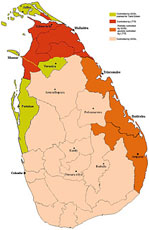
"Its only one border in Sri Lanka" President Mahinda Rajapakse BBC Interview
ENB
EELAM

|
People Struggle |
|
Tasks |
|
India |
|
Construction 6 |
|
Construction 7 |
|
Construction 8 |
|
Construction 9 |
|
Construction 10 |
|
Puplications |
Last updated 04 April 2007, 21.50 GMT

Top Stories

India donates second warship to Sri Lanka
[TamilNet, Sunday, 25 February 2007, 19:24 GMT]
India is to grant the Sri Lanka Navy another ocean-going warship as part of greater cooperation between the two countries, media reports in Colombo said Sunday. The Nation newspaper said India "will either grant or lease a coast guard vessel" to the Sri Lanka Navy.
The former Indian Coast Guard vessel, 'Varaha', is similar to the Offshore Patrol craft (OPC) which India provided in 2000 and which is now the flagship of the SLN, the paper said. The Varaha will be the third large 'blue water' warship in the SLN's fleet along with the US-supplied cutter.
The Varaha has already been serving with the SLN as a substitute while the SLNS Sayura, the flagship of the Sri Lanka navy, which was bought from India seven years ago, was being refurbished in India.
The refurbishment of SLNS Sayura was reportedly being conducted at no cost to Sri Lanka, press reports last year said./ A Vikram class OPV with the Indian Navy.
The 75 metre length Varaha requires a crew of 100 including 11 officers. It can reach a top speed of 22 knots and has a range of 8500 nautical miles.
If the proposed grant is carried through by the Indian government, the Varaha will be the SLN's third such vessel with a deep sea capability, The Nation reported.
Formally known as Indian Navy's Ship (INS) Saryu, the SLNS Sayura was provided to increase Colombo's blue water capability, especially in the light of LTTE smuggling weapons on oceangoing ships.
Another OPC was added to the fleet last year when the US Coast Guard vessel, 'Courageous' was donated to Sri Lanka. It was refurbished and mounted with a weapons system in the United States and commissioned as SLNS Samudura.
All three vessels (Sayura, Samudura and Varaha) have the ability to carry one or two helicopters on board and leave the option open for the establishment of the naval air wing, which has been put off on several previous occasions due to monetary considerations, the paper said.
Varaha is a Vikram class OPC which was commissioned in 1992. At the time of construction it was designed to be in service for 20 years till 2012. However, after some modifications the vessel is expected to be in service for approximately 26 years.
The wear and tear of Coast Guard ships is greater since they stay longer at sea and cruise faster when involved in a chase and therefore, their lifespan is shorter than other naval assets of similar size, The Nation reported.
Interestingly, Sri Lankan military cooperation between its vital regional allies seems to be differentiated on specific needs, the paper said: "while Indian assistance has mainly focused on the maritime defence area, Pakistan has been involved in improving the capabilities of the Sri Lanka Air Force."
Due to Indian sensitivities, Sri Lanka and Pakistan are playing down Islamabad's support for Colombo by way of arms and ammunition, the paper said.
Indian defence analysts have said Pakistani Air Force commanders are in Sri Lanka helping the SLAF plan air attacks against the Liberation Tigers.
Reproduction of this news item is allowed when used without any alterations to the contents and the source, TamilNet, is mentioned
BRITAIN
Britain could withold Sri Lanka aid
From correspondents in Colombo
February 19, 2007 04:39am Article from: Reuters
BRITAIN warned overnight it will withhold millions of pounds worth of aid to Sri Lanka if the island's government fails to provide assurances it is fulfilling agreed human rights and defence spending conditions.
Britain agreed in 2005 to provide Sri Lanka £41 million ($102.4 million) in debt relief through 2015 in yearly instalments of around £4 million ($10 million), as long as it meets conditions related to various issues, including human rights and defence expenditure.
The British government has written to its Sri Lankan counterpart asking it to clarify whether those conditions were still being met.
"If the response doesn't reassure the UK government that conditions agreed by both governments are being met, we will not disburse the next instalment," a spokeswoman for Britain's Department for International Development (DFID) said from London.
The British warning comes as both the Sri Lankan government and Tamil Tiger rebels ignore repeated pleas from the international community to halt a new chapter of a two decade civil war that has killed more than 67,000 people since 1983.
Truce monitors and rights groups have accused both government forces and the Tigers of repeated violations of a now tattered 2002 ceasefire pact, and a team of international experts has been appointed to observe a probe into a series of killings and abuses blamed on both sides.
Britain this week offered to play a bigger role in Sri Lanka's moribund peace process, including talking directly to Tamil Tiger rebels it has labelled as terrorists, as part of efforts to end the war that has killed around 4000 people in the past year alone.

Britain threatens to stop aid to Lanka
From Neville de Silva in London
The British government is putting the squeeze on Sri Lanka, threatening to stop a grant of £41 million for breaching international obligations and for "unjustified" military spending.
The British threat to cut off the grant came a few days ahead of the Colombo visit of foreign office minister Kim Howells who offered to talk to the Tamil Tigers as part of an effort to play a greater role in the Sri Lanka conflict.
Britain's twin track policy is seen as part of its carrot-and-stick approach that dovetails into an overall European effort to save the LTTE from the current military pressure by Colombo, as India did when the Tigers were cornered in Vadamarachchi some 20 years ago, analysts here said./ Britain's International Development Minister Hilary Benn has written to Sri Lanka seeking assurances that it would demonstrate in the coming year that Colombo is meeting the concerns raised by the British government, well informed sources said
Mr. Benn in his letter to Treasury Secretary P.B. Jayasundera says he wants to be assured that Colombo would adhere to certain criteria before he puts his signature to the transfer of the £41 million which Britain promised following the Asian tsunami to meet Sri Lanka's debt reduction under the multilateral debt relief initiative.
Britain had promised to provide £41 million over 10 years to meet the cost of Sri Lanka's debt to the World Bank International Development Association. This would have allowed the Sri Lanka government to redirect a similar sum from its own resources for tsunami recovery and poverty reduction.
But now Britain claims that Sri Lanka is guilty of a significant violation of international obligations, particularly human rights, an instigation of hostilities and an unjustified rise in military spending. It believes that instead of spending the sum released on tsunami recovery and poverty reduction it has gone on a spending spree for military hardware and logistics.
The use of economic aid as a pressure point is in keeping with the call made by the German development minister when she announced two months ago that Berlin was stopping aid and called on other EU countries to do the same.
While analysts here see the British move as an attempt to save the LTTE which it banned six years ago as a terrorist organisation, from a lot of grief, it is also an attempt to get its foot in the peace process.
Observers here said that Britain's policy is not to talk to organisations designated as terrorists. If now it is offering to talk to the LTTE on Colombo's behalf to kick start the peace process, observers wonder whether Britain is planning to lift the ban on the Tigers.
Germany
Germany Insists On Fresh Talks Before New Aid To Sri Lanka
Sunday, 15 October 2006
Germany's Ministry of Economic Cooperation and Development (BMZ), with its statement on Friday has come down strongly on the warring parties in Sri Lanka to return to the Peace Arena before expecting any new aid projects in the country.
Germany has insisted there can be no development without peace.
"New commitments of more than 38 million euros, meant for projects in Government as well as Tamil areas, are therefore frozen until the peace process will be restarted.
Already for some time several projects in the Tamil areas had to be interrupted due to security reasons as well as the EU listing of the LTTE as a terror organization," Minister Heidi Wieczorek-Zeul is to have said in a statement.
"For weeks we have been demanding an immediate return to the negotiating table and a shaping of a common future," Ms Wieczorek-Zeul said, adding that as long as both sides engage in intensive conflict, "it is not meaningful for the German government to commit additional funding that cannot reach the people of Sri Lanka".
"There cannot be a military solution to the conflict between the Singhalese and Tamils," the statement said.
The move comes after a failed Sri Lanka offensive last week Wednesday saw nearly 200 troops killed.
The fighting has been some of the worst since the truce was signed in 2002.
Farmers come to streets protesting against privatization of water!
[14th February 2007 - 05:00 S.L.T)

Sri Lanka
Members of 15 farmer associations came down to the streets today protesting against selling the ownership of water resources to multi national companies. A large number of farmers participated at the protest campaign held opposite Fort Railway Station.
A leaflet was distributed stating that the government is deceitfully preparing to privatize water resources and calling everyone to rally to defeat the vile attempt of the government.
The farmers attired in the loin cloth they usually wear in their paddy fields was an unusual sight in the streets in Colombo .
Skeptics Doubt U.S. Evidence on Iran Action in Iraq
By HELENE COOPER and MARK MAZZETTI WASHINGTON, Feb. 12 NYTimes
Three weeks after promising it would show proof of Iranian meddling in Iraq, the Bush administration has laid out its evidence - and received in return a healthy dose of skepticism.
The response from Congressional and other critics speaks volumes about the current state of American credibility, four years after the intelligence controversy leading up to the Iraq war. To pre-empt accusations that the charges against Iran were politically motivated, the administration rejected the idea of a high-level presentation, relying instead on military and intelligence officers to make its case in a background briefing in Baghdad.
Even so, critics have been quick to voice doubts. Representative Silvestre Reyes of Texas, the Democratic chairman of the House Intelligence Committee, suggested that the White House was more interested in sending a message to Tehran than in backing up serious allegations with proof. And David Kay, who once led the hunt for illicit weapons in Iraq, said the grave situation in Iraq should have taught the Bush administration to put more of a premium on transparency when it comes to intelligence.
"If you want to avoid the perception that you've cooked the books, you come out and make the charges publicly," Mr. Kay said.
Administration officials say their approach was carefully calibrated to focus on concerns that Iran is providing potent weapons used against American troops in Iraq, not to ignite a wider war. "We're trying to strike the right tone here," a senior administration official said Monday. "It would have raised the rhetoric to major decibel levels if we had had a briefing in Washington."
At the State Department, the Pentagon and the Office of the Director of National Intelligence, officials had anticipated resistance to their claims. They settled on an approach that sidelined senior officials including Zalmay Khalilzad, the American ambassador to Iraq, and John D. Negroponte, who until last week was the director of national intelligence. By doing so, they avoided the inevitable comparisons to the since-discredited presentation that Secretary of State Colin L. Powell made to the United Nations Security Council in 2003 asserting that Iraq had illicit weapons.
The White House and the State Department both made clear on Monday that they endorsed the findings presented in Baghdad. Asked for direct evidence linking Iran's leadership to the weapons, Tony Snow, the White House spokesman, said: "Let me put it this way. There's not a whole lot of freelancing in the Iranian government, especially when its comes to something like that."
Sean McCormack, the State Department spokesman, said: "While they presented a circumstantial case, I would put to you that it was a very strong circumstantial case. The Iranians are up to their eyeballs in this activity, I think, very clearly based on the information that was provided over the weekend in Baghdad."
In Australia, however, Gen. Peter Pace, the chairman of the Joint Chiefs of Staff, told reporters that he "would not say" that Iran's leadership was aware of or condoned the attacks. "It is clear that Iranians are involved, and it's clear that materials from Iran are involved, but I would not say by what I know that the Iranian government clearly knows or is complicit," according to an account posted on the Voice of America Web site.
An Iranian government spokesman, Mohammad Ali Hosseini, has sought in denying the charges to exploit the lingering doubts about American credibility. "The United States has a long history of fabricating evidence," Mr. Hosseini, a Foreign Ministry official, told reporters in Tehran.
The administration's scramble over how to present its evidence started in January, after President Bush accused Iran of meddling in Iraq. Iran's ambassador to Iraq, Hassan Kazemi Qumi, demanded that the United States present its evidence, and Mr. Khalilzad, the American ambassador in Baghdad, responded that America would "oblige him by having something done in the coming days."
That set Bush administration officials racing to produce a briefing that would hold up to scrutiny. Military officials in Baghdad developed the first briefing, a wide-ranging dossier that contained dozens of slides about Iranian activities inside Iraq, which was then sent to Washington for review, administration officials said.
But after a careful vetting by intelligence officials, senior administration officials, including National Security Adviser Stephen J. Hadley and Defense Secretary Robert M. Gates, concluded that there were aspects of the briefing that could not be supported by solid intelligence. They sent the briefing back to Baghdad to be shored up, a senior official said.
The evidence that military officials presented Sunday was a stripped-down version of the original presentation, focusing almost entirely on the weapons, known as explosively formed penetrators, and the evidence that Iran is supplying the weapons to Shiite groups.
Both Democratic and Republican officials on Capitol Hill said that while they do not doubt that the weapons are being used to attack American troops, and that some of those weapons are being shipped into Iraq from Iran, they are still uncertain whether the weapons were being shipped into Iraq on the orders of Iran's leaders.
Several experts agreed. "I'm not doubting the provenance of the weapons, but rather, the issue of what it says about Iranian policy and whether Iran's leaders are aware of it," said George Perkovich, a nonproliferation specialist at the Carnegie Endowment for International Peace in Washington.
Philip D. Zelikow, who until December was the top aide to Secretary of State Condoleezza Rice, said American politics and the increased unpopularity of the war in Iraq is obscuring the larger issue of the Iran evidence, which he described as "abundant and so multifaceted."
"People have lost their moorings," Mr. Zelikow said. He said the administration was trying to overcome public distrust by asking, in essence, "Don't you trust our soldiers?"
Nazila Fathi contributed reporting from Tehran.
European Officials Agree to Widen Economic Sanctions Against Iran Over Nuclear Program
By STEVEN R. WEISMAN Published: February 13, 2007 WASHINGTON, Feb. 12
European negotiators, yielding to pressure from the United States, have agreed to widen a ban on financial transactions with Iran and the export of materials and technology that Iran could use to develop nuclear weapons.
European officials said a resolution embodying the wider ban was negotiated over the last week and should go far toward satisfying the Bush administration, which has been pressing European governments for firmer action against Iranian individuals and companies as part of a campaign to isolate the Tehran government because of its suspected nuclear arms program.
"This is a very positive initiative because it takes the European Union beyond where they were until recently," said R. Nicholas Burns, the under secretary of state for political affairs. "It's not everything we would like to see happen. But the trajectory is good and the momentum is good, so we think this is a positive event."
A text of the resolution, released Monday evening by officials of the European Union, calls for steps to carry out a United Nations Security Council resolution adopted in December. Europeans have been slow to follow through, saying governments do not have the legal tools to act against Iranian companies.
Two European officials said that in some respects the draft complies with American wishes for a broad move against Iran, but in other respects it could fall short. If the European Union adopts the resolution, European governments will have to enact laws individually to carry it out.
"The point is that it takes time for the Europeans to work out exactly where the center of gravity is so they can do something like this," said a European official, asking not to be identified because of the delicate nature of the discussions. "It's not as if the European Union can snap its fingers and get it done right away."
In a separate development, two top diplomats from the European Union said in Brussels that their talks in Tehran over the weekend left them encouraged that negotiations might resume over Iran's nuclear program.
There was no sign, however, that Iran would be willing to suspend its enrichment of uranium, which the West has insisted is a precondition for a resumption of talks.
"We got the impression that in Iran there's a new ambition to return to the negotiating table," said the German foreign minister, Frank-Walter Steinmeier, who has taken the lead for the European Union because Germany serves as its current president.
Both Mr. Steinmeier and Javier Solana, the European Union's foreign policy chief, spoke in Brussels a day after returning from Tehran, where they had held talks with Ali Larijani, the top Iranian national security official.
The Security Council resolution of Dec. 23 listed a dozen individuals and several Iranian corporations as effectively off-limits to transactions with European banks and European companies, including those that might get government-backed guarantees for loans to facilitate transactions with Iran.
Responding to the urgings of the Bush administration, the draft would seek to freeze funds of those entities and also of others that might later be designated as engaging in "sensitive" nuclear or weapons activities.
The draft would also call for a ban on visas for individuals identified as involved in Iran's nuclear programs, except for limited relief purposes. The draft would encompass anything "that could contribute to" uranium enrichment or processing of nuclear fuel that could be used for a nuclear weapon.
The draft has a bit of an escape clause, saying it does not apply to payments under contracts that were concluded or that were even discussed before Dec. 23, the date of the Security Council resolution.
It calls on European countries "in accordance with their national legislation" to take "the necessary measures" to prevent teaching or training of Iranians in their countries of any studies that might contribute to nuclear proliferation.
North Korea to Close Reactor in Exchange for Aid
By JIM YARDLEY BEIJING, Feb. 13 NYTimes
North Korea agreed today to close its main nuclear reactor in exchange for a package of food, fuel and other aid from the United States, China, South Korea and Russia.
The breakthrough, which was announced by the Chinese government after intense negotiations and welcomed by the White House as a "very important first step," comes four months after North Korea tested a nuclear bomb.
The partner nations agreed to provide roughly $400 million worth of various kinds of aid in return for the North starting the process of permanently disabling its nuclear facilities and allowing inspectors into the country.
Perhaps equally important, the United States and Japan, which also took part in the talks, agreed to discuss normalizing relations with the Pyongyang regime. The United States will also begin the process of removing North Korea from its list of terror-sponsoring states, and lifting trade and financial sanctions.
In September, 2005, the United States, North Korea and four other nations signed a draft accord in which the North promised to abandon efforts to produce nuclear weapons and re-admit international inspectors to its nuclear facilities, but leaving open a range of issues for future talks.
"Today's announcement represents the first step toward implementing that agreement," President Bush said in a statement.
He said that the talks were the best opportunity to use diplomacy to address North Korea's nuclear program.
The White House spokesman, Tony Snow, said that the new agreement was stronger than previous deals with North Korea because the United States was not the only other party.
"There is still a possibility of sanctions through the international community," Mr. Snow said. "And there is considerably more leverage on the North Koreans, by virtue of the fact that you have the Chinese, the South Koreans, the Japanese and the Russians also involved here. They're answerable not merely to the United States, but in fact to their own neighbors, who are significant stakeholders in this."
Mr. Snow also said that the North Koreans would be under an obligation to disclose everything publicly, and said that there would be very specific requirements from the North Koreans, including shutting down the Yongbyon nuclear plant and enrichment facilities.
Mr. Snow said the breakthrough was a result of "some very tough and hard-nosed diplomacy."
But the agreement drew strong criticism from John Bolton, a former United States ambassador to the United Nations, who urged President Bush to reject it.
He called it a "charade" and a "hollow agreement."
"I am very disturbed by this deal," Mr. Bolton told CNN. "It sends exactly the wrong signal to would-be proliferators around the world: 'If we hold out long enough, wear down the State Department negotiators, eventually you get rewarded,' in this case with massive shipments of heavy fuel oil, for doing only partially what needs to be done."
He added that the agreement focused too narrowly on Yongbyon.
"That is not nearly the entire threat," Mr. Bolton said, adding that the agreement says nothing about the stock of nuclear weapons North Korea already possesses.
Japan has not agreed to join the other four countries in providing the aid package to the North, saying that it cannot take part until some bilateral issues between Japan and the North are worked out. Abductions of Japanese citizens by the North over the Cold War years are the main issue.
The accord sets a 60-day deadline for North Korea to accomplish its first steps toward disarmament, and leaves until an undefined moment - and to another negotiation - the actual removal of North Korea's nuclear weapons and the fuel manufactured to produce them.
Under the agreement, the first part of the aid - 50,000 tons of fuel oil, or an equivalent value of economic or humanitarian aid - will be provided by South Korea, Russia, China and the United States; in the case of the United States, doing so requires congressional approval, which Mr. Bush is likely to have a difficult time securing.
In return for disabling the reactor and declaring all its nuclear programs, the North is to eventually receive another 950,000 tons of oil in stages. Further negotiations among the six nations are scheduled to begin on March 19 in Beijing.
"It's about actions for actions," Gordon Johndroe, a spokesman for the National Security Council, said this morning. "We have leverage because they're under a U.N. Security Council sanctions regime."
The agreement was read aloud this morning to all the delegates, gathered in a conference room at a Chinese state guesthouse in Beijing. The Chinese envoy, Wu Dawei, then asked if there were any objections. When none were made, the officials all stood and applauded.
Though Mr. Hill and other envoys spoke to reporters about the accord as soon as it had been reached, in the small hours of this morning, the formal announcement was not made by China, host of the talks, until this afternoon. During a ceremony televised nationally, the chief Chinese negotiator, Wu Dawei, praised the participating nations for their flexibility and declared the deal a "successful ending."
Negotiators spent five days trying to reach a deal but were stymied until the very end by North Korean demands for large amounts of energy aid. Mr. Hill said he and the North Korean envoy, Kim Kye-gwan, had initially agreed at an informal January meeting in Berlin that the amount of energy promised to the North would not be specified until working groups were established. But the North insisted at the neijing talks that a hard figure be set in the new agreement.
Ultimately, the delegations agreed on 1 million tons of fuel oil. But the pil will not all come right away: After the first 50,000 tons are delivered in the initial 60-day period, the remainder will be tied delivered as the North meets later requirements to disclose and disable its nuclear arsenal.
The United States is obliged to make progress on its promises in the 60-day period as well, including starting bilateral discussions on various issues with the North.
At the end of the 60 days, the agreement calls for the foreign ministers of the six nations to meet and discuss, among other things, security cooperation in Northeast Asia. A separate forum would also be created to negotiate a permanent peace treaty for the Korean Peninsula, replacing the armistice that stopped the fighting in the 1950-53 Korean War but has never formally ended the war.
The ultimate goal is the complete denuclearization of North Korea, and the next round of talks is expected to begin to wade into the thicket of disputes over how to carry this out. North Korea has sidestepped some previous agreements, and is thought to have many mountainside tunnels where it can hide nuclear materials and projects from foreign observers if it chooses.
The agreement obliges the North to provide a complete list of its nuclear programs, including an inventory of its plutonium stockpile. It must also disable all its nuclear facilities, including "graphite-moderated reactors and reprocessing facilities." International inspectors are to verify the process.
The agreement marks a major change of course for the Bush administration, which has been beset by six years of virulent internal arguments over whether to negotiate with North Korea or to try to squeeze its government until it collapses.
The administration ultimately settled on pursuing a deal through the six-nation talks because of a view that North Korea would be more likely to honor a deal if China were a party to it.
"If they renege on this," said one senior Bush administration official, who would not speak on the record because the deal had yet to be signed, "they are sticking their fingers into the eyes of the Chinese."
Nonetheless, some administration officials acknowledged that they had concluded that a step-by-step accord was their only choice, and that it would be impossible to set a schedule for the North's disarmament without taking initial steps to build trust.
The disarmament process promises to be enormously complex, far harder than dismantling Libya's comparatively small nuclear complex three years ago. Libya never produced nuclear material, whereas North Korea is believed to have made one or two weapons, or the fuel for them, nearly two decades ago, and perhaps a half dozen or more since 2003.
But American officials are uncertain exactly how many weapons the North possesses, and in the second phase of the accord, the North would have to explain what it did with the uranium-enrichment equipment that it apparently purchased in the 1990's from the Pakistani nuclear engineer Abdul Qadeer Khan, whose network also supplied Iran and Libya.
Some experts doubt that the North will ever agree to turn over its weapons, which it considers its main bargaining chip with the West, and Kim Jong-Il's only insurance policy against being toppled as the country's leader.
Jim Rutenberg and David E. Sanger contributed reporting from Washington. Christine Hauser contributed reporting from New York.
Regional wars leads to World War
RUSSIA Vs USA
"Old spies have a habit of blunt speaking."
Gates Counters Putin's Words on U.S. Power
Michaela Rehle
Reuters
Defense Secretary Robert M. Gates said of President Vladimir V. Putin of Russia,
"Old spies have a habit of blunt speaking."
Published: February 12, 2007
MUNICH, Feb. 11 - Defense Secretary Robert M. Gates, disputing a lengthy critique of American power by President Vladimir V. Putin of Russia on Saturday, said Sunday at a European security conference here, "One cold war was quite enough."
"As an old cold warrior, one of yesterday's speeches almost filled me with nostalgia for a less complex time," he said. "Almost."
Mr. Gates, a former director of the Central Intelligence Agency called back to government service from academia to become defense secretary, told attendees of the 43rd Munich Conference on Security Policy that both he and Mr. Putin had spent most of their careers in their governments' spy agencies.
"And, I guess, old spies have a habit of blunt speaking," Mr. Gates said. "However, I have been to re-education camp - spending four and half years as a university president and dealing with faculty." His remark drew laughs and applause.
His sharpest response to Mr. Putin was gently couched. "Russia is a partner in endeavors," Mr. Gates said. "But we wonder, too, about some Russian policies that seem to work against international stability, such as its arms transfers and its temptation to use energy resources for political coercion."
Throughout the rebuttal, and in a longer discourse on how America's European allies must help rebuild Afghanistan and remain engaged in the fight against terrorism, Mr. Gates mentioned Mr. Putin only once by name. That came when he said he had accepted an invitation from Mr. Putin to visit Moscow.
On Saturday, Russia's defense minister, Sergei B. Ivanov, a Putin confidant, denied that Mr. Putin's speech had been confrontational. "We are not interested in imposing our opinion on anybody," Mr. Ivanov said. But he cautioned that his government would not support international actions taken without consultation with Russia, nor those taken without its consent, and certainly none that are "imposed on Russia."
The speech by Mr. Gates was delivered under the long shadow of his predecessor, Donald H. Rumsfeld, who both charmed and offended European audiences during his tenure as defense secretary, which included several speeches to this conference.
Mr. Gates cast himself as a geopolitical realist and drew a knowing laugh when he focused on Mr. Putin's assertion that the United States and its allies were dividing Europe.
"All of these characterizations belong in the past," Mr. Gates said. "The free world versus those behind the Iron Curtain. North versus South. East versus West, and I am told that some have even spoken in terms of 'Old Europe' versus 'new.' "
The last was a reference to a characterization Mr. Rumsfeld made in January 2003 to contrast Germany and France, which objected to the United States plan to invade Iraq, with neighboring supporters, not all of which are NATO members.
Reviewing NATO's success in standing up to the Soviet threat, "it seems clear that totalitarianism was defeated as much by ideas the West championed then and now as by ICBMs, tanks and warships that the West deployed," Mr. Gates said. The alliance's most effective weapon, he said, was a "shared belief in political and economic freedom, religious toleration, human rights, representative government and the rule of law."
"These values kept our side united, and inspired those on the other side," he added.
Shifting to current threats and challenges, he called on NATO members to support a comprehensive strategy to stabilize Afghanistan, "combining a muscular military effort with effective support for governance, economic development and counternarcotics."
He also urged NATO allies to increase their military spending to meet the benchmark of 2 percent of gross domestic product set by the alliance; only 6 of NATO's 26 members fulfill that standard.
Mr. Gates briefly turned to the war in Iraq, to echo President Bush's insistence that the United States and its partners there must prevail. If chaos tears Iraq apart, Mr. Gates warned, "every member of this alliance will feel the consequences" of regional turmoil and terrorism.
He acknowledged the damage done to America's global standing by its conduct in the campaign against terrorism, particularly in holding detainees without due process at the United States naval base in Cuba.
"There is no question in my mind that Guantánamo and some of the abuses that have taken place in Iraq have negatively impacted the reputation of the United States," Mr. Gates said. "It is also true, though, that there are real terrorists at Guantánamo."
Repeating comments from a number of American officials, Mr. Gates said most members of the Bush administration would like to close the detention center, and he pledged that tribunals for detainees would be conducted in a legitimate and transparent manner.
Putin: People who teach us democracy don't want to learn it themselves [AFP]
Vladimir Putin, the Russian president, has harshly criticised the US for what he said was an attempt to force its will on the rest of the world.
"What is a unipolar world? No matter how we beautify this term it means one single centre of power, one single centre of force and one single master," he said to an annual gathering of top security and defence officials in Munich, Germany, on Saturday.
"It has nothing in common with democracy because that is the opinion of the majority taking into account the minority opinion," Putin said.
"People are always teaching us democracy but the people who teach us democracy don't want to learn it themselves."
'World less safe'
Putin said that the US, above other western nations, had repeatedly overstepped its national borders in questions of international security, a policy that he said had not made the world safer.
On the contrary, the world had become less safe, he said.
Putin said: "Unilateral actions have not resolved conflicts but have made them worse.
"This is very dangerous. Nobody feels secure any more because nobody can hide behind international law."
He did not mention any specific conflicts, but he has been very critical of the US decision to invade Iraq in 2003.
Missile defence system
Putin also voiced concern about US plans to build a missile defence system in eastern Europe, probably Poland and the Czech Republic, and the expansion of Nato as possible challenges to Russia.
"The process of Nato expansion has nothing to do with modernisation of the alliance or with ensuring security in Europe," Putin said.
"On the contrary, it is a serious factor provoking reduction of mutual trust."
He also dismissed suggestions that the European Union and Nato had the right to intervene alone in crisis regions.
"The legitimate use of force can only done by the United Nations, it cannot be replaced by EU or Nato," he said.
On the missile defence system, Putin said: "I don't want to accuse anyone of being aggressive" but suggested it would seriously change the balance of power and could provoke an unspecified response.
"That balance will be upset completely and one side will have a feeling of complete security and given a free hand in local, and probably in global, conflicts...," he said.
"We need to respond to this."
Putin Says U.S. Is Undermining Global Stability
By THOM SHANKER and MARK LANDLER
Published: February 11, 2007 /MUNICH, Feb. 10
President Vladimir V. Putin of Russia accused the United States on Saturday of provoking a new nuclear arms race by developing ballistic missile defenses, undermining international institutions and making the Middle East more unstable through its clumsy handling of the Iraq war.
In an address to an international security conference, Mr. Putin dropped all diplomatic gloss to recite a long list of complaints about American domination of global affairs, including many of the themes that have strained relations between the Kremlin and the United States during his seven-year administration. Among them were the expansion of NATO into the Baltics and the perception in Russia that the West has supported groups that have toppled other governments in Moscow's former sphere of influence.
"The process of NATO expansion has nothing to do with modernization of the alliance," Mr. Putin said. "We have the right to ask, against whom is this expansion directed."
He said that the United States had turned the Organization for Security and Cooperation in Europe, which sends international monitors to elections in the former Soviet sphere, "into a vulgar instrument of insuring the foreign policy interests of one country."
The comments were the sternest yet from Mr. Putin, who has long bristled over criticism from the United States and its European allies as he and his cadre of former Soviet intelligence officials have consolidated their hold on Russia's government, energy reserves and arms-manufacturing and trading complexes.
Rubble from the Berlin Wall was "hauled away as souvenirs" to countries that praise openness and personal freedom, he said, but "now there are attempts to impose new dividing lines and rules, maybe virtual, but still dividing our mutual continent."
The world, Mr. Putin said, is now unipolar: "One single center of power. One single center of force. One single center of decision making. This is the world of one master, one sovereign."
With the German chancellor, Angela Merkel, the American defense secretary, Robert M. Gates, and a Congressional delegation sitting stone-faced, Mr. Putin warned that the power amassed by any nation that assumes this ultimate global role "destroys it from within. It has nothing in common with democracy, of course."
"Today we are witnessing an almost uncontained hyper use of force in international relations - military force," he said.
"Primarily the United States has overstepped its national borders, and in every area," said Mr. Putin, who increasingly has tried to re-establish Russia's once broad Soviet-era influence, using Russia's natural resources as leverage and defending nations at odds with the United States, including Iran.
American military actions, which he termed "unilateral" and "illegitimate," also "have not been able to resolve any matters at all," and have created only more instability and danger. "They bring us to the abyss of one conflict after another," he said. "Political solutions are becoming impossible."
The comments irritated some European leaders and prompted sharp criticism from the Americans in attendance. Senator John McCain, the Arizona Republican widely expected to make a bid for the White House, made a rebuttal that began, "In today's multipolar world, there is no place for needless confrontation." He said that the United States won the cold war in partnership with powerful nations of Western Europe, and that "there are power centers on every continent today."
Mr. McCain then hit back at Mr. Putin more directly. "Will Russia's autocratic turn become more pronounced, its foreign policy more opposed to the principles of the Western democracies and its energy policy used as a tool of intimidation?" he asked. "Moscow must understand that it cannot enjoy a genuine partnership with the West so long as its actions, at home and abroad, conflict fundamentally with the core values of the Euro-Atlantic democracies."
Russia has also faced criticism from the United States and other Western countries that believe it has used energy reserves and transport pipelines to reward friendly countries and to punish those seeking to distance themselves from Kremlin control. Some analysts saw the tone of the speech as evidence of how much oil and mineral revenues have strengthened Mr. Putin.
The occasion of the speech was the 43rd Munich Conference on Security Policy - an event begun deep in the cold war, when Germany was divided and hundreds of thousands of American troops were stationed in Western Europe as a bulwark against Communist Warsaw Pact forces.
Mr. Putin began with an apology for the tough talk to come. But during a lively question and answer period full of challenges and rebukes, the Russian president indicated that he relished provoking the international audience of legislators, government leaders, political analysts and human rights advocates.
"I love it," Mr. Putin said as he reviewed a long list of questions. He has long enjoyed high and durable public approval ratings at home, in part for standing up to the West and for pursuing an assertive foreign policy with former Soviet states.
He did offer at least two significant and conciliatory statements to the United States.
President Bush "is a decent man, and one can do business with him," he said. From their meetings and discussions, Mr. Putin said, he has heard the American president say, "I assume Russia and the United States will never be enemies, and I agree."
And while Mr. Putin denied that Russia had assisted the Iranian military with significant arms transfers, he also criticized the government in Tehran for not cooperating more with the United Nations nuclear watchdog agency or responding to questions about its nuclear program.
Other American lawmakers offered measured criticism after the speech. "He's done more to bring Europe and the U.S. together than any single event in the last several years," said Senator Lindsey Graham, Republican of South Carolina. "It was seen as unnecessary bravado."
Senator Joseph Lieberman, an independent from Connecticut, described the speech as "confrontational," saying, "some of the rhetoric takes us back to the cold war."
Iran's top nuclear official, Ali Larijani, listened impassively from the back of the room. Mr. Larijani's attendance at the conference had become a sideshow in itself. After accepting an invitation to speak on Sunday, he canceled, citing health reasons, after a tense meeting with the International Atomic Energy Agency in Vienna that concluded with a decision to freeze technical cooperation projects.
Mr. Putin joked that he worried the United States was "hiding extra warheads under the pillow" despite its treaties with Moscow to reduce strategic nuclear stockpiles. And he indicated obliquely that the new Russian ballistic missile, known as the Topol-M, was being developed at least in part in response to American efforts to field missile defenses.
He expressed alarm that an effective antimissile shield over the United States would upset a system of mutual fear that kept the nuclear peace throughout the cold war. "That means the balance will be upset, completely upset," he said.
Addressing tensions between Europe and Russia over energy exports, Mr. Putin noted that 26 percent of Russian oil was extracted by foreign companies. While Russia is open to outside investment, he said, it has found its businessmen blocked from deals abroad.
The Kremlin has been criticized for attempting to impose registration and taxation laws that could restrict the work of foreign nongovernmental organizations with offices in Russia to aid democratization.
But Mr. Putin said his concerns about the work grew from the fact that they "are used as channels for funding, and those funds are provided by governments of other countries." This flow of foreign money to assist opposition Russian political organizations, he said, is "hidden from our society. What is democratic about this? This is not about democracy. This is about one country influencing another."
Mrs. Merkel, in her opening speech, struck a far more diplomatic tone than Mr. Putin, though she alluded to the tensions between Europe and Russia over energy shipments and the independence of Kosovo.
Addressing herself to Mr. Putin, who was sitting in the front row, Mrs. Merkel said, "In my talks with you, I have sensed that Russia is going to be a reliable and predictable partner." But she added, "We need to speak frankly with each other. There's no point in sweeping things under the carpet."
Mrs. Merkel sharply criticized Russia's recent shutdown of oil shipments to Belarus, which followed a dispute over the price of natural gas deliveries. She is pressing Russia to sign a charter with the European Union that governs energy, which Moscow has so far resisted.
Mrs. Merkel also alluded to another potential confrontation between Europe and Russia. The United Nations is weighing a proposal that would put Kosovo on the path to independence from Serbia, which Russia opposes because it fears that such a move could upset its own turbulent relations with ethnic groups in the Caucasus. Russia has crushed one separatist-minded people within its own borders, in Chechnya, but supports breakaway regions in Abkhazia and South Ossetia, both in Georgia.
"We're going to come to the stage where we have to decide: does Serbia, does Kosovo want to move in the European direction?" Mrs. Merkel asked. "If that's the route they choose, both will have to make compromises."
C. J. Chivers contributed reporting from Moscow.
Putin rails against US foreign policy
By Stephen Fidler and Demetri Sevastopulo in Munich By Stephen Fidler and Demetri Sevastopulo in Munich
Published: February 10 2007 15:46 | Last updated: February 10 2007 17:20
Vladimir Putin threw down the gauntlet to the west in a confrontational speech on Saturday, attacking what he called "illegal" US unilateral military action and arguing it had made the world more dangerous.
In a speech that stunned most of the audience at an annual security conference held in Munich, Mr Putin also railed against US plans to build anti-missile defences in Europe, the expansion of Nato to include countries that were formerly part of the Soviet Union, and a host of other western policies.
To an audience that included Robert Gates, US defence secretary, John McCain, US presidential contender, and a group of Washington lawmakers, Mr Putin declared the end of the unipolar world, which he described as a failure for the world and the US itself.
In a presumed reference mainly to the war in Iraq, Mr Putin said, "unilateral illegal actions have not resolved any single problem," emphasising the many more people who had been killed as a result of US military action.
He added: "We don't have enough force to resolve anything comprehensively." He said that only the United Nations - not Nato or the European Union - could authorise the use of military force around the world, and even then it should be as a last resort.
Mr Putin also called into question a nuclear missile disarmament treaty that formed the bedrock of arms reduction efforts during the Cold War. He said he was concerned about the spread of medium range missiles around the world to countries such as North Korea, Iran, Pakistan and India.
In a worrying development for arms control advocates, he said that only the US and Russia had made commitments not to build such weapons - and said these commitments had to be revisited to ensure security.
Under the 1988 Intermediate-Range Nuclear Forces treaty agreed by Ronald Reagan and Mikhail Gorbachev, the US and Soviet Union agreed to eliminate and renounce nuclear and conventional ground-launched ballistic and cruise missiles with ranges of 500-5,500km.
The Russian president said the treaty was outdated because it prohibited the US and Russia from possessing such weapons while other countries were not restricted in developing them.
"We are forced to think about guarantees of our security," Mr Putin said.
In 2005, Sergei Ivanov, the Russian defence minister and potential successor to Mr Putin, asked Donald Rumsfeld, then US defence minister, how the Bush administration would respond if Russia quit the INF treaty. US-based experts at the time were divided over whether he was representing the Kremlin, or just the views of the Russian defence ministry.
Mr Putin's attacked Washington's missile defence plans, which he suggested could trigger an arms race. "We can't be happy with plans to deploy elements of anti-ballistic missile defences in Europe," he said. He cast doubt on the justification for such defences in Europe, saying no "problem state" had missiles capable of reaching European soil.
The US has long said its missile defences were aimed not at major nuclear powers, such as Russia or China, but at "rogue" states with just a handful of missiles.
Speaking in Seville earlier this week, Mr Gates said the rudimentary US missile defence system was not aimed at Russia.
"We have made quite clear that it is not directed at them," said Mr Gates. "In India, deputy prime minister [Ivanov] acknowledged that it posed no threat to Russia or its strategic interests."
Asked whether Washington would be prepared to sign a binding agreement saying the system was not intended as a defence against Russia, Mr Gates responded: "I don't know if that would be appropriate."
Mr Putin said Russia's decision to deploy new Topol M long range missiles in Russia were to ensure that Moscow's nuclear deterrent remained potent in the face of more developed US missile defences.
"If you say that your ABM system is not directed at us, our missiles are not aimed at you," he said.
He said militarisation of space could have unpredictable consequences for world security and was unacceptable. To deal with this, Russia had drafted a treaty to prevent the placing of weapons in space, which it would send to its international partners in the near future, he said.
He was critical of western countries for not ratifying a treaty signed in 1999 to reduce the number of conventional forces in Europe - and of US construction of so-called forward operating bases in Romania and Bulgaria.
Even in the investment field, Russia was discriminated against, he said. Foreign companies were responsible for the extraction of 26 per cent of Russian oil. But Russian companies faced obstacles when they wanted to invest abroad: the ratio of inward investment by foreign companies in Russia to outward investment by Russian companies abroad was 15:1.
In almost the only conciliatory remarks in his presentation, he described President George W. Bush as a "decent man".
One can do business with him.when I talk to him I assume Russia and the US will never be enemies and I agree with him." Mr Putin also provided a glimmer of hope that Russia might put more pressure on Iran to respond more positively to efforts by the International Atomic Energy Agency to force Iran to resolve the standoff over its controversial nuclear programme.
In his speech, Mr Putin said: "I don't understand why Iran has not responded positively and constructively to these [nuclear] concerns and the proposals by [IAEA chief Mohamed] El Baradei that would address these concepts". The international community should provide incentives, he said, to show Iran that "cooperation is better than confrontation".
John McCain, the influential Republican senator and potential candidate for the 2008 presidential race, hit back at Mr Putin's suggestion that the US was operating unilaterally under the assumption that the end of the cold war had produced a uni-polar world.
"Today's world is not unipolar," Mr McCain said "The US did not single-handedly win the Cold War in some unilateral victory. The transatlantic alliance won the Cold War, and there are power centres on every continent today. Russian leaders' apparent belief to the contrary raises a number of difficult questions." While criticising Mr Putin for making the "most aggressive remarks by a Russian leader since the end of the Cold War", Mr McCain welcomed his comments on Iran as a "positive note".
Protesters and Israeli Police Clash at Holy Site

Muslims who had come for Friday prayers threw rocks and bottles to protest an Israeli construction project that they feared would damage the mosque. By GREG MYRE Published: February 9, 2007/ JERUSALEM,
Israeli troops charged onto the grounds of Jerusalem's most contentious religious site today, firing tear gas and stun grenades at stone-throwing Palestinians who were protesting Israeli excavation work taking place just outside the hilltop shrine.
The New York Times The confrontation took place immediately after midday prayers on the Muslim Sabbath. Palestinians have been protesting for four days against the digging next to the mosque compound, known to Muslims as the Noble Sanctuary and to Jews as the Temple Mount.
The clashes today quickly spread to other parts of Jerusalem's Old City and to streets nearby, as Palestinian youths who were barred from the compound hurled stones at the large contingent of Israeli police deployed in the city. Overall, 19 Israeli policemen and 17 Palestinian protesters were lightly injured, and 17 Palestinians were arrested.
Because of the holy site's significance to Jews and Muslims, any dispute there has the potential to ignite a major conflict both in Jerusalem and in the wider region.
Israel says it is carrying out routine repair work that poses no threat to the mosque compound, and that Muslim extremists are trying to use it to manufacture a crisis.
But the Palestinians say they are worried that the mosque's foundations could be harmed by the work, and other Muslim states have joined them in criticizing Israel over the issue.
With tensions running high, Israel ordered that men under 45 be barred from attending the Friday prayers at the mosques today. But some younger men did manage to get inside, and they emerged from the prayers chanting "God is great."
They immediately headed toward the police and began throwing stones and bottles at the officers, who were just outside the gate of the compound. Some 200 officers then ran into the grounds, firing tear gas and stun grenades that sent up clouds of smoke.
As they chased the stone-throwers, the Israeli police approached the entrances to the two mosques in the compound, Al Aksa and the Dome of the Rock, but they did not enter either building.
"There is no justification for what they did today," Adnan Husseini, the head of the Islamic Waqf, the Muslim trust that runs the mosque compound, said of the Israeli officers.
But Micky Rosenfeld, a spokesman for the Israeli police, said that the officers used "a minimum amount of force to disperse the rioters after they started throwing rocks."
In the past, Palestinians in the compound have thrown rocks down on Jewish worshippers praying at the Western Wall below. When the clashes broke out today, the police directed the Jewish worshippers to leave the area.
The compound has often been the flashpoint for clashes between Israel and the Palestinians.
The current Palestinian uprising, or intifada, erupted on Sept. 29, 2000, at the mosque compound, one day after Ariel Sharon, then Israel's opposition leader, made a controversial visit to the site emphasize Israel's claim of sovereignty over it.
The latest controversy began Tuesday when Israel started renovations on a 50-yard-long pedestrian walkway that leads up to the compound.
The walkway, which is adjacent to the Western Wall, is used primarily by tourists and some Jews to visit the mosque compound, which was built centuries ago atop the ruins of the Biblical Jewish temples. The walkway was damaged by a snowstorm and an earthquake three years ago and needed to be repaired, according to the Israelis. The office of Israeli Prime Minister Ehud Olmert said in a statement Thursday that the renovations "do not constitute any damage to the Mount or Islamic holy places." It continued, "The work is being carried out by professionals and with the complete transparency, entirely for the safety of visitors."
But the site is so sensitive that any action by either side tends to provoke howls of protests.
Many Palestinians claim that the Israelis want to destroy the mosques and build a new temple at the site. While some fringe Jewish groups have expressed a to do this, the Israeli government says that the compound will remain a place for Muslim worship, as it has been for most of the past 1,300 years.
"The Israeli plan is very clear," said Palestinian Maher Gounamah, 40, a money changer. "They want to do something much bigger, and they are starting at this point."
The Israeli digging has been the leading news for several days on pan-Arab television channels like Al Jazeera. Several Arab states, including Jordan and Saudi Arabia, have been critical of Israel's plans. Iran's president, Mahmoud Ahmadinejad, said that the "Zionist regime always does something to cause tension and escalate hostility."
In the past, Muslim authorities have carried out renovations of their own at the mosque compound.
Seven years ago, the Waqf removed thousands of tons of dirt in trucks to make way for a staircase leading to one of the mosques. Israeli archaeologists complained that the work removed many artifacts from the periods of the First and Second Jewish Temples, and that the dirt and the artifacts were tossed into a garbage dump.
Just last month, Mr. Husseni, the head of the Waqf, complained that he wanted to carry out additional renovations, but was being blocked by the Israeli authorities.
Khaled Abu Aker contributed reporting.

How Neocon Shiite Strategy Led to Sectarian War in Iraq
POLITICS-US: How Neocon Shiite Strategy Led to Sectarian War Analysis by Gareth Porter*
WASHINGTON, Feb 6 (IPS) -
The supreme irony of President George W. Bush's campaign to blame Iran for the sectarian civil war in Iraq, as well as attacks on U.S. forces, is that the Shiite militias who started to drive the Sunnis out of the Baghdad area in 2004 and thus precipitated the present sectarian crisis did so with the support of both Iran and the neoconservative U.S. war planners.
The U.S. policy decisions that led to the sectarian war can be traced back to the conviction of a group of right-wing zealots with close ties to Israel's Likud Party that overthrowing the Saddam Hussein regime in Iraq would not destabilise the region, because Iraqi Shiites would be allies of the United States and Israel against Iran.
The idea that Iraqi Shiites could be used to advance U.S. power interests in the Middle East was part of a broader right-wing strategy for joint U.S.-Israeli "rollback" of Israel's enemies. In 1996, a task force at the right-wing Israeli think tank, the Institute for Advanced Strategic and Political Studies, under Richard Perle advised Israeli Prime Minister Benjamin Netanyahu that such a strategy should begin by taking control of Iraq and putting a pro-Israeli regime in power there.
Three years later, the former director of that think tank, David Wurmser, who had migrated to the neoconservative American Enterprise Institute, spelled out how the United States could use Iraqi Shiites to support that strategy in "Tyranny's Ally". Wurmser sought to refute the realist argument that overthrowing Saddam Hussein would destroy the balance of power between Sunni-controlled Iraq and Shiite Iran on which regional stability depended.
Wurmser proposed replacing the existing "dual containment" policy toward Iran and Iraq with what he called "dual rollback". He did not deny that taking down Hussein's regime would "generate upheaval in Iraq", but he welcomed that prospect, which would "offer the oppressed, majority Shiites of that country an opportunity to enhance their power and prestige."
Whereas the "realists" had assumed the Iraqi Shiites would be "Iran's fifth column", Wurmser argued that the Iraqi Shiite clerics would "present a challenge to Iran's influence and revolution." He cited their rejection of the central concept of the Iranian revolution of Ayatollah Khomeini -- the "rule of the jurisprudent" -- justifying clerical rule.
From that fact, Wurmser leaped to the conclusion that Iraqi Shiites would be an ally of the United States in promoting a "regional rollback of Shiite fundamentalism". Wurmser even suggested that Iraqi Shiites could help pry Lebanese Shiites, with whom they had enjoyed close ties historically, away from the influence of Hezbollah and Iran.
Wurmser was close to the key officials in the Pentagon and the White House who were planning the invasion of Iraq: Deputy Secretary of Defence Paul Wolfowitz and Undersecretary of Defence for Policy Douglas Feith. After 9/11 it was Wurmser who set up the now-infamous "Policy Counterterrorism Evaluation Group" in Feith's office to produce the evidence that could be used to justify invading Iraq. After the U.S. occupation, he became Vice President Cheney's Middle East adviser.
The neoconservative plan for invading Iraq reflected Wurmser's assumption that the United States would not need to plan a long military occupation of Iraq, because toppling Hussein's regime would unleash the power of the Iraqi Shiites.
But the political realities in Iraq were nothing like Wurmser and his allies imagined them. They had not counted on the Sunnis mounting an effective resistance instead of rolling over. Nor had they anticipated that Shiite clerics of Iraq would demand national elections and throw their support behind the militant Shiite parties, SCIRI and Dawa, which had returned from exile in Iran in the wake of the U.S. overthrow of Hussein.
SCIRI and Dawa were not what the hardliners had in mind when they thought about Shiite power in Iraq. Their paramilitary formations had been created, trained and nurtured by Iran's Revolutionary Guards, and their views on international politics were not known to be distinguishable from those of the Islamic Republic of Iran.
The neoconservatives also knew that the Dawa Party was a terrorist organisation. Its operatives were behind the bombing of the U.S. and French embassies in Kuwait in 1983 in an effort to drive the U.S. out of the country. (One of the Shiites elected to the Iraqi parliament in December 2005, Jamal Jaafar Mohammed, was said by the U.S. Embassy spokesman Tuesday to be under investigation for his participation in that bombing.)
When Ahmed Chalabi's U.S. enemies accused the neoconservative favourite of having spied for Iran, and the National Security Council wrote a policy paper called "marginalising Chalabi," the neocons outside the government were livid. Michael Ledeen wrote a column in the National Review Online May 28, 2004 pointing out that Abdul Aziz al-Hakim, the head of SCIRI, and Ibrahim Jaffari of the Dawa were still on the Iranian payroll, but were nevertheless "in our good graces".
Meanwhile, the AEI's Michael Rubin began warning in spring 2004 that Iran was consolidating its influence in Shiite southern Iraq by funneling large amounts of money into support for their Iraqi clients.
But Wolfowitz, Feith and Wurmser, faced with a rising tide of Sunni armed resistance, had already decided that they had to accept the pro-Iranian groups as temporary allies against the Sunnis. When Wolfowitz testified before the Senate Foreign Relations Committee on May 18, 2004, he suggested that the administration had accepted the continued existence of these Shiite militias, as long as they remained friendly to the United States.
As for disarming them, he said, "That is not part of the mission unless it is necessary to bring them under control." Once the United States had been able to build an "alternative security institution," he said, "then the militias can go away."
The war planners in the Bush administration had also decided that the militant Shiites would get their election in January 2005, which meant that a Shiite government would be formed later that year. With those decisions, the descent of Iraq into sectarian civil war became unavoidable.
Throughout 2004 and the first half of 2005, the Shiite militias took advantage of the supportive policy of the United States to consolidate their power in Baghdad and began terrorising Sunni communities. After the government formed under the Dawa Party's Ibrahim Jaffari, the Shiite Badr Brigade moved into the Ministry of Interior, which became a vehicle for state terror. Despite media coverage of Shiite death squads operating freely in the capital, the Bush administration refused to admit that there was any problem with Shiite militias.
Only in October 2005, after what must have been a fierce internal struggle in Washington, did the U.S. Embassy began to oppose the Shiite effort to force Sunnis out of the capital. By then it was far too late. The genie of sectarian civil war could not be put back in the bottle.
*Gareth Porter is an investigative historian and journalist specialising in U.S. national security policy. His latest book, "Perils of Dominance: Imbalance of Power and the Road to War in Vietnam", was published in June 2005. (END/2007)
Eastern War Front and its Politics
-------------------------------------------------------------------------------------------------------------------- Rajapaksa government waged an anti people war to remove Ceylon people from their land by fire power, to make Trincomale harbour safe for USA's neo-colonial agenda in Asia.
UK, EU, ISRAEL and INDIA helping Rajapaksa's anti people war,
UN, NORWAY, NGOs imperialist agencies hiding this truth and raise their voice for " freedom of movement "!!
War front of the EAST, and its immediate aim is another High Security Zone in Eelam, around Trinco harbour.
Unite and defeat!
Our mother lands (Sri Lanka and Eelam) shouldn't be an ISRAEL OF ASIA
---------------------------------------------------------------------------------------------------------------------
What Israel does in Middle east is Sri Lanka does for Eelam. (Watch this video)
LEBANON

Eelam News Bulletin- ENB! Eelam Web 1917!!
VOICE OF THE OPPRESSED PEOPLE AROUND THE GLOBE,
FOR THEIR FREEDOM AND LIBERATION, SO DO THE REVOLUTION. Join FREE.
