 EELAM.WEB.1917
Iraq
EELAM.WEB.1917
Iraq
Last updated: 08/05/2007 16:55
<< Saddam made it to midway through his second recitation of the verse. His last word was Muhammad.
The floor dropped out of the gallows.
"The tyrant has fallen," someone in the group of onlookers shouted. The video showed a close-up of Saddam's face as he swung from the rope.
Then came another voice: "Let him swing for three minutes." >>

Bush vetoes troop withdrawal bill
By ANNE FLAHERTY and JENNIFER
LOVEN, Associated Press Writers
8 minutes ago
WASHINGTON - President Bush vetoed
legislation to pull U.S. troops out of Iraq Tuesday night in a historic
showdown with Congress over whether the unpopular and costly war should
end or escalate.
In only the second veto of his presidency, Bush rejected legislation that
would require the first U.S. combat troops to be withdrawn from Iraq by
Oct. 1 with a goal of a complete pullout six months later.
He vetoed the bill immediately upon his return to the White House from a
visit to MacDill Air Force Base in Tampa, Fla., the headquarters of U.S.
Central Command, which oversees military operations in the Middle East,
including Iraq.
He was to comment on television at 6:10 p.m. EDT.
Democrats made a last-minute plea for Bush to sign the bill, knowing their
request would be ignored. "The president has put our troops in the middle
of a civil war," said Senate Majority Leader Harry Reid (news, bio, voting
record). "Reality on the ground proves what we all know: A change of
course is needed."
Lacking the votes to override the president, Democratic leaders quietly
considered what might be included or kept out of their next version of the
$124 billion spending bill.
It was a day of high political drama, falling on the fourth anniversary of
Bush's "Mission Accomplished" speech and his declaration that major combat
operations in Iraq had ended. Democrats held an unusual signing ceremony
of their own before sending the bill to the White House.
"This legislation respects the wishes of the American people to end the
Iraq war," House Speaker Nancy Pelosi (news, bio, voting record) said.
Bush signed the veto with a pen given to him by Robert Derga, the father
of Marine Corps Reserve Cpl. Dustin Derga, who was killed in Iraq on May
8, 2005. The elder Derga spoke with Bush two weeks ago at a meeting the
president had with military families at the White House.
Derga asked Bush to promise to use the pen in his veto. On Tuesday, Derga
contacted the White House to remind Bush to use the pen, and so he did.
Minutes after Bush vetoed the bill, an anti-war demonstrator stood outside
the White House with a bullhorn: "How many more must die? How many more
must die?"


 FM 3-24:
America's new master plan for Iraq
FM 3-24:
America's new master plan for Iraq
Divide and rule - America's plan for Baghdad
Robert Fisk:
Revealed: a
new counter-insurgency strategy to carve up the city into sealed areas.
The tactic failed in Vietnam. So what chance does it have in Iraq?
Published: 11 April 2007
Faced with an
ever-more ruthless insurgency in Baghdad - despite President George Bush's
"surge" in troops - US forces in the city are now planning a massive and
highly controversial counter-insurgency operation that will seal off vast
areas of the city, enclosing whole neighbourhoods with barricades and
allowing only Iraqis with newly issued ID cards to enter.
The campaign of "gated communities" - whose genesis was in the Vietnam War
- will involve up to 30 of the city's 89 official districts and will be
the most ambitious counter-insurgency programme yet mounted by the US in
Iraq.
The system has been used - and has spectacularly failed - in the past, and
its inauguration in Iraq is as much a sign of American desperation at the
country's continued descent into civil conflict as it is of US
determination to "win" the war against an Iraqi insurgency that has cost
the lives of more than 3,200 American troops. The system of "gating" areas
under foreign occupation failed during the French war against FLN
insurgents in Algeria and again during the American war in Vietnam. Israel
has employed similar practices during its occupation of Palestinian
territory - again, with little success.
But the campaign has far wider military ambitions than the pacification of
Baghdad. It now appears that the US military intends to place as many as
five mechanised brigades - comprising about 40,000 men - south and east of
Baghdad, at least three of them positioned between the capital and the
Iranian border. This would present Iran with a powerful - and potentially
aggressive - American military force close to its border in the event of a
US or Israeli military strike against its nuclear facilities later this
year.
The latest "security" plan, of which The Independent has learnt the
details, was concocted by General David Petraeus, the current US commander
in Baghdad, during a six-month command and staff course at Fort
Leavenworth in Kansas. Those attending the course - American army generals
serving in Iraq and top officers from the US Marine Corps, along with,
according to some reports, at least four senior Israeli officers -
participated in a series of debates to determine how best to "turn round"
the disastrous war in Iraq.
The initial emphasis of the new American plan will be placed on securing
Baghdad market places and predominantly Shia Muslim areas. Arrests of men
of military age will be substantial. The ID card project is based upon a
system adopted in the city of Tal Afar by General Petraeus's men - and
specifically by Colonel H R McMaster, of the 3rd Armoured Cavalry Regiment
- in early 2005, when an eight-foot "berm" was built around the town to
prevent the movement of gunmen and weapons. General Petraeus regarded the
campaign as a success although Tal Afar, close to the Syrian border, has
since fallen back into insurgent control.
So far, the Baghdad campaign has involved only the creation of a few US
positions within several civilian areas of the city but the new project
will involve joint American and Iraqi "support bases" in nine of the 30
districts to be "gated" off. From these bases - in fortified buildings -
US-Iraqi forces will supposedly clear militias from civilian streets which
will then be walled off and the occupants issued with ID cards. Only the
occupants will be allowed into these "gated communities" and there will be
continuous patrolling by US-Iraqi forces. There are likely to be pass
systems, "visitor" registration and restrictions on movement outside the
"gated communities". Civilians may find themselves inside a "controlled
population" prison.
In theory, US forces can then concentrate on providing physical
reconstruction in what the military like to call a "secure environment".
But insurgents are not foreigners, despite the presence of al-Qa'ida in
Iraq. They come from the same population centres that will be "gated" and
will, if undiscovered, hold ID cards themselves; they will be "enclosed"
with everyone else.
A former US officer in Vietnam who has a deep knowledge of General
Petraeus's plans is sceptical of the possible results. "The first loyalty
of any Sunni who is in the Iraqi army is to the insurgency," he said. "Any
Shia's first loyalty is to the head of his political party and its
militia. Any Kurd in the Iraqi army, his first loyalty is to either
Barzani or Talabani. There is no independent Iraqi army. These people
really have no choice. They are trying to save their families from
starvation and reprisal. At one time they may have believed in a unified
Iraq. At one time they may have been secular. But the violence and
brutality that started with the American invasion has burnt those liberal
ideas out of people ... Every American who is embedded in an Iraqi unit is
in constant mortal danger."
The senior generals who constructed the new "security" plan for Baghdad
were largely responsible for the seminal - but officially "restricted" -
field manual on counter-insurgency produced by the Department of the Army
in December of last year, code-numbered FM 3-24. While not specifically
advocating the "gated communities" campaign, one of its principles is the
unification of civilian and military activities, citing "civil operations
and revolutionary development support teams" in South Vietnam, assistance
to Kurdish refugees in northern Iraq in 1991 and the "provincial
reconstruction teams" in Afghanistan - a project widely condemned for
linking military co-operation and humanitarian aid.
FM 3-24 is harsh in its analysis of what counter-insurgency forces must do
to eliminate violence in Iraq. "With good intelligence," it says,
"counter-insurgents are like surgeons cutting out cancerous tissue while
keeping other vital organs intact." But another former senior US officer
has produced his own pessimistic conclusions about the "gated"
neighbourhood project.
"Once the additional troops are in place the insurrectionists will cut the
lines of communication from Kuwait to the greatest extent they are able,"
he told The Independent. "They will do the same inside Baghdad, forcing
more use of helicopters. The helicopters will be vulnerable coming into
the patrol bases, and the enemy will destroy as many as they can. The
second part of their plan will be to attempt to destroy one of the patrol
bases. They will begin that process by utilising their people inside the
'gated communities' to help them enter. They will choose bases where the
Iraqi troops either will not fight or will actually support them.
"The American reaction will be to use massive firepower, which will
destroy the neighbourhood that is being 'protected'."
The ex-officer's fears for American helicopter crews were re-emphasised
yesterday when a military Apache was shot down over central Baghdad.
The American's son is an officer currently serving in Baghdad. "The only
chance the American military has to withdraw with any kind of tactical
authority in the future is to take substantial casualties as a token of
their respect for the situation created by the invasion," he said.
"The effort to create some order out of the chaos and the willingness to
take casualties to do so will leave some residual respect for the
Americans as they leave."
FM 3-24: America's new masterplan for Iraq
FM 3-24 comprises 220 pages of counter-insurgency planning, combat
training techniques and historical analysis. The document was drawn up by
Lt-Gen David Petraeus, the US commander in Baghdad, and Lt-Gen James Amos
of the US Marine Corps, and was the nucleus for the new US campaign
against the Iraqi insurgency. These are some of its recommendations and
conclusions:
* In the eyes of some, a government that cannot protect its people
forfeits the right to rule. In [parts] of Iraq and Afghanistan... militias
established themselves as extragovernmental arbiters of the populace's
physical security - in some cases, after first undermining that
security...
* In the al-Qa'ida narrative... Osama bin Laden depicts himself as a man
purified in the mountains of Afghanistan who is inspiring followers and
punishing infidels. In the collective imagination of Bin Laden and his
followers, they are agents of Islamic history who will reverse the decline
of the umma (Muslim community) and bring about its triumph over Western
imperialism.
* As the Host Nation government increases its legitimacy, the populace
begins to assist it more actively. Eventually, the people marginalise
insurgents to the point that [their] claim to legitimacy is destroyed.
However, victory is gained not when this is achieved, but when the victory
is permanently maintained by and with the people's active support...
* Any human rights abuses committed by US forces quickly become known
throughout the local populace. Illegitimate actions undermine
counterinsurgency efforts... Abuse of detained persons is immoral, illegal
and unprofessional.
* If military forces remain in their compounds, they lose touch with the
people, appear to be running scared, and cede the initiative to the
insurgents. Aggressive saturation patrolling, ambushes, and listening post
operations must be conducted, risk shared with the populace and contact
maintained.
* FM 3-24 quotes Lawrence of Arabia as saying: "Do not try to do too much
with your own hands. Better the Arabs do it tolerably than that you do it
perfectly. It is their war, and you are to help them, not to win it for
them."
* FM 3-24 points to Napoleon's failure to control occupied Spain as the
result of not providing a "stable environment" for the population. His
struggle, the document says, lasted nearly six years and required four
times the force of 80,000 Napoleon originally designated.
* Do not try to crack the hardest nut first. Do not go straight for the
main insurgent stronghold. Instead, start from secure areas and work
gradually outwards... Go with, not against, the grain of the local
populace.
* Be cautious about allowing soldiers and marines to fraternise with local
children. Homesick troops want to drop their guard with kids. But
insurgents are watching. They notice any friendships between troops and
children. They may either harm the children as punishment or use them as
agents.

By EDWARD WONG, NEW YORK TIMES
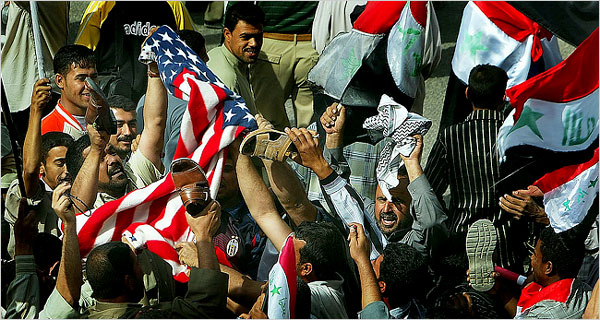
BAGHDAD, April 9 — Tens of thousands of protesters loyal to Moktada al-Sadr,
the Shiite cleric, took to the streets of the holy city of Najaf on Monday
in an extraordinarily disciplined rally to demand an end to the American
military presence in Iraq, burning American flags and chanting “Death to
America!”
Residents said that the angry, boisterous demonstration was the largest in
Najaf, the heart of Shiite religious power, since the American-led
invasion in 2003. It took place on the fourth anniversary of the fall of
Baghdad, and it was an obvious effort by Mr. Sadr to show the extent of
his influence here in Iraq, even though he did not appear at the rally.
Mr. Sadr went underground after the American military began a new security
push in Baghdad on Feb. 14, and his whereabouts are unknown.
Mr. Sadr used the protest to try to reassert his image as a nationalist
rebel who appeals to both anti-American Shiites and Sunni Arabs. He
established that reputation in 2004, when he publicly supported Sunni
insurgents in Falluja who were battling United States marines, and quickly
gained popularity among Sunnis across Iraq and the region. But his
nationalist credentials have been tarnished in the last year, as Sunni
Arabs have accused Mr. Sadr’s militia, the Mahdi Army, of torturing and
killing Sunnis.
Iraqi policemen and soldiers lined the path taken by the protesters, and
there were no reports of violence during the day. The American military
handed security oversight of the city and province of Najaf to the Iraqi
government in December, and the calm atmosphere showed that the Iraqi
security forces could maintain control, keeping suicide bombers away from
an obvious target. In March, when millions of Shiite pilgrims flocked to
the holy cities of the south, Iraqi security forces in provinces adjoining
Najaf failed to stop bombers from killing scores of them.
Vehicles were not allowed near Monday’s march, and Baghdad had a daylong
ban on traffic to prevent outbreaks of violence.
During the protest in Najaf, Sadr followers draped themselves in Iraqi
flags and waved them to symbolize national unity, and a small number of
conservative Sunni Arabs took part in the march.
“We have 30 people who came,” said Ayad Abdul Wahab, an agriculture
professor in Basra and an official in the Iraqi Islamic Party, a leading
fundamentalist Sunni Arab group. “We support Moktada in this
demonstration, and we stress our rejection of foreign occupation.”
He and his friends together carried a 30-foot-long Iraqi flag.
In the four years of war, the only other person who has been able to call
for protests of this scale has been Grand Ayatollah Ali al-Sistani, Iraq’s
most powerful Shiite cleric, who, like Mr. Sadr, has a home in Najaf.
The protest was in some ways another challenge to the Shiite clerical
hierarchy, showing that in the new Iraq, a violent young upstart like Mr.
Sadr can command the masses right in the backyard of venerable clerics
like Ayatollah Sistani. Mr. Sadr has increasingly tapped into a powerful
desire among Shiites to stand up forcefully to both the American presence
and militant Sunnis, and to ignore calls for moderation from older
clerics.
Lt. Col. Christopher Garver, an American military spokesman in Baghdad,
said that American officers had helped officials in Najaf plan security
for the event, but that the Iraqis had taken the lead.
Colonel Garver and other American officials tried to put the best possible
light on the event, despite the fiery words. “We say that we’re here to
support democracy,” he said. “We say that free speech and freedom of
assembly are part of that. While we don’t necessarily agree with the
message, we agree with their right to say it.”
The protest unfolded as heavy fighting continued in parts of Diwaniya, a
southern city where American and Iraqi forces have been battling cells of
the Mahdi Army since Friday. Mr. Sadr issued a statement on Sunday calling
for the Mahdi militiamen and the Iraqi forces there to stop fighting each
other, but those words went unheeded. Gun battles broke out on Monday, and
an American officer said at a news conference that at least one American
soldier had been killed and one wounded in four days of clashes.
That fighting and the protest in Najaf, as well as Mr. Sadr’s mysterious
absence, raise questions about how much control he actually maintains over
his militia. Mr. Sadr is obviously still able to order huge numbers of
people into the streets, but there has been talk that branches of his
militia have split off and now operate independently. In Baghdad, some
Mahdi Army cells have refrained in the last two months from attacking
Americans and carrying out killings of Sunni Arabs, supposedly on orders
from Mr. Sadr, but bodies of Sunnis have begun reappearing in some
neighborhoods in recent weeks.
The protest in Najaf was made up mostly of young men, many of whom drove
down from the sprawling Sadr City section of Baghdad, some 100 miles
north, the previous night. They gathered Monday morning in the town of
Kufa, where Mr. Sadr has his main mosque, and walked a few miles to
Sadrain Square in Najaf. Protesters stomped on American flags and burned
them. “No, no America; leave, leave occupier,” they chanted. At Sadrain
Square, the protesters listened to a statement read over loudspeakers that
was attributed to Mr. Sadr.
“Oh Iraqi people, you are aware, as 48 months have passed, that we live in
a state of oppression, unjust repression and occupation,” the statement
read. “Forty-eight hard months — that make four years — in which we have
gotten nothing but more killing, destruction and degradation. Tens of
people are being killed every day. Tens are disabled every day.”
Mr. Sadr added: “America made efforts to stoke sectarian strife, and here
I would like to tell you, the sons of the two rivers, that you have proved
your ability to surpass difficulties and sacrifice yourselves, despite the
conspiracies of the evil powers against you.”
An Interior Ministry employee in a flowing tan robe, Haider Abdul Rahim
Mustafa, 23, said that he had come from Basra “to demand the withdrawal of
the occupier.”
“The occupier supported Saddam and helped him to become stronger, then
removed him because his cards were burned,” he said, using an Arabic
expression to note that Saddam Hussein was no longer useful to the United
States. “The fall of Saddam means nothing to us as long as the alternative
is the American occupation.”
Estimates of the crowd’s size varied wildly. A police commander in Najaf,
Brig. Gen. Abdul Karim al-Mayahi, said there were at least half a million
people. Colonel Garver said that military reports had estimates of 5,000
to 7,000. Residents and other Iraqi officials said there were tens of
thousands, and television images of the rally seemed to support their
estimates.
The colonel declined to give any information on the whereabouts of Mr.
Sadr, though American military officials said weeks ago that they believed
he is in Iran. Mr. Sadr’s aides declined to say where he is, but
previously they have said he remained in Iraq.
In Diwaniya, hospital officials said their wards were overwhelmed by
casualties. There was a shortage of food and oxygen, and ambulances were
being blocked from the scene of combat, said Dr. Hamid Jaati, the city’s
health director. The main hospital received 13 dead Iraqis and 41 injured
ones over the weekend, he added.
The fighting started Friday after the provincial council and governor
called for the Iraqi Army and American forces to take on the Sadr
militiamen. The governor and 28 of 40 council members belong to a powerful
Shiite party called the Supreme Council for the Islamic Revolution in
Iraq, which is the main rival to the Sadr organization. Sadr officials
have accused the party of using the military to carry out a political
grudge, but the governor, Khalil Jalil Hamza, denied that on Monday.
In Diyala Province, northeast of Baghdad, a suicide car bomb killed three
civilians and wounded four others on Sunday night, police officials said
Monday. Also in Diyala, a local politician was fatally shot on Monday in
Hibhib, and three bodies were found in Khalis.
Iraqi employees of The New York Times contributed reporting from Najaf and
Diwaniya.
" I say good bye to you "
The history of neocolonial WAR continues.........
(2) Updated: March 15, 2007 SKY NEWS - INTERVIEW WITH TONY BLAIR ON IRAQ 15.3.07
ADAM BOULTON: You saw the footage of the execution of Saddam Hussein, these were people, senior people who had access to that very serious moment and there were sectarian taunts going on.
TONY BLAIR: And these are completely unacceptable and I would simply say that .
ADAM BOULTON: But surely it gives an indication of how far reaching this division has now become.
TONY BLAIR: Surely a better indication that when they were asked to come out and vote for a non sectarian unity government in which you had Sunni, Shia and Kurd, that's what they voted for.
(1) Updated: March 15, 2007 Iraq war was clearly illegal.'It Has Been A Tragedy'
Former United Nations weapons inspector Hans Blix was a central figure in the build-up to the invasion of Iraq in March 2003.
***************************************************************
" I say good bye to you "
A revolutionary tribute to late Iraqi president and leader Mr.Sadam Hussein
 Burry US
neo-colonialism, Free Iraq!!
Burry US
neo-colonialism, Free Iraq!!
Late Iraqi President Sadam Hussein murder, expose the character of US made Iraqi state : Fascism!
US made this 'Puppet warlord�s fascist state' to grab Iraq and its wealth, against the wish of Iraqi people!
And also use this 'changed regime�, and 'built nation' to advance its neo-colonial agenda to grab more nations!
Against this, Sadam built a giant wall, now Sadam fall but not the WALL ! Iraqi people will strengthen the wall ,
will reach their goal : Burry US neo-colonialism, Free Iraq!!
Workers of all countries oppressed nations Unite!!! - ENB
--------------------------------------------------------------------------------------------------------------------------
 As long as the
SAND AND SUN REMAIN,
As long as the
SAND AND SUN REMAIN,
As long as the OIL AND SOIL REMAIN,
Your name will remain, Arab land's every vein,
And it will make Imperialist ambitions a vain.
History will judge you as a great Arab leader who defeat the neocolonial ambitions of US imperialism!
You gave the right tactics to Iraq people for a complete victory over US imperialism
all along your days behind the iron curtain of US and its puppets!!
Iron Ruler 


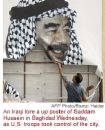
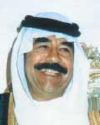
Liberator 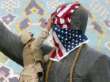
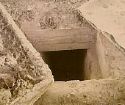
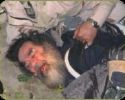
Humiliation
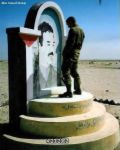
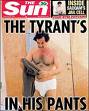

Leader
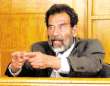
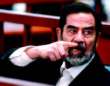
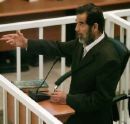
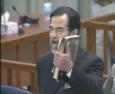
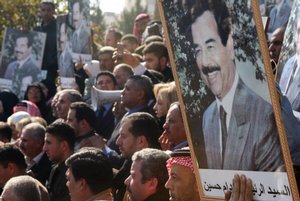
The
Martyr
--------------------------------------------------------------------------------------------------------------------------
Late leader's final time and thoughts:
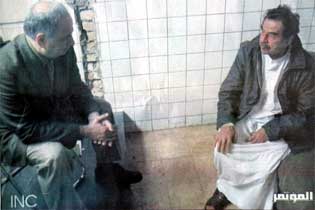
In Solitary Confinement:
* When he was allowed short visits outside, Saddam would feed the birds crusts of bread saved from his meals.
He also watered a dusty plot of weeds.
"That was my job: to keep him alive and healthy, so they could kill him at a later date," Sgt Ellis -The Nurse who
looked after Sadam in his US prison cell- said.
"He said he was a farmer when he was young and he never forgot where he came from," Sgt Ellis said.
* "He said everything he did was for Iraq," Sgt Ellis said.
After the US verdict for murder:
* "Direct your enmity towards the invaders, Don't let them divide you
Long live Iraqi people! Down with invaders!!"
* �I call on you not to hate, because hate does not leave space for a person to be fair and it makes you
blind and closes all doors of thinking.�
* �I say goodbye to you, but I will be with the merciful God who helps those who take refuge in him and who will never
disappoint any honest believer,� the letter said.
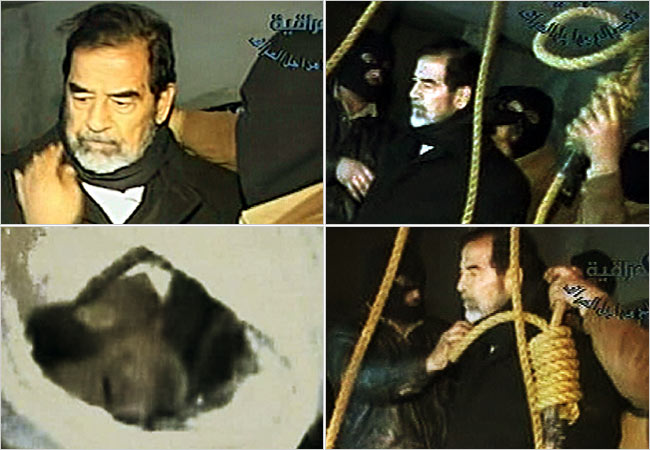
In the gallows:
* Saddam is scornful: �I have saved you from destitution and misery and destroyed your enemies, the Persians and
Americans.�
* �Down with the traitors, the Americans, the spies and the Persians.�
* �Long live the nation!� Mr. Hussein shouted. �Long live the people! Long live the Palestinians!"Palestine is Arab."!
* �I am a militant and I have no fear for myself. I have spent my life in jihad and fighting aggression. Anyone who
takes this route should not be afraid.�
* �There is no God but God, and Muhammad...�
<< Saddam made it to midway through his second recitation of the verse. His last word was Muhammad.
The floor dropped out of the gallows.
"The tyrant has fallen," someone in the group of onlookers shouted. The video showed a close-up of Saddam's face as he swung from the rope.
Then came another voice: "Let him swing for three minutes." >>
(By STEVEN R. HURST, Associated Press Writer)
Let him swing !
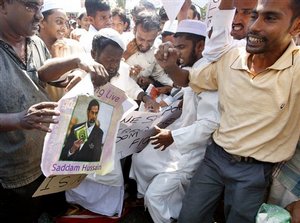
"We won't abandon two things, Iraq and Saddam Hussein!" shouted the protesters at the Professional Associations. "We sacrifice our blood and souls for you, Saddam," they chanted .
By SHAFIKA MATTAR ASSOCIATED PRESS AMMAN, Jordan (AP) -
Home Town Sri Lanka Jordan
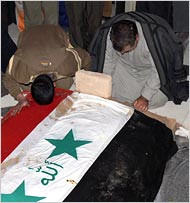
The history of neocolonial WAR continues..........
Iraq war was clearly illegal.'It Has Been A Tragedy'
Updated: 21:54, Sunday March 11, 2007
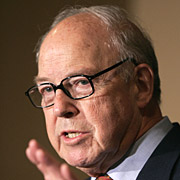
Former United Nations weapons inspector Hans Blix was a central figure in the build-up to the invasion of Iraq in March 2003.
He warned Britain and the US against military action - and now tells Sky's Anna Botting that the invasion has been a tragedy and that he fears the current American policy will not succeed.
This is the full transcript of the interview:
ANNA BOTTING: When you told Tony Blair that you hadn't found anything, did he look at you sceptically, quizically?
HANS BLIX: Well, he was always a charming person....
BOTTING: Do you think he acted in good faith?
BLIX: I would never dare to accuse any statesman of bad faith unless I had absolute evidence of it. I do think they exercised spin. They put exclamation marks instead of question marks. There were question marks but they changed them to exclamation marks. And I think they got the political punishement for that. They lost a lot of confidence. Both Bush and Blair lost a lot of confidence.
BOTTING: Should they be censured for what happened in Iraq?
BLIX: Aren't they already? I'm less interesed in punishment than getting the world better.
BOTTING: Was the war illegal?
BLIX: Yes it was. It was clearly illegal. Condoleezza Rice tried some acrobatic number, saying that they were actually upholding the authority of the Security Council. Upholding the authority of the Council when they knew that the majority of the Council were against it? As a lawyer I certainly don't buy that argument.
BOTTING: Could the war have been stopped through diplomacy? Fears over Iran's intentions
BLIX: I think if they'd allowed us to carry on the inspections a couple of months more (which was the European position) then we would have been able to go to all the sites suspected of by intelligence - British, American or other. And since there weren't any weapons we'd have come with that answer: there are no weapons at all the sites that you have given us. And I think then the intelligence would themselves have said 'our sources are evidently poor'. They had other sources - they had the defectors, satellite. But they had defectors above all. And the defectors didn't want inspection. They wanted invasion. And the US after all were witch-hunters. They wanted to see anything as evidence that the Iraqis had weapons of mass destruction. We were simply looking for the truth. We didn't assume that they had them. We didn't assume that they did not have them.
BOTTING: Do you sense the same happening now with Iran? BLIX: There are similarities which are strong. But also dissimilarities. We see the pressure being increased on Iran. They go to the Security Council, they have some economic sanctions. Clearly at the time of the 'if' and 'when' they ask for military sanctions, clearly the Russians and the Chinese would say no. I would hope that the majority of the Council would also be against it. Then maybe the Americans would say, as usual, the Council is impotent and someone who's more responsible in this world will have to do something about it and go in. I wouldn't be surprised if people in Washington who reason that way. But the atmosphere in Washington has changed a good deal. The American people are tired of military adventures. Anna Botting
BOTTING: Do you think, therefore, that it's better that Iran has nuclear weapons than that there's another war? Where do you draw the line?
BLIX: That's fairly far down the line...
BOTTING: But it's a line that we may face in five or six years time.
BLIX: Well, why bomb now if you have that in five or six years time...
BOTTING: In order to stop them getting the capability...
BLIX: But they have now succeeded in enriching perhaps a gram of uranium. They have a long way to go to industrial grade production.
BOTTING: If you have only two options: One is that Iran has nuclear weapons and the other is a war, which would you choose?
BLIX: We are not there yet. I am not going to choose today. I am saying drop your demand for preconditions. That's what prevents you from sitting down with the Iranians. The Iranians say 'we are ready to sit down, we are ready to discuss the question of enrichment'. So why not take them up on that? I think it's a silly diplomatic dance about a tactical advantage and they should find a diplomatic way out of that.
BOTTING: When you see the pictures of the latest bloodshed do you watch in horror?
BLIX: I think everything in Iraq after the invasion has been a tragedy. The only positive thing I think is the disappearance of Saddam Hussein.
BOTTING: Are you optimistic about Iraq's future?
BLIX: In the short term, no. There are lots of intelligent people and well educated people. I met some of them who were my opposite numbers. You must empower them. They must feel that they have the future in their hands. Whether they will succeed, I don't know. But I don't see that the US can succeed.
 ADAM BOULTON
SKY NEWS - INTERVIEW WITH TONY BLAIR ON IRAQ 15.3.07
ADAM BOULTON: Prime Minister,
a lot of voices there from inside Iraq, one of them was Cindy Sheehan who of course lost a son, American soldier, she said that George Bush always said it was a noble cause, she wants to know exactly what that noble cause was. Would you describe the Iraq conflict as a noble cause?
TONY BLAIR: Well I can't think of a better cause than helping people who want to be democratic and free to be democratic and free and the British soldiers and the American soldiers have done extraordinary work in Iraq, they have made very great sacrifices. It is a tragedy that so many have lost their lives but they have not lost their lives because we have been trying to do the wrong thing in Iraq, we have been trying to do the right thing. We have been trying, after the fall of Saddam, to allow that country to stand on its feet, to be governed by its people, to be governed by the same basic democratic principles that we're governed by.
ADAM BOULTON: The problem is you haven't achieved that have you? I mean more than 200 deaths this week which has been a relatively modest week so far. You have go civil war according to a latest document from the Pentagon in some areas and most people say that ordinary lives are worse than they were under Saddam.
TONY BLAIR: Well I think that would be disputed by a lot of people in Iraq. However, you are absolutely right, it has been extremely tough, very challenging, it is a very difficult situation but my point is, why is it difficult? And it is difficult because there are people deliberately trying to give us a problem, trying to stop Iraq achieving stability, trying to plunge it into chaos, trying to provoke civil war, trying to terrorism and sectarian murder to go against what the majority of people in Iraq want, because they voted very clearly for a non sectarian unified government and they came out in their millions.
ADAM BOULTON: So in spite of the civilian deaths which I think have been the majority, all the other deaths, all the other injuries, the destruction of infrastructure, I mean the hospital for example in Baghdad used to be a world class hospital, you would still say on balance it was worth it?
TONY BLAIR: Well I think it was the right thing to get rid of Saddam and I think it is the right thing now to stand alongside the majority of Iraqis who want their country to be governed properly in fighting terrorists .
ADAM BOULTON: The majority also say that the British troops should get out now, in opinion polls.
TONY BLAIR: Well, look, the majority of people in Iraq have got a government they have elected and we go, if the government asks us to go. I think what you will find with Iraqis is that most of them want to know that at some point they take full charge of their country but I think they would also know for example in Baghdad, if there weren't American troops alongside Iraqi troops the job couldn't be done. But in Basra for example we will be drawing back.
ADAM BOULTON: Okay, let's start talking about the British casualties, more than a hundred people have died there, one who died there recently was Luke Simpson in a roadside bomb. Now his father, Major Nigel Simpson, has said that two people are responsible for Luke's death, the bomber and Tony Blair for failing to protect him, Luke would probably be alive today if he hadn't been in a snatch Landrover, inappropriate for Iraq. Do you accept that the troops have been exposed unnecessarily?
TONY BLAIR: As I always say when people ask me about this, we take the advice of our commanders on the ground as to the equipment they need and what they should have and insofar as it is possible to do so, we provide them with that equipment.
ADAM BOULTON: But in that case there was a promise of some Mastiff heavily armoured vehicles, a hundred promised by the MoD last year. Do you know how many are now there? TONY BLAIR: I don't know how many are now there but I know that the Mastiff vehicles, and I think there is another vehicle as well which they're wanting, and there are requests not just in respect of Iraq but in respect of Afghanistan, we meet these requests as fast as we can but .
ADAM BOULTON: But in the meantime troops go out there and they maybe get killed and they wouldn't get killed if they were American.
TONY BLAIR: There is a continual debate as to the right vehicles and protection and I'm not the expert on this. What we have to do of course is to say that there is going to be no resource barrier for getting the best for our forces and that's what we try and do but sometimes when you look into these issues you find it is not quite as it is reported and in particular . I'm sorry, let me finish, in particular in relation to these vehicles, there was a whole debate about what was the right type of vehicle to have. We simply sit and say, whatever people want insofar as it is possible for us to acquire those vehicles and get them there, we will do that.
ADAM BOULTON: Another person, a brave father who you know, Reg Keys, he stood against you in Sedgefield, he said "I hope in my heart that one day the Prime Minister will be able to say sorry to the families bereaved." Are you ready to say that?
TONY BLAIR: I have on every occasion expressed my sadness and sorrow for the families who are bereaved and some of these are very young men, the same age as my oldest boys and younger so I understand for these families it is a time of immense grief and anguish but I can't say what I don't believe and I don't believe it was the wrong thing to get rid of Saddam, I think we'd have a whole series of problems were he still in power today and I also don't believe that the reason that we have the problem we have in Iraq that we have today and are facing the challenge we're facing, is because of anything other than a deliberate attempt to give us that problem by terrorists.
ADAM BOULTON: But there is this issue of you coming to office and saying that we might be a lucky generation that might never have to send people into war, yet you've sent them into war a number of times and some of your generals looking back on that, I'm thinking of people like Michael Jackson and Charles Guthrie, have said that obviously when sending people into war was discussed, you asked what the likely consequence was going to be in casualties and Mike Jackson calls it the Butchersville, as he puts it, but he then said you didn't finch in making the decision when you thought it was right. Why was that?
TONY BLAIR: Well I think if you think it is the right thing to do, then you have got to do it.
ADAM BOULTON: Even though it is going to mean people's lives?
TONY BLAIR: There is no way of fighting war that is bloodless and if you take the .
ADAM BOULTON: You can stop the war. Say don't fight the war.
TONY BLAIR: Yes, but that's what we did in Bosnia in the early 1990s and over 100,000 people died and in the end we had to go and do it, later in Kosovo and people forget .
ADAM BOULTON: The Iraq war and, I don't know, 500,000 died.
TONY BLAIR: Actually if you look at what has happened in the time before Saddam was removed from power, there were a million casualties in the Iran-Iraq War, there was the invasion of Kuwait, hundreds of thousands of people that died in Iraq and the mass graves that have been uncovered, the Marsh Arabs that have been driven from their land .
ADAM BOULTON: So it is a bargain?
TONY BLAIR: Well in the end the important thing is to do what you think is right and I believed after September 11th that the whole security situation in the world had changed and that we had to be prepared to intervene if necessary and I think if we had not intervened in Afghanistan and in Iraq we would just face a completely different set of problems and my own view, and I know this is not a majority view in Western opinion, it isn't and I've got to accept that.
ADAM BOULTON: Or even British opinion now.
TONY BLAIR: Well that's probably true but I believe that this threat is a global threat, it's real, its roots are deep and if we don't go out and fight it and defeat it, we are absolutely kidding ourselves if we think we are going to be protected from it.
ADAM BOULTON: I remember talking to you at the time of the last election and you said you couldn't possibly say how many people you think have died in Iraq. Do you have an idea now?
TONY BLAIR: No, because you . there are all sorts of different figures that are put about and there are groups like the Iraq Body Count that put it into tens of thousands and then there are other, I think frankly exaggerated claims.
ADAM BOULTON: But we know hundreds are still dying each week and they are mainly Iraqi civilians.
TONY BLAIR: But they are dying . we're not killing them. You see this is where we have got to get ourselves in a different frame of mind in the West. What you are putting to me is exactly the way this argument runs through most of the Western media which is there are these people who are dying in Iraq, it is terrible that they are dying and therefore you shouldn't be there and what I say to that is, hold on a moment, who's killing these people? We're not killing them, it's not British soldiers who are killing the innocent in Iraq or American soldiers, what is actually happening is that we are trying to .
ADAM BOULTON: But it is a situation that you created though, that's the problem.
TONY BLAIR: Yes, but the . we haven't created a situation where terrorists are killing innocent people. Terrorists create that situation.
ADAM BOULTON: But you created it where you deposed the dictator, you destroyed the infrastructure, you disbanded the police, you disbanded the army and civil war and terrorism came in.
TONY BLAIR: Let's just take each of those things. We did depose the dictator, that is absolutely true. We didn't destroy the infrastructure. In respect of the police, the police had to be disbanded, the police were an arm of Saddam's oppression and the army virtually melted away so you have got to be incredibly careful when this conventional wisdom that somehow there was no planning for what happened afterwards, the reason we have a problem in Iraq is that people are deliberately, external extremists are linking up with the minority .
ADAM BOULTON: External extremists?
TONY BLAIR: Yes, Al Qaida are doing suicide bombings, the Iranian elements who are linked, for example down in Basra if you took the Iranian backed elements out of the situation you would have a completely different .
ADAM BOULTON: But what about the Sunni and Shia, they are mainly Iraqis aren't they?
TONY BLAIR: Yes, but there are a minority on either side. Actually one of the things .
ADAM BOULTON: But there are a million people displaced now in Iraq because of sectarian violence, they are not outsiders.
TONY BLAIR: No, no, I am not saying that those people who are displaced are . they are not the extremists though.
ADAM BOULTON: But they have been thrown out by what's been going on. We are talking about have you made things better for ordinary Iraqis.
TONY BLAIR: But my point is very simple. The reason why they face that difficulty is not because of us, it is because of the small number of extremists who are prepared to use suicide bombs, for example the bombing of the Samara Shrine which really was designed to provoke Shia retaliation against Sunni. You have got small numbers of people on both sides.
ADAM BOULTON: But this has been created by an optional war. You had the choice, you and George Bush could have decided not to do it. It wasn't as if the Iraqis were going to invade tomorrow was it.
TONY BLAIR: If you had left the situation as it was you would have had Saddam in power and many people dying as a result of the oppression of Saddam. My point is this, the Iraqi people should not be faced with a choice between either a brutal dictator, namely Saddam, or a gang of extremists and fanatics who are bound together by a perverted doctrine of the Islamic religion. Why can't they have the same choice as everybody else when it is obvious they want to make that choice? When they got the chance to come out and vote in the election .
ADAM BOULTON: Well it is certainly isn't the same choice as most people in the Arab world is it?
TONY BLAIR: Do you know, I have absolutely no doubt at all that if people in the Arab world were given a chance to elect their government they would have proper democratic government.
ADAM BOULTON: But they don't have that choice. You were saying why can't they have the same choice as everybody else, I am saying generally it is not the rule in that part of the country.
TONY BLAIR: No, but it's interesting, isn't it, that wherever they are given a chance, for example Lebanon, to elect a government, they elect the government. What you have got all round that region in the Middle East is elements of extremism trying to prevent that region and the people in that region getting to progress and .
ADAM BOULTON: When you and George Bush spoke about going to war what did you say to each other? What was the reason for going to war
TONY BLAIR: The reason was the threat that Saddam posed and the failure to comply with the UN resolutions on WMD and so on and we have gone back through that many, many times but I have got no doubt at all that Saddam was a threat to the world.
ADAM BOULTON: Is that linked to the wider threat of Islamic fundamentalism or not?
TONY BLAIR: I don't think that . I mean we have certainly never argued that Saddam was linked with Al Qaida although it is true actually that the Al Qaida group was in Iraq prior to Saddam's fall, but we've never made that case, no. However the reason .
ADAM BOULTON: I mean Bush emphatically denied it, he said that there wasn't a connection between Iraq and the people who attacked on 9/11.
TONY BLAIR: And we have not made that case either. However now in Iraq there is absolutely no doubt that the people trying to prevent Iraq, after the fall of Saddam, becoming a democracy represent precisely the same global threat and ideology that we're facing everywhere. My point, and if I can just finish this point because this is the crux of the argument, until we understand that we are going to have to stand up and fight these people and defeat them, we will always be in the situation where when they do something terrible and the carnage is spread across our television screens, we say, well we shouldn't be there. No, this is completely . we should reverse our thinking, get it completely round the other way. We should be there to fight those people when what they are trying to do is destroy by terrorism the chance of people to get democracy.
ADAM BOULTON: Not if it is making things worse, some may say, but .
TONY BLAIR: We're not making it worse, they are making it worse and therefore - and this is the crucial point, Adam, because until the Western world stops apologising for its values, stops apologising for the work that its troops are doing in places like Iraq and Afghanistan, we are never going to defeat this. We'll end up with a situation where the worse these people are, that becomes a reason for our retreat rather than our determination to see the job done.
ADAM BOULTON: I don't remember if you know if you remember but back in 2003 in the summer I did an interview with in St Petersburg at the celebrations at St Petersburg just after we had gone to war and you told me then that weapons of mass destruction were, and I quote, "were the basis in law for taking military action." Given that there weren't weapons of mass destruction, doesn't that mean that the war was illegal?
TONY BLAIR: No, it doesn't mean that because the basis of the case was the UN resolution and whether it had been complied with or not and incidentally, just to repeat this, everybody at the time was convinced that there were WMD so history can get somewhat rewritten but .
ADAM BOULTON: I would have thought you would have taken longer to check. I mean people like Hans Blix or President Chirac or whoever.
TONY BLAIR: Yes, and I know you did the interview with Hans Blix but I had many conversations with Hans Blix at the time .
ADAM BOULTON: He said you used spin, you acted in bad faith, you were guilty of witchcraft.
TONY BLAIR: Those weren't quite the conversations we were having at the time.
ADAM BOULTON: He didn't back you going to war at the time you went to war did he?
TONY BLAIR: No, he didn't back us but neither did he say that Saddam was complying with the UN resolutions.
ADAM BOULTON: Isn't the truth of it really that we know from the axis of evil speech that George Bush was going to do it anyway and you basically had to make the choice, are you going to be with the Americans or not?
TONY BLAIR: No, because when we went back through the United Nations and we got the resolution in November 2002 it was clear at that time that if Saddam complied fully, then we couldn't have begun the conflict but he didn't and he never had any intention of doing.
ADAM BOULTON: There is a lot of evidence on this, I mean Richard Dearlove, this is writing in 2002 "Military action is seen as inevitable, the intelligence and facts have been fixed around the policy." That's a quote from Richard Dearlove.
TONY BLAIR: Yes, but again with all of these things, they get completely taken out of context. I mean actually what was being said was, look the chances of Saddam.
ADAM BOULTON: Or David [inaudible] memo which again seemed to say, are the Americans going to do this, where are we going to be?
TONY BLAIR: Listen, I was part of all those discussions and most intimately involved in them. The thing is, if he complied with the UN resolutions there wouldn't have been a conflict but he didn't and actually with the greatest respect to Hans Blix, what he forgets now is that at the time he was the person standing up in front of the UN and saying, actually he hasn't complied.
ADAM BOULTON: Why did you trust George Bush? It has become clear, again John Prescott said he doesn't think a great deal of him and others of your cabinet ministers have been equally uncomplimentary. What did you see in Bush that others didn't see?
TONY BLAIR: Well I saw after September 11th, an American president who had to decide whether the whole security picture had changed and whether his country faced a fundamental threat that he had to go out and confront and George Bush took that decision. You know, I'm not, I've long since ceased in all this to be in a position where i am going to pander to anyone's opinion on it. I mean I do not either regret the strength of our alliance with the United States or standing by the US President and the American people in the aftermath of September 11th and I'm never going to do that.
ADAM BOULTON: It was a problem that neither you nor her actually knew what was going on in terms of military command, in terms of operations in Iraq because in fact it was Donald Rumsfeld and Dick Cheney who were taking the decisions.
TONY BLAIR: Again, you see, you get all these theories about was there this aspect of planning or that aspect of planning .
ADAM BOULTON: But it has been established in report after report in America that the policy was driven from the Pentagon hasn't it?
TONY BLAIR: The Pentagon is the arm of the American government, it is the defence department, the same as our MoD, who are tasked with implementing the policies. The policy was not set by the Pentagon, the policy was set by the President and I don't shelter behind the MoD in respect of our policy.
ADAM BOULTON: On that basis of course George Bush would have resigned as well because Rumsfeld's gone hasn't he?
TONY BLAIR: Actually it is for the President to decide who is the Secretary of State for Defence, but the basic point, which is why all of this very circular issue about the Pentagon and so on, the basic point is that it comes back to what I was saying to you earlier. The reason we had the difficulty is not because someone made a planning mistake in the ..
ADAM BOULTON: But a lot of people say, and again Sir Jeremy Greenstock who is your advisor, talking about the immediate aftermath, says "no one was instructed to put the security of Iraq first, to put law and order on the streets first, there was a vacuum from the beginning." We have got Mike Jackson saying exactly the same thing, that we lost the first hundred days and therefore that's when the anarchy came in and that was an absence of forethought wasn't it?
TONY BLAIR: No because first of all those first hundred days or first few months, of course it was immensely difficult for all sorts of reasons. The police, as I say, had to be disbanded and .
ADAM BOULTON: But you knew you were going to win a war militarily didn't you? So why didn't you, I mean Jay Garner says it was wrong to go for a de-baathification policy, he was working for Bush at the time.
TONY BLAIR: Look, all of these debates we had at the time and you could argue about the handling of the army, the de-baathification point and all the rest of it. My view, others have expressed their view and I will express mine, is that irrespective of any of that, once you had a concerted attempt inside the country supported by elements outside the country, to cause mayhem through suicide bombing and terrorism then .
ADAM BOULTON: You didn't have suicide bombing four years ago, just after the war begun, did you?
TONY BLAIR: You did, I'm afraid, or terrorists .
ADAM BOULTON: In Iraq?
TONY BLAIR: Yes, the first . look, one of the most pivotal moments was when the United Nations building was bombed and the United Nations staff was killed and a special representative of the United Nations was killed. Now that happened I think in August 2003, so that was very shortly after .
ADAM BOULTON: After the first hundred days after the fall.
TONY BLAIR: Yes, but a very short period of time afterwards, and the fact is that at that point the international community had to decide, are we going to stand up to these people and take them on or are we going to use the fact that they are prepared to use these methods, actually killed United Nations people coming there to support the country, do we use that as an excuse to withdraw?
ADAM BOULTON: Can you see the extent to which, and again people have said to us repeatedly throughout this war that before it was never like this, Sunni house, Shia house, we lived together, there was no difference between Sunni and Shia. Did you foresee that the destruction of the Saddam regime could lead to this sectarian violence?
TONY BLAIR: No, as I said on many occasions I don't think anybody foresaw the degree to which as a result of this attempt to provoke a conflagration that you would end up with a situation where there was this degree of violence. No, I think that is true but .
ADAM BOULTON: But you were being told about it, weren't you? For example we have got November 2002, here in Downing Street you had six of the UK's leading experts on Iraq, they say they came here, they warned you of the consequences of invasion, of Shia/Sunni violence and they say of your approach that you were dismissive, it seemed as if you were just going through the motions and that you had already made up your mind. Do you remember that meeting?
TONY BLAIR: I remember the meeting, I'm afraid I don't remember that characterisation of it at all and let me just say, on the Sunni/Shia violence, again this comes back to this issue, is Iraq a country at civil war and it's not a country at civil war. The majority of people in this country don't want this violence .
ADAM BOULTON: So the latest Pentagon document is wrong, the latest Pentagon document.
TONY BLAIR: I don't think they are saying that either in actual fact but if you look at the facts of what is happening in Iraq today, and I think our programmes have brought this out, the Sunni people don't want this violence with the Shia, the Shia people don't want this violence with the Sunni. The warning that was given to me back in November 2002, or the discussion actually about it, was predicated on the basis that the Sunni and Shia would want to go to war with each other. They don't want to go to war with each other. What is happening is that small numbers on either side of extremists - no, hang on a minute - who don't represent the majority, are trying to provoke people into a civil war. That is a completely different thing.
ADAM BOULTON: You saw the footage of the execution of Saddam Hussein, these were people, senior people who had access to that very serious moment and there were sectarian taunts going on.
TONY BLAIR: And these are completely unacceptable and I would simply say that .
ADAM BOULTON: But surely it gives an indication of how far reaching this division has now become.
TONY BLAIR: Surely a better indication that when they were asked to come out and vote for a non sectarian unity government in which you had Sunni, Shia and Kurd, that's what they voted for.
ADAM BOULTON: You know that the government of Mr Amaliki is often seen as Shia faction effectively.
TONY BLAIR: Look, they all come from their different respective parts of Iraq but actually when Prime Minister Amaliki went into the Anbar Province the other day, which is a highly Sunni province, that was precisely to indicate that people wanted reconciliation.
ADAM BOULTON: I haven't been to Iraq that much but I have been there generally when you've been there and I have to say it gets worse rather than better doesn't it? The level of security that is required in the green zone is higher, the difficulty of moving around gets greater and frankly, when you listen to what Prime Minister Amaliki has got to say, it doesn't sound like the model of Western democracy that you've been talking about.
TONY BLAIR: Well I don't think there is a, I have never accepted this concept that there are different models of democracy and .
ADAM BOULTON: And you think he's a democrat?
TONY BLAIR: I do believe he is a democrat, he was elected, right, and he was then chosen as the President ..
ADAM BOULTON: So was Robert Mugabe. T
ONY BLAIR: Well the elections in Zimbabwe have not been fair, the elections in Iraq were fair.
ADAM BOULTON: . just being elected doesn't make you a democrat does it?
TONY BLAIR: Er, well I think it is quite a good indication but anyway, look, if you take what's happened in Baghdad with the Baghdad security plan over these last few weeks, I think it is far too early to say but for example the last report that I got in from Baghdad today, and I think this chimes in with some of what's been in your programme, shows two things. It shows some, it is far too early to say but it does show some significant improvement but the real point it shows is this, that the Sunnis and Shia in Baghdad want to live with each other, they want to be in peace, that is why this situation has got to be analysed correctly. They are not wanting to have war with each other, they are wanting to live in peace.
ADAM BOULTON: One of the things the troops have said to us repeatedly is that they just want to know how long they are going to be in Iraq. How long are they going to be in Iraq?
TONY BLAIR: Well for our troops it depends on continuing to make progress on the security situation down south and for the Iraqis to be able to handle the security in Basra. We'll be drawing down as you know over the next few months and the rest of that depends on when the Iraqis are strong enough to .
ADAM BOULTON: Do you think they are going to be there in five years time?
TONY BLAIR: There is no point in getting me to put time limits on it because I don't think that is sensible.
ADAM BOULTON: And could they be deployed across the border into Iran.
TONY BLAIR: Nobody is talking about military action against Iran .
ADAM BOULTON: They are, a lot of people are talking about military action against Iran.
TONY BLAIR: Well nobody who has .
ADAM BOULTON: Well Seymour Hirsch has tended to be more right than wrong on this conflict and he certainly says that .
TONY BLAIR: He's a journalist, he is not .
ADAM BOULTON: He says plans are being drawn up and a list of targets. Also a deputy director in the State Department says an array of targets has been drawn up by the Americans.
TONY BLAIR: Yes, and I think it was following that report that the President himself said that no one was planning to invade Iran.
ADAM BOULTON: Do you accept now that there is a link, or there was a link, between what you have done in Iraq and the terrorism that has come to threaten us at home?
TONY BLAIR: Well again I read regularly that I am supposed to have said that what happens in Iraq has got absolutely nothing to do with any radicalisation of people back here. I have never said that.
ADAM BOULTON: You accept that?
TONY BLAIR: I have always said the same which is of course these people will use Iraq or Afghanistan, indeed before Iraq and Afghanistan because remember September 11th happened before either of those .
ADAM BOULTON: Khaled Sheikh Mohammed said in his evidence, here he is precisely talking about if America wants to invade Iraq they will not send to Saddam roses and kisses, they send for a bombardment, I consider myself a religious as well as a fundamentalist and doing the same thing as George Washington. I mean that's how they think isn't it?
TONY BLAIR: That's how those people think, absolutely right and so what's our response to them? To say okay, well if you think like that we'd better not do it. I mean they will use any of these issues, they used Palestine, they used Kashmir, they used Chechnya, the question is are they justified? Wait a minute, just think about the absolutely warped logic of these people, we get rid of the Taliban in Afghanistan and Saddam in Iraq, who brutally suppressed their people, we then put in a United Nations led process to allow the people a democracy so that the country can prosper. No, hang on, and these people say that is a reason for them blowing innocent people up in London. Now I don't doubt that's what they say, my point is that should we be accepted the twisted and ridiculous logic?
ADAM BOULTON: You see the problem is that you said to me right at the beginning of this interview that we should be proud of what the troops are doing, that we should be prepared to intervene around the world, this has been entirely consistent in your premiership, you have sent troops in a lot, you have made a speech in Chicago outlining this idea, but the irony of all that is that the legacy you hand on is that this war is so controversial for us here in Britain that it is probably going to be more difficult for Gordon Brown or anyone else to commit forces even when they need to be committed. You only have to look at what happened in the House of Commons yesterday on Trident to see how the mood is running.
TONY BLAIR: In the end it is for any Prime Minister to make these decisions but my view is that .
ADAM BOULTON: But we'll be less safe if we can't defend ourselves because we've been put off by what you've done.
TONY BLAIR: Well I don't think that would be the case, I think people would judge each of these issues on their merits but, look, I've never hidden the fact that I take a view about this which is in the early 21st century, the world is inter-dependent, that we should be prepared to intervene in order to prevent our security being threatened in the future. That's what I think about global terrorism, I think there is a link world-wide, I think we are kidding ourselves, as I say, if we think we can shut ourselves away from it and I would today take a far tougher line on Sudan, I agree.
ADAM BOULTON: Send troops in?
TONY BLAIR: I don't think we are able to send troops in but I certainly think the international community should be and I think it should be saying to the Bashir government in Sudan, if you are not prepared to comply with what the United Nations are saying, we are going to get progressively harder with you. Now let me just say why I say that, because I believe if Sudan descends much further into the chaos that is already there, it will spread across that part of Africa, you will get new radicalisation going on because this extremism is now preying on all of these conflict and my view is that at some point the world has got to wake up and understand we are in a fundamental conflict with these people and we are going to win when we stand up to them and if we carry on apologising for ourselves, leaving them the excuse that it's because of George Bush that they are doing these terrible things, or ridiculous nonsense like that, the more we give in to their propaganda and ideas, the less chance we have of protecting our security. Now that's my view and I know it's not a universal view across Western opinion but it's what I believe.
ADAM BOULTON: Two final questions. First is in terms of defence expenditure, you made it very clear you believe there is a lot for the military to do and you backed Trident yesterday which is very expensive yet we know that America spends more than the top ten put together.
TONY BLAIR: Well we're not going to reach those ..
ADAM BOULTON: But do we need to spend more, I mean qualitatively?
TONY BLAIR: I think that, I mean for the first time in several decades, in the last ten years we have kept spending on defence stable as a proportion of our national income and I think we need to carry on at least making that investment if we are going to be able to do the things that we want to do as a country and that our [inaudible] want to do.
ADAM BOULTON: [Question inaudible - over talking]
TONY BLAIR: Well it depends, I'm not going to write the next spending review but in the end there is another question for us as a country as well which is I think there is a feeling that many people in the country, and I understand this feeling, look, why don't we get out of all this stuff, what are we doing in Iraq and Afghanistan anyway, it's nothing to do with us, let's leave all that behind. If we face a threat the Americans will come and sort it out, and there is quite a lot of that in Europe, I mean that view in Europe. I personally don't think it is very sensible, I think we should stay in the first division of countries who are prepared to intervene, I think we are incredibly lucky in having troops who are actually prepared to go and do combat as well as peacekeeping and incidentally, I think one of the things that people often don't understand is that actually our troops, I find whenever I visit them I find they have tremendous morale and are absolutely up for what they are doing.
ADAM BOULTON: And finally, a lot of talk about your legacy, a lot of people like me writing about what it's going to be and all that but just on Iraq, how do you think you are going to be judged both here, and because you are religious man, in the hereafter?
TONY BLAIR: Ah, it depends what happens in the future with Iraq and with the global threat that we face. But I don't, and never have had, any doubt that we are better off with Saddam out of power, that to try and support what I genuinely believe is the wish of the majority of Iraqis to have a democracy is a good cause and I believe in the end that the spirit of the majority of Iraqis will prevail, that's what I believe but, you know, I have long since given up predicting my own legacy, you guys have .
ADAM BOULTON: A clear conscience?
TONY BLAIR: Well in respect of that decision, yes. In respect of the weight of responsibility particularly because I know there are many people that have suffered, that weight of responsibility stays with me and so it should.
ADAM BOULTON: Prime Minister, thank you very much indeed.
TONY BLAIR: Thank you.
END
Eelam News Bulletin- ENB! Eelam Web 1917!!
VOICE OF THE OPPRESSED PEOPLE AROUND THE GLOBE, FOR THEIR FREEDOM AND LIBERATION, SO DO THE REVOLUTION. Join FREE.
