
|
 |
|

Home Page
Cocktails
Groups of Things
Horoscopes
Phobias
Pictures
Zodiac (Chinese)

All About Rastas
Cannabis Timeline
Ganja in The USA
Rolling - Lego Story
The Good Drinking Guide
Wicked Recipes

Alcohol Guide
Drug Guide
Holiday Guide
Rolling Guide
Rolling Guide (Advanced)

Articles:
Drug Addiction
Drugs:
Alcohol
Cannabis
Ecstacy

Erowid
Drum&Bass Arena
Ravislayer
Stagg's Site

About Us
Contact Us
Sign Guestbook
View Guestbook

Skip to: Introduction | History | Analogues | Dosage | Effects | Combinations | Dangers | The Law | Guide | Myths | Sciency Bit
Introduction
|
 |
MDMA, or 'ecstasy' is a 'psychedelic amphetamine' that has gained popularity over the past 20 years because of its ability to produce strong feelings of comfort, empathy, and connection to others. It most frequently comes in tablet form, although it is occasionally sold in capsules or as powder. It is used orally and rarely snorted. MDMA use is closely tied to the underground rave (and dance club) scene throughout the world, but has also been widely used by therapists as an adjunct to psychotherapy. |
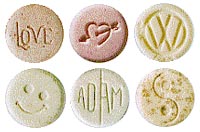
Pure MDMA is a white powder but street ecstasy is almost always pressed into pills, usually coloured and stamped with different 'brand logos' such as Mitsubishi, Rolls Royce, etc. Brands are meant to help users gauge what they are buying but quality brands are quickly imitated by inferior pills. The only way to known the quality for sure is to test it. Ecstasy pills are sometimes mixed with other active substances, most commonly amphetamines (speed), caffeine and ephedrine (a natural stimulant). Rarely, some pills have been found to contain DXM (dextromethorphan) - a dissociative psychedelic found in some cough medicine and PMA (paramethoxyamphetamine) - a highly toxic hallucinogenic stimulant. Other, more easily synthesised analogs of MDMA often replace MDMA as the main psychoactive component of pills.
Rumours that pills contains cocktails of heroin, cocaine or LSD are false - none of these have ever been found in extensive lab tests (heroin and cocaine are both more expensive to produce than ecstasy).

History
MDMA was first synthesized in 1912. It was patented in Germany by the Merck Company in 1914. At that time it was not the subject of human research. Merck stumbled across MDMA when they tried to synthesize Hydrastinine, a vasoconstrictive and styptic medicine. MDMA was an unplanned by-product of this synthesis. As usual, the process of its synthesis was patented.
In the 1950s it was briefly researched by the U.S. Government as part of the CIA's and the Army's chemical warfare investigations, a commissioned research in 1953/54 on MDA, MDMA and other substances as a truth serum. They proved to be unsuitable for this purpose. The results of this research were not published until 1973. The first reported recreational use was in the 1960s.
In the middle 1970s, it was rediscovered by the psychedelic therapy community and began to be used as an adjunct to psychotherapy by psychiatrists and therapists who were familiar with the field of psychedelic psychotherapy. In the early 1980s, the drug began to be used non-medically, particularly in Texas, under the name Ecstasy.
Both the non-medical and therapeutic use of MDMA were made illegal in 1985 despite the Drug Enforcement Administration Administrative Law Judge Francis Young's recommendation that physicians be permitted to continue to administer it to their patients.
Analogues
Analogues are compounds which are chemically and structually similar to each other.
MDA (3,4-methylenedioxyamphetamine): MDA is often found in ecstasy tablets rather than MDMA, simply because it slightly easier to synthesise, produces more intense effects than MDMA and lasts slightly longer. The differences between MDMA and MDA are that MDA is more hallucinogenic with noticeable closed eye imagery, is a much greater aesthetic enhancer, especially of people and of music; is more euphoric; more "drug-like", and has more bodily-involved trips. MDA inhibits the reuptake of dopamine more than MDMA and has also been noted to be approximately twice as neurotoxic as MDMA (probably because of increased levels of dopamine).
MDEA or MDE (N-ethyl-methylendioxyamphetamine): MDE is slightly milder than MDMA and is commonly known as 'Eve'. It seems to turn the subject inwards and invite less communication than MDMA. This analogue of MDMA is uncommon.
MMDA (3-methoxy-4,5-methylenedioxyamphetamine): MMDA is reported to generate interesting, closed-eye hallucinations - "brain movies", or conscious dreams. This analogue of MDMA is reasonably rare as it is more a hallucinogen than a party-drug.
MBDB (N-methyl-1-(1,3-benzodioxol-5-yl)-2-butanamine): MBDB is the alpha-ethyl homologue of MDMA. Effects are similar to MDMA but considerably weaker and with less of a 'rush'. MBDB is extremely uncommon.
Dosage
| Threshold | 30 mg |
| Common | 50-75 mg |
| Strong | 75-125 mg |
| Heavy | 125-175 mg |
| LD50 (Lethal Dose*) | 6000 mg |
Metabolism: Unlike other drugs, MDMA actually inhibits its own metabolism. That means, the more you take, the less able your body is to break it down and get rid of it. On the plus side, as any clubber will tell you, this means you can keep "peaking" way into the night just by taking half or full pills every hour or so which bring back the full effects. On the negative side, this means the brains exposure to MDMA increases, quickly overwhelming the body's ability to get rid of it, resulting in massive accumulated drug exposure. In fact the effect increase isn't simply doubled. It follows steep curve which sees a tripling or quadrupling of effects with only minor increases in dose.For example, a 150mg might produce double the effects of a 120mg dose.
Sensitivity: Not all people react to Ecstasy in the same way. Some people are more sensitive to MDMA than others. Your size, race, weight, and gender can all play a part. Size plays an important part in sensitivity because MDMA is distributed equally around the body. For example, for a 70kg man given a 100mg pill the distribution will be 1.4mg/kg (which is a medium dose) but for a 50kg geezer given the same strength pill the distribution will be 2.0mg/kg and since relatively small dosage increases can cause a dramatic increase in effect (as explained above) he will have a much stronger dose. Note that with a stronger dose it's not only the positive effects that are enhanced, the side-effects and the come-down are also amplified. For some as yet undiscovered reason, women experience a 10-20% greater response to MDMA effects. Women are also more likely to experience hallucinogenic visuals and 'trippy' effects. About 10% of the population of the world lack a liver enzyme called CYP2D6 (pronounced zip-2D6) needed by the body to break down MDMA. These people will have a substantially stronger and longer Ecstasy effects. There is no way of knowing if you lack this enzyme unless you are tested for it, therefore if it's your first time on MDMA take a low dose.
Effects
|

Positive: Extreme mood lift
Increased willingness to communicate
Increased energy
Ego softening
Feelings of comfort, belonging, and closeness to others
Feelings of love and empathy
Increased awareness & appreciation of music
Increased awareness of senses. (eating, drinking, smell)
Profound life-changing spiritual experiences
Neutral: Appetite loss
Visual distortion
Rapid, involuntary eye jiggling (nystagmus)
Mild visual hallucinations (uncommon)
Moderately increased heart rate and blood pressure (increases with dose)
Restlessness, nervousness, shivering
Change in body temperature regulation
Desire to do or want more when coming down
Negative: Tendency to say things you might feel uncomfortable about later
Mild to extreme jaw clenching (trisma) and teeth grinding (bruxia) Impaired short-term memory
Muscle tension
Erectile disfunction and difficulty reaching orgasm
Increase in body temperature, hyperthermia, dehydration (drink water)
Hyponatremia (anti-diuretic effect)
Nausea and vomiting
Headaches, dizziness, loss of balance, and vertigo
Post-trip Crash - unpleasantly harsh comedown from the peak effect
Hangover the next day, lasting days to weeks
Mild depression and fatigue for up to a week
Possible allergic reaction in approximately 2 per 100,000 users
Coming up: When ecstasy is swallowed, the full effect is usually felt within one hour. It starts with tingling and little rushes of exhilaration. Some people may experience nausea or dizziness while coming up but it quickly passes. The effect builds quickly, coming on in waves within the first two hours, strengthening with each pass.
Peak: A lightness of mood and relaxation gives way to waves of physical pleasure, euphoria, openness and empathy to others around you. The awareness of touch is strongly heightened. The muscles relax. The peak arrives and then the effects last 4-6 hours, with a gradual tapering come-down in the last two. Jaw clenching and "clamping" is a common side-effect of E and many people get relief by chewing on dummies or gum, smoking cigarettes or sucking lollies (I recommend soft mints).
Come-down: The come-down will last 1-2 hours, during which time you will feel physically and emotionally drained. Without the artificial stimulation of E, the body and mind can suffer from exhaustion and anxiety. It's very important to have somewhere warm and comfortable to go back to, preferably stocked with refreshments, and gentle 'chill out' music. General health and regularity of use play a very large part in the harshness of the after-effects.
After-effects: The first day or two after taking E, senses are a little blunted, but a general sense of contentment can result in 'Happy Mondays'. E temporarily depletes serotonin levels in the brain for several days, which can prompt mood swings or mild depression. Wednesday is usually the bleakest day before moods stabilise again. Often, weekly users do not regain neurochemical balance before they dose again. Permanently fluctuating moods can be a symptom of over-use. Some users take the food supplement 5-HTP, a chemical precursor of serotonin (available from most health food shops) to help regain this balance quickly. Tryptophan-heavy foods such as bananas, milk, apples, turkey, chicken, yoghurt and chocolate can also help.
Combinations
Alcohol: Reduces the clarity of the E high; places a greater strain on the kidneys; delays onset; heavy drinking can lead to dehydration and a much worse come-down; makes overheating much more likely; alcohol is involved in most Ecstasy-related deaths
Amphetamines: Commonly used to prolong the energised ecstasy state but too much places a greater strain on the kidneys and heart; can also lead to anxiety, paranoia and burn-out. Not recommended.
Anti-depressants: Research suggests that prozac taken up to 6 hours after an E session can significantly reduce neurotoxicity since it plugs up the re-uptake transporters. This also means that prozac will stop a ecstasy session. Other Selective Serotonin Re-uptake Inhibitors (SSRIs) may have a similar effect but Mono Amine Oxidase Inhibitor (MAOI) type anti-depressants should be avoided, as should tricyclics. To be honest it would be best to avoid anything other than Prozac.
Cannabis: Used to help bring on the high, it mellows the intense rushes and helps with the come-down; makes the ecstasy more psychedelic. Like Prozac it should also reduce the neurotoxicity of the come-down but because it only has a half-life of 1 hr, Prozac is probably better for doing this (as the half-life is 30hrs).
GHB: Shouldn't be used as a way of getting to sleep after a trip as the sedative effects of GHB are negated by the E and you will be left awake but very fucked up from the GHB (not good at all). Small doses in the middle of a trip seems to be fine but don't over do it. Combining the two isn't dangerous unless there are other sedatives or depressants involved.
Heroin: Smoking heroin to come down after a hard weekend partying, usually on a number of drugs rather than just E, is becoming slightly more popular, but not to the level reported in the media. No pharmcological interaction; not dangerous.
Ketamine: Can overpower the ecstasy very easily, leaving the user sat in the corner staring at the ceiling for an hour; is increasingly used to transform the last few hours of the E into a contemplative, calming-down period or to 'bump' up the effect.
LSD: known as 'candy-flipping'; more common in America, extremely psychedelic, less chance of a bad LSD trip.
Mushrooms: as above
Tobacco: many smokers smoke more heavily while on E, but there are no adverse side effects
Dangers
Death: About 0.0007% of users overdose on ecstasy per year in the UK (about the same as the percentage of Americans that kill themselves accidentally with ball-point pens every year). Dying from MDMA is very unlikely and can generally be avoided (see the guide section). A very small number of people have allergic reactions to MDMA; these can be fatal but are usually treatable.
Overheating: The most common cause of Ecstasy-related death is overheating (hyperthermia). MDMA interferes with the body's thermoregulatory ability, allowing the body to overheat without discomfort and other warning signs, especially when dancing for hours in hot clubs. In a worse case scenario, the body can reach extreme temperatures (41-42°C) resulting in severe heatstroke which causes unpredictable and often medically-untreatable problems, including unstoppable bleeding, liver and kidney failure and ultimately death (not the nicest way to go). Most fatalities occur amongst inexperienced users, who have not learnt how to read their body's response to Ecstasy. Heavy drinking of alcohol increases your body temperature, making over-heating much easier.
Drinking too much water: Inexperienced users who are worried about overheating and dehydration may over-compensate, drink huge amounts of water and suffer from 'water-poisoning' or hyponatraemia. Ecstasy has an anti-diuretic effect, which disrupts the osmotic gradient of the body, making it retain more water than it should. When excessive amounts of water or fluid are present in the body, the sodium balance of the body is disturbed and the organs swell. This is very dangerous for the brain, which cannot expand inside the skull. It becomes compressed, putting pressure on the brain stem which controls heart and breathing functions. This can lead to coma and death. Leah Betts is a tragic case in point. This can generally be avoided though by drinking only 500ml of water per hour, eating salty snacks and not going all out with the drinking.
Over-sensitivity: About 10% of the population have below average amounts of an enzyme called CYP2D6 which is used to metabolise and breakdown MDMA in the liver. First time users should always take lesser amount to assess their sensitivity to Ecstasy.
Short-term: Basically ecstasy makes your brain release all its stored neurotransmitter, serotonin (5-HT) at once as well as inhibiting noradrenalin reuptake and to a lesser degree dopamine reuptake. Serotonin regulates many things in the body and mind and low levels of serotonin will cause depression, suppressed appetite, irritability, etc. It is serotonin depletion which is the main reason for the unpleasant, ecstasy 'hangover'. The effects are only temporary, of course, until the brain can build up its stores again.
Long-term: Ecstasy use seems to impair memory, specifically delayed verbal and visual memory and short-term memory. Overall, ecstasy users find it more difficult to recall and memorize information than non-users. The degree of memory impairment is between 20-40%, however this is well within the range of 'normal' memory performance and doesn't seem to affect users everyday lives. For all but the most heavy of users this can be reversed by abstaining for around 6 months. Other studies have shown that ecstasy also impair other cognitive abilities such as problem solving, general knowledge and logic thinking. Ecstasy use can also damage serotonin nerve cells in high or repeated dosages, or where the user has a low serotonin level. Damage to the serotonin axon causes a decrease in production of serotonin and may be permanent. This can be prevented by using Prozac which blocks neurotoxic chemicals getting into the serotonin axon.
Addiction potential: Physically, ecstasy is not addictive, the body will not crave more, or become dependent with repeated use. There is a psychological danger, however, that users can start to like it too much and crave the emotional contentment that it provides. Craving the next party, mood swings and inability to concentrate on mundane tasks are common signs.
Contradictions:
- Avoid MAOIs, including anti-depressant MAOIs such
as Nardil (phenelzine), Parnate (tranylcypromine), Marplan (isocarboxazid)
and St John's Wort (Hypericin).
- Avoid taking MDMA if you are currently using
the protease inhibitor Ritonavir, this is very dangerous.
- Individuals with a history of heart ailments,
high blood pressure, aneurysm or stroke, glaucoma, hepatic (liver) or
renal (kidney) disorders, or hypoglycaemia may be at higher risk.
- Avoid foodstuffs containing artificial sweeteners
as they increase the neurotoxicity of MDMA (this includes diet drinks)
- Avoid strong stimulants in combination with
MDMA
- Keep cool and don't drink too much water
- Do not operate heavy machinery. Do Not Drive.
The Law
(Note this is British, not American law)
Ecstasy is classified as a Class A drug, the maximum penalty for any Class A drug is 7 years for possession and life for supply. MDMA and its analogues are not tested for as such but it is chemically close enough to amphetamines that recent users will test positive for amphetamines (which are commonly tested for).
Drug tests: A single use will show up for 1-3 days, whereas heavy use will show up for 3-5 days.
Ecstasy Guide
Helping the hangover: The 'hangover' is mainly caused by two things; abnormally low levels of serotonin in the brain and general physical and mental exhaustion caused by the ecstasy (and probably the all-night clubbing). The best way to prevent a hangover is of course to not do ecstasy at all but if you do, don't go mental, munch 10 pills at once and then go to a rave. Obviously if this cannot be avoided then I recommend plenty of L-tryptophan containing foods (such as bananas, apples, milk and red meat) or better yet taking L-tryptophan supplements. This will help your body build up diminished levels of serotonin in the brain after an E trip. In the US the amino acid L-tryptophan is illegal (yes, illegal) but you can get 5-HTP supplements instead which are almost identical but can be more easily converted to serotonin (5-HTP is also availiable in the UK). This will also help prevent the midweek mood swing which often follows a weekend of larging it. Limiting the number of pills you take to two (assuming an average strength) would also dramatically reduce the side-effects of the drug.
Preventing long-term damage: It has been proven that taking prozac up to 6 hours after an E session can prevent any neurotoxicity. Basically the lack of serotonin in the brain means the reuptake proteins are empty and so tend to transport harmful chemicals into these sensitive areas of the brain (serotonin axons) when they get bored. What prozac does is give these proteins something to do and since Prozac has a higher affinity for being picked up by these proteins it means that the toxic stuff cannot be transported into the serotonin axon. Theoretically, THC (cannabis) should have the same neuroprotective qualities as prozac, although since THC has a much lower half-life, regular doses will be required. Note that taking prozac during an E session will stop the ecstasy from working completely.
Taking large doses of vitamin C (without artificial
sweeteners) has also been proven to prevent neurotoxicity.
Clubbing:
- Never take too much, remember
that taking 2 pills will be about 4-5x stronger than 1 pill (because
ecstasy inhibits its own metabolism).
- Avoid drinking soft drinks with artificial sweeteners since they contain
phenylalanine, a substance which increases the neurotoxicity of MDMA.
Watch for sweeteners in 'alco-pops' and other crappy club drinks (be
a man, get a beer).
- Keep cool, the dangers of ecstasy and overheating
are well known, but heat also increases the neurotoxicity of MDMA. Take
breaks, get fresh air, keep cool.
- Vitamin C is an antioxidant which will help prevent
MDMA neurotoxicity. Take large amounts of it (500-2000mg) before, during
and after, preferably in pill form, as juice realistically contains
bugger all of it. Check that it doesn't contain any artificial sweeteners
in the pills first though.
- Avoid alcohol if you can. It increases body temperature,
makes the kidneys work much harder and gives a much worse come-down.
Almost all E-related deaths have involved alcohol.
- Don't mix pills in the same session to reduce the
chance of impurity interactions, or being flattened by two pills with
radically different strengths.
- Avoid taking MDMA with any other medications as they will generally interact and cause damage. Particularly avoid Ritonavir as it often results in upturned toes.
- Don't drink too much water, remember ecstacy stops you pissing it out so all your cells expand and your brain will expode (no joke).
Myths
Ecstasy drains your spinal fluid: False, this myth started because researchers used a spinal tap for some pharmacological studies.
Ecstasy can cause Parkinson's disease: False, someone got confused between MDMA and MPTP (a contaminant from the bad manufacture of a synthetic opiate).
Sciency Bit
Name: MDMA
Chemical Name: 3,4-methylenedioxymethamphetamine
Chemical Formula: C11H15NO2
Molecular Weight: 193.25
Melting Point: 147-153°C
LD50: 49 mg/kg - 98 mg/kg (≈ 6000mg)
Anti-diuretic effect: MDMA is an anti-diuretic that stimulates vasopressin (Anti-Diuretic Hormone) and causes the kidneys to reabsorb more water than they should. This causes abnormally high levels of water and can be dangerous.
Method of action: The most promising theory is this; MDMA enters the serotonin axon terminal by going through the uptake transporters. MDMA has a greater affinity for the transporter than serotonin (just like prozac does). Once MDMA is released from the transporter into the axon the transporter undergoes a change in "configuration" (The transporter can change configuration, or "shape" and so, can also change its affinity to certain molecules making them more or less likely to bind to it). The transporter now has the correct configuration to attract and bind cytoplasmic serotonin inside the axon. The bound serotonin is then transported out of the presynaptic cell, and when the transporter changes configuration again, the serotonin falls off into the synapse. The transporter is now in the correct configuration to attract more MDMA in the synapse, and the whole process is repeated. In layman's terms, ecstasy makes the reuptake transporters to work in reverse. Normally serotonin is stored and released, over time, into the synapse and then taken back into storage by the reuptake transporters. Ecstasy makes the reuptake transporters take serotonin from storage and take it to the synapse.
Copyright CUBE 2003
